A vector embedding is a dense list of numbers that represents the meaning or useful features of data such as text, images, audio, or code. An embedding model turns each input into a fixed-length vector, so a sentence, paragraph, image, or product record can be compared mathematically with other items. Inputs with similar meaning or related features tend to produce vectors that are close together in vector space, which is why embeddings are widely used in AI databases for semantic search, recommendations, retrieval-augmented generation, clustering, and multimodal search.
Vector embeddings can sound abstract at first, but the core idea is practical: they give AI systems a way to compare meaning with numbers. This guide explains what an embedding is, how models turn text and images into fixed-length vectors, why similar concepts often end up near one another, and how embeddings differ from older representations such as one-hot encoding and bag-of-words. By the end, you should understand why embeddings matter for AI databases and how they support retrieval systems that need to find information by meaning rather than only by exact keywords.
What Is a Vector Embedding?
A vector embedding is a numerical representation of an object. The object can be a word, sentence, document chunk, image, user profile, product description, support ticket, code snippet, or another piece of data. The embedding itself is usually a dense vector, which means it is a list of numbers where most positions contain meaningful values rather than mostly zeros.
For example, a short sentence might be represented as a vector with hundreds or thousands of numbers. A simplified version could look like this:
[0.18, -0.42, 0.07, 0.91, -0.13, ...]
The individual numbers are not meant to be read like ordinary labels. One number does not usually mean “topic,” another number “tone,” and another number “date.” Instead, the meaning is distributed across the whole vector. The pattern of numbers is what matters, because that pattern gives the system a way to compare one item with another.
In an AI database, embeddings are commonly stored alongside the original content and metadata. The original content might be a document passage, and the metadata might include fields such as source, date, category, language, or access permissions. The vector lets the database search by semantic similarity, while metadata filters let the system narrow results by structured conditions.
Once you see an embedding as a learned numerical summary, the next question is how the model creates it. The process is different for text and images in its input handling, but the goal is similar: convert messy real-world data into a stable vector shape that can be compared efficiently.
How a Model Turns Text Into a Fixed-Length Vector
An embedding model turns text into a fixed-length vector through a learned sequence of transformations. The model has been trained on large amounts of data so it can recognize patterns in language, such as which words appear in similar contexts, which phrases express related ideas, and which sentences are likely to answer similar questions. When new text is passed into the model, the model uses what it learned during training to produce a vector that captures useful semantic information about that text.
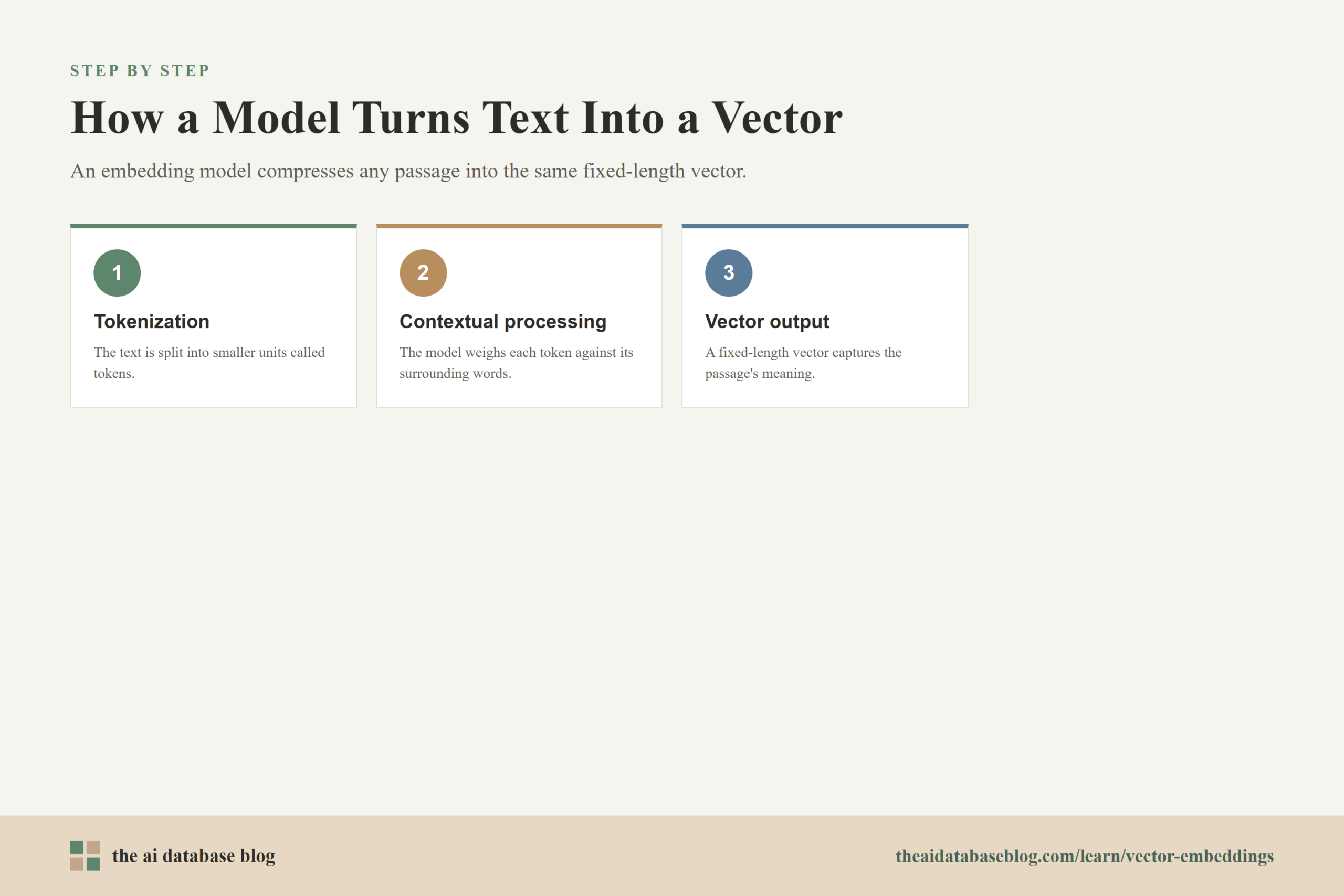
Tokenization
The first step is usually tokenization. The model breaks the input text into smaller units called tokens. A token may be a word, part of a word, punctuation, or another text fragment depending on the tokenizer. This step turns raw text into a sequence the model can process.
Contextual Processing
After tokenization, the model analyzes the tokens in context. Modern embedding models do not simply assign a fixed dictionary meaning to each word. They consider surrounding words and the overall phrase or passage. This matters because the same word can mean different things in different contexts. The word “bank” in a finance article should be represented differently from “bank” in a sentence about a river.
Vector Output
The model then produces a fixed-length vector. Fixed-length means the vector has the same number of dimensions no matter whether the input is a short phrase or a longer passage within the model’s input limits. One sentence and one paragraph may both become vectors with the same dimensionality. This consistency is what allows an AI database to store vectors in an index and compare them quickly.
The fixed length does not mean every input contains the same amount of information. It means the model compresses each input into the same numerical format. A longer document is often split into smaller chunks before embedding so each vector represents a focused passage rather than an entire file with too many unrelated ideas.
Text is the most common way people first encounter embeddings, but the same concept applies to other data types. Images, for example, can also be converted into vectors so they can be searched and compared by visual or conceptual similarity.
How a Model Turns Images Into a Fixed-Length Vector
Image embedding models work with pixels rather than words, but they still learn to produce a fixed-length vector that represents useful features of the input. Instead of looking for exact text patterns, an image model learns visual patterns such as shapes, edges, textures, objects, layouts, colors, and relationships between regions of an image. In multimodal systems, the model may also learn connections between images and text descriptions.
A model might turn a product photo, diagram, chart, medical scan, or screenshot into a vector. That vector can then be stored in an AI database and compared with other image vectors. If the system also uses a shared embedding space for text and images, a text query such as “red running shoes with white soles” may retrieve matching images even when the image files do not contain those exact words in their metadata.
This is one reason embeddings are important for multimodal retrieval. They let systems compare different kinds of content through a common numerical representation. A text document, a caption, and an image can all become vectors that support similarity search, even though the original formats are very different.
Whether the input is text or an image, the value of an embedding comes from the geometry of the vector space. The next part explains why nearby vectors often correspond to similar meaning or related content.
Why Similar Meaning Produces Nearby Vectors
Similar meaning produces nearby vectors because embedding models are trained to arrange related inputs close together and unrelated inputs farther apart. During training, the model sees many examples that help it learn which items should be considered similar. For text, this may involve language context, paired examples, search behavior, question-answer relationships, or contrastive learning signals. For images, this may involve visual similarity, captions, labels, or paired image-text data.
The result is a vector space where distance carries meaning. If two sentences express similar ideas, their vectors are likely to point in similar directions or occupy nearby regions. If two images show similar objects or visual concepts, their vectors may also be close. AI databases use this property to find nearest neighbors: stored vectors that are closest to a query vector according to a similarity measure.
Common similarity measures include cosine similarity, dot product, and Euclidean distance. Cosine similarity compares the direction of two vectors. Dot product can combine direction and magnitude depending on how vectors are normalized. Euclidean distance measures straight-line distance between points. The right metric depends on the embedding model and database configuration, so production systems should use the similarity measure recommended for the chosen embeddings.
Nearby does not always mean perfectly relevant. A vector search system may retrieve content that is topically similar but not the best answer to a user’s question. This is why practical AI retrieval often combines embeddings with metadata filtering, keyword signals, reranking, access controls, and evaluation. Embeddings are powerful, but they are one part of a retrieval system rather than the entire system.
This distinction becomes clearer when embeddings are compared with older text representations. One-hot encoding and bag-of-words also turn language into vectors, but they represent text in a much more literal and sparse way.
How Embeddings Differ From One-Hot Encoding
One-hot encoding represents each item as a vector with a single active position. If a vocabulary has 50,000 words, each word can be represented as a 50,000-dimensional vector where one position is 1 and every other position is 0. The word’s identity is preserved, but the vector does not directly express meaning or similarity.
For example, in a tiny vocabulary, the words might look like this:
cat    = [1, 0, 0, 0]
kitten = [0, 1, 0, 0]
car    = [0, 0, 1, 0]
road   = [0, 0, 0, 1]
In this representation, “cat” and “kitten” are no closer than “cat” and “road” unless extra rules are added outside the representation. The vectors identify words, but they do not show that some words are semantically related.
Embeddings solve this by using dense learned vectors. A model can learn that “cat” and “kitten” appear in related contexts and should have similar representations. The vectors are usually much shorter than one-hot vectors and far more expressive for similarity search, classification, clustering, and retrieval.
One-hot encoding is still useful in some contexts because it is simple, exact, and easy to inspect. But for AI databases that need to retrieve content by meaning, dense embeddings are usually more useful because they encode relationships rather than only identity.
Bag-of-words is another important comparison because it moves beyond single words and represents whole documents. It is still sparse and literal, which makes its strengths and limitations different from embeddings.
How Embeddings Differ From Bag-of-Words
Bag-of-words represents a document by counting which words appear in it. Each dimension corresponds to a vocabulary term, and each value usually indicates whether the word appears or how often it appears. This approach can work well for tasks where exact words are strong signals, such as simple topic classification, spam detection, or keyword-heavy search.
However, bag-of-words has a major limitation: it ignores word order, context, and deeper meaning. The sentences “the database stores vectors” and “vectors are stored in the database” may look similar because they share words, but a paraphrase using different words may look unrelated. A bag-of-words system may miss that “find similar documents” and “retrieve related passages” can describe nearly the same task.
Embeddings represent the whole input as a learned semantic pattern rather than a simple count of terms. This makes them better suited for semantic search, where the query and the best result may use different vocabulary. A user might search for “how do I make search understand meaning,” while the best document might discuss “semantic retrieval with vector embeddings.” Embeddings help connect those ideas even when exact keyword overlap is limited.
The difference can be summarized this way:
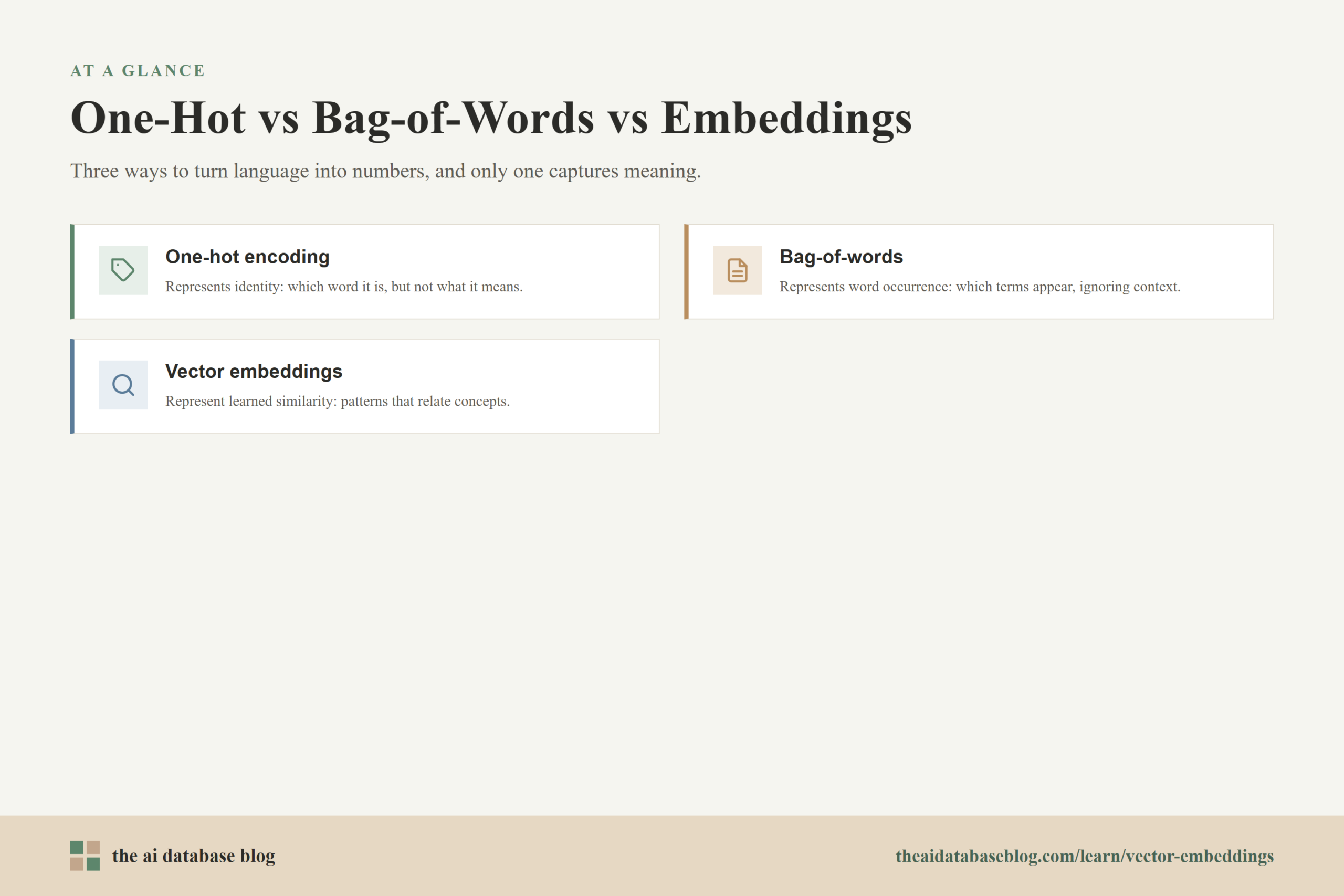
- One-hot encoding represents identity. It says which item something is, but not what it means.
- Bag-of-words represents word occurrence. It says which terms appear in a document, but does not understand context deeply.
- Vector embeddings represent learned similarity. They capture patterns that make related concepts easier to compare.
These differences explain why embeddings are central to modern AI database design. The database is not just storing vectors for storage’s sake; it is storing them so applications can retrieve information by similarity, context, and intent.
Why Embeddings Matter in AI Databases
AI databases use embeddings to make unstructured and semi-structured data searchable by meaning. Traditional databases are excellent at exact lookup, filtering, joins, and structured queries. Search engines are excellent at matching words and ranking documents with lexical signals. AI databases add vector search so applications can ask, “Which stored items are most similar to this query?”
This capability supports several common patterns. In semantic search, a query is embedded and compared with embedded documents. In retrieval-augmented generation, the system retrieves relevant passages before generating an answer. In recommendation systems, user behavior or item descriptions can be embedded so similar items can be found. In duplicate detection, embeddings can reveal records that look different textually but mean the same thing.
Embeddings also work well with metadata. A system can search for semantically similar documents while filtering to a specific language, product area, date range, customer segment, or permission group. This combination of vector similarity and structured filtering is one of the practical reasons AI databases are useful for production retrieval systems.
Still, good embedding use requires careful design. Teams need to choose chunking strategies, update embeddings when source data changes, evaluate retrieval quality, handle privacy and permissions, and decide whether to combine vector search with keyword search or reranking. The embedding is the starting point, not the full application architecture.
With that practical role in mind, it helps to close by answering the questions readers most often ask when they first start working with embeddings in retrieval systems.
FAQs
1. Is an embedding the same thing as a vector?
An embedding is a type of vector, but the word “embedding” usually means the vector was produced by a model to represent meaning or useful features. A vector is any ordered list of numbers. An embedding is a learned vector representation designed to make comparison useful.
2. Why do embedding vectors have a fixed length?
Embedding vectors have a fixed length so they can be stored, indexed, and compared consistently. An AI database needs every vector in an index to have the same dimensionality. This allows efficient nearest-neighbor search across many records.
3. Do individual dimensions in an embedding have clear meanings?
Usually, no. Meaning is distributed across the full vector rather than stored in one obvious dimension at a time. Some dimensions may correlate with certain patterns, but embeddings are generally not designed to be interpreted one number at a time.
4. Can embeddings represent images and text in the same database?
Yes, if the system uses suitable embedding models and compatible vector spaces. Some systems store text embeddings and image embeddings separately, while multimodal systems can make text and images comparable. This allows use cases such as searching images with natural language queries.
5. Are embeddings always better than keyword search?
No. Embeddings are better for semantic similarity, paraphrases, and concept-based retrieval, but keyword search can be better for exact names, identifiers, rare terms, error codes, and precise phrase matching. Many strong retrieval systems combine vector search with keyword search and reranking.
6. What makes embeddings useful for retrieval-augmented generation?
Embeddings help a retrieval system find passages that are semantically related to a user’s question. Those passages can then be provided as context to a generation model. This helps the system answer from relevant stored information rather than relying only on what the model already knows.
Takeaway
Vector embeddings turn text, images, and other data into dense fixed-length vectors that make similarity searchable. They differ from one-hot encoding and bag-of-words because they represent learned relationships rather than only identity or word counts. This guidance is most useful for readers building or evaluating AI databases, semantic search systems, recommendation features, and retrieval-augmented generation pipelines where the goal is to find information by meaning, not just by matching exact words.
Watch this video to learn more