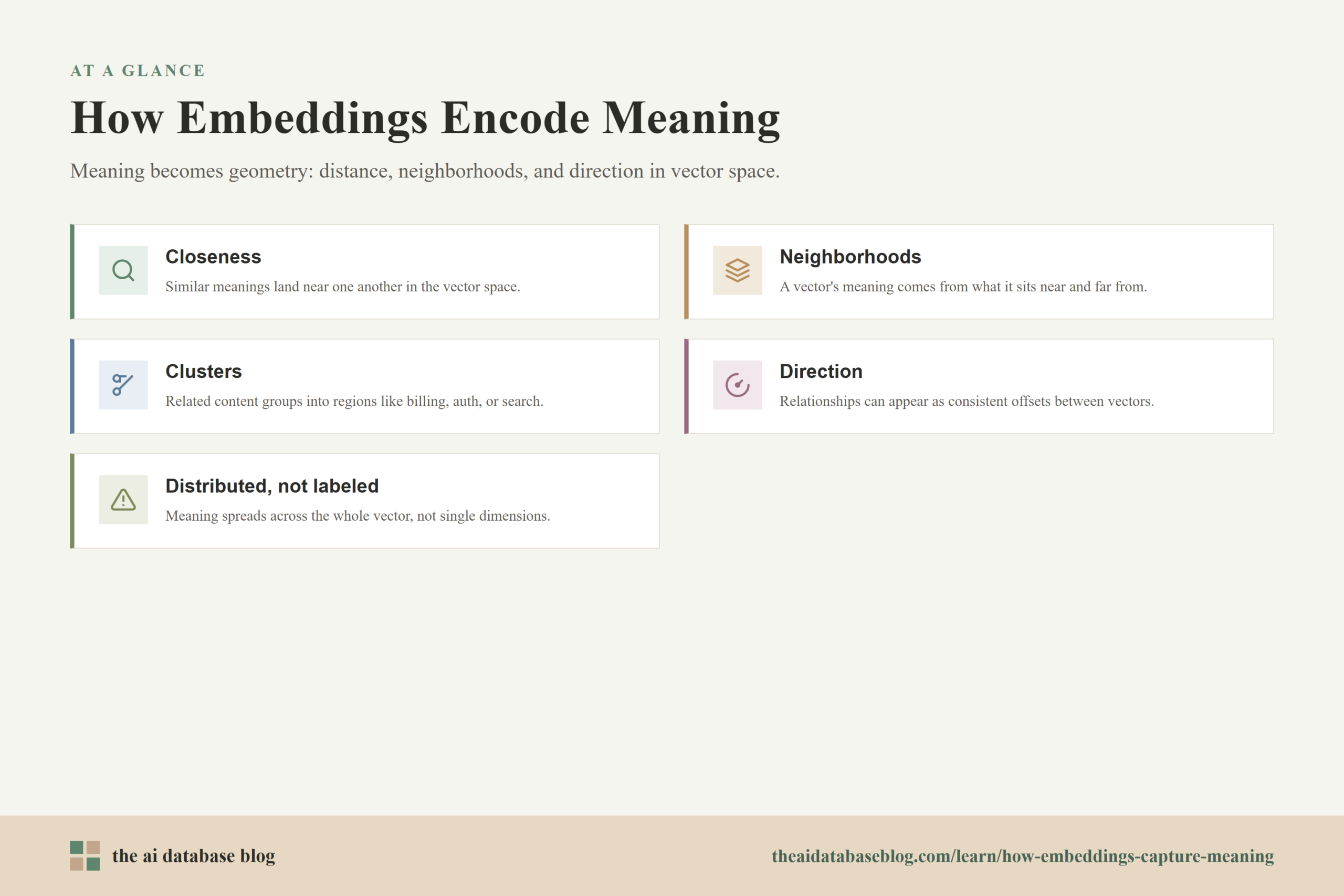
Embeddings capture meaning by turning text, images, code, or other data into vectors: lists of numbers that place similar items near one another in a high-dimensional space. The model learns this geometry from patterns in data, so related concepts tend to cluster, useful relationships can appear as directions, and some analogies can be approximated with vector arithmetic. The important caveat is that the numbers are usually distributed representations, which means individual dimensions rarely have simple human meanings on their own.
Embeddings are one of the core ideas behind semantic search, retrieval-augmented generation, recommendations, clustering, and many AI database workflows. They make it possible to search by meaning instead of relying only on exact keywords. This guide explains the intuition behind semantic geometry, why related concepts form neighborhoods, how analogy-style vector arithmetic works, why direction can encode meaning, and why interpreting a single embedding dimension is usually harder than it first appears.
What an Embedding Represents
An embedding is a compact numerical representation of an input. For text, the input might be a word, sentence, paragraph, query, document chunk, support ticket, product description, or code snippet. The embedding model converts that input into a vector, and that vector can then be stored, compared, indexed, and retrieved by an AI database or vector search system.
The key idea is that the vector is not a random identifier. It is learned so that useful relationships in the original data are reflected as geometric relationships in the vector space. When two pieces of text are similar in meaning, their vectors tend to be closer together. When they are unrelated, their vectors tend to be farther apart, at least according to the similarity measure used by the retrieval system.
This is why embeddings are so useful for AI databases. A traditional database can efficiently filter and retrieve exact values, while an embedding index can retrieve items that are conceptually close to a query. A user can search for “how to reduce cloud costs” and still retrieve a document titled “rightsizing compute workloads” because the system compares meaning, not just matching words.
Once an embedding is understood as a location in a learned space, the next question is what that space looks like. The answer is not a simple map with labeled axes, but it does have structure. That structure is what people usually mean when they talk about semantic geometry.
The Intuition Behind Semantic Geometry
Semantic geometry is the idea that meaning can be represented through distance, direction, and neighborhoods in a high-dimensional vector space. This does not mean the model understands meaning exactly as a person does. It means that the model has learned a useful geometry where language patterns, contexts, categories, and relationships become measurable.
In ordinary two-dimensional space, you can say that two points are near each other, far apart, or moving in a similar direction. Embedding spaces use the same basic geometric ideas, but with many more dimensions. A modern text embedding may have hundreds or thousands of dimensions, and the AI database compares vectors using measures such as cosine similarity, dot product, or distance.
The practical result is that meaning becomes searchable. Instead of asking whether two strings share the same terms, the system asks whether their vectors occupy nearby regions or point in similar directions. This is the foundation of semantic search, document clustering, recommendation, deduplication, and many retrieval workflows.
Similarity as Closeness
The most common intuition is that similar meanings land near one another. A paragraph about database indexing should be closer to another paragraph about search performance than to a paragraph about baking bread. The model learns this by observing patterns in training data, where words and phrases that appear in related contexts are pushed into more compatible representations.
For AI databases, this closeness is operational. When a query is embedded, the system searches for stored vectors that are close to the query vector. The returned items are not guaranteed to be perfect answers, but they are likely to be semantically related candidates that can then be ranked, filtered, reranked, or passed to a language model.
Meaning as a Neighborhood
An embedding is best understood in relation to its neighbors. The vector for a document chunk becomes meaningful because of what it is close to and what it is far from. A single point in isolation tells you very little; its location inside a larger field of examples tells you much more.
This is why data quality and chunking matter. If an AI database contains noisy, duplicated, vague, or poorly segmented content, the neighborhood around a query may be confusing. Good retrieval depends not only on the embedding model, but also on the structure of the content being embedded and the way vectors are indexed.
Closeness gives us the first useful mental model: related things form neighborhoods. From there, it is natural to ask whether those neighborhoods are random collections or whether they form recognizable groups. In many cases, related concepts do cluster, and those clusters are one reason embeddings work well for search and discovery.
How Related Concepts Cluster
Clustering happens when many related items occupy the same region of an embedding space. In a document collection, chunks about authentication may form one cluster, chunks about billing may form another, and chunks about search relevance may form a third. These clusters are not manually labeled by default; they emerge because the model has placed similar meanings near one another.
Clusters are useful because they give retrieval systems a way to organize information without requiring every possible topic to be predefined. An AI database can use vector similarity to find nearby content, but teams can also inspect clusters to discover themes, identify duplicated knowledge, separate unrelated topics, or build topic-aware navigation.
It is important to remember that clusters are approximate. A document can sit near the boundary between two topics, and some topics overlap naturally. A chunk about “authentication for billing APIs” may sit between an authentication region and a billing region. That fuzziness is not necessarily a flaw; it reflects the fact that meaning itself is often contextual and overlapping.
Why Clusters Help Semantic Search
Clusters help because search queries often describe an idea rather than a fixed vocabulary. A user may ask about “customer login problems,” while the best document uses the phrase “identity provider configuration.” If those ideas appear in similar contexts, their embeddings may land close enough for the retrieval system to connect them.
This is especially helpful in retrieval-augmented generation. The language model can only answer well if the retriever supplies relevant context. Clustering and nearest-neighbor search improve the odds that the system retrieves meaningfully related chunks even when the wording differs from the user’s query.
Why Clusters Can Also Mislead
Clusters can mislead when surface similarity hides an important difference. Two documents may use similar words but answer different questions, belong to different product versions, or apply to different regions. Embeddings may pull them close together, while metadata filters are needed to keep retrieval precise.
This is why AI database design often combines vector search with metadata filtering and sometimes keyword search. The embedding finds semantically close candidates, while filters enforce constraints such as language, date, access permissions, product area, or document type. Strong retrieval usually depends on both meaning and structure.
Clustering explains why nearby points can share topics, but embeddings also show another kind of structure: relationships can sometimes look like movement. This is where analogies and vector arithmetic enter the picture.
Analogies as Vector Arithmetic
One of the best-known embedding examples is analogy arithmetic. In classic word embedding research, operations such as “king minus man plus woman” often produced a vector close to “queen.” The exact example is overused, but the underlying intuition is useful: some relationships can appear as consistent offsets in vector space.
An offset is the difference between two vectors. If the movement from “man” to “woman” captures a gender-related relationship in one part of the space, a similar movement from “king” may point toward “queen.” The model is not following a symbolic rule like a dictionary or logic engine. It is using geometric regularities learned from many examples of language use.
In practical AI database work, analogy arithmetic is less important than similarity search, but it helps explain why vectors can represent more than simple topic labels. They can encode relationships, transformations, and attributes that affect how items compare to one another.
A Simple Way to Think About Vector Arithmetic
Imagine that an embedding space has learned a rough direction for “more technical,” another for “more formal,” and another for “about database performance.” These are not usually named dimensions. They are more like patterns spread across many dimensions. Moving through the space can change the meaning represented by a vector, at least approximately.
For example, a support query about “slow search results” might be close to content about latency, indexing, query planning, and retrieval performance. If a system could move the query vector toward a “beginner explanation” direction, it might retrieve more introductory material. If it moved toward an “implementation detail” direction, it might retrieve more technical documentation. Real systems do not always do this with explicit arithmetic, but the mental model helps explain why directions matter.
Why Analogy Arithmetic Is Approximate
Analogy arithmetic works best when the relationship is common, consistent, and well represented in the training data. It becomes less reliable when the relationship is ambiguous, culturally dependent, rare, domain-specific, or expressed differently across contexts. The arithmetic is a useful signal, not a universal reasoning method.
This matters for AI applications because vector similarity should not be treated as proof. A close vector match means the system found something geometrically related according to the model. It does not mean the retrieved result is factually correct, current, authorized, or complete. Retrieval systems still need evaluation, constraints, and often reranking to produce dependable results.
Analogy examples show that vectors can encode relationships as offsets. The next question is why a direction in space can correspond to meaning at all. The answer comes from how embedding models learn distributed patterns across many examples.
Why Direction Encodes Meaning
Direction matters because many similarity measures compare the orientation of vectors, not just their raw position. Cosine similarity, for example, focuses on whether two vectors point in similar directions. If two pieces of text activate similar learned patterns, their vectors may point in similar directions even if their exact magnitudes differ.
During training, embedding models learn to place inputs so that useful comparisons become easier. Texts that occur in similar contexts, answer similar questions, or describe similar concepts are shaped into compatible vector orientations. Over many examples, certain semantic features can become associated with broad directions through the space.
This is why a vector can feel like a compressed meaning profile. The model is not storing one dimension for “finance,” another for “medical,” and another for “database.” Instead, it distributes signals across many coordinates. Direction emerges from the combined pattern of those coordinates, and that combined pattern is what similarity search uses.
Direction Versus Distance
Direction and distance are related, but they are not identical. Direction asks whether vectors point in similar ways. Distance asks how far apart they are. Depending on the model and database configuration, one measure may be more appropriate than another.
For many text retrieval systems, cosine similarity is popular because it emphasizes orientation. That can be useful when the magnitude of a vector is less meaningful than its semantic profile. Other systems may use dot product or Euclidean distance depending on how the embeddings were trained and normalized.
Directions Are Learned Patterns, Not Handwritten Rules
A semantic direction is not usually created by a person labeling an axis. It emerges from the model’s training objective and data. If many examples teach the model that certain contexts, terms, and relationships belong together, the resulting vectors may develop directions that reflect those patterns.
This is powerful, but it also explains why embeddings can inherit weaknesses from their data. If the training data is incomplete, biased, stale, or mismatched to a domain, the learned geometry may produce poor neighborhoods. Domain-specific retrieval often improves when the content is clean, metadata is well modeled, and evaluation is based on real user queries.
Direction gives embeddings much of their expressive power, but it also creates a common misunderstanding. Because vectors have dimensions, it is tempting to assume each dimension has a clean meaning. In most modern embeddings, that is usually not how the representation works.
The Limits of Interpreting Individual Dimensions
Individual embedding dimensions are usually difficult to interpret because meaning is distributed across the full vector. One coordinate might contribute to many different patterns, and one concept might be represented through many coordinates at once. This is different from a spreadsheet where each column has a human-defined label.
In a dense embedding, the model is free to use dimensions in whatever way helps its training objective. It does not need to make dimension 17 mean “sports” or dimension 408 mean “legal language.” Even if a dimension appears correlated with a concept in one dataset, that correlation may not hold across models, domains, languages, or contexts.
Researchers do study interpretability methods that try to explain embedding spaces, identify semantic directions, or build more transparent representations. These methods can be useful, especially for debugging and analysis, but they should not be confused with the everyday behavior of dense production embeddings. Most AI database teams should treat the whole vector and its retrieval behavior as the meaningful object, not a single coordinate.
Why Dense Dimensions Are Not Like Database Columns
A database column is usually explicit. A field named “created_at” stores a timestamp, and a field named “category” stores a category. Dense embedding dimensions are different. They are internal numerical features learned by a model, and they often interact with one another in ways that are hard to name.
This is one reason vector search needs evaluation. You cannot usually inspect a vector coordinate and decide whether a document will retrieve correctly. Instead, you test the retrieval system with realistic queries, measure relevance, inspect failure cases, and improve the content, model, filters, chunking, or ranking strategy.
When Interpretation Is Still Useful
Interpretation can still be useful at higher levels. You can inspect nearest neighbors, visualize reduced-dimensional projections, compare clusters, test controlled query pairs, or identify directions associated with a known attribute. These methods do not make every dimension transparent, but they can help teams understand retrieval behavior.
For example, if a set of medical policy documents retrieves too many billing documents, inspecting neighborhoods may reveal that shared administrative language is overpowering the clinical distinction. The solution might involve better metadata filters, revised chunking, a different embedding model, hybrid search, or a reranker trained to separate the relevant cases.
Understanding the limits of interpretability helps turn embeddings from a mysterious black box into an engineering tool. You do not need to name every coordinate to build useful systems. You do need to understand how the geometry behaves, where it helps, and where it needs support from database design.
What This Means for AI Databases
AI databases use embeddings to make semantic relationships searchable at scale. They store vectors alongside source content and metadata, then use indexing methods to retrieve nearby vectors efficiently. This turns the geometry of embeddings into an application feature: semantic search, recommendation, question answering, clustering, or retrieval for generative AI.
The quality of that feature depends on more than the embedding model. It depends on how content is chunked, what metadata is stored, how filters are applied, which similarity measure is used, how candidates are reranked, and how results are evaluated. Embeddings provide the semantic signal, but the database architecture determines how reliably that signal becomes useful retrieval.
A good AI database workflow treats embeddings as one part of a retrieval system. Semantic geometry helps find likely matches, metadata keeps those matches within the right boundaries, keyword or hybrid search can preserve exact terms, and evaluation shows whether the results actually serve user needs.
Practical Design Implications
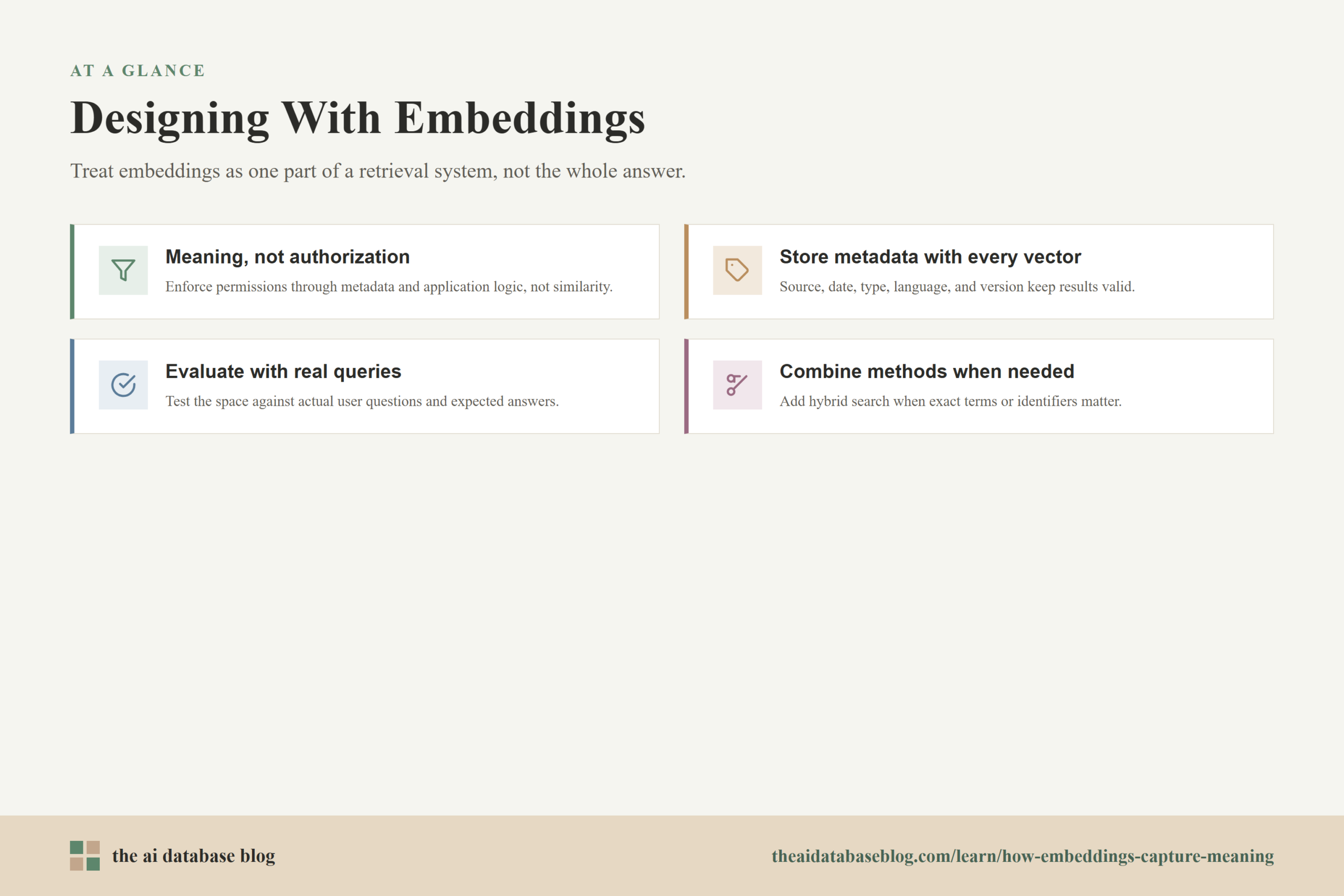
- Use embeddings for meaning, not authorization. Vector similarity can find related content, but permissions and access rules should be enforced through explicit metadata and application logic.
- Store useful metadata with every vector. Fields such as source, date, document type, language, tenant, product area, and version can prevent semantically similar but invalid results from being returned.
- Evaluate retrieval with real queries. Embedding spaces are learned approximations, so teams should test them against actual user questions and expected answers.
- Combine methods when needed. Hybrid search can help when exact terms, identifiers, names, or domain-specific vocabulary matter as much as semantic similarity.
These design choices make the abstract geometry practical. The goal is not to admire the vector space; the goal is to retrieve the right information at the right time. With that in mind, it helps to summarize the most common questions readers have about embeddings and meaning.
FAQs
1. Do embeddings actually understand meaning?
Embeddings represent meaning in a computational sense, but they do not understand meaning the way people do. They learn patterns from data and encode those patterns as vectors. This can produce very useful semantic behavior, especially for search and retrieval, but it should not be treated as human understanding or factual judgment.
2. Why do similar concepts cluster in embedding space?
Similar concepts cluster because embedding models are trained so that related inputs have compatible representations. Texts that appear in similar contexts or answer similar kinds of questions tend to be placed near one another. In an AI database, this makes it possible to retrieve relevant documents even when the query uses different wording.
3. Is vector arithmetic reliable for analogies?
Vector arithmetic can reveal useful regularities, but it is not always reliable. It works best for common and consistent relationships that are well represented in the training data. For ambiguous, rare, or domain-specific relationships, analogy arithmetic may fail or return misleading results.
4. Why does direction matter in embeddings?
Direction matters because many similarity methods compare how vectors are oriented in space. When two vectors point in similar directions, they often represent related meanings or contexts. This is why cosine similarity is widely used in text retrieval, although the best similarity measure depends on the embedding model and system design.
5. Can each embedding dimension be interpreted?
Usually, no. Dense embedding dimensions are learned internal features, not human-labeled fields. A single concept is often spread across many dimensions, and a single dimension may contribute to many concepts. Higher-level analysis, such as inspecting neighbors and clusters, is usually more useful than trying to label individual coordinates.
6. How should AI database teams use this knowledge?
AI database teams should use embeddings for semantic retrieval, but pair them with strong data modeling. That means storing metadata, applying filters, testing real queries, using hybrid search when exact terms matter, and evaluating whether retrieved results are relevant. Understanding semantic geometry helps teams design better retrieval systems without overestimating what vectors can explain by themselves.
Takeaway
Embeddings capture meaning by placing data in a learned geometric space where related concepts cluster, relationships can appear as directions, and some analogies can be approximated through vector arithmetic. This knowledge is most useful for builders, data teams, and technical readers designing semantic search, RAG, recommendation, or clustering systems inside AI databases. A practical use case is a knowledge base where users ask questions in natural language and the database retrieves relevant documents based on semantic closeness, while metadata filters and evaluation keep the results accurate, current, and appropriate.
Watch this video to learn more