A vector database sits in the retrieval layer of the modern AI stack. It does not replace the embedding model, the large language model, the orchestration framework, or the application code. Instead, it stores searchable representations of data, uses those representations to find relevant context, and returns that context to the rest of the system so the AI application can answer with information that is more specific, current, and grounded than the model’s training data alone.
This guide explains where the vector database fits in an AI application, how it works with embedding models and LLMs, what orchestration frameworks usually coordinate around it, and why the retrieval-layer mental model is the clearest way to understand its role. By the end, you should be able to describe the vector database as one component in a larger retrieval and generation pipeline rather than treating it as the whole AI system.
What a Vector Database Does in an AI System
A vector database is a database designed to store and search vectors, which are numerical representations of data such as text, images, audio, code, or product records. In AI applications, these vectors are usually produced by an embedding model. The basic idea is simple: items with similar meaning should have vectors that are close to each other in the embedding space, so a search can find content that is semantically related even when it does not share the same exact keywords.
In a retrieval-augmented generation system, the vector database usually stores document chunks, embeddings, metadata, and references back to the original source content. When a user asks a question, the system embeds the question, searches the vector database for nearby items, and passes the best-matching context to the language model. The LLM then uses that retrieved context when generating the answer.
This makes the vector database a specialized memory and search layer for AI applications. It is not memory in the human sense, and it is not reasoning in the LLM sense. Its job is to make relevant external information available at query time, especially when that information is too large, too private, too recent, or too frequently changing to rely on model training alone.
Once that basic job is clear, the next question is where the vector database belongs among the other moving parts. The easiest way to answer that is to separate the stack into model components, retrieval components, orchestration components, and application components.
Where the Vector Database Sits in the Modern AI Stack
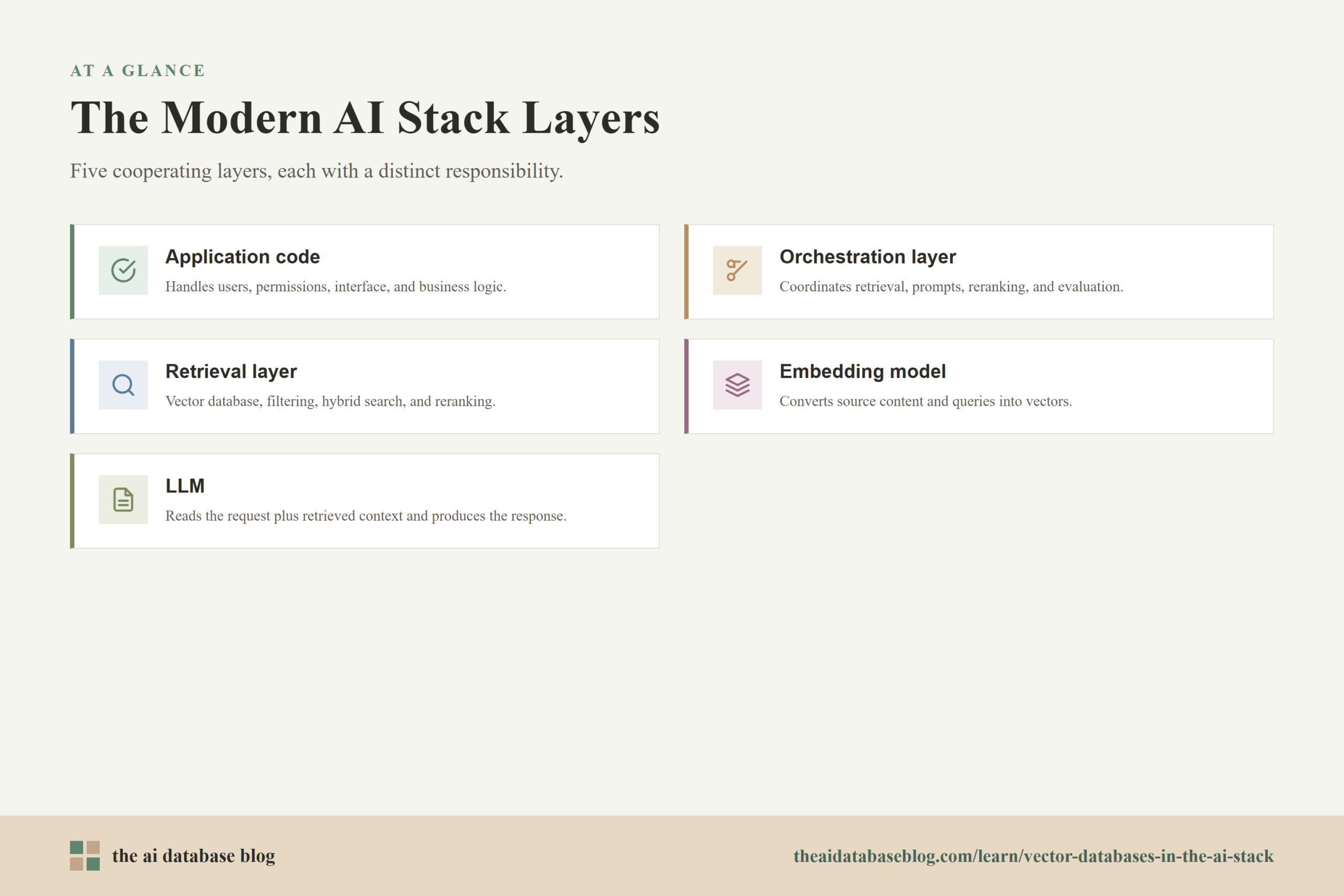
The modern AI stack is best understood as a set of cooperating layers. Each layer has a different responsibility, and the vector database becomes confusing only when those responsibilities are blurred. The embedding model turns data into vectors. The vector database stores and searches those vectors. The orchestration layer decides when retrieval should happen and what to do with the results. The LLM generates or reasons over the final context. The application code connects the AI behavior to the product experience, user permissions, business logic, and interface.
A simplified view looks like this:
Application code
  handles product logic, users, permissions, interface, and workflows

Orchestration layer
  coordinates retrieval, prompts, tools, reranking, retries, and evaluation hooks

Retrieval layer
  includes vector database, metadata filtering, hybrid search, reranking, and source selection

Embedding model
  converts source content and user queries into vectors

LLM
  reads the user request plus retrieved context and produces the response
The vector database belongs inside the retrieval layer. It is close to the embedding model because it stores the vectors that the embedding model creates, and it is close to the LLM because its search results often become part of the LLM prompt. But it is not owned by either model. It is an infrastructure component that gives the system a searchable external knowledge base.
This distinction matters because many AI application problems are retrieval problems, not model problems. If the system retrieves the wrong content, retrieves too much content, misses important metadata filters, or sends weak context to the LLM, a stronger model may still produce a poor answer. The retrieval layer determines what the model gets to see.
With the stack position established, the next step is to look at the relationship between the vector database and the embedding model. They are tightly connected, but they do very different work.
How Vector Databases Work with Embedding Models
An embedding model is the component that turns raw content into vectors. For text, the input might be a paragraph, a document chunk, a title, a support ticket, or a user query. The output is a list of numbers that captures patterns in meaning, usage, and similarity. The vector database does not usually create those meanings by itself. It stores the vectors, indexes them, and makes them searchable at scale.
There are two common moments when embeddings are created. The first is ingestion time, when source data is prepared for search. Documents are cleaned, split into chunks, embedded, and written into the vector database along with metadata such as source, author, date, access level, product area, or document type. The second is query time, when the user’s question is embedded so it can be compared against the stored vectors.
For retrieval quality, the embedding model and vector database need to be treated as a pair. The embedding model shapes what similarity means. The vector database determines how quickly and accurately the system can search that similarity space, apply filters, and return candidates. If the embeddings are weak, the database may faithfully retrieve weak matches. If the database is poorly indexed or filtered, good embeddings may still produce poor results in the application.
Why the Same Embedding Space Matters
In most vector search systems, stored content and incoming queries need to be embedded into the same vector space. That means the system should use a compatible embedding model and representation for both sides of the search. If documents are embedded with one model and queries are embedded with an unrelated model, distances between vectors may stop being meaningful. The result can be retrieval that looks technically successful but returns context that does not answer the user’s question.
What Metadata Adds to Embeddings
Embeddings help the system find semantic similarity, but metadata helps the system enforce constraints. For example, a query might need results only from a particular customer account, language, time period, product line, security level, or document type. The vector database often combines vector similarity with metadata filtering so that the system retrieves not just similar information, but allowable and relevant information for that specific user and task.
Once the vector database has retrieved candidate context, the LLM becomes important. The LLM is the component that uses the retrieved material to produce a natural-language answer, make a decision, draft a response, or call another tool.
How Vector Databases Work with LLMs
A large language model and a vector database solve different parts of the same user problem. The LLM is good at interpreting instructions, synthesizing text, explaining ideas, and producing structured responses. The vector database is good at finding relevant information from an external collection. In a retrieval-augmented workflow, the vector database supplies context and the LLM turns that context into a useful answer.
The common flow is: a user asks a question, the system embeds the query, the vector database retrieves relevant chunks, the orchestration layer may filter or rerank those chunks, and the LLM receives a prompt that includes the original question plus the selected context. The LLM can then answer using information that was not necessarily present in its training data.
This is why vector databases are often used for private or changing knowledge. A company policy, technical manual, product catalog, legal document, research archive, or support history can be updated in the retrieval system without retraining the LLM. The model remains a general reasoning and generation engine, while the vector database provides a way to retrieve specific knowledge at runtime.
The Vector Database Does Not Make the LLM Automatically Correct
Retrieval improves grounding, but it does not guarantee correctness. The system can still fail if the wrong chunks are retrieved, if important context is missing, if the LLM misreads the retrieved material, or if the prompt does not clearly instruct the model how to use sources. A vector database should therefore be evaluated as part of the full retrieval and generation pipeline, not as an isolated storage component.
The LLM Does Not Replace Retrieval
Even strong LLMs have limits. Their training data may be outdated, their context windows are finite, and they may not know private information that lives inside an organization’s systems. Retrieval gives the application a controlled way to bring selected information into the model’s working context. The better the retrieval layer is, the more useful the model can be for domain-specific questions.
Between the vector database and the LLM, many production systems add an orchestration layer. This layer is where the application decides how retrieval should happen, what should be sent to the model, and how the final answer should be handled.
How Orchestration Frameworks Fit Around the Vector Database
Orchestration frameworks and custom orchestration code sit above the raw retrieval components. Their role is to coordinate the steps that turn a user request into a complete AI response. In a simple application, the orchestration layer may only call an embedding model, query the vector database, format a prompt, call the LLM, and return the answer. In a more advanced application, it may also handle query rewriting, multi-step retrieval, reranking, citations, tool calls, memory, observability, permissions, fallback paths, and evaluation.
The vector database is one of the tools the orchestration layer can call. It may be the main retriever, or it may be one retriever among several. For example, a system may combine vector search with keyword search, structured database lookup, graph traversal, or a rules-based filter. The orchestration layer decides which retrieval method to use, how to merge results, and how much context to pass forward.
This is why the vector database should not be treated as the entire RAG architecture. It is a critical component, but the quality of the application also depends on chunking, embedding selection, filters, ranking logic, prompt construction, model behavior, and evaluation. In practice, many improvements to AI answers come from changing the retrieval strategy around the vector database rather than simply swapping the database itself.
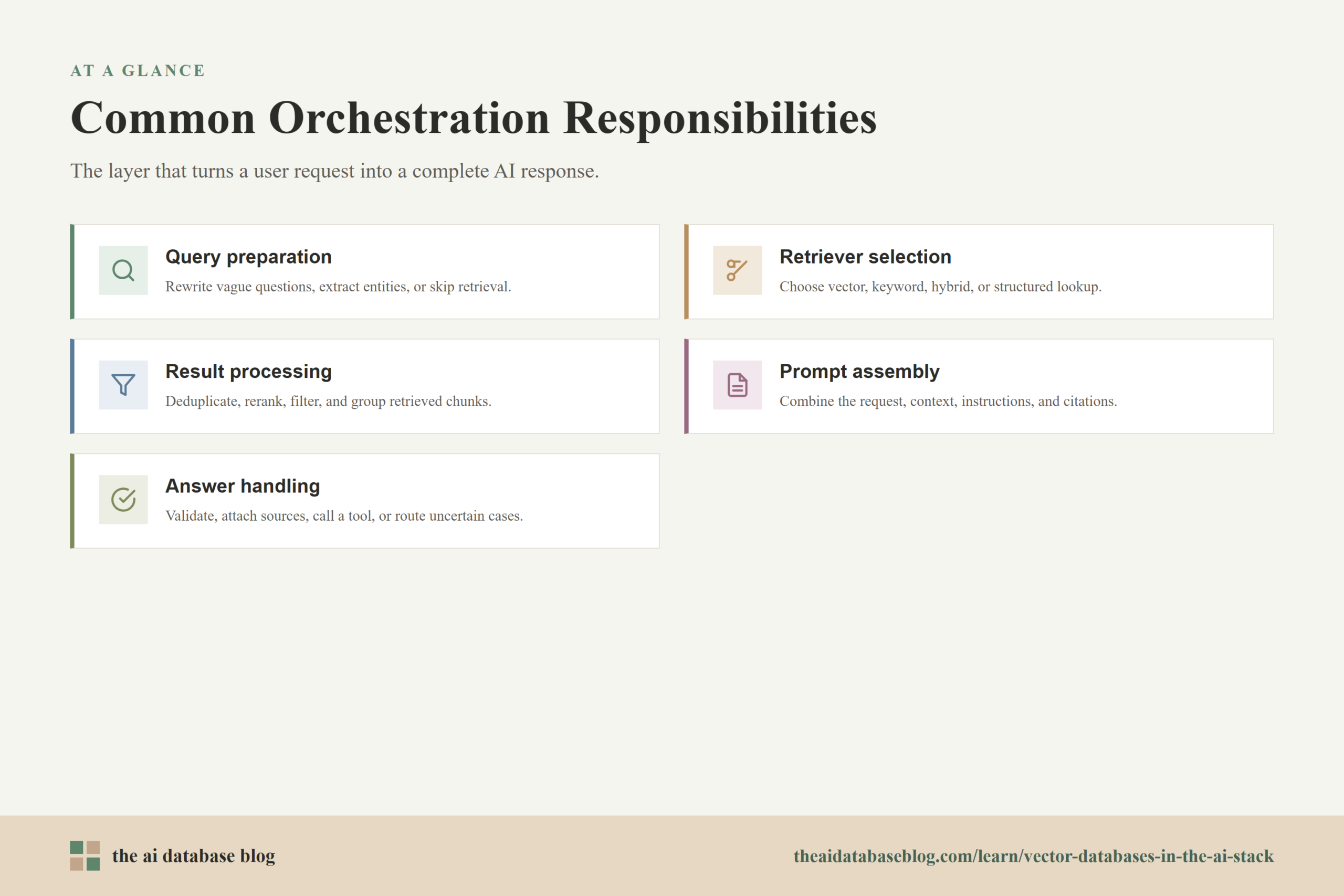
Common Orchestration Responsibilities
- Query preparation: The system may rewrite a vague user question, extract entities, generate multiple subqueries, or decide whether retrieval is needed at all.
- Retriever selection: The system may choose vector search, keyword search, hybrid search, structured lookup, or a combination depending on the task.
- Result processing: Retrieved chunks may be deduplicated, reranked, filtered by metadata, shortened, or grouped by source before they reach the LLM.
- Prompt assembly: The system decides how to combine the user request, retrieved context, instructions, citations, and output format.
- Answer handling: The system may validate the response, attach sources, call another tool, ask a follow-up question, or route uncertain cases to a different workflow.
Orchestration explains how retrieval is used, but application code explains why it is used. The same vector database can power very different products depending on the application logic around it.
How Application Code Uses the Vector Database
Application code is where the AI system becomes a usable product. It handles users, sessions, permissions, account boundaries, interface events, business rules, logging, billing, and integrations with other systems. The vector database may answer the question “what content is similar to this query?”, but the application code decides whose content can be searched, what action the user is trying to complete, and how the response should appear in the product.
For example, a customer support assistant might use the vector database to retrieve relevant help articles, but the application code determines the customer’s plan, language, region, product version, and support entitlement. An internal knowledge assistant might use vector search over company documents, but application code must respect document permissions and workspace boundaries. A recommendation feature might retrieve semantically similar items, while application code applies availability, pricing, inventory, or policy constraints.
This means vector search should be integrated with normal software engineering discipline. Authentication, authorization, observability, caching, rate limits, testing, data freshness, and error handling still matter. The vector database improves retrieval, but the application is responsible for turning retrieval into a reliable user experience.
Application Code Also Controls Feedback Loops
Production AI systems often improve through feedback. Users may mark answers as helpful, select better sources, edit generated drafts, or abandon poor results. Application code captures these signals and can feed them into evaluation, retrieval tuning, chunking updates, or metadata improvements. The vector database stores and searches content, but the application decides how learning signals are collected and used.
After separating the surrounding components, the retrieval-layer mental model becomes much easier to see. The vector database is not just a place where embeddings live. It is part of the system that decides what external knowledge enters the model’s context.
The Retrieval-Layer Mental Model
The retrieval-layer mental model says that an AI application has a dedicated layer responsible for finding, filtering, ranking, and preparing context before the LLM generates an answer. The vector database is central to this layer when semantic search is needed, but it often works alongside other retrieval techniques. This mental model is useful because it keeps teams focused on the quality of the information being supplied to the model, not only on the model’s ability to write fluently.
In this model, the retrieval layer has several jobs. It must represent knowledge in a searchable form, retrieve candidates that are likely to answer the query, enforce metadata and permission constraints, rank the best evidence, remove noise, and package the final context for the LLM. Each step affects answer quality. A poor chunking strategy can hide the answer. A weak embedding model can miss relevant content. A missing metadata filter can leak irrelevant or unauthorized material. A bad reranking step can bury the most useful evidence.
Thinking in terms of a retrieval layer also makes the system easier to debug. If an answer is wrong, the team can ask a sequence of practical questions: Was the right data ingested? Was it chunked well? Were the embeddings appropriate? Did the vector database return the right candidates? Were filters too narrow or too broad? Did reranking help or hurt? Did the prompt preserve the important context? This is more productive than treating every failure as an LLM failure.
Retrieval Is More Than Vector Similarity
Vector similarity is powerful because it can find conceptual matches, but modern retrieval often combines several signals. Keyword search can help with exact terms, names, IDs, error codes, and rare phrases. Metadata filtering can enforce scope. Reranking can compare candidate passages more carefully before the final prompt is built. Structured lookup can retrieve facts from tables or transactional systems. The vector database may support some of these capabilities directly, or it may be combined with other systems in the retrieval layer.
The Best Retrieval Layer Is Task-Specific
There is no universal retrieval design that fits every AI application. A legal research assistant, a product support bot, a code search tool, and a medical document assistant all place different demands on precision, recall, citations, freshness, latency, and permissions. The vector database provides the foundation for semantic retrieval, but the surrounding retrieval design should reflect the task, the data, and the cost of getting an answer wrong.
With the retrieval layer in mind, it becomes easier to evaluate what a vector database should actually be responsible for in production. The answer is not simply “store embeddings.” A useful vector database also needs to support the operational requirements of the application.
What to Expect from a Vector Database in Production
In a production AI stack, a vector database needs to do more than run a nearest-neighbor search. It should support the retrieval patterns the application depends on, while fitting into the system’s reliability, security, and performance requirements. The exact requirements vary, but the core questions are usually about relevance, scale, latency, filtering, update behavior, observability, and operational complexity.
Teams should evaluate a vector database by asking how well it supports their real query patterns. Some applications need high recall across large document collections. Some need very strict metadata filters. Some need frequent updates as documents change. Some need hybrid retrieval because exact keywords matter as much as semantic similarity. Some need low-latency search inside a user-facing workflow. These needs affect indexing choices, storage design, chunking strategy, and query flow.
It is also important to evaluate retrieval quality with realistic questions. A vector database can appear to work well in a demo while still failing on ambiguous queries, short queries, permission-sensitive queries, or questions that require multiple pieces of evidence. Production readiness depends on testing the whole retrieval path, not just confirming that vectors can be inserted and searched.
Practical Evaluation Questions
- Does retrieval return the right source content? The first test is whether the relevant passages appear in the candidate results before the LLM ever sees them.
- Do filters match the product’s rules? Metadata filters should reflect permissions, time ranges, account boundaries, document types, and other business constraints.
- Does ranking match the user’s intent? The top result should not merely be similar; it should be useful for the specific question being asked.
- Can the system handle updates? AI applications often need new documents, deleted documents, revised content, and re-embedding workflows.
- Is latency acceptable? Retrieval time becomes part of the user experience, especially when embedding, search, reranking, and LLM generation all happen in one request.
These production questions lead naturally to common misunderstandings. Many teams know they need a vector database, but they may overestimate or underestimate what it can solve on its own.
Common Misunderstandings About Vector Databases
Vector databases are important in the AI stack, but they are sometimes described in ways that make them sound more magical than they are. A vector database is not a complete AI brain, not a replacement for a language model, and not a guarantee of factual answers. It is a retrieval system that becomes valuable when paired with good data preparation, good embeddings, thoughtful orchestration, and careful application logic.
One common misunderstanding is that storing embeddings automatically creates knowledge. In reality, embeddings are searchable representations of content. The quality of retrieval still depends on what content was ingested, how it was split, what metadata was attached, and whether the query flow retrieves the right evidence. Bad source data becomes bad searchable data.
Another misunderstanding is that vector search always beats keyword search. Vector search is often better for semantic questions, paraphrases, and conceptual similarity. Keyword search can be better for exact identifiers, error messages, part numbers, names, and terms that should not be semantically broadened. Many modern retrieval systems combine both because users ask both meaning-based and exact-match questions.
A third misunderstanding is that a larger LLM removes the need for retrieval. Better models can reason and write more effectively, but they still need access to the right external context when answering questions about private, recent, or specialized information. Retrieval remains the mechanism that connects the model to that information at the moment it is needed.
These misunderstandings are avoidable when the vector database is seen as a retrieval-layer component. That view makes it easier to design the rest of the AI stack around clear responsibilities instead of expecting one component to solve every problem.
FAQs
1. Is a vector database the same thing as an embedding model?
No. An embedding model creates vectors from data, while a vector database stores, indexes, filters, and searches those vectors. The embedding model defines the representation of meaning, and the vector database makes that representation usable for retrieval at application scale.
2. Is a vector database the same thing as an LLM?
No. An LLM generates or reasons over text and other inputs, while a vector database retrieves relevant external context. In a RAG system, the vector database usually finds information and the LLM uses that information to produce the final answer.
3. Where does the vector database sit in a RAG pipeline?
It sits in the retrieval layer. During ingestion, it stores embeddings and metadata for source content. During query time, it searches for relevant content that can be passed into the LLM prompt, often after filtering, reranking, or other retrieval steps.
4. Do all AI applications need a vector database?
No. A vector database is most useful when the application needs semantic retrieval over external data. If the application only uses model reasoning, simple structured queries, or a small fixed prompt, it may not need vector search. If it needs to search large bodies of unstructured or semi-structured content, a vector database often becomes important.
5. Why not put all information directly into the LLM prompt?
Prompts and context windows have limits, and sending too much information can increase cost, latency, and confusion. A retrieval layer helps select the most relevant information before the LLM is called. The vector database supports that selection by searching a larger knowledge base than the model can reasonably receive in one prompt.
6. What makes a good retrieval layer?
A good retrieval layer returns context that is relevant, allowed, current, and useful for the user’s task. It usually combines good data preparation, appropriate embeddings, vector search, metadata filtering, ranking or reranking, and evaluation. The vector database is a major part of this layer, but the surrounding design matters just as much.
Takeaway
The vector database plays the role of a retrieval-layer database in the modern AI stack: it stores searchable embeddings, supports similarity search and filtering, and supplies relevant context to LLM-powered applications. This is most useful for builders, product teams, and technical readers who need to understand how AI systems connect models to external knowledge without retraining the model for every update. In practical use cases such as knowledge assistants, support bots, research tools, and domain-specific search, the vector database helps decide what information the model sees, while embedding models, orchestration frameworks, LLMs, and application code each handle their own part of the pipeline.
Watch this video to learn more