A vector database can act as searchable memory for an AI agent by storing past messages, facts, decisions, documents, or task outcomes as embeddings and retrieving the most relevant items when the agent needs context. This is useful, but it is not the same as full memory. A vector store can help an agent find semantically related information, but it cannot reliably decide what is still true, what should be private, what has been superseded, or what should be forgotten unless the application adds policies around storage, retrieval, updating, and deletion.
This guide explains how vector databases fit into agent memory systems, where they work well, where they break down, and how to combine them with practical rules for remembering and forgetting. By the end, you will understand why vector memory should be treated as one part of a larger memory design rather than as the whole memory layer.
What Agent Memory Means in an AI Database Context
Agent memory is the ability of an AI system to use information from outside the current prompt or conversation turn. In simple systems, this may mean passing the recent chat history into the model. In more advanced systems, it can mean storing long-term knowledge about users, tasks, project decisions, documents, workflows, or previous outcomes so the agent can retrieve that information later.
From an AI database perspective, memory is not just a psychological metaphor. It is a data architecture problem. The system needs to decide what information becomes durable, how that information is represented, how it is searched, how it is scoped to the right user or task, and how old or incorrect information stops influencing future responses.
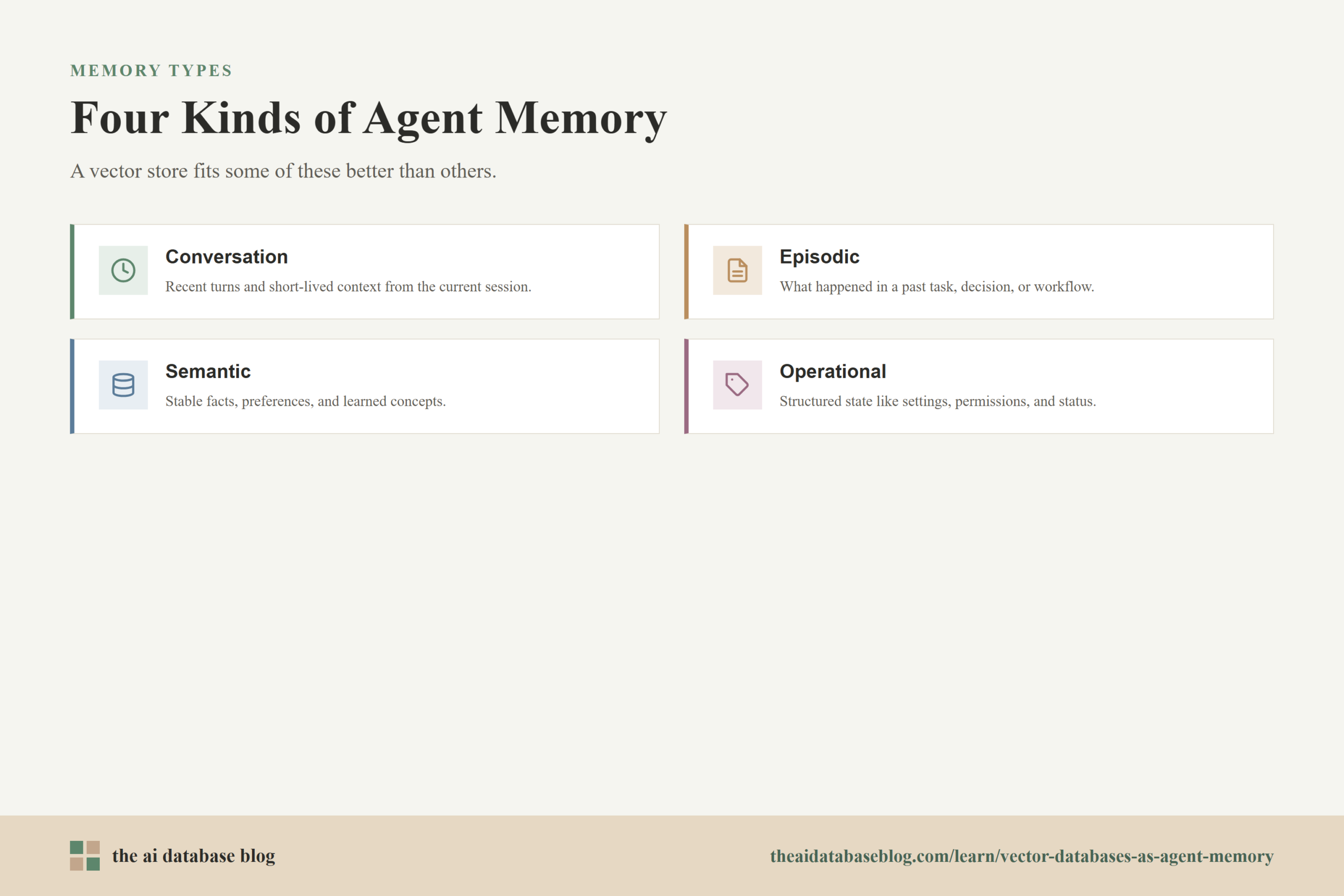
A useful way to think about agent memory is to separate it into several kinds of data:
- Conversation memory, which includes recent turns, clarifications, and short-lived context from the current session.
- Episodic memory, which records what happened during a past task, decision, conversation, or workflow.
- Semantic memory, which stores more stable facts, preferences, concepts, and learned information.
- Operational memory, which includes structured state such as account settings, permissions, workflow status, or task ownership.
A vector database is strongest when the memory item is best found through meaning rather than an exact key. If the agent needs to remember that a user once described a project as “focused on reducing duplicate support work,” semantic search can retrieve that idea even if the later query uses different words. If the agent needs the user’s current billing tier, however, a structured database field is usually a better fit than vector similarity.
That distinction matters because many memory failures start when teams put every kind of memory into the same vector index. Once everything is treated as a chunk of text, the agent may be able to retrieve similar passages, but it loses the stronger guarantees that come from structured records, timestamps, ownership rules, and explicit state transitions.
How a Vector Store Becomes Searchable Memory
A vector store becomes searchable memory by turning memory items into embeddings and indexing those embeddings for similarity search. An embedding is a list of numbers produced by a model that represents the meaning or features of a piece of data. When the agent later needs context, the current query is embedded in the same vector space, and the database returns stored items whose vectors are closest to the query vector.
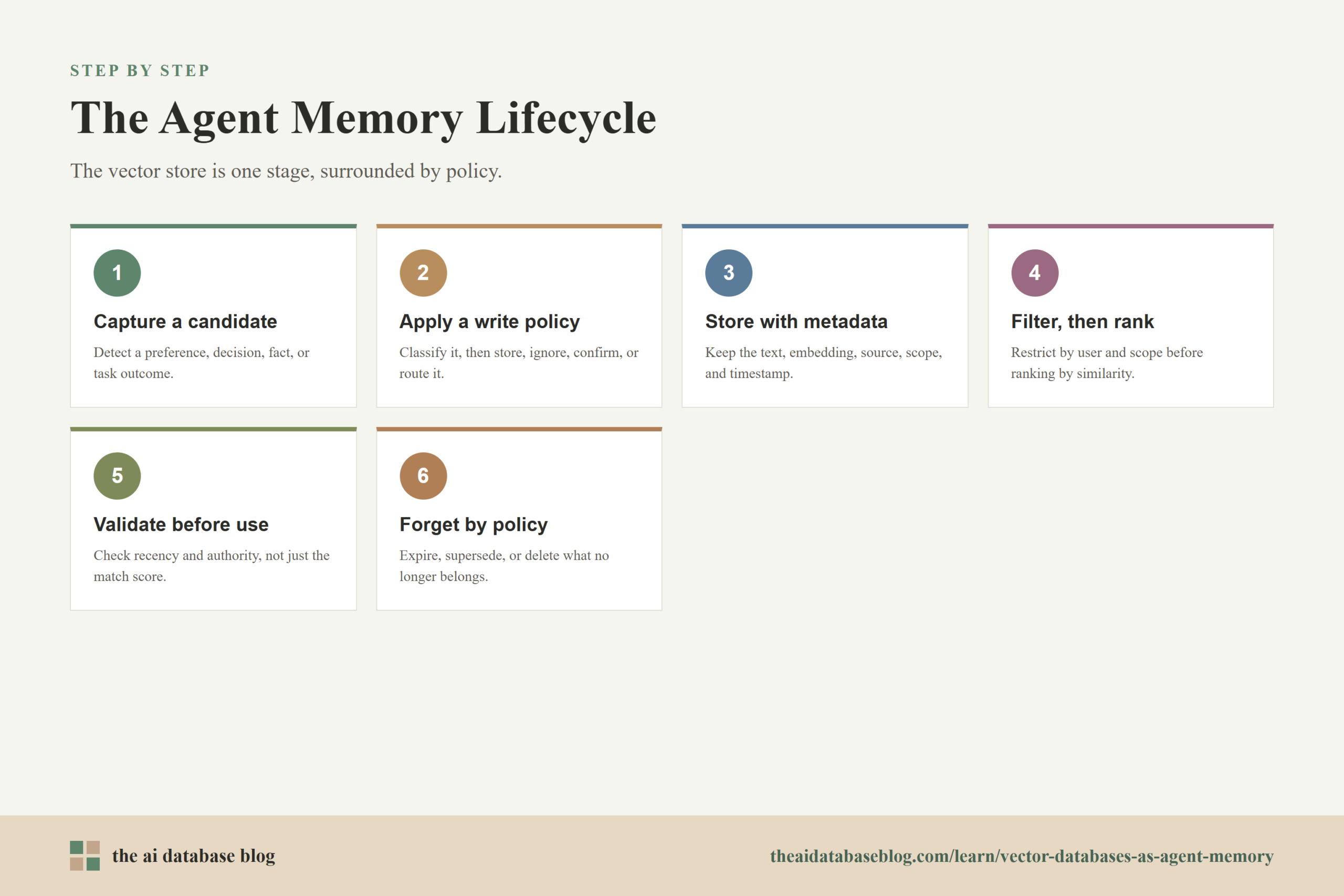
In an agent memory workflow, this usually involves five steps. First, the system detects a candidate memory, such as a user preference, a resolved issue, a decision, or a useful observation. Second, it stores the original text or structured content along with metadata. Third, it creates an embedding for the memory item. Fourth, it retrieves candidate memories during a future interaction. Fifth, it decides which retrieved memories are safe and relevant enough to pass into the model’s context.
The stored memory should not be only a vector. The vector is useful for search, but the surrounding metadata is what makes the result usable. Common metadata includes the user or tenant ID, source, timestamp, task type, confidence, permissions, expiration date, memory category, and whether the item has been replaced by a newer fact.
For example, an agent that helps a team manage research notes might store this memory item:
- Content: “The team prefers concise summaries with implementation tradeoffs listed separately.”
- Type: user or team preference.
- Scope: specific workspace or project.
- Created date: the day the preference was observed.
- Source: the conversation or document where the preference appeared.
- Retention rule: keep until replaced or explicitly deleted.
The embedding makes the preference discoverable when a future query asks for a report format, but the metadata tells the system where the preference applies and whether it is still allowed to be used. Without that metadata, the agent is relying on semantic closeness alone, which is too weak for dependable memory.
Once the basic storage loop is in place, the next question is what the vector store is actually good at. The answer is narrower than “remember everything,” but still very valuable when the memory is designed around retrieval instead of accumulation.
What Vector Databases Can Do Well for Agent Memory
Vector databases are useful for agent memory because they make large amounts of unstructured or semi-structured context searchable by meaning. Agents often work with messy language: chat messages, documents, notes, code comments, emails, support tickets, and task histories. These inputs rarely fit cleanly into exact keyword search, especially when users ask questions in different words than the stored material used.
The strongest use cases are those where the agent needs to recall relevant context, not enforce authoritative truth. A vector database can help an agent find related examples, previous decisions, recurring user preferences, similar support cases, historical project notes, or documentation passages. This can reduce repeated context entry and help the agent respond with more continuity across sessions.
Retrieving Related Past Interactions
Agents often need to know whether a similar issue has come up before. A vector database can store summaries of past interactions and retrieve them when a new request resembles an old one. This is helpful for support agents, research assistants, coding agents, and internal workflow agents that need continuity over time.
The memory item should usually be a concise summary rather than a raw transcript. Raw transcripts contain too much noise, while summaries can capture the durable point: what the user asked for, what decision was made, what constraints mattered, and what outcome followed. The source transcript can remain linked for audit or review, but the retrievable memory should be shaped for future usefulness.
Finding Semantically Similar Knowledge
Vector search is especially useful when the wording changes. A stored note about “reducing onboarding friction” may be relevant to a later query about “making setup easier for new users.” Keyword search may miss that connection, while embedding search can find it because the concepts are related.
This makes vector memory valuable for knowledge-heavy agents. Instead of relying only on the current prompt, the agent can retrieve prior explanations, decisions, examples, and documentation snippets that match the meaning of the user’s current task.
Combining Semantic Search With Filters
In practical systems, vector search should almost always be combined with metadata filtering. Filters narrow the candidate set before or during retrieval, so the agent searches only memories that belong to the right user, team, project, time period, data classification, or task type. This prevents a memory that is semantically similar but operationally wrong from being used.
For example, an agent should not retrieve a preference from one customer workspace simply because it is similar to another customer’s query. It should first filter by tenant or workspace, then rank the allowed memories by semantic relevance. The filter controls eligibility; the vector search controls ranking.
These strengths make vector databases a natural fit for searchable memory, but they also reveal the boundary. A system that retrieves similar text is not automatically a system that knows what to believe, what to ignore, or what to remove.
What Vector Databases Cannot Do by Themselves
A vector database does not understand memory in the human sense. It does not know that a preference changed, that a policy expired, that one statement was more authoritative than another, or that a retrieved item is inappropriate for the current user. It returns nearby items in vector space, and the application must decide what those items mean in context.
This limitation is easy to miss because semantic retrieval can feel like memory during a demo. The agent appears to remember earlier information because it can retrieve a related passage. In production, the difference becomes clear: memory is not just recall. It also requires selection, revision, conflict handling, access control, and forgetting.
Similarity Is Not the Same as Relevance
Vector search finds items that are close to the query embedding. Close does not always mean relevant. A memory about “pricing rules” may be semantically close to a current pricing question even if the rules changed months ago. A past project decision may sound related but may apply to a different customer, product version, or legal environment.
This is why vector results need additional checks. The system should consider scope, recency, authority, source quality, and task fit before inserting a retrieved memory into the agent’s prompt. A high similarity score should be treated as a candidate signal, not as proof that the memory should be used.
Vector Search Does Not Resolve Contradictions
Agent memory often contains contradictions because people change their minds, projects evolve, and systems update over time. A user may say in January that they prefer detailed explanations and say in April that they now prefer short summaries. If both statements live in the vector store, a similarity search may retrieve either one depending on the query wording.
Contradictions need explicit revision rules. The system should be able to mark older memories as superseded, connect newer facts to the memories they replace, or maintain validity windows that show when each memory was true. Without this layer, the agent may present outdated information as if it were current.
Vector Databases Do Not Decide What Should Be Stored
Storing everything is one of the fastest ways to make agent memory worse. A raw stream of chat turns, half-formed thoughts, jokes, temporary preferences, sensitive details, and obsolete task notes creates retrieval noise. The agent may later retrieve something that was never meant to become durable knowledge.
A memory system needs a write policy before data enters the store. The policy should define which observations are worth keeping, which should remain temporary, which require user confirmation, which are too sensitive to store, and which belong in a structured database instead of a vector index.
Vector Databases Do Not Provide Complete Governance
Governance means the system can explain and enforce who may store, retrieve, update, and delete memory. A vector database may support access controls and deletion operations, but the larger governance question sits above the database: what policies apply to this memory, what source produced it, who owns it, how long should it live, and how can the organization prove what influenced an agent’s decision?
This is especially important when memory contains personal data, customer data, regulated information, confidential work, or decision context. The application needs audit logs, retention rules, deletion workflows, and policy-aware retrieval. A vector index is an important retrieval component, but it should not be the only place where memory governance is defined.
After these limitations are clear, the design goal becomes more practical: use the vector database for what it does well, then surround it with policies that control the memory lifecycle from write to retrieval to deletion.
Policies for Storing Agent Memory
A storage policy decides what becomes memory in the first place. This is where many agent systems need the most discipline. If every message becomes a permanent embedding, the memory store grows quickly, retrieval quality declines, and the agent becomes more likely to use irrelevant or outdated context.
A good storage policy starts by asking whether a memory item will help future behavior. The system should prefer durable facts, explicit preferences, important decisions, task outcomes, and reusable lessons. It should avoid storing passing remarks, sensitive data without a clear purpose, temporary instructions, and information that belongs in a structured system of record.
Classify Memory Before Writing It
Before writing to the vector store, the application should classify the candidate memory. The classification can be simple at first: preference, fact, decision, task outcome, document reference, or temporary context. This gives the system a basis for retention, retrieval, and conflict handling.
For example, a user saying “for this draft, make the tone more technical” may be temporary task context. A user saying “our engineering blog generally avoids promotional language” may be a durable editorial preference. Treating both as the same type of memory creates confusion later.
Store Summaries With Evidence
Memory entries should be compact, but they should not be source-free. A useful pattern is to store a concise memory statement, the evidence that supported it, and a pointer to the original source. The agent retrieves the clean statement for efficiency, while the system can still inspect the source if the memory is challenged or needs review.
This also helps prevent overconfident memory. A memory item should not say “the user always wants short answers” if the evidence is one request for a short answer in one task. A better memory would say “In this workspace, the user requested a shorter answer for the June product summary.” The more specific statement is easier to apply correctly.
Separate Durable Memory From Working Context
Not every useful detail deserves long-term storage. Agents also need working context, such as the current task plan, files being edited, temporary constraints, or the user’s most recent correction. This information may matter for minutes or hours but should not become a permanent memory unless it has ongoing value.
Separating working context from durable memory keeps the vector store cleaner. It also helps the agent forget naturally when a task ends. The short-term layer can be cleared or summarized, while the long-term layer receives only selected items that passed the storage policy.
Storage policies reduce noise at the front door. Retrieval policies are the next safeguard, because even well-chosen memories can become wrong when they are used in the wrong situation.
Policies for Retrieving and Using Memory
A retrieval policy decides which stored memories are eligible to influence the agent’s response. The policy should not simply take the top few vector matches and place them into the prompt. It should treat retrieval as a staged process: filter, search, rerank, validate, and then use only the memories that pass the checks.
This matters because agent memory can quietly shape outputs. If irrelevant or stale context enters the prompt, the model may treat it as important. A careful retrieval policy protects both relevance and trust by making the memory layer more selective.
Filter Before Ranking
The first retrieval rule should be eligibility. The system should filter by user, tenant, project, data classification, permission, memory type, and validity window before relying on vector similarity. This reduces the chance that a semantically similar but unauthorized or outdated memory is retrieved.
For example, an agent may have thousands of memories about contract review. The current task might belong to one customer, one jurisdiction, and one contract type. Filters can restrict retrieval to that scope before semantic ranking chooses the closest memories.
Use Recency and Authority Signals
Memory is often time-sensitive. A recent preference may override an older one. A final policy document may override a draft. A verified setting in a system of record may override a casual chat statement. Retrieval should account for these signals instead of relying only on vector distance.
Authority can be modeled through metadata. A memory from an approved document, explicit user confirmation, or structured database may receive higher trust than a memory inferred from a casual conversation. This does not mean older or lower-authority memories are useless, but it does mean they should be used more carefully.
Keep Retrieved Memory Visible to the System
When an agent uses memory, the application should record which memories were retrieved and which were actually inserted into the prompt or used by the agent. This creates a basic audit trail and makes debugging possible when the agent gives a surprising answer.
Visibility also helps evaluation. If the agent gives a wrong answer, teams can inspect whether the problem came from missing memory, bad retrieval, stale memory, or poor reasoning over retrieved context. Without this trace, memory quality becomes difficult to improve.
Even with good retrieval rules, memory stores cannot grow forever without consequences. The final part of the design is forgetting, which is not a failure of memory but a necessary feature of a healthy memory system.
Policies for Forgetting and Updating Memory
Forgetting is not just deleting old data to save space. In agent memory, forgetting is how the system prevents outdated, low-value, or unsafe information from continuing to shape future behavior. A memory system that only accumulates will eventually become noisy, stale, and harder to govern.
Forgetting should be policy-driven rather than accidental. The system should define when memories expire, when they are superseded, when they need confirmation, when they should be archived, and when they must be deleted. These rules should be attached to memory types and use cases rather than applied as one generic retention period.
Use Expiration for Time-Bound Memory
Some memories are useful only for a short period. A project deadline, a temporary style preference, a task-specific constraint, or a draft decision may expire after the task ends or after a defined date. These memories should carry expiration metadata so they do not keep appearing in future retrieval.
Expiration does not always require immediate physical deletion. In some systems, expired memory can be hidden from normal retrieval but retained for audit or review. In other systems, especially when personal or sensitive data is involved, deletion may be required. The right choice depends on the data and the policy environment.
Supersede Instead of Duplicating Stable Facts
When a memory changes, the system should update or supersede the old memory rather than simply adding a new conflicting entry. If a user changes their preferred report format, the older preference should be marked as replaced by the newer one. This preserves history while preventing the old memory from competing during retrieval.
Supersession is especially important for preferences, policies, account facts, project decisions, and anything that can become outdated. It turns memory from a pile of passages into an evolving state that the agent can use more reliably.
Use Reinforcement Carefully
Some memory systems strengthen frequently used memories and let rarely used memories decay. This can be useful because recurring facts and preferences are more likely to matter in future interactions. However, reinforcement should not be the only forgetting mechanism, because some important information is rarely used but still critical when needed.
A safer approach is to combine reinforcement with memory type, authority, sensitivity, and explicit user control. A rarely used legal constraint should not disappear simply because it was not retrieved often. A casual preference should not become permanent just because it matched several similar prompts.
Make Deletion a First-Class Operation
Users and administrators may need to remove memory. This can be for privacy, correction, compliance, or product trust. A memory system should support deletion by identity, source, memory type, tenant, time range, and explicit memory ID. It should also make clear whether deletion removes only the stored text, the embedding, related summaries, and any derived indexes.
Deletion should be logged in a way that proves the request was handled without retaining unnecessary sensitive content in the log itself. This is part of treating memory as governed data rather than invisible context.
With storing, retrieval, and forgetting policies in place, the architecture becomes clearer. The vector database is still central, but it is surrounded by components that make memory safer and more useful.
A Practical Architecture for Vector-Based Agent Memory
A practical vector-based memory architecture separates the memory lifecycle into clear layers. The goal is not to make the design complicated. The goal is to prevent one component, the vector database, from carrying responsibilities that belong elsewhere.
A simple production-oriented design can include these components:
- Memory capture layer: Detects candidate memories from conversations, documents, task results, or explicit user actions.
- Write policy layer: Classifies each candidate memory and decides whether to store, ignore, confirm, redact, or route it elsewhere.
- Memory store: Stores memory content, metadata, embeddings, links to sources, and state such as active, expired, superseded, or deleted.
- Retrieval layer: Applies permissions and filters, performs vector or hybrid search, reranks results, and checks recency and authority.
- Context assembly layer: Converts approved memories into concise context for the model without overloading the prompt.
- Governance layer: Tracks access, source, retention, deletion, audit events, and policy decisions.
In this architecture, a vector database may hold the embeddings and searchable memory objects, but it does not have to be the only database involved. Structured facts can live in relational tables, event histories can live in logs, documents can live in object storage, and relationships can live in a graph-like structure if the use case needs it. The agent memory layer coordinates these stores based on the type of memory being handled.
This layered approach also makes evaluation easier. Teams can measure whether the right memories were captured, whether retrieval found the right candidates, whether stale memories were blocked, and whether the final context actually improved the agent’s answer.
The architecture does not need to be fully mature on day one. Many teams can start with a vector store, metadata, filters, and a simple storage policy. The important part is to design the memory system so it can add revision, deletion, and governance rules before the memory store becomes too large or too important to fix easily.
Common Mistakes to Avoid
Most vector memory mistakes come from treating retrieval as if it were judgment. A vector database can surface likely relevant memories, but it does not know whether the memory should affect the current response. Avoiding that confusion prevents many reliability problems.
The most common mistake is storing raw conversation history without summarization or classification. This creates a large index full of fragments that may be semantically close to future queries but not useful. A better approach is to store selected memory statements with evidence, source links, and metadata.
Another mistake is using top-k retrieval without thresholds or filters. A vector search will usually return something, even when nothing is truly relevant. Thresholds, filters, and reranking reduce the chance that the agent treats the nearest bad result as useful memory.
A third mistake is ignoring memory conflicts. When newer information contradicts older information, the system needs a way to revise or supersede memory. Otherwise, the agent may switch between old and new facts depending on small changes in query wording.
A fourth mistake is failing to give users control. If an agent claims to remember something, users should be able to correct it, remove it, or understand why it was used. This is not only a trust feature; it is also a practical way to improve memory quality.
These mistakes are avoidable when teams treat memory as a managed data lifecycle. The result is an agent that can use long-term context without turning every past interaction into uncontrolled influence.
FAQs
1. Is a vector database the same thing as agent memory?
No. A vector database is a useful storage and retrieval component for agent memory, but it is not the whole memory system. Agent memory also needs rules for what to store, who can access it, how it is updated, how conflicts are resolved, and when information should be forgotten.
2. What should be stored in vector memory?
Vector memory works best for information that should be found by meaning, such as past decisions, task summaries, reusable explanations, user preferences, and semantically related notes. Exact facts that require strong consistency, such as account status or permissions, usually belong in structured storage and can be linked to vector memory when needed.
3. Should an agent store every conversation turn in a vector database?
Usually no. Storing every turn creates noise and can cause the agent to retrieve temporary or irrelevant information later. A better pattern is to keep recent conversation in short-term context, summarize important outcomes, classify candidate memories, and store only the items that are likely to be useful in future sessions.
4. How does metadata improve vector memory?
Metadata gives the retrieval system context that embeddings do not contain reliably. It can identify the user, tenant, project, source, timestamp, memory type, permission level, confidence, and expiration date. This lets the system filter and validate memories before ranking them by similarity.
5. How should an agent forget old memories?
An agent should forget through explicit policies, not by accident. Some memories should expire after a task ends, some should be superseded by newer information, some should decay if they are low value, and some should be deleted on request. The right forgetting rule depends on the memory type, sensitivity, and use case.
6. Can vector memory make an agent more accurate?
It can improve accuracy when the retrieved memory is relevant, current, and properly scoped. It can also reduce accuracy if stale, unauthorized, or loosely related memories enter the prompt. Vector memory works best when retrieval is combined with filters, thresholds, recency checks, source tracking, and evaluation.
Takeaway
Vector databases are a strong foundation for searchable agent memory because they help agents retrieve semantically related context across sessions, documents, and past tasks. They are most useful for recalling meaning-rich information such as decisions, preferences, examples, and summaries, but they cannot independently decide what is true, current, authorized, or safe to remember. This guidance is most useful for builders designing AI agents, RAG systems, support assistants, research tools, and workflow automation systems where long-term context matters. A reliable memory system uses the vector store for semantic recall while adding policies for storage, filtering, revision, deletion, and forgetting so the agent remembers what helps and stops using what no longer belongs.
Watch this video to learn more