Long-term memory for AI agents is the system that lets an agent preserve useful knowledge beyond a single conversation or task. Because large language model calls are usually stateless on their own, the agent needs an external memory layer that can store facts, events, preferences, decisions, and lessons, then retrieve the right pieces when they become relevant again. In practice, this usually means combining persistent storage, embeddings, vector search, metadata, update rules, and evaluation so memory becomes an actively maintained knowledge system rather than a pile of old chat logs.
This guide explains why AI agents do not automatically remember across sessions, how persistent memory is commonly built with a retrieval layer, what kinds of information are worth saving, and how teams can maintain memory over time so it stays accurate, useful, and safe to retrieve. By the end, you should understand the database and retrieval patterns that make agent memory work in real applications.
Why AI Agents Need Long-Term Memory
An AI agent is expected to do more than answer one isolated question. It may help a customer over several support sessions, assist an employee across a long project, monitor recurring operational tasks, or coordinate multi-step workflows that unfold over days or weeks. In those settings, the value of the agent depends on continuity: it should remember prior decisions, user preferences, unresolved issues, and lessons from earlier work.
Without long-term memory, each new interaction starts with only the information provided in the current prompt or current context window. The agent may appear intelligent inside one session but lose important continuity as soon as the conversation ends or the context is shortened. This leads to repetitive questions, inconsistent recommendations, and weak task follow-through.
Long-term memory does not mean the model permanently changes its internal weights every time a user speaks. For most applications, memory is an external system around the model. The agent reads from that system when it needs context, writes to it when new information should persist, and updates it when old information becomes incomplete or wrong.
Once memory is treated as an external system, the design question shifts from “Can the model remember?” to “What should the application store, retrieve, update, and forget?” That is where AI databases become important, because memory is only useful when the right information can be found at the right moment.
The Stateless Nature of LLMs
Most LLM interactions are request-based. A model receives input, produces output, and does not automatically carry private application state into the next independent request. Developers can simulate continuity by sending prior messages again, using a conversation-state API, summarizing history, or passing retrieved context into the prompt. But the model itself is not a durable database of everything that happened before.
This stateless pattern is useful because it makes model calls easier to scale, isolate, audit, and control. It also prevents every interaction from automatically becoming permanent knowledge. The tradeoff is that the application must decide what context to provide each time. If nothing is supplied, the model has no reliable access to previous session details.
Context windows help, but they are not the same as long-term memory. A context window is the information included in the current model call. It may contain recent conversation turns, documents, tool results, or summaries, but it is bounded by size, cost, latency, and relevance. Long-running agents need a way to keep useful knowledge outside the prompt and retrieve only the pieces that matter for the current task.
This is the practical reason long-term memory often becomes a retrieval problem. Instead of forcing every previous interaction into every prompt, the system stores memory externally, searches it when needed, and injects a compact set of relevant memories into the model’s working context.
Persisting Knowledge Across Sessions
Persisting knowledge means converting useful moments from an interaction into durable records that can survive beyond the current session. A memory record might describe a user preference, a project constraint, a recurring error pattern, a decision the agent helped make, or a fact extracted from a trusted source. The important point is that memory should be selective. Saving everything makes retrieval noisy and can cause the agent to resurface stale or irrelevant details.
A strong memory system usually separates raw history from curated memory. Raw history is the full record of what happened, such as transcripts, logs, tool calls, and timestamps. Curated memory is the smaller set of distilled entries that the agent may actively use later. This distinction matters because transcripts are often too verbose for reliable retrieval, while curated memories can be shaped into clear, searchable units.
Common long-term memory records include:
- User preferences: Stable details such as preferred formats, recurring constraints, communication style, or product settings. These memories help the agent adapt without asking the same questions repeatedly.
- Project or task state: Current goals, open decisions, blockers, milestones, and next actions. These memories help the agent resume work across sessions.
- Domain facts: Information about customers, internal systems, policies, datasets, or procedures. These memories are often tied to source documents or database records so they can be checked and updated.
- Episodic history: Events that happened at a specific time, such as a previous support case, a completed workflow, or a decision made during a planning session. These memories help the agent understand sequence and cause.
- Lessons and corrections: Feedback that changes future behavior, such as a user correcting a mistaken assumption or clarifying what should not be repeated.
Persisted memory becomes more useful when each entry has structure. At minimum, a memory entry should include the memory text, the entity or user it belongs to, timestamps, source references, permissions, and metadata describing its type. For AI database retrieval, it is also common to store an embedding, which is a numeric representation that helps the system find semantically similar memories.
Once useful information is stored in a structured way, the next challenge is recall. A memory system is not successful because it contains many records; it is successful when it can retrieve the right records with enough precision to improve the agent’s next action.
The Retrieval-Layer Pattern
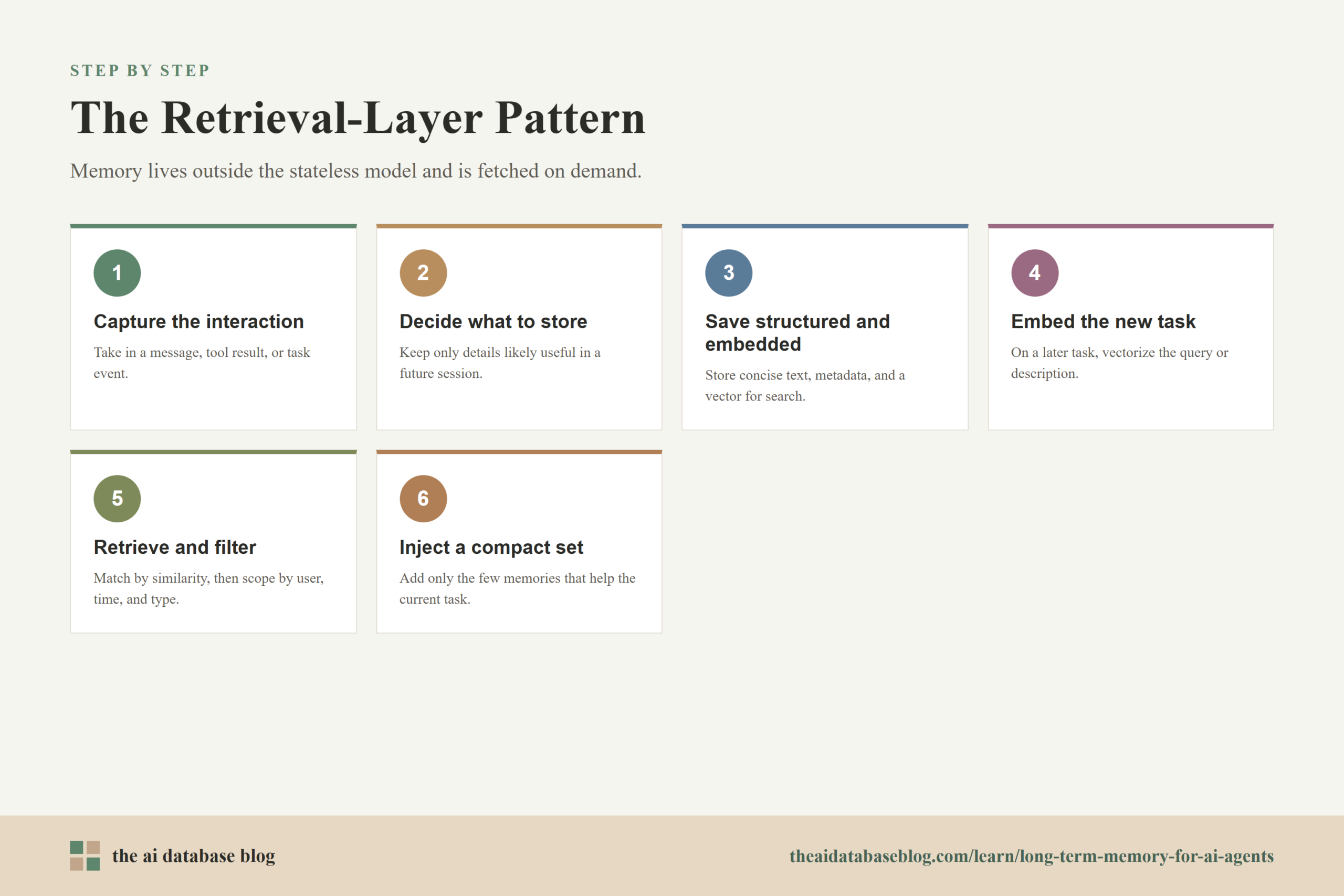
The retrieval-layer pattern is the most common way to give an AI agent long-term memory without changing the model itself. The application stores memory in an external database, retrieves relevant entries for each task, and passes those entries into the model as context. This is closely related to retrieval-augmented generation, but agent memory has a more dynamic update cycle because new memories may be created, revised, merged, or retired during normal use.
A typical retrieval-layer flow looks like this:
- The agent receives a user message, task event, or tool result.
- The system decides whether any part of that interaction should be stored as memory.
- Important memory candidates are cleaned, summarized, structured, and saved with metadata.
- The memory text is embedded and indexed for semantic search.
- When the agent handles a future task, the system embeds the new query or task description.
- The database retrieves relevant memories using vector similarity, keyword search, metadata filters, or a hybrid of these methods.
- The application ranks, filters, and injects a small set of memory entries into the model prompt.
Vector search is valuable because memory is rarely recalled with the exact same words used when it was stored. A user might say “use the same format as last time,” while the relevant memory says “user prefers concise implementation summaries with verification notes.” Embeddings allow the database to match meaning rather than only exact terms. Metadata filtering is equally important because the system often needs to restrict memory by user, workspace, time period, project, permission, or memory type.
Hybrid search is often a practical choice for memory because different memories are found in different ways. Semantic search is good for conceptual matches, while keyword search is useful for names, identifiers, error messages, dates, and exact phrases. A retrieval layer that combines both can reduce missed recalls and avoid over-relying on vague similarity.
Retrieval also needs ranking and context control. The agent should not receive every matching memory; it should receive a compact, relevant set that helps the current task. Teams often use scores, recency, importance, source reliability, and explicit user permissions to decide what gets included. Some systems also use a reranking step to compare candidate memories against the current task before adding them to the prompt.
The retrieval-layer pattern solves the basic continuity problem, but it also introduces a new maintenance problem. If memory can be written, searched, and injected into future reasoning, then memory quality becomes part of application quality.
Building Actively Maintained Memory
Actively maintained memory is memory that has a lifecycle. It is created intentionally, reviewed for usefulness, updated when reality changes, and removed or deprioritized when it becomes stale. This is different from passive memory, where a system simply stores past interactions and hopes retrieval will surface the right ones later. Passive memory usually degrades over time because old entries conflict with new ones, duplicate memories crowd the index, and low-quality summaries become hard to interpret.
A maintained memory layer needs clear write rules. The system should decide when a detail is stable enough to store, whether it belongs in user memory or task memory, and whether it should be saved as a new entry or used to update an existing one. For example, “I prefer short answers today” may be a temporary instruction, while “For weekly reports, use a concise executive summary first” may be a persistent preference.
Good memory systems also need update and conflict handling. If a user changes a preference, the system should not keep retrieving the outdated preference as if it were still true. If two records disagree, the system should prefer the newer, more specific, or more authoritative record. In some cases, the memory layer should preserve history but mark older entries as superseded so the agent can understand how the state changed over time.
Maintenance also includes forgetting. Forgetting can mean deleting a memory, archiving it, lowering its retrieval priority, or setting an expiration rule. This is not only a privacy concern; it is a relevance concern. Agents that remember too much can become worse at helping because retrieval fills the prompt with clutter.
For production systems, user control is part of active maintenance. Users may need to inspect what the agent remembers, correct inaccurate memories, delete sensitive information, or disable memory for certain interactions. This is especially important for agents that support personal work, customer interactions, internal operations, or regulated data.
After the memory lifecycle is defined, the remaining question is how to model memory so it can be queried reliably. The database schema does not need to be complicated at first, but it should support the retrieval and governance patterns the agent will depend on.
How to Model Memory in an AI Database
A memory schema should make retrieval precise and maintenance practical. The simplest useful design stores each memory as an individual record with text, embedding, ownership metadata, timestamps, source information, and status fields. This lets the system retrieve memories semantically while still enforcing filters such as user ID, organization ID, project ID, memory type, and access permissions.
A basic memory record might include:
- Memory text: The concise statement the agent may use later, written in a form that is clear without the full transcript.
- Memory type: A category such as preference, task state, domain fact, event, correction, or decision.
- Embedding: A vector representation used for semantic retrieval.
- Owner and scope: The user, team, workspace, tenant, project, or agent that the memory belongs to.
- Source reference: A pointer to the transcript, document, tool result, or record that produced the memory.
- Timestamps: Creation time, last updated time, last retrieved time, and optional expiration time.
- Status: Active, archived, superseded, deleted, pending review, or low confidence.
- Confidence and importance: Signals that help decide whether the memory should be retrieved or trusted.
Some systems also add graph-style relationships between memories. A graph can connect people, projects, decisions, documents, incidents, and follow-up actions. This is useful when the agent needs to reason over relationships or timelines rather than retrieve isolated snippets. For many teams, a practical starting point is a vector index plus rich metadata; graph structure can be added later if the agent repeatedly needs relationship-aware recall.
Memory should also be separated by scope. Personal user memory, shared team memory, application knowledge, and task-specific working memory should not all live in the same undifferentiated bucket. Scope controls reduce privacy risk and improve retrieval because the agent can search the right memory collection for the current job.
Once the schema exists, the agent still needs policies for when to write to memory. A good schema can store knowledge well, but poor write behavior will still create a low-quality memory layer.
When an Agent Should Write to Memory
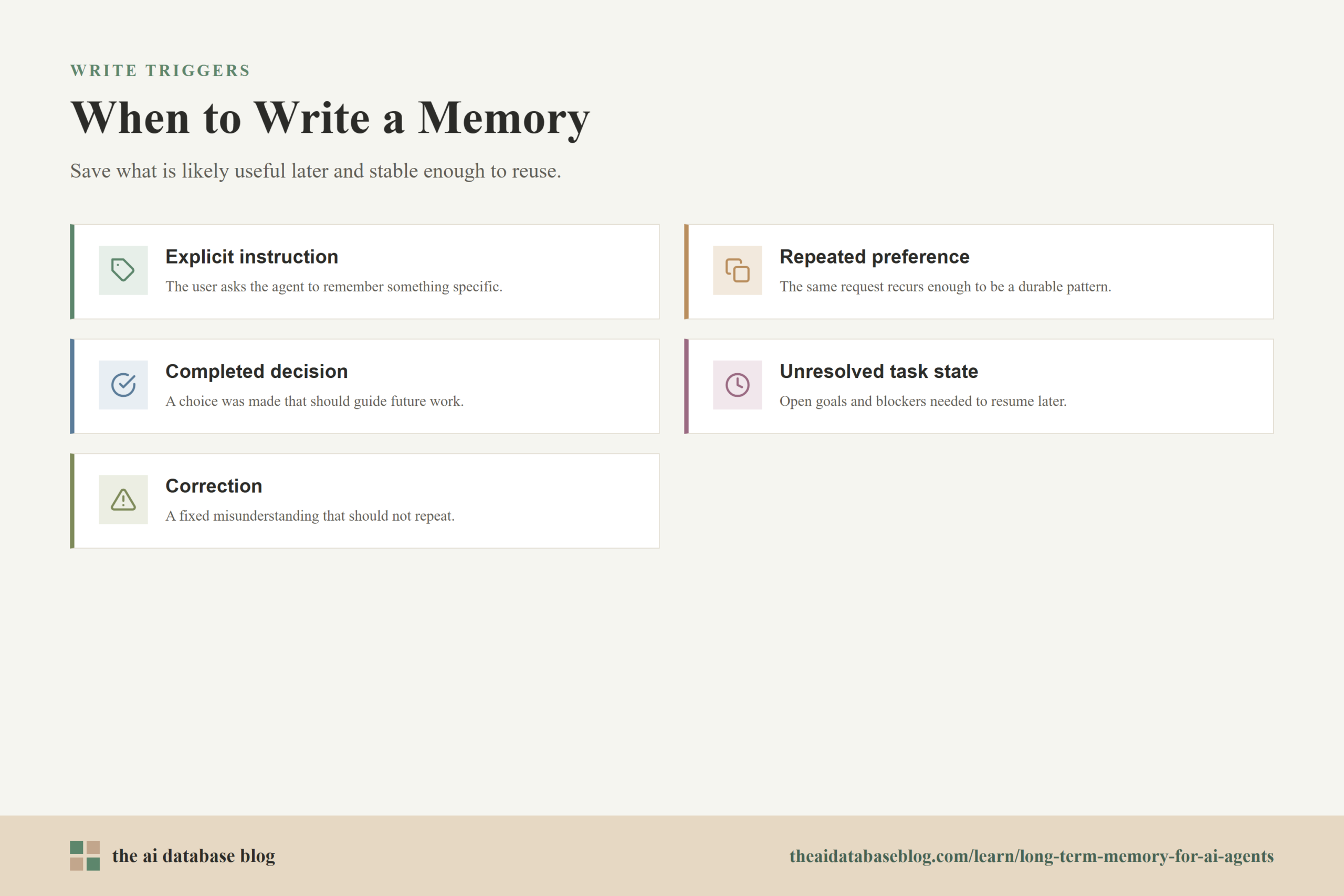
Memory writes should be deliberate because each saved entry can influence future behavior. If the agent saves too little, it forgets important continuity. If it saves too much, retrieval becomes noisy and the system may over-personalize based on temporary details. The best rule is to save information that is likely to be useful in a future session and stable enough to reuse.
Useful write triggers include explicit user instructions, repeated preferences, completed decisions, unresolved task state, corrected misunderstandings, and verified facts from trusted tools or documents. A user saying “remember that our staging environment uses synthetic customer data” is an explicit signal. A user repeatedly asking for the same report format may be an implicit signal, but it may still need confirmation before becoming durable memory.
Agents should be careful with sensitive, temporary, or ambiguous information. A passing comment, emotional state, one-time instruction, or inferred personal trait should not automatically become long-term memory. In many applications, the safest approach is to require stronger evidence before writing personal or high-impact memories, and to expose those memories for review.
A memory write pipeline can use the LLM to propose candidate memories, but the database and application rules should govern what is actually saved. This gives the system a balance of flexibility and control: the model can interpret messy conversation, while the application enforces structure, permissions, retention, and review thresholds.
Writing memory carefully is only half of the system. The other half is measuring whether retrieved memories actually help the agent perform better without adding confusion.
Evaluating Memory Quality
Long-term memory should be evaluated as a retrieval and behavior problem, not only as a storage problem. A memory layer can contain accurate records and still fail if it does not retrieve them when needed. It can also retrieve accurate records and still harm performance if those records are irrelevant to the task or injected without enough context.
Useful evaluation questions include:
- Recall: Does the system retrieve the memory when the current task genuinely needs it?
- Precision: Are the retrieved memories relevant, or does the system add distracting context?
- Freshness: Does the system prefer current information over outdated memories?
- Conflict handling: Does the agent notice when old and new memories disagree?
- Grounding: Can important memories be traced back to a source?
- User trust: Can users understand, correct, and control what is remembered?
Evaluation should include realistic multi-session tasks. Single-turn tests rarely reveal memory problems because they do not show whether the agent can preserve continuity over time. Better tests simulate returning users, changing preferences, evolving project state, repeated decisions, and contradictory updates.
Teams should also inspect memory failures manually. Common failure modes include retrieving stale preferences, mixing memory across users or projects, storing summaries that are too vague, failing to retrieve exact identifiers, and treating inferred information as confirmed fact. These issues usually require adjustments to schema, chunking, metadata, ranking, write rules, or user review flows.
When memory is measured this way, it becomes easier to see long-term memory as an operational system. It has data quality, retrieval quality, latency, permissions, and lifecycle concerns just like any other important application database.
Practical Architecture for Long-Term Agent Memory
A practical architecture starts with a clear separation between the agent, the memory service, and the underlying database. The agent should not blindly dump every exchange into the prompt. Instead, it should call a memory service that handles memory extraction, storage, retrieval, ranking, and updates according to application rules.
A common architecture includes:
- Event capture: The application records conversations, tool calls, user actions, and task events that may contain useful memory.
- Memory extraction: A model or rules engine identifies candidate memories and turns them into concise records.
- Validation and policy checks: The system applies permission, sensitivity, confidence, and retention rules before saving.
- Persistent storage: The memory is stored in a database that supports text, metadata, timestamps, and vector indexes.
- Retrieval and ranking: The system finds relevant memories using vector search, keyword search, filters, and reranking.
- Prompt assembly: The agent receives only the memory entries that are useful for the current task.
- Maintenance jobs: Background processes merge duplicates, expire old entries, detect conflicts, and refresh summaries.
This architecture keeps memory separate from the model while still making it available at the moment of reasoning. It also gives the application a place to enforce governance. Access control, user deletion, retention, audit logs, and source tracking are easier to manage in a memory service than inside prompt text.
The best implementation depends on the use case. A personal assistant may need strong user-facing controls and preference memory. A support agent may need customer-specific history, product issue patterns, and strict tenant isolation. A coding or operations agent may need project state, tool outcomes, and lessons from previous failures. The underlying pattern is similar, but the memory types, retention rules, and retrieval filters differ.
With the architecture in place, the most important design choice is restraint. Long-term memory should make the agent more consistent and useful, not turn every interaction into permanent context.
Common Mistakes to Avoid
Many memory systems fail because they treat memory as unlimited storage rather than curated context. The easiest mistake is to save complete transcripts and retrieve chunks from them without distilling what matters. This can work for simple search, but it often gives the agent noisy, repetitive, or ambiguous context.
Another common mistake is relying only on vector similarity. Semantic search is powerful, but memory retrieval often needs exact filters, dates, names, identifiers, and permission boundaries. A memory about one project should not appear in another project just because the wording is similar. Hybrid search and metadata filters are usually necessary for reliable recall.
Teams also underestimate memory updates. A user’s preference may change, a project may close, a policy may be replaced, or a previous decision may be reversed. If the memory layer cannot revise or supersede entries, the agent may keep acting on stale information.
Finally, some systems hide memory from users. That may make the interface simpler at first, but it can reduce trust when the agent remembers something unexpected or wrong. For user-facing agents, visibility and correction are often as important as retrieval accuracy.
Avoiding these mistakes requires treating memory as a product and infrastructure feature at the same time. The database design, retrieval strategy, maintenance policy, and user experience all shape whether the agent feels coherent or confusing.
FAQs
1. Is long-term memory built into the LLM itself?
Usually, no. Most application-level long-term memory is built outside the model with persistent storage, retrieval, and prompt assembly. The model may help extract, summarize, or use memories, but the durable memory layer is typically an external system managed by the application.
2. How is agent memory different from a longer context window?
A longer context window lets the model receive more information in a single request, but it does not automatically decide what should persist across sessions. Long-term memory stores selected knowledge outside the prompt and retrieves relevant pieces later, which is more scalable and controllable for ongoing use.
3. Why are vector databases useful for AI agent memory?
Vector databases help retrieve memories by meaning rather than exact wording. This matters because users often refer to past preferences, decisions, or events indirectly. A vector index can find semantically related memory entries, while metadata filters keep retrieval limited to the right user, project, time period, or permission scope.
4. Should an AI agent remember every conversation?
No. Remembering everything can make retrieval noisy and can create privacy or governance problems. A better approach is to keep raw logs when appropriate, then create curated memory records only for information that is likely to be useful, stable, and allowed to persist.
5. What makes memory actively maintained?
Actively maintained memory has rules for creating, updating, merging, expiring, and deleting entries. It also handles conflicts, tracks source information, and gives users or administrators a way to review and correct important memories. The goal is to keep memory useful as the real world changes.
6. What is the biggest risk in long-term memory for agents?
The biggest risk is not simply forgetting; it is remembering the wrong thing at the wrong time. Stale, irrelevant, sensitive, or cross-user memories can make an agent less reliable. Good retrieval filters, lifecycle policies, source tracking, and user controls help reduce that risk.
Takeaway
Long-term memory for AI agents is best understood as a maintained retrieval layer around a stateless model, not as a magical property of the model itself. The agent persists useful knowledge across sessions, stores it with structure and metadata, retrieves it through vector search, keyword search, and filters, and updates or forgets it as circumstances change. This guidance is most useful for teams building assistants, copilots, support agents, or workflow agents that need continuity over time, especially when the agent must remember user preferences, project state, previous decisions, and domain-specific knowledge without overwhelming each new prompt.
Watch this video to learn more