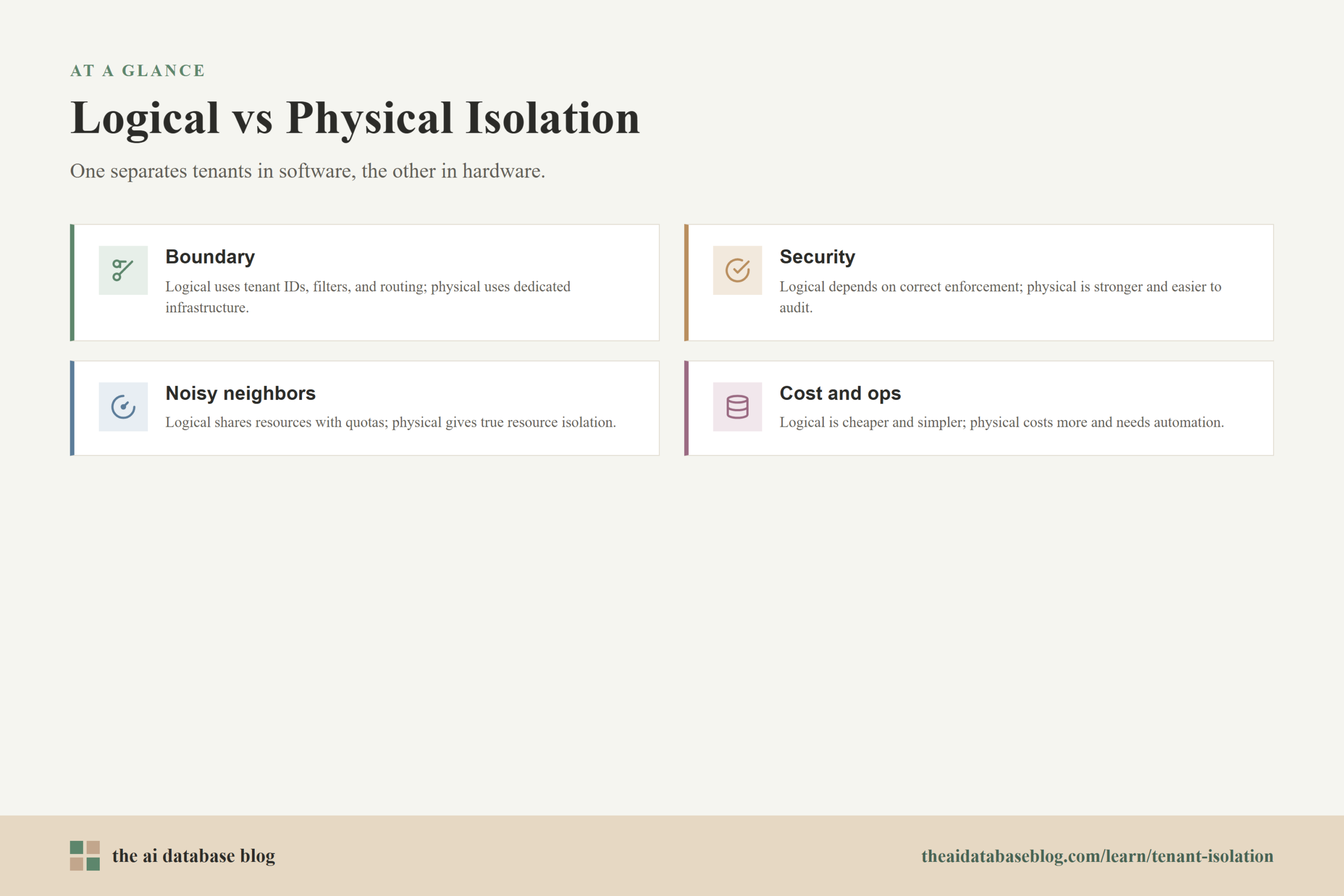
Tenant isolation is the set of boundaries that keeps one customer, team, application, or workload from accessing or disrupting another in a shared system. Logical isolation separates tenants through software controls such as tenant IDs, access policies, metadata filters, namespaces, schemas, partitions, and query routing. Physical isolation separates tenants by giving them dedicated infrastructure such as separate database instances, clusters, accounts, storage, or compute nodes. Logical isolation is usually more cost-efficient and operationally simple, while physical isolation gives stronger security, compliance, and performance guarantees when the risk or workload profile justifies the extra complexity.
This guide explains how logical and physical tenant isolation work in AI databases, what each model can and cannot guarantee, why noisy-neighbor problems matter for vector search and retrieval systems, when physical isolation becomes necessary, and how teams can choose the right approach based on security, compliance, performance, cost, and operational needs.
Why Tenant Isolation Matters in AI Databases
AI databases often store data that is both sensitive and operationally important. A tenant might represent a customer account, an internal department, a product workspace, or an application environment. In a retrieval-augmented generation system, that tenant boundary can include source documents, vector embeddings, metadata, access rules, query logs, generated context, and relevance-tuning signals. If the boundary is weak, the system might retrieve the wrong tenant’s information, leak private documents into an answer, or allow one heavy workload to slow down others.
Tenant isolation is not only about whether the database stores data in different places. It also includes how data is written, indexed, filtered, retrieved, monitored, backed up, deleted, encrypted, and charged back. A vector database might place many tenants in one index but require every query to include a tenant filter. Another system might maintain a separate collection per tenant. A higher-isolation design might place each tenant in a separate database, cluster, or cloud account. These choices affect risk, cost, performance, and operational control.
The important point is that tenant isolation should match the promise the system needs to make. A consumer-facing application with many small tenants might prioritize efficient sharing. A regulated enterprise application handling confidential documents might require stronger isolation, separate keys, dedicated capacity, and a clearer audit trail. Both designs can be valid, but they do not provide the same guarantees.
Once the purpose of isolation is clear, the next question is what kind of boundary the system is actually using. Logical and physical isolation are often discussed as opposites, but in practice they are points on a spectrum. Understanding the difference helps teams avoid assuming that a software rule provides the same protection as a dedicated deployment.
What Logical Tenant Isolation Guarantees
Logical tenant isolation means multiple tenants share some underlying infrastructure while the application and database enforce separation through software-defined boundaries. In an AI database, this might mean one shared cluster with tenant-specific collections, namespaces, schemas, partitions, metadata fields, or access policies. The system allows many tenants to use the same database layer, but every request is scoped so that each tenant can only access its own data.
Logical isolation can provide strong practical protection when it is implemented carefully. A well-designed system validates tenant identity at the application boundary, attaches the tenant context to every read and write, applies tenant filters before retrieval, restricts administrative access, and tests for cross-tenant leakage. For AI retrieval, this means tenant scoping must happen before candidate documents are sent to the model, not after the model has already received mixed context.
Common Logical Isolation Patterns
There are several common ways to apply logical isolation in AI database systems. A shared collection with a tenant ID field is the simplest pattern. Each object, document chunk, embedding, and metadata record includes a tenant identifier, and every query filters by that identifier. A namespace or collection-per-tenant model gives each tenant a more explicit logical boundary while still sharing the same cluster. A schema-per-tenant or database-per-tenant model may be logically separate at the database layer but still share the same physical hardware or managed service account.
Logical isolation is often paired with access control. The application should not simply trust that callers will pass the right tenant ID. Instead, the system should derive tenant context from authenticated identity, apply policy checks consistently, and prevent users from overriding scope in query parameters. This is especially important for AI applications because retrieval errors can become answer errors. If the retriever returns cross-tenant context, the model may treat it as valid information.
What Logical Isolation Can Guarantee
Logical isolation can guarantee that the system is designed to restrict data access by tenant when every control works as intended. It can support tenant-specific permissions, query scoping, deletion workflows, metadata filters, and audit logs. It can also support efficient multi-tenant scaling because many tenants share the same infrastructure, indexes, monitoring stack, and deployment pipeline.
In practical terms, logical isolation is usually enough when tenants have similar risk profiles, similar performance needs, and no hard requirement for dedicated infrastructure. It works well for many AI applications where the primary need is to prevent accidental cross-tenant data retrieval while keeping costs manageable. It can also be easier to operate because schema changes, indexing updates, and platform improvements can be applied once across the shared environment.
What Logical Isolation Cannot Fully Guarantee
Logical isolation does not guarantee that tenants are free from every form of shared-infrastructure risk. If tenants share compute, memory, storage, network capacity, or index-processing pipelines, one tenant’s workload can still affect another tenant’s latency or throughput. Logical isolation also depends heavily on correct implementation. A missing tenant filter, a flawed authorization check, an unsafe admin tool, or a misconfigured background job can create cross-tenant exposure.
Logical isolation may also fall short for customers that need independent encryption keys, separate backups, tenant-specific retention policies, dedicated incident scope, or proof that their data is not co-located with other tenants. These requirements are not just technical preferences. They often come from compliance obligations, procurement rules, risk models, or contractual promises.
Logical isolation is therefore best understood as a software-enforced boundary. It can be strong, testable, and appropriate, but it still relies on shared infrastructure and shared control planes. That naturally leads to the stronger but more expensive option: physical isolation.
What Physical Tenant Isolation Guarantees
Physical tenant isolation means a tenant receives dedicated infrastructure or a substantially dedicated deployment boundary. In an AI database, this could mean a separate database cluster, separate compute nodes, separate storage volume, separate cloud account, separate network boundary, or even dedicated hardware. The exact meaning depends on the architecture, but the central idea is that tenants are not merely separated by query filters or namespaces. They are separated by infrastructure boundaries that reduce shared failure, access, and performance risks.
Physical isolation provides stronger guarantees because fewer resources are shared. If one tenant runs a large embedding ingestion job, performs expensive hybrid search queries, or grows an index rapidly, that activity is less likely to consume capacity needed by other tenants. If a tenant needs a different encryption key, backup policy, region, retention schedule, or upgrade window, a physically isolated environment can usually support those requirements more cleanly.
Forms of Physical Isolation
Physical isolation does not always mean one tenant owns a bare-metal server. Many practical designs use a hierarchy of isolation levels. A tenant might have its own database instance while still sharing a cloud provider’s broader infrastructure. Another tenant might have a dedicated cluster but share an observability platform. A highly sensitive tenant might require separate accounts, networks, storage, keys, and administrative access paths.
For AI database workloads, physical isolation often appears as a dedicated vector index, dedicated retrieval service, dedicated query workers, or dedicated ingestion pipeline. These boundaries can be as important as database storage itself. A tenant with a massive document corpus can create heavy indexing and embedding workloads, while a tenant with intense real-time search traffic can create query pressure. Separating only the data is not enough if the expensive processing layers remain shared.
What Physical Isolation Can Guarantee
Physical isolation can provide stronger performance predictability, clearer blast-radius control, and cleaner evidence for compliance reviews. It can guarantee that a tenant has dedicated capacity, independent scaling decisions, and a reduced chance of being affected by another tenant’s resource usage. It can also make data deletion, backup restoration, encryption-key management, and incident analysis simpler because the tenant’s environment has a clearer boundary.
From a security perspective, physical isolation reduces the number of shared paths through which mistakes can occur. There is less reliance on every query including the correct tenant filter, less risk from shared metadata indexes, and fewer opportunities for cross-tenant administrative mistakes. It does not remove all risk, because applications, operators, dependencies, and control planes can still fail. But it moves the architecture closer to a dedicated system, which can be easier to reason about and audit.
The Cost of Physical Isolation
The tradeoff is cost and operational complexity. Dedicated infrastructure can increase idle capacity, monitoring overhead, provisioning time, upgrade coordination, and incident-management work. It can also make cross-tenant analytics harder because data is distributed across more environments. A provider may need automation for tenant provisioning, routing, schema updates, capacity planning, backups, and observability before physical isolation becomes manageable at scale.
This is why physical isolation is rarely the default for every tenant. It is usually reserved for tenants with high security needs, strict compliance requirements, large workloads, custom performance commitments, or unusual operational constraints. For everyone else, strong logical isolation plus resource governance may provide the right balance.
The difference between the two models becomes most visible when performance becomes unpredictable. Even if data access is correctly scoped, shared infrastructure can still create a noisy-neighbor problem.
The Noisy-Neighbor Problem in AI Database Workloads
The noisy-neighbor problem happens when one tenant consumes a disproportionate amount of shared resources and degrades service for other tenants. In traditional cloud systems, this can involve CPU, memory, network bandwidth, storage throughput, or disk input and output. In AI database systems, the problem can also involve vector index updates, embedding ingestion, hybrid search scoring, reranking, metadata filtering, cache pressure, and background compaction or optimization jobs.
A noisy neighbor does not need to be malicious. A tenant might upload a large batch of documents, run an evaluation job with thousands of test queries, trigger a reindex after changing metadata, or send a sudden burst of semantic search traffic. If the platform has shared capacity and weak resource controls, other tenants may see higher latency, lower throughput, queue delays, failed writes, or reduced retrieval freshness.
How Noisy Neighbors Show Up in Retrieval Systems
In a retrieval system, noisy-neighbor effects are often more subtle than a simple outage. A query might still return results, but latency may rise enough to hurt the user experience. Index updates might lag, so newly added documents do not appear in search results quickly. Hybrid search might become slower because keyword and vector scoring both compete for shared resources. Reranking might queue behind another tenant’s batch workload. These issues can reduce the quality and reliability of AI answers even when the database remains available.
Vector search can be especially sensitive because performance depends on index structure, memory locality, filtering behavior, and candidate-set size. A tenant with very large indexes or broad metadata filters may create more expensive queries than a tenant with small, well-scoped collections. If those tenants share the same capacity pool, the larger workload can affect the smaller one unless the system enforces limits.
How Logical Isolation Handles Noisy Neighbors
Logical isolation can reduce noisy-neighbor risk, but it usually needs additional resource governance. Useful controls include per-tenant rate limits, query budgets, concurrency limits, ingestion quotas, priority queues, backpressure, and workload-aware routing. The system should also monitor resource use by tenant, not just at the cluster level. Without tenant-level observability, the platform may know that latency increased but not know which tenant or workload caused it.
For many applications, these controls are enough. A shared AI database can perform well when tenants have predictable workloads, the platform can throttle heavy usage, and service-level commitments are modest. The goal is not to prevent every spike. The goal is to keep one tenant’s spike from becoming every tenant’s problem.
How Physical Isolation Handles Noisy Neighbors
Physical isolation handles noisy-neighbor risk by reducing shared capacity. If a tenant has dedicated query workers, dedicated storage throughput, or its own database cluster, its workload is less likely to affect other tenants. This is especially valuable for customers with strict latency requirements, large-scale ingestion, high-volume retrieval, or workloads that change sharply over time.
Physical isolation does not eliminate the need for capacity planning. A tenant can still overwhelm its own dedicated environment if the workload grows beyond provisioned limits. However, the impact is more contained. Other tenants should not experience the same degradation, and the affected tenant can be scaled, tuned, or migrated independently.
Once noisy-neighbor risk is understood, the next practical question is when the stronger guarantees of physical isolation are worth the cost. The answer depends on the combination of security, compliance, performance, and operational requirements.
When Physical Isolation Is Required
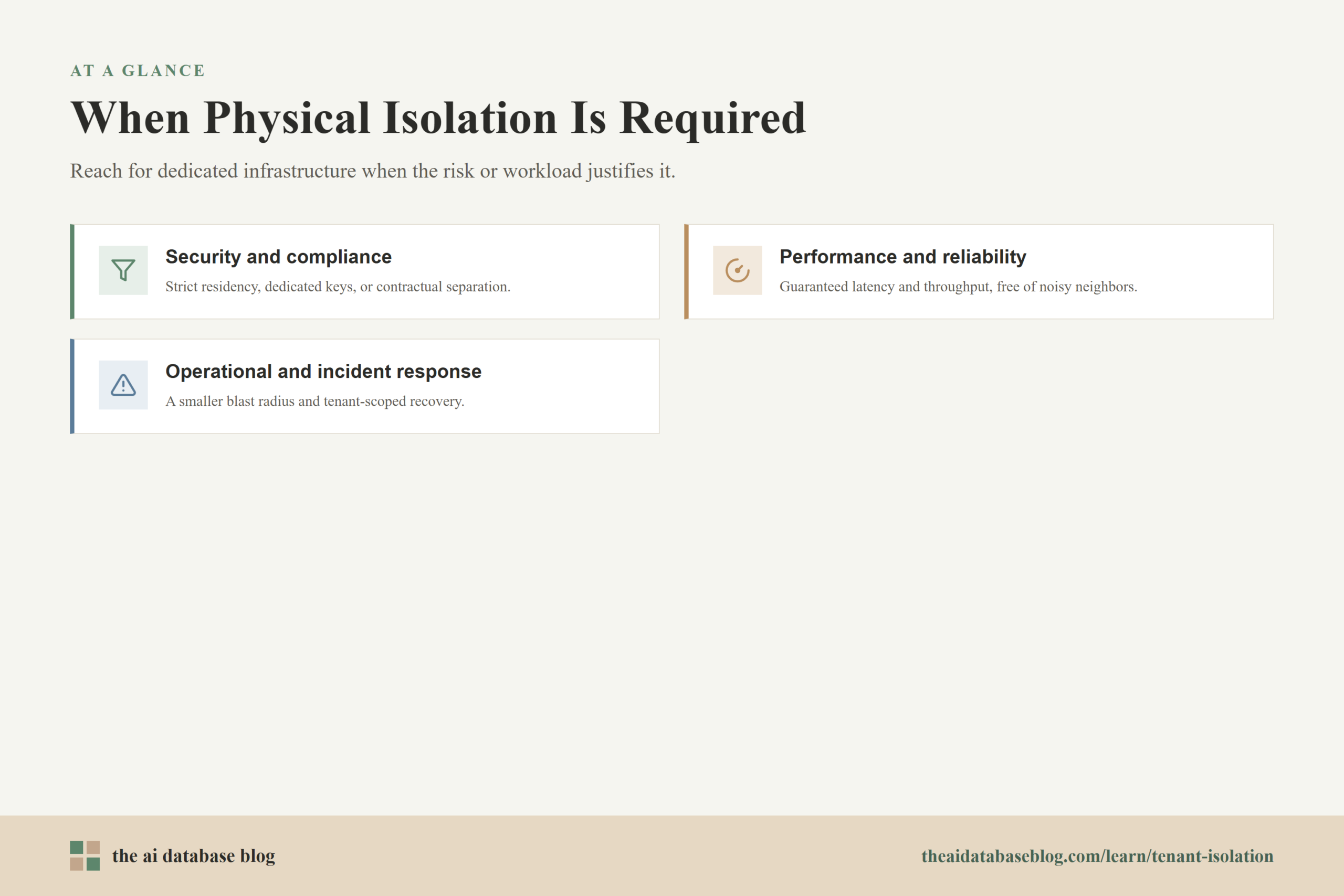
Physical isolation is required when logical controls cannot satisfy the security, compliance, or performance promise the system has made. This can happen because of law, contract, customer policy, risk tolerance, or workload behavior. In AI database systems, the need is often driven by sensitive source documents, regulated data, high-value enterprise knowledge, strict retrieval latency targets, or tenant-specific infrastructure controls.
A common trigger is a requirement for tenant-specific encryption keys. If a tenant must control its own key, rotate it independently, or revoke access in a way that affects only its data, a shared logical model may not be enough. Another trigger is data residency. If one tenant’s data must stay in a specific region or environment, the system may need a separate deployment boundary to make that guarantee credible and auditable.
Security and Compliance Requirements
Physical isolation is often appropriate when tenants handle regulated or highly confidential data, such as legal records, healthcare documents, financial analysis, government data, or internal strategic documents. In these cases, the risk is not only that another tenant might access the data. The risk also includes auditability, administrator access, backup scope, incident response, data deletion, and proof that controls are applied consistently.
Physical isolation may also be needed when customers require separate networks, separate identity boundaries, private connectivity, tenant-specific logging, custom retention rules, or independent security review. These requirements can be difficult to satisfy cleanly in a shared environment because the system must prove that one tenant’s rules do not accidentally affect another tenant’s data or controls.
Performance and Reliability Requirements
Physical isolation becomes more compelling when a tenant needs guaranteed throughput, predictable latency, or a custom service-level agreement. AI retrieval workloads can vary widely. One tenant may send a few searches per minute, while another runs continuous evaluation, ingestion, and real-time retrieval across millions of embeddings. If both tenants share the same capacity pool, the system needs strong governance to protect the smaller workload. If the high-volume tenant has contractual performance guarantees, dedicated capacity may be simpler and safer.
Physical isolation is also useful when a tenant’s workload has unusual indexing or storage needs. Large document sets, frequent updates, high-dimensional embeddings, complex metadata filters, and expensive hybrid search patterns can all change how infrastructure behaves. A dedicated environment allows the platform to tune index settings, scaling policies, caching, and maintenance windows for that tenant without compromising others.
Operational and Incident-Response Requirements
Physical isolation can make operations cleaner when tenants need independent backups, restores, migrations, upgrade timing, or incident handling. If a customer needs its environment restored to a specific point in time, separate infrastructure can reduce the risk of affecting other tenants. If an incident occurs, a dedicated boundary can make it easier to understand what was affected and what was not.
This matters in AI systems because data pipelines are often broader than the database itself. Documents may pass through parsing, chunking, embedding, indexing, evaluation, and generation steps. If those steps are shared, physical isolation at the database layer alone may not satisfy the customer’s expectation. Teams should define which layers are isolated and which are shared before promising dedicated tenancy.
Physical isolation is powerful, but it should be chosen deliberately. The next step is to compare both models through a decision framework rather than treating one as automatically better.
How to Choose Between Logical and Physical Isolation
The right isolation model depends on what the system must guarantee and what the tenant is willing to pay for those guarantees. A good decision process starts by separating data-access risk from performance risk. Logical isolation may be strong enough for access control, but it may still need rate limits and quotas for performance. Physical isolation may solve noisy-neighbor concerns, but it may introduce provisioning complexity and higher costs. The best architecture is often tiered, with different isolation levels for different tenant profiles.
For AI database teams, the decision should include the retrieval layer, not just the storage layer. Ask whether tenants share embedding queues, vector indexes, reranking services, caches, monitoring tools, or background jobs. If they do, a physically separate database may not provide the full isolation story. Conversely, a shared database with strong per-tenant routing and resource controls may be sufficient for low-risk tenants.
Choose Logical Isolation When
Logical isolation is usually the right starting point when tenants have similar security needs, similar workload sizes, and no requirement for dedicated infrastructure. It works well when the product needs fast tenant onboarding, efficient shared operations, and manageable cost. It is also useful when many tenants are small and would not justify dedicated clusters, databases, or compute pools.
Logical isolation is strongest when the system has strict tenant-aware authorization, mandatory query scoping, well-tested metadata filters, per-tenant monitoring, and resource controls. In AI databases, this means every document, chunk, embedding, metadata field, and retrieval result must remain associated with the correct tenant. Testing should include attempts to query across tenants, bypass filters, misuse admin tools, and retrieve context from the wrong workspace.
Choose Physical Isolation When
Physical isolation is the better choice when tenants require dedicated capacity, independent encryption keys, separate regions, stricter audit boundaries, or stronger blast-radius control. It is also appropriate for tenants with unusually large or unpredictable workloads. If a tenant’s ingestion, indexing, or search traffic can materially affect shared infrastructure, a dedicated environment may be less risky than trying to govern every spike inside a shared pool.
Physical isolation is also useful when customer trust depends on a simple explanation. Some customers will accept a well-documented logical model. Others need a clear statement that their data, keys, compute, or database instance is separate. In those cases, a physically isolated design can reduce both technical risk and commercial friction, provided the provider can operate it reliably.
Use a Tiered Isolation Model for Mixed Tenant Needs
Many mature systems use more than one isolation model. Smaller tenants may run in a shared logical environment with strong access control and quotas. Larger or higher-risk tenants may receive dedicated collections, dedicated query workers, or separate database instances. The most sensitive tenants may receive fully dedicated infrastructure with separate keys, networks, and operational controls.
A tiered model lets the platform match isolation to actual needs instead of overbuilding for every tenant or under-protecting the most demanding ones. It also creates a migration path. A tenant can start in a logical shared environment and move to a dedicated environment when its workload, contract, or compliance needs change.
A Practical Decision Checklist
Before choosing an isolation model, teams should answer a few practical questions. These questions help turn vague security and performance concerns into concrete architectural requirements.
- What data does each tenant store, and how sensitive is it?
- Can every query, write, deletion, backup, and admin action be reliably scoped to one tenant?
- Does any tenant require its own encryption key, region, retention rule, or audit boundary?
- What happens if one tenant suddenly increases ingestion, indexing, or search traffic?
- Can the system measure CPU, memory, storage, query latency, index activity, and cost by tenant?
- Does the tenant need guaranteed latency or throughput, or only best-effort shared performance?
- How hard would it be to move a tenant from shared logical isolation to dedicated infrastructure later?
If the answers point to ordinary data sensitivity, predictable usage, and no dedicated-control requirements, logical isolation is often appropriate. If the answers point to regulated data, custom controls, strict performance promises, or high-impact workloads, physical isolation should be seriously considered.
After selecting an isolation model, teams still need to implement it carefully. The label alone does not make a system safe. The next section covers practical design rules that make either approach more reliable.
Design Practices That Improve Either Isolation Model
Whether a system uses logical isolation, physical isolation, or both, the implementation should be explicit and testable. Tenant boundaries should not depend on informal conventions or developer memory. They should be built into request handling, data models, query planning, observability, and operational workflows. This is especially important in AI systems because retrieval pipelines can involve many stages before the final answer is generated.
The first practice is to make tenant context mandatory. Every request should carry authenticated tenant identity, and the system should derive that identity from trusted authentication rather than user-supplied query parameters. Every stored object should have a clear tenant association, and every retrieval path should enforce that association before results reach the model.
The second practice is to measure tenant behavior directly. A shared system should track per-tenant query volume, latency, index size, ingestion rate, cache use, error rate, and cost. A dedicated system should still track the same metrics because physical isolation does not prevent a tenant from outgrowing its own capacity. Monitoring should make it easy to identify whether a problem is global, tenant-specific, or tied to a particular workload type.
The third practice is to separate interactive and background work when possible. User-facing retrieval should not be starved by a tenant’s bulk ingestion, evaluation job, or index rebuild. Queues, priority levels, concurrency limits, and backpressure can protect live search from heavy maintenance or batch work. This matters even in dedicated environments, but it is essential in shared logical models.
The fourth practice is to test isolation as a failure mode. Teams should run tests that intentionally omit tenant filters, attempt cross-tenant reads, exercise admin operations, stress shared resources, and verify deletion boundaries. For AI retrieval, tests should confirm that retrieved context only contains data from the correct tenant before that context is passed into a generation step.
These practices do not remove the need to choose the right isolation model. Instead, they make the chosen model real. A logical design without enforcement is only a naming convention, and a physical design without careful operations can still fail through shared tools, shared administrators, or shared pipelines.
FAQs
1. What is the main difference between logical and physical tenant isolation?
Logical isolation separates tenants through software controls while they share some infrastructure. Physical isolation separates tenants through dedicated infrastructure boundaries such as separate clusters, instances, storage, accounts, or compute resources. Logical isolation is usually more efficient, while physical isolation provides stronger security, performance, and compliance guarantees.
2. Is logical isolation secure enough for AI databases?
Logical isolation can be secure enough when it is implemented with mandatory tenant scoping, strong authorization, careful metadata filtering, per-tenant monitoring, and thorough testing. It is less appropriate when tenants require dedicated keys, strict regulatory separation, custom network boundaries, or guaranteed performance that shared infrastructure cannot provide.
3. Why is the noisy-neighbor problem important for vector search?
Vector search can consume significant compute, memory, storage bandwidth, and indexing capacity. If one tenant runs large queries, heavy ingestion, broad metadata filters, or frequent index updates in a shared environment, other tenants may see slower retrieval, delayed updates, or less reliable AI responses. Noisy-neighbor controls are therefore important for both performance and user trust.
4. Does physical isolation completely eliminate noisy-neighbor issues?
Physical isolation greatly reduces noisy-neighbor risk between tenants because fewer resources are shared. However, it does not remove capacity planning. A tenant can still overload its own dedicated environment if its workload exceeds provisioned resources. The difference is that the impact is contained to that tenant instead of spreading across the shared platform.
5. When should a tenant get dedicated AI database infrastructure?
A tenant should get dedicated infrastructure when it has strict security requirements, regulated or highly confidential data, custom encryption keys, separate regional or network requirements, predictable high-volume workloads, or contractual performance guarantees. Dedicated infrastructure is also useful when the tenant’s workload could materially affect others in a shared environment.
6. Can a system use both logical and physical isolation?
Yes. Many systems use a tiered model. Smaller tenants may share infrastructure with logical controls and quotas, while larger or higher-risk tenants receive dedicated collections, query workers, database instances, or full clusters. This lets the platform balance cost and operational simplicity with stronger guarantees for tenants that need them.
Takeaway
Tenant isolation in AI databases is a practical design choice about what a system must guarantee. Logical isolation uses software boundaries to keep tenants separated in shared infrastructure, making it useful for cost-efficient multi-tenant retrieval systems with similar workloads and moderate risk. Physical isolation uses dedicated infrastructure boundaries to provide stronger security, compliance, performance, and incident-containment guarantees. This guidance is most useful for teams designing AI applications, vector search systems, and retrieval-augmented generation platforms that need to protect tenant data while keeping search fast and reliable. A common use case is an enterprise knowledge assistant that starts with shared logical isolation for ordinary workspaces but moves regulated or high-volume customers into dedicated infrastructure when their security or performance needs justify it.