Multi-tenancy in an AI database means designing one retrieval system to safely serve many tenants, such as customers, workspaces, teams, or organizations. The main architecture choices are a shared collection with a tenant filter, a namespace-per-tenant model, a collection-per-tenant model, and a database-per-tenant model. The right choice depends on how much isolation you need, how many tenants you expect, how large each tenant’s data is, and how much operational cost you can accept.
This guide explains the four common multi-tenancy patterns for AI databases and retrieval systems, especially systems that store embeddings for semantic search, hybrid search, or retrieval-augmented generation. It covers how each pattern works, where it fits best, and how to evaluate the tradeoffs between isolation, cost, query performance, operational complexity, and long-term scale.
Why Multi-Tenancy Matters in AI Databases
AI databases are often used to retrieve private or tenant-specific context for applications such as RAG assistants, semantic search tools, internal knowledge systems, and AI agent memory. In these systems, retrieval is not just a performance feature. It is also an access-control boundary because the model can only ground its answer in the information the retrieval layer provides.
This makes multi-tenancy especially important. If the database returns the wrong tenant’s records, the application may expose private documents, customer-specific knowledge, internal notes, or regulated data. Unlike a traditional user interface bug, a retrieval isolation bug can be harder to notice because the leaked content may appear inside a generated answer rather than in a simple database row or table view.
Multi-tenancy also affects cost and scale. A system with thousands of small tenants has different needs from a system with twenty large enterprise tenants. Small tenants usually benefit from shared infrastructure and lower overhead. Large tenants may need stronger isolation, dedicated indexes, predictable performance, custom retention policies, or separate backup and deletion workflows.
Once the purpose of multi-tenancy is clear, the next question is where the tenant boundary should live. The boundary can be a metadata filter, a namespace, a collection, or a fully separate database. Each option changes how much the system depends on query-time logic versus structural separation.
Pattern 1: Shared Collection With Tenant Filter
In a shared-collection pattern, all tenants store their vectors and metadata in the same collection or index. Each record includes a tenant identifier, usually a field such as tenant_id, workspace_id, or organization_id. Every retrieval query must include a filter that restricts results to the authenticated tenant.
This is usually the simplest and lowest-cost multi-tenancy model. The application can maintain one collection, one index configuration, and one ingestion pipeline. It works well when tenants are small, the data model is uniform, and the application has strong centralized query logic that always applies the tenant filter before vector or hybrid search results are returned.
How It Works
When content is ingested, the pipeline stores each chunk, vector, and metadata object with a tenant field. At query time, the retrieval layer combines the semantic query with a hard metadata filter. For example, a query might search for the nearest vectors only where tenant_id equals the tenant attached to the user’s session.
The filter should be treated as part of the security model, not as an optional search preference. In a production system, tenant-scoped retrieval should be wrapped in one shared service or function so application developers cannot accidentally query the shared collection without the tenant condition.
Isolation, Cost, and Scale Tradeoffs
The shared-collection model has the weakest structural isolation because all tenants physically coexist in the same collection. Its safety depends on correct filtering, authorization mapping, and test coverage. If one code path forgets the tenant filter, the collection itself may not prevent cross-tenant retrieval.
The cost profile is attractive because the system uses fewer database objects and usually fewer indexes. It can also simplify onboarding because new tenants do not require new database resources. However, scale can become uneven as tenants grow. Large tenants may dominate the index, create noisy-neighbor effects, or make filtered vector search less efficient if the database has to search a broad shared space before narrowing results.
This pattern is best for early-stage systems, internal tools, high-volume small tenants, and applications where tenant data is relatively small and consistent. It is less suitable when tenants require strong contractual isolation, separate lifecycle management, or highly variable performance guarantees.
A shared collection gives teams a fast and economical starting point, but it places a lot of responsibility on query discipline. If that responsibility becomes too risky or performance starts to vary by tenant size, the next step is usually a model that gives each tenant a stronger logical partition.
Pattern 2: Namespace-Per-Tenant
A namespace-per-tenant pattern places each tenant’s records inside a separate namespace, partition, tenant shard, or similar tenant-scoped container within a broader database or collection. The exact term varies by system, but the idea is the same: tenant data remains inside one shared database environment while queries are routed to a tenant-specific partition.
This model is often a practical middle ground for AI databases. It provides clearer tenant boundaries than a pure metadata filter while avoiding the cost and operational load of creating a separate collection or database for every tenant. It can also make tenant deletion, tenant-level maintenance, and tenant-scoped metrics easier because the system has an explicit partition to target.
How It Works
During ingestion, the application writes each tenant’s vectors into that tenant’s namespace. During retrieval, the application selects the namespace based on the authenticated tenant and sends the query only to that namespace. In many systems, this means the query does not need to scan or rank across every tenant’s vectors before applying a tenant filter.
Namespaces can also support cleaner lifecycle operations. If a tenant churns, the application may be able to delete the namespace rather than scan a shared collection for every record with a matching tenant field. If a tenant becomes inactive, the system may be able to move that namespace to a colder storage tier or reduce its active resource footprint, depending on the database’s capabilities.
Isolation, Cost, and Scale Tradeoffs
Namespace-per-tenant improves isolation because the tenant boundary is represented in the database structure, not only in metadata. It is not always equivalent to a separate database, but it usually reduces the chance that a missing filter will expose other tenants’ records because the query is routed into a tenant-specific partition.
The cost is usually moderate. The system still shares infrastructure, but tenants have clearer logical or physical partitions. This makes it appealing for SaaS-style AI applications with many tenants, especially when each tenant has enough data to justify a partition but not enough to justify a dedicated collection or database.
The main scale concern is namespace management. A system with hundreds or thousands of tenants may work cleanly, but a system with millions of tenants needs careful support for tenant creation, routing, lifecycle state, and monitoring. Teams should also check whether the database can query across namespaces when needed, because some applications need both tenant-private retrieval and shared or cross-tenant retrieval for approved global content.
Namespaces are often the most balanced pattern, but they are not always the strongest fit. If tenants need different schemas, different index settings, or sharply different performance profiles, the system may need to move the boundary up from namespace to collection.
Pattern 3: Collection-Per-Tenant
In a collection-per-tenant pattern, each tenant gets its own collection, index, or equivalent top-level search container. The application still runs one shared service, but the retrieval layer routes each request to the tenant’s dedicated collection. This provides stronger separation than namespaces in systems where collections carry their own schemas, vector dimensions, index settings, metadata fields, or search configuration.
This pattern is useful when tenants are large enough or different enough that they should not all share the same index structure. For example, one tenant might need a high-recall vector index for long technical documents, while another tenant might need hybrid search over short support articles with heavy metadata filtering. Keeping them in separate collections allows each tenant’s retrieval configuration to match its data shape.
How It Works
When a tenant is onboarded, the control plane creates a dedicated collection and records the mapping between the tenant and that collection. Ingestion jobs write only to that tenant’s collection. Query services look up the tenant mapping, select the correct collection, and run vector, keyword, hybrid, or filtered retrieval inside that collection.
Because each collection is separate, tenant-specific reindexing and schema changes become easier. A team can rebuild one tenant’s index, adjust its metadata model, or change its retention workflow without necessarily touching every other tenant. This can be valuable in enterprise environments where tenants have different data sources, compliance requirements, or service-level expectations.
Isolation, Cost, and Scale Tradeoffs
Collection-per-tenant offers strong logical isolation. A query routed to one collection cannot accidentally retrieve records from another collection unless the application selects the wrong collection. This reduces reliance on metadata filters as the only isolation mechanism and makes tenant boundaries easier to reason about during audits and incident reviews.
The cost is higher than shared-collection or namespace-per-tenant models because each collection may have its own index overhead, configuration, and operational state. This overhead can be acceptable for large B2B tenants but inefficient for many small tenants. Collection sprawl can also become difficult to manage if onboarding, schema migration, backup, monitoring, and deletion are not automated.
Scale depends on the number and size of tenants. This pattern can scale well for a moderate number of meaningful tenants, especially when each tenant has a sizable corpus. It is less attractive for consumer-scale applications with a huge number of tiny tenants unless the database is specifically designed to handle very large numbers of collections efficiently.
Collection-per-tenant gives teams more control, but control comes with more operational surface area. When tenants are high-value, heavily regulated, or performance-sensitive, that tradeoff can be worthwhile. When each tenant is small, a separate collection may be more structure than the workload needs.
Pattern 4: Database-Per-Tenant
In a database-per-tenant pattern, each tenant receives a separate database, cluster, project, or deployment boundary. This is the strongest isolation pattern in the list because the tenant boundary exists at the infrastructure or database-instance level rather than only inside a shared index or collection.
This approach is common when isolation is a business requirement, not just an engineering preference. It may be appropriate for regulated customers, strict data residency needs, contractual separation, dedicated encryption and backup policies, or tenants whose workloads are large enough to justify dedicated infrastructure.
How It Works
The application maintains a control plane that maps each tenant to its database environment. When a request arrives, the retrieval service authenticates the user, resolves the tenant, and routes the query to that tenant’s database. Ingestion, indexing, backups, retention, monitoring, and deletion all happen within the tenant’s own database boundary.
This pattern often requires mature automation. Without automated provisioning, migrations, health checks, and cost reporting, database-per-tenant can become expensive and slow to operate. With strong automation, it can provide clean boundaries and predictable performance for tenants that justify the added complexity.
Isolation, Cost, and Scale Tradeoffs
Database-per-tenant provides the highest isolation. It reduces the blast radius of configuration mistakes, makes per-tenant access controls easier to validate, and can simplify customer-specific compliance or audit stories. It also gives stronger performance isolation because one tenant’s indexing or query load is less likely to affect another tenant.
The cost is the highest of the four patterns. Each tenant may require separate compute, storage, indexes, backups, monitoring, and operational attention. Even if the platform uses shared underlying hardware, the management layer still has to track many database-level resources.
The scale profile is strongest for fewer, larger tenants and weakest for many small tenants. A database-per-tenant model can work for enterprise SaaS or managed AI systems where each tenant has meaningful volume, strict requirements, or dedicated pricing. It is usually too heavy for small workspaces, free-tier users, or applications where tenants appear and disappear frequently.
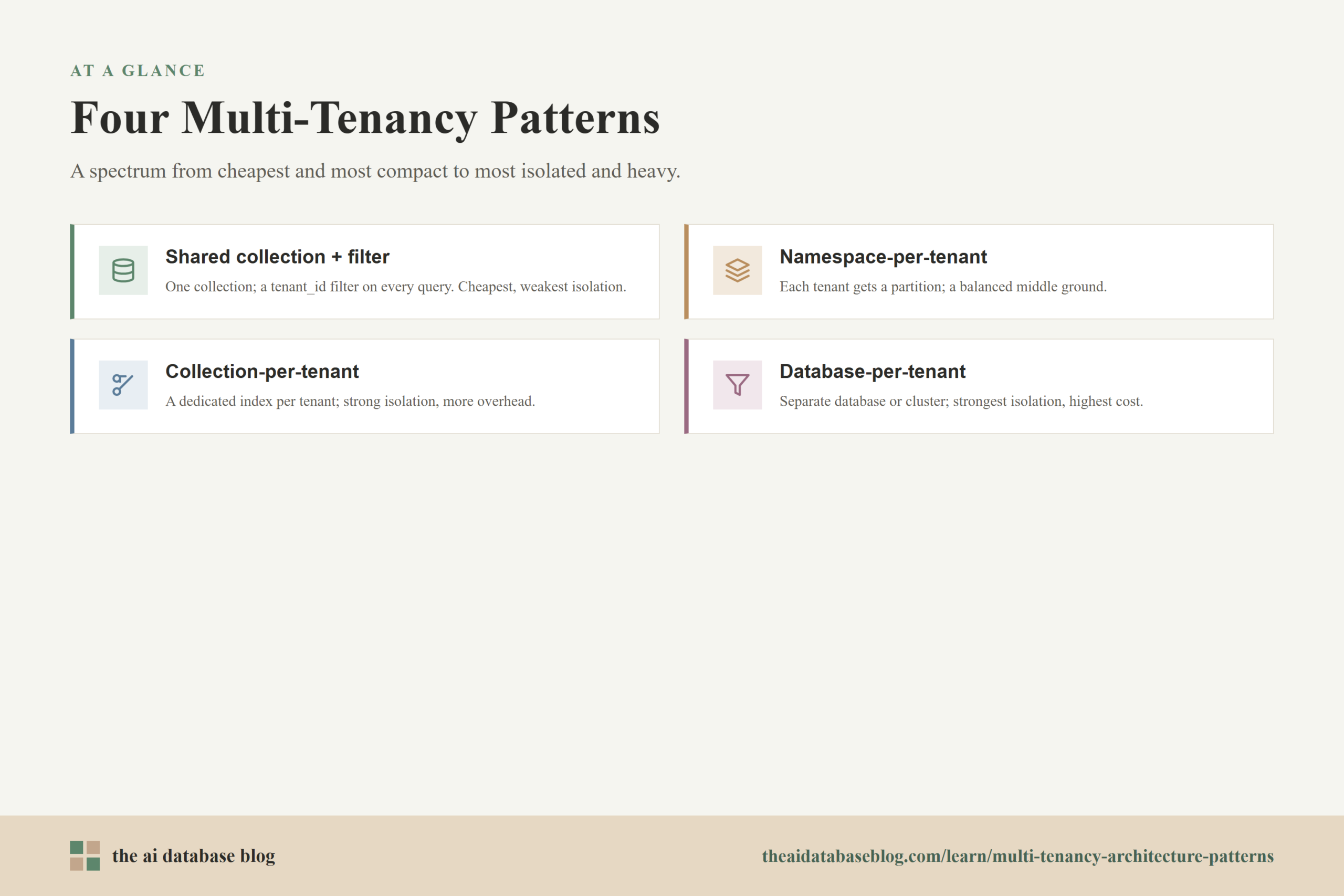
The four patterns now form a spectrum: shared collection is cheapest and most compact, while database-per-tenant is most isolated and operationally heavy. To choose well, teams should compare the patterns across the dimensions that matter most in production rather than treating one model as universally best.
Tradeoff Comparison
The best multi-tenancy architecture depends on the relationship between tenant count, tenant size, isolation requirements, and operational maturity. A useful way to compare the patterns is to ask where the boundary lives and what happens when a query, tenant, or index behaves unexpectedly.
| Pattern | Isolation | Cost | Scale Fit | Best Use Case |
|---|---|---|---|---|
| Shared collection with tenant filter | Lowest structural isolation; depends heavily on correct filters | Lowest | Many small tenants with similar data | Early-stage systems, internal tools, small workspaces, uniform datasets |
| Namespace-per-tenant | Moderate to strong logical partitioning, depending on database behavior | Low to moderate | Many tenants with manageable per-tenant data | SaaS-style RAG, tenant-specific search, clean tenant offboarding |
| Collection-per-tenant | Strong logical isolation at the collection or index level | Moderate to high | Fewer or medium numbers of larger tenants | Tenants with different schemas, index settings, or performance needs |
| Database-per-tenant | Highest isolation at the database or infrastructure level | Highest | Fewer high-value or regulated tenants | Enterprise, regulated, dedicated, or high-volume tenant environments |
This comparison shows why multi-tenancy is not only a database-design question. It is also a product, security, and operations question. A low-cost pattern can be the right answer when tenants are small and risk is low, while a more expensive pattern can be the right answer when a tenant’s privacy, performance, or compliance expectations are high.
How to Choose the Right Pattern
Choosing a multi-tenancy pattern starts with the tenant model. A tenant might be a customer organization, an individual user, a workspace, a project, or an internal department. The choice matters because a system with one tenant per user may need to support far more tenants than a system with one tenant per enterprise account.
Next, estimate the size and shape of each tenant’s data. If most tenants have only a few hundred or a few thousand vectors, a shared or namespace-based model may be efficient. If some tenants have millions of vectors, heavy ingestion jobs, or custom retrieval settings, those tenants may need their own collections or databases while smaller tenants remain pooled.
Teams should also evaluate the authorization model. Tenant isolation is only one layer. Many AI applications also need document-level permissions, team-level access, source-system access control, or sensitivity labels. A tenant-specific collection does not automatically solve user-level authorization inside that tenant, so the retrieval layer may still need metadata filters, row-level rules, or a policy service.
Finally, consider operational maturity. More isolated patterns require better automation. Collection-per-tenant and database-per-tenant models need reliable provisioning, migrations, monitoring, backup, deletion, and billing attribution. If those systems are not in place, the architecture may be theoretically safer but practically fragile.
Many production systems do not use only one pattern forever. They begin with a pooled model, move larger tenants into stronger partitions, and keep small tenants on shared infrastructure. This hybrid approach can offer a useful balance between cost efficiency and tenant-specific control.
Hybrid and Migration Strategies
Multi-tenancy decisions are rarely permanent. A system may start with a shared collection because it is simple and inexpensive, then migrate high-volume tenants to namespaces, collections, or dedicated databases as their requirements become clearer. Designing for migration early can prevent the tenant boundary from becoming trapped in application code.
A common hybrid strategy is to pool small tenants and isolate large tenants. Small tenants remain in a shared collection or shared namespace group, while large tenants receive dedicated namespaces, collections, or databases. This keeps cost low for the long tail of small tenants while protecting performance and isolation for tenants that create more load or require stricter controls.
Another useful strategy is to separate shared knowledge from tenant-private knowledge. Some applications need global content that every tenant can retrieve, such as product documentation, public policies, or common help content. That data can live in a shared retrieval space, while tenant-specific documents remain in tenant-scoped storage. The retrieval service then combines approved shared results with tenant-private results under explicit authorization rules.
Migration requires careful metadata hygiene. Every record should carry stable tenant identifiers, source identifiers, document identifiers, timestamps, and deletion markers where appropriate. Even if the current architecture uses namespaces or separate collections, good metadata makes reindexing, moving tenants, rebuilding search spaces, and proving deletion much easier.
Planning for migration does not mean overbuilding the first version. It means keeping tenant identity explicit, avoiding scattered query logic, and making the retrieval service the single place where tenant routing decisions are made. That foundation matters just as much as the specific pattern selected.
Security and Reliability Practices Across All Patterns
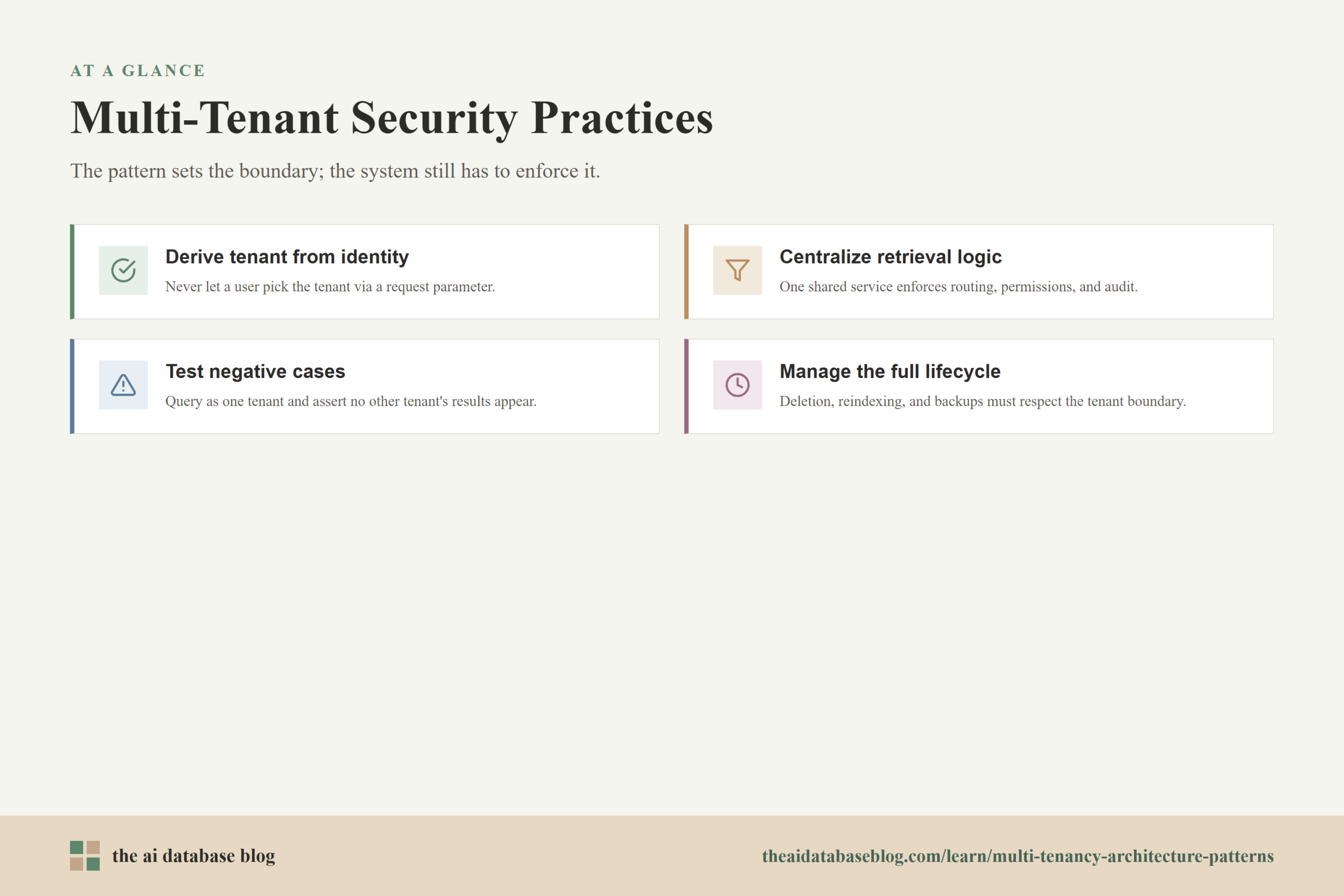
No multi-tenancy pattern is secure by itself. Even database-per-tenant architectures can fail if the application routes a user to the wrong tenant database. Shared-collection architectures can be safe enough for some uses if filters are enforced consistently, tested thoroughly, and backed by strong authorization logic. The pattern sets the boundary, but the system still has to enforce it.
The retrieval layer should always derive the tenant from authenticated identity, not from a user-provided query parameter. Users should not be able to choose a tenant by typing an identifier into a request. The application should map the authenticated user to the tenant or workspace they are allowed to access, then pass that tenant context into the retrieval service.
It is also important to centralize retrieval logic. If every feature builds its own vector query, one missed filter or routing step can become a data exposure issue. A shared retrieval service can enforce tenant routing, document permissions, audit logging, query limits, and result validation in one place.
Testing should include negative cases. For example, create records for two tenants, query as one tenant, and assert that every returned result belongs to the allowed tenant or to an explicitly shared corpus. These tests should cover semantic search, keyword search, hybrid search, metadata-filtered search, reranking inputs, and any fallback retrieval paths.
The final reliability concern is lifecycle management. Tenant deletion, backup restoration, reindexing, and source-document removal must respect the tenant boundary. In AI databases, stale embeddings can survive after source content changes unless ingestion and deletion workflows are designed carefully. Strong multi-tenancy includes not only safe reads, but also safe updates, deletes, audits, and rebuilds.
FAQs
1. What is the simplest multi-tenancy pattern for an AI database?
The simplest pattern is a shared collection with a tenant filter. All tenants share one collection, and every record includes a tenant identifier that must be used as a query filter. This is easy to operate and inexpensive, but it requires strict query controls because isolation depends on the filter being applied correctly every time.
2. Is namespace-per-tenant safer than metadata filtering?
Namespace-per-tenant is usually safer than relying only on metadata filtering because the tenant boundary is represented as a database partition or tenant-specific container. However, safety still depends on correct routing and authorization. The application must still ensure that each user is routed only to the namespace they are allowed to access.
3. When should a tenant get its own collection?
A tenant should usually get its own collection when it has a large corpus, different schema needs, custom index settings, strict performance expectations, or separate lifecycle requirements. Collection-per-tenant is also useful when tenant-specific reindexing, deletion, or auditability matters enough to justify the extra operational overhead.
4. When is database-per-tenant worth the cost?
Database-per-tenant is worth considering when tenants are high-value, regulated, performance-sensitive, or contractually entitled to strong separation. It gives the clearest isolation and the strongest performance boundary, but it also carries the highest cost and requires mature automation for provisioning, monitoring, migrations, backups, and deletion.
5. Can one system use more than one multi-tenancy pattern?
Yes. Many systems use a hybrid model. For example, small tenants may stay in a shared collection or namespace model, while large tenants move to dedicated collections or databases. This lets the architecture preserve cost efficiency for small tenants while giving stronger isolation and performance control to tenants that need it.
6. Does tenant isolation replace document-level permissions?
No. Tenant isolation only separates one tenant from another. Many AI database applications also need permissions inside a tenant, such as department access, document ownership, source-system access control, or sensitivity labels. Those rules still need to be enforced during retrieval so users see only the documents they are authorized to use.
Takeaway
Multi-tenancy architecture for AI databases is a balance between isolation, cost, and scale. A shared collection with tenant filters is economical but depends heavily on correct filtering, namespace-per-tenant offers a strong middle ground for many SaaS-style retrieval systems, collection-per-tenant gives more control for larger or more varied tenants, and database-per-tenant provides the strongest isolation for regulated or high-value environments. This guidance is most useful for teams building multi-tenant RAG, semantic search, hybrid search, or AI agent memory systems where each tenant’s data must stay separate while the system remains practical to operate.