Serverless vector database architecture separates the work of storing vector data from the work of searching it, then allocates compute only when queries, writes, indexing jobs, or maintenance tasks need it. This design can reduce idle infrastructure cost, simplify scaling, and make multi-tenant AI applications easier to operate, but it also introduces tradeoffs around cold starts, cache warming, query latency, and predictable performance under sudden demand.
This guide explains how serverless vector databases are typically organized, why decoupled storage and compute matter, how autoscaling and pay-per-use pricing change operations, where cold-start behavior appears, and how serverless design can make multi-tenancy more practical for retrieval systems, AI assistants, semantic search, and retrieval-augmented generation applications.
What Serverless Means for Vector Databases
A serverless vector database is not a database with no servers. It is a managed architecture where the user does not provision fixed database nodes for every workload. Instead, the system hides much of the capacity planning behind elastic pools of compute, shared storage, background indexing workers, routing layers, and tenant-aware controls. The application still sends vector inserts, metadata updates, and similarity search queries, but the database service decides how much compute to allocate and when to release it.
This matters because vector workloads are often uneven. A retrieval-augmented generation application may receive bursts of search traffic during work hours, then sit nearly idle overnight. A product search system may experience sharp query spikes during campaigns. A document ingestion pipeline may need heavy write and indexing capacity for a short period, while query traffic remains modest. Traditional always-on clusters can handle these patterns, but they often require overprovisioning for peak demand or careful manual scaling.
Serverless architecture tries to match resources more closely to actual activity. Storage persists independently, query workers can be added or removed, indexing can run in separate background capacity, and tenant workloads can be isolated through routing, quotas, namespaces, or physical partitioning. The result is not automatically faster in every case, but it can be operationally simpler for teams that want vector search without running a dedicated cluster all the time.
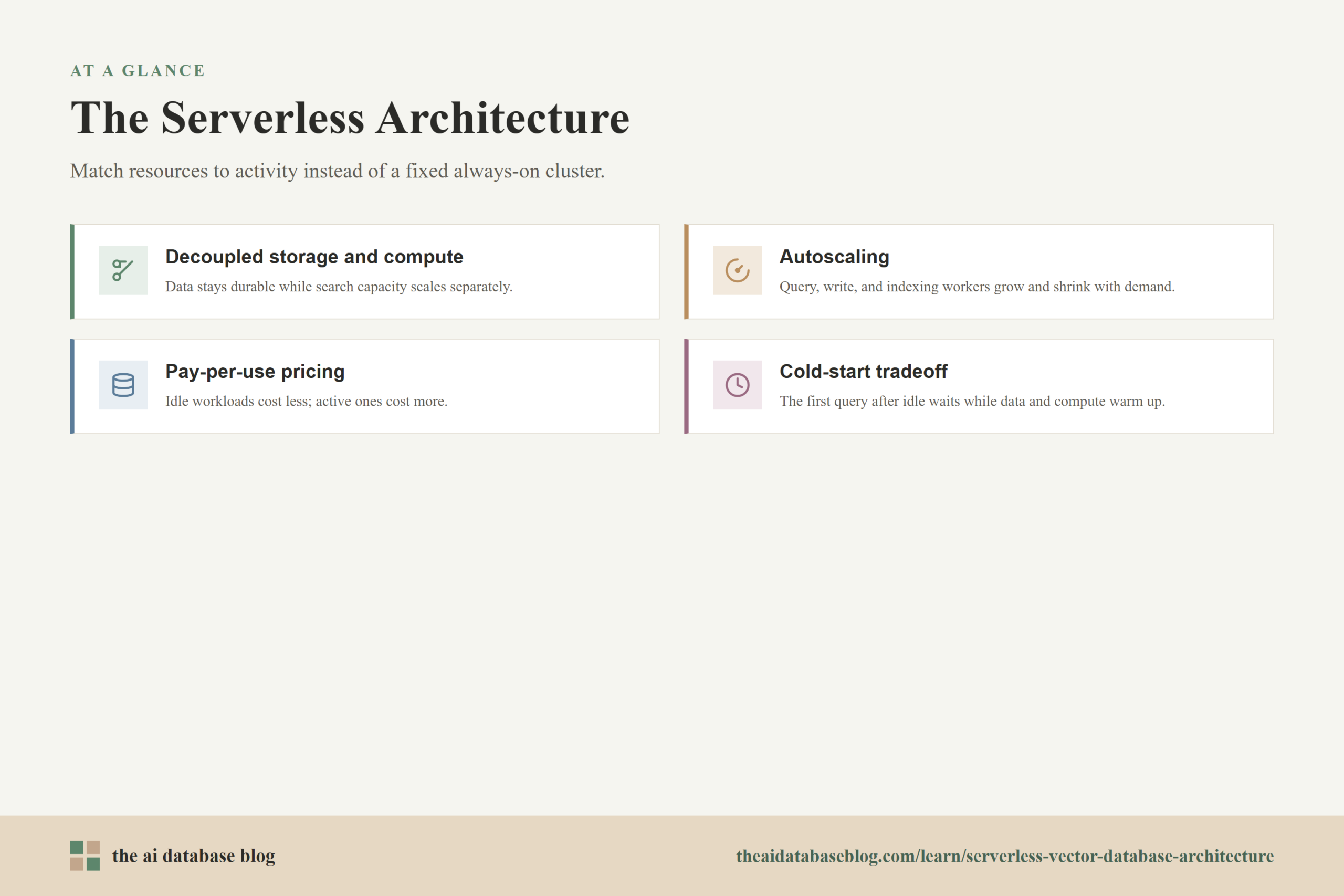
Once the idea of serverless is clear, the next question is what architectural change makes it possible. The central shift is the separation of storage and compute, because that separation lets a vector database keep data durable while treating search capacity as elastic.
Decoupled Storage and Compute
Decoupled storage and compute means that the vector database does not require every search node to own the durable copy of the data it searches. In older or simpler deployments, a node often stores local index files, serves queries, and participates in replication as one tightly coupled unit. In a serverless design, durable vector data, metadata, index segments, and logs are commonly kept in a separate storage layer, while compute workers load, cache, search, update, or compact the data as needed.
This separation gives the system more freedom. Storage can grow with the number of vectors, while compute can grow with query volume, write volume, or indexing pressure. A dataset with many vectors but low traffic may need significant durable storage but very little always-on compute. A small dataset with intense query traffic may need more search workers even though the stored data is modest. Treating these needs separately helps the architecture avoid tying cost and capacity to a single fixed cluster size.
In vector search, decoupling is more complex than it is for simple key-value lookups. Vector databases use indexes such as graph-based, inverted-file, product-quantized, or disk-aware structures to avoid scanning every vector for every query. Those indexes must remain searchable, fresh enough for recent writes, and compatible with metadata filters. Serverless systems often solve this by organizing data into immutable or semi-immutable segments, keeping frequently used partitions cached, and running separate workers for ingestion, compaction, and index building.
The practical benefit is flexibility. If a tenant is idle, its vector data can remain in durable storage without occupying the same amount of memory or CPU as an active tenant. If a tenant becomes active, query workers can load the relevant index segments, warm caches, and serve searches. If new data arrives, write and indexing workers can update the searchable representation without forcing the entire system to scale as one block.
Decoupled architecture also changes how engineers think about performance. The key question becomes not just “How large is the database?” but “Which data is hot, which data is cold, how quickly can cold data become searchable, and how much compute is needed for the current query mix?” That naturally leads into autoscaling, because elastic compute is only useful if the system can add and remove it at the right moments.
Autoscaling in Serverless Vector Search
Autoscaling is the process of adjusting compute capacity based on workload demand. In a serverless vector database, this can happen at several layers: API routing, query execution, background indexing, compaction, cache population, and sometimes ingestion pipelines. The goal is to absorb changes in traffic without requiring the application team to manually resize a cluster or predict every usage spike in advance.
Query autoscaling usually responds to search volume, concurrency, latency, and resource pressure. If many users are issuing similarity searches at the same time, the system can add search workers or assign more parallel execution capacity. If traffic drops, those workers can be reduced so the application is not paying for unused CPU and memory. This is especially useful for AI applications with bursty interaction patterns, such as internal copilots, customer support retrieval, or search features that are active only during certain business hours.
Write and indexing autoscaling is equally important. Vector databases often need to ingest documents, generate or accept embeddings, attach metadata, build indexes, and make new records available for search. In a serverless design, indexing can be handled by background workers that scale with the ingestion queue. This keeps query-serving compute from being overwhelmed by heavy write periods, although the system still needs careful coordination so newly written data becomes visible within an acceptable freshness window.
Autoscaling is not magic, and it is not instantaneous. Scaling decisions depend on signals such as queue depth, recent latency, cache hit rate, memory pressure, and active tenant count. Scale too slowly and users see higher latency. Scale too aggressively and costs can rise unexpectedly. A well-designed serverless vector database needs control loops that understand the difference between a short traffic spike, a sustained workload increase, and a one-off ingestion job.
Autoscaling improves the operational story, but most teams also care about cost. The same elastic behavior that reduces manual capacity planning also changes the pricing model, because serverless systems tend to charge closer to actual use than to fixed infrastructure size.
Pay-Per-Use Pricing and Cost Behavior
Pay-per-use pricing is one of the main reasons teams consider serverless vector databases. Instead of paying primarily for provisioned nodes that run continuously, the bill may be based on some mix of stored data, reads, writes, query compute, indexing work, data transfer, metadata operations, and retained backups. The exact units vary by provider and implementation, but the architectural idea is the same: idle workloads should cost less than active workloads.
This can be a strong fit for early AI products, prototypes, internal tools, and applications with unpredictable demand. A team can store embeddings and run searches without committing to a large always-on cluster before traffic is proven. If usage grows, the database can allocate more compute. If usage drops, the application is not necessarily stuck paying for peak capacity around the clock.
The tradeoff is that cost becomes more usage-sensitive. In a fixed cluster, the bill is relatively predictable even if traffic varies. In a serverless model, an inefficient retrieval workflow can create unexpected charges if it sends too many queries, retrieves too many candidates, overuses metadata filters, repeatedly searches cold data, or triggers frequent reindexing. The architecture lowers the cost of being idle, but it does not remove the need to design efficient retrieval patterns.
For practical planning, teams should separate storage cost from activity cost. Storage cost grows with vector count, dimensionality, metadata size, replicas or durability settings, and retained index files. Activity cost grows with query frequency, top-k size, filter complexity, ingestion rate, index maintenance, and cache misses. A low-traffic knowledge base with millions of vectors may be storage-heavy. A smaller conversational assistant with many users may be compute-heavy.
Cost-aware design is tightly connected to performance-aware design. The same cache miss that increases query latency may also increase backend storage access or compute work. That makes cold-start behavior one of the most important tradeoffs to understand before choosing a serverless vector database for production retrieval.
Cold-Start Considerations
A cold start happens when the system must prepare resources before it can serve a request at the expected speed. In serverless vector databases, cold starts can appear when query compute has scaled down, when an inactive tenant becomes active, when index segments are not in memory or local cache, or when data must be fetched from remote durable storage before search can complete. The database is available, but the first query after inactivity may be slower than later warm queries.
Vector search is especially sensitive to this because fast retrieval often depends on memory-resident or locally cached index structures. If a query worker already has the right index partitions, metadata structures, and routing information loaded, search can be efficient. If those structures must be loaded from remote storage, mapped from disk, rebuilt, or fetched into cache, the first request may pay extra latency. This is the cost side of scaling compute down during idle periods.
Cold starts are not always a problem. For batch jobs, internal tools, occasional administrative search, or low-urgency document discovery, a slower first query may be acceptable if it meaningfully reduces idle cost. For user-facing chat, customer support search, recommendation systems, or interactive product search, cold starts can be more visible. In those cases, teams often need warm pools, minimum capacity settings, scheduled warming, tenant prioritization, or cache policies that keep important data ready.
The important design question is not simply whether cold starts exist. It is which workloads can tolerate them, which tenants or indexes need warm capacity, and what service-level expectations the application has. A system can be serverless while still keeping selected workloads warm, but that usually means accepting some baseline cost in exchange for more predictable latency.
Cold starts show why serverless architecture is a set of tradeoffs rather than a single feature. Those tradeoffs become even more interesting in multi-tenant applications, where the system must balance many customers, workspaces, organizations, or user groups on shared infrastructure.
How Serverless Eases Multi-Tenancy
Multi-tenancy means serving many logically separate tenants from a shared system. In AI database use cases, a tenant might be a customer account, workspace, team, application, department, or end user. Each tenant may have its own documents, embeddings, metadata filters, access controls, usage patterns, and relevance expectations. Serverless architecture can make this easier because it naturally supports shared pools of compute and storage while allowing inactive tenants to consume fewer active resources.
In a traditional fixed cluster, teams often face a difficult choice. They can place many tenants in one shared index, which may be cost-efficient but harder to isolate. They can create separate indexes or clusters per tenant, which improves isolation but can become expensive and operationally heavy. Serverless designs offer a middle path by separating durable tenant data from elastic compute, then routing tenant queries to workers that load only the needed data or partitions.
This is useful because tenant activity is usually uneven. A small number of tenants may be active at any moment, while many others are idle. Serverless systems can keep idle tenant data in durable storage and allocate compute when those tenants issue queries or ingest data. That reduces the waste of reserving memory and CPU for every tenant all the time. It also makes it easier to support long-tail tenants whose data must remain searchable but whose usage is infrequent.
Multi-tenancy still requires careful data modeling. The database must enforce tenant boundaries through namespaces, collections, partitions, metadata filters, access-control checks, or separate physical storage layouts. It must also avoid relevance problems caused by mixing unrelated tenant data in the same search space. For many applications, tenant-aware filtering is not just a convenience; it is part of correctness, privacy, and security.
Serverless helps most when the architecture combines elastic resource allocation with strong tenant isolation. Compute pooling lowers cost, while routing and filtering preserve boundaries. Storage separation keeps tenant data durable even when compute is released. Usage metering can also make internal cost allocation easier, because teams can see which tenants or workloads drive query, storage, and indexing activity.
With the main architectural pieces in place, it becomes easier to think about where serverless vector databases fit best and where a more traditional deployment may still be the better choice.
When Serverless Vector Databases Work Best
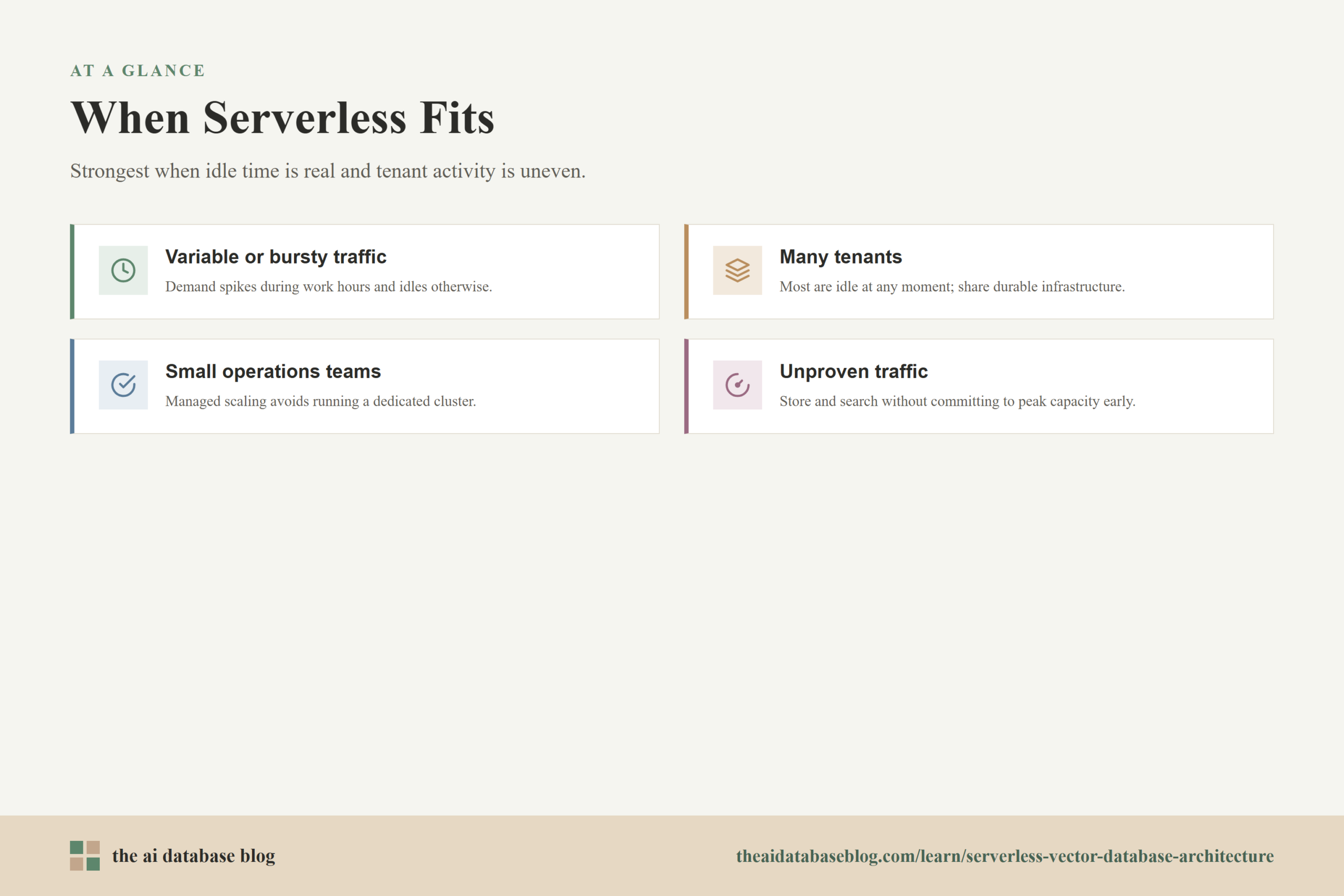
Serverless vector databases tend to work best when workloads are variable, tenant counts are high, operations teams are small, or the product is still finding its traffic pattern. They are especially attractive for retrieval-augmented generation applications, semantic search features, internal knowledge systems, AI assistants, and SaaS products where many customers need isolated search without dedicated infrastructure for every account.
They are also useful when storage and query demand grow at different rates. A company may need to store a large document corpus but only search it occasionally. Another application may have a smaller dataset but unpredictable bursts of conversational retrieval traffic. Decoupled storage and compute let each case scale along the dimension that matters most.
A more fixed deployment may still make sense when traffic is consistently high, latency requirements are strict, data must remain warm at all times, or cost predictability matters more than elastic scaling. Dedicated clusters can be easier to reason about when the workload is stable and the team wants direct control over capacity, index residency, and performance tuning. The best choice depends less on whether serverless is modern and more on whether the workload benefits from elasticity.
As a rule of thumb, serverless is strongest when idle time is real, tenant activity is uneven, and the team values managed scaling. It needs more care when first-query latency, strict performance guarantees, or highly customized indexing behavior are central to the application. Understanding that balance helps teams choose architecture based on workload shape rather than trend language.
Practical Design Questions to Ask
Before adopting a serverless vector database, teams should ask questions that connect architecture to application behavior. The most important questions are about latency, scale, freshness, tenant isolation, and cost visibility. These are the areas where serverless design can help significantly, but also where vague assumptions can lead to surprises in production.
- How often will data be queried after periods of inactivity? This reveals whether cold starts are likely to affect users or only background workflows.
- Which tenants need consistently warm performance? High-value or high-traffic tenants may need minimum capacity, priority routing, or cache policies that differ from long-tail tenants.
- How fresh must search results be after writes? Some systems can tolerate eventual indexing, while others need recent documents to appear quickly in retrieval results.
- How selective are metadata filters? Tenant filters, permissions filters, and category filters can affect recall and latency if they are applied after vector search rather than integrated into the retrieval path.
- What drives cost: storage, queries, ingestion, or reindexing? Different applications produce different cost profiles, so teams should model expected usage rather than comparing only headline pricing.
These questions make the architecture concrete. Serverless vector databases are not just about avoiding server management; they are about matching durable vector storage, elastic search compute, indexing work, and tenant boundaries to the actual shape of an AI application.
FAQs
1. What is a serverless vector database?
A serverless vector database is a vector database where the user does not manage fixed database servers or manually provision search nodes for every workload. The system stores vector data durably and allocates compute for queries, writes, indexing, and maintenance as needed. This can reduce idle cost and simplify scaling, especially for applications with uneven traffic.
2. Why is decoupled storage and compute important?
Decoupled storage and compute let the database scale stored data separately from search capacity. This is important because vector count and query volume do not always grow together. A workload may store many embeddings but receive few searches, or it may have a small dataset with heavy query traffic. Separating these concerns gives the system more flexibility and can reduce wasted resources.
3. Does serverless vector search always cost less?
No. Serverless can cost less when workloads have idle periods, unpredictable demand, or many inactive tenants. It may cost more than expected if an application sends many inefficient queries, repeatedly searches cold data, performs heavy ingestion, or triggers frequent indexing work. The cost advantage depends on workload shape and retrieval design.
4. What causes cold starts in a serverless vector database?
Cold starts happen when compute or index data must be prepared before a query can run at normal speed. This may occur after a tenant has been idle, after compute has scaled down, or when the relevant index segments are not cached locally. Cold starts are a tradeoff of reducing idle compute, and they matter most for latency-sensitive applications.
5. How does serverless architecture help multi-tenancy?
Serverless architecture helps multi-tenancy by allowing many tenants to share durable infrastructure while using compute only when active. Idle tenants can keep their data stored without occupying the same level of memory and CPU as active tenants. The database can route tenant-specific queries, apply isolation controls, and scale resources around actual tenant activity.
6. When should a team avoid serverless vector databases?
A team should be cautious with serverless vector databases when every query requires consistently low latency, when workloads are always busy, when cold starts are unacceptable, or when the team needs deep control over index placement and tuning. In those cases, a dedicated or provisioned deployment may be simpler to predict, even if it requires more operational management.
Takeaway
Serverless vector database architecture is built around separating durable vector storage from elastic compute, then scaling query, indexing, and maintenance work according to demand. This approach is useful for teams building AI applications with bursty traffic, many tenants, uneven usage, or uncertain growth because it can lower idle cost and reduce operational overhead. The main tradeoffs are cold-start latency, cache behavior, usage-sensitive pricing, and the need for strong tenant-aware filtering, so the best use case is a retrieval system where elasticity, managed scaling, and multi-tenant efficiency matter as much as raw always-warm performance.
Watch this video to learn more