Semantic search is a way to retrieve information by matching the meaning of a query, not just the exact words typed into the search box. Instead of looking only for literal keyword overlap, a semantic search system represents queries and documents as embeddings, compares them by similarity, and returns content that is conceptually related. This makes it useful for synonyms, paraphrases, natural-language questions, and some cross-lingual queries, but it is not always better than keyword search. Keyword search often wins when the user needs exact terms, codes, names, filters, or highly specific technical language.
Semantic search matters because many real search queries do not use the same words as the documents that contain the right answer. A person might search for “how to stop duplicate customer profiles,” while the relevant document says “entity resolution for identity records.” A literal keyword system may miss that connection, while a semantic system can often recognize that both phrases point to the same underlying idea. This article explains how semantic search works, how it differs from literal matching, how it handles synonyms, paraphrases, and cross-lingual queries, and where it beats or loses to keyword search in practical AI database and retrieval systems.
What Semantic Search Means
Semantic search is meaning-based retrieval. The goal is to understand what the user is trying to find and return results that satisfy that intent, even when the query and the result use different wording. In modern AI database systems, semantic search usually depends on embeddings. An embedding is a numerical representation of text, image, audio, or another data object. Texts with related meanings are placed near each other in a vector space, which lets the system compare meaning mathematically.
For example, the phrases “reset my password,” “recover account access,” and “I cannot log in” may not share many exact words. A semantic search system can still rank them as related because their embeddings are close to each other. The system is not truly understanding language in the human sense, but it is using a model trained on language patterns to represent semantic similarity.
This is why semantic search is often discussed alongside vector databases. A vector database stores embeddings and supports similarity search across them. When a user submits a query, the query is also converted into an embedding. The database then finds documents, chunks, products, tickets, or records whose embeddings are nearest to the query embedding.
Once the basic idea is clear, the next question is how this differs from the search systems people already know. The biggest difference is that keyword search starts from words, while semantic search starts from represented meaning.
Meaning-Based Retrieval vs Literal Matching
Literal matching, often called lexical or keyword search, ranks results based on the words that appear in the query and the words that appear in the document. A common keyword ranking method is BM25, which considers how often query terms appear in a document, how rare those terms are across the collection, and how document length should affect scoring. This can be very effective when the right result contains the same terms the user typed.
Semantic search works differently. It converts the query and searchable content into embeddings, then uses a similarity measure to find nearby items. Instead of asking, “Does this document contain these words?” it asks, “Is this document close in meaning to the query?” That difference changes what search can recover.
How Keyword Search Thinks About Relevance
Keyword search is strongest when terms are precise. If a user searches for “invoice 48391,” “SOC 2 report,” “PostgreSQL timeout,” or “employee_id,” the exact words or identifiers matter. Keyword search can also be easier to debug because the reason for a match is often visible: the matching words are in the document, title, field, or metadata.
Keyword systems can be improved with stemming, stop-word handling, field weighting, phrase matching, synonym dictionaries, and spelling correction. These techniques make literal search more flexible, but they still depend heavily on visible term overlap or manually defined expansions.
How Semantic Search Thinks About Relevance
Semantic search is strongest when users describe what they want in everyday language. A user may not know the official phrase used inside the content. They may type a question, describe a symptom, use a synonym, or provide a rough idea. Semantic retrieval can surface relevant material that keyword search might miss because it compares the broader meaning of the query with the broader meaning of the stored content.
This is especially useful in retrieval-augmented generation, customer support search, internal knowledge search, document discovery, recommendation, and product search. In these settings, users often search by intent rather than by exact database vocabulary.
However, meaning-based retrieval also introduces a new problem: semantic similarity is not the same as task relevance. A result can feel conceptually close while still being the wrong answer. That is why many production retrieval systems combine semantic search with keyword search, metadata filters, and re-ranking.
How Semantic Search Handles Synonyms
Synonyms are one of the easiest ways to see the value of semantic search. In literal matching, “car” and “automobile” are different strings. A keyword engine will not automatically know they are related unless the system has stemming, a synonym map, query expansion, or another lexical enhancement. Semantic search can often connect them because the embedding model has learned that the words appear in similar contexts.
Consider a help center where the article title is “How to change your billing address.” A user searches for “update payment location.” The query does not match the title exactly, but the meaning is close. A semantic system may retrieve the article because “change” and “update,” as well as “billing address” and “payment location,” are semantically related.
Synonym handling is not perfect. Domain-specific language can cause problems. In a medical, legal, financial, engineering, or internal enterprise setting, two terms that look similar in general language may have different meanings in the domain. The reverse can also happen: two internal acronyms may mean the same thing, but a general embedding model may not know that. For this reason, semantic search often improves when embeddings are chosen, tuned, or evaluated against the actual content and user queries in the target domain.
Synonyms show how semantic search expands the range of retrievable content. But users rarely change only one word. They often phrase the same need in a completely different way, which brings us to paraphrases.
How Semantic Search Handles Paraphrases
A paraphrase expresses the same or a similar idea using different wording. This is where semantic search can be more powerful than simple synonym matching. Instead of replacing one word with another, the system needs to recognize that a full phrase, sentence, or question points to a related concept.
For example, a user might search for “why are my search results showing old documents first?” The relevant documentation might say “ranking freshness can be adjusted with a recency boost.” A keyword system may struggle because the query and document share few important terms. A semantic system can connect the complaint to the concept of freshness ranking because the overall meanings are related.
Paraphrase handling is one reason semantic search is valuable for natural-language interfaces. Users can ask questions the way they would ask a person. They do not need to guess the exact terms used in the content. This is particularly useful when the searchable data includes long documents, support tickets, meeting notes, product descriptions, research papers, or knowledge base articles.
Still, paraphrase retrieval has limits. If the query is vague, the embedding may retrieve broadly similar results instead of the exact result the user needs. A query like “how do I fix the sync problem?” may match many documents about syncing unless the system uses metadata, conversation context, filters, or follow-up questions to narrow the intent.
Paraphrases explain how semantic search handles different wording within one language. The same idea can also extend across languages when the system uses multilingual embeddings.
How Semantic Search Handles Cross-Lingual Queries
Cross-lingual semantic search means a user can search in one language and retrieve relevant content written in another language. This works when the embedding model maps related meanings from different languages into a shared vector space. For example, a Spanish query such as “como restablecer mi contraseña” could retrieve an English article titled “Reset your password” if the multilingual embedding model represents both texts as semantically close.
This is different from basic keyword search, which usually depends on matching text in the same language unless a translation layer or multilingual synonym system is added. Semantic search can sometimes reduce the need for direct query translation because the model has already learned cross-language relationships.
Cross-lingual retrieval is useful for global support centers, multilingual documentation, international ecommerce, research discovery, and organizations where employees search across documents written in different languages. It can help users find useful information even when the organization has not translated every document into every language.
However, cross-lingual semantic search is not equally strong for every language pair, domain, or script. Performance depends on the embedding model, the quality of multilingual training data, the length and clarity of the text, and whether domain-specific vocabulary is represented well. For high-stakes content, cross-lingual retrieval should be tested with real multilingual queries before relying on it as the only retrieval method.
Now that the mechanics are clearer, it helps to look at examples that show where semantic search changes the results a user might see.
Real Examples of Semantic Search
Semantic search is easiest to understand through examples because the difference often appears in the gap between what the user says and what the content says. The following examples show how meaning-based retrieval can help in common AI database and retrieval scenarios.
Example 1: Internal Knowledge Search
A user searches for “how do we remove duplicate customers?” The relevant internal document is titled “Entity resolution workflow for identity consolidation.” Keyword search may miss the document because it does not contain “duplicate customers.” Semantic search can identify that duplicate customer records and entity resolution are closely related concepts.
Example 2: Customer Support Search
A customer searches for “my upload keeps freezing halfway.” The support article says “Large file ingestion may time out when the network connection is unstable.” Semantic search can connect “freezing halfway” with “time out” and “upload” with “file ingestion.” Keyword search might only succeed if the article also uses everyday customer language.
Example 3: Product Search
A shopper searches for “shoes for running in the rain.” A product description says “water-resistant road running trainers with high-traction outsole.” Semantic search can connect the practical need with the product attributes. Keyword search may perform well if the catalog includes careful tags, but it may miss products that do not use the word “rain.”
Example 4: Research and Document Discovery
A researcher searches for “methods for finding similar text without exact overlap.” Relevant papers or notes may discuss “dense retrieval,” “sentence embeddings,” or “semantic similarity.” Semantic search can surface these related concepts, helping the researcher discover the vocabulary of the field.
Example 5: Cross-Lingual Support
A user searches in French for “changer l’adresse de facturation,” while the documentation is in English and says “Update your billing address.” With a suitable multilingual embedding model, semantic search can retrieve the English article because both phrases express the same intent.
These examples show why semantic search can feel more natural for users. But natural does not always mean more accurate, especially when exactness matters.
Where Semantic Search Beats Keyword Search
Semantic search tends to beat keyword search when the query is conceptual, conversational, ambiguous in wording, or different from the language used in the content. It is especially helpful when users do not know the official terminology, when documents are written by different teams using inconsistent language, or when the system needs to retrieve useful context for an AI assistant.
Semantic search is often stronger in these cases:
- Natural-language questions: Users can ask “how do I reduce irrelevant results?” instead of knowing to search for “relevance tuning.”
- Synonyms and wording variation: The system can connect “cancel,” “terminate,” “stop,” and “deactivate” when the context supports that relationship.
- Paraphrased problems: A user can describe a symptom, while the document describes the underlying cause or fix.
- Discovery tasks: Semantic search can help users find related concepts when they do not yet know the exact vocabulary.
- Multilingual retrieval: With multilingual embeddings, the system can sometimes retrieve content across languages without relying only on literal translation.
- RAG context retrieval: AI applications often need passages that answer a user’s intent, not just passages that repeat the user’s words.
In these situations, semantic search can improve recall, which means it can find relevant results that keyword search might miss. But recall is only one part of search quality. A system also needs precision, explainability, speed, cost control, and predictable behavior.
Where Semantic Search Loses to Keyword Search
Semantic search loses to keyword search when exact wording is the signal that matters most. Dense embeddings are designed to generalize, which is useful for meaning-based retrieval but risky for precise lookup. If the user searches for a model number, legal clause, error code, product SKU, field name, account ID, or quoted phrase, they usually expect exact matching.
Keyword search is often stronger in these cases:
- Exact identifiers: Queries like “ERR-1042,” “invoice 77821,” or “policy section 9.3” should match the exact token.
- Named entities: People, companies, projects, and product names can be distorted if the embedding model treats nearby concepts as interchangeable.
- Specialized jargon: Domain-specific terms may have meanings that a general embedding model does not capture well.
- Short queries: One-word or two-word queries may not provide enough context for a useful semantic embedding.
- Boolean or compliance search: Users may need documents that contain exact required terms, not semantically similar alternatives.
- Debuggability: Keyword scores are often easier to explain because the matching terms are visible.
Semantic search can also retrieve results that are similar but not useful. For example, a query about “data retention policy” might retrieve general privacy documents that discuss related ideas but do not answer the specific retention question. This is a common issue in AI retrieval systems: the nearest vector is not always the most relevant answer.
Because both approaches have real strengths, the practical choice is rarely “semantic or keyword forever.” The better question is how to use each one where it fits.
Why Many Systems Use Hybrid Search
Hybrid search combines semantic retrieval with keyword retrieval. A typical hybrid system retrieves candidates from both a vector index and a keyword index, merges the candidates, and ranks them using a scoring method, learned ranker, or re-ranking model. The goal is to capture the fuzzy, meaning-based strengths of semantic search while preserving the precision of keyword search.
This matters in real AI database applications because user queries vary. One user may ask a broad conceptual question, while the next may search for an exact error code. A semantic-only system can miss exactness. A keyword-only system can miss intent. Hybrid retrieval gives the system more signals to work with.
Hybrid search is especially useful for enterprise knowledge bases, technical documentation, product catalogs, and RAG systems. These environments often contain a mix of natural-language prose, structured metadata, acronyms, IDs, domain terms, and user questions. The best retrieval path may change from query to query.
A strong hybrid system still needs evaluation. Teams should test real queries, inspect missed results, measure recall and precision, and compare semantic, keyword, and hybrid behavior. Search quality depends on the data, the embedding model, the chunking strategy, metadata quality, ranking logic, and the actual language users type.
How Semantic Search Works in an AI Database
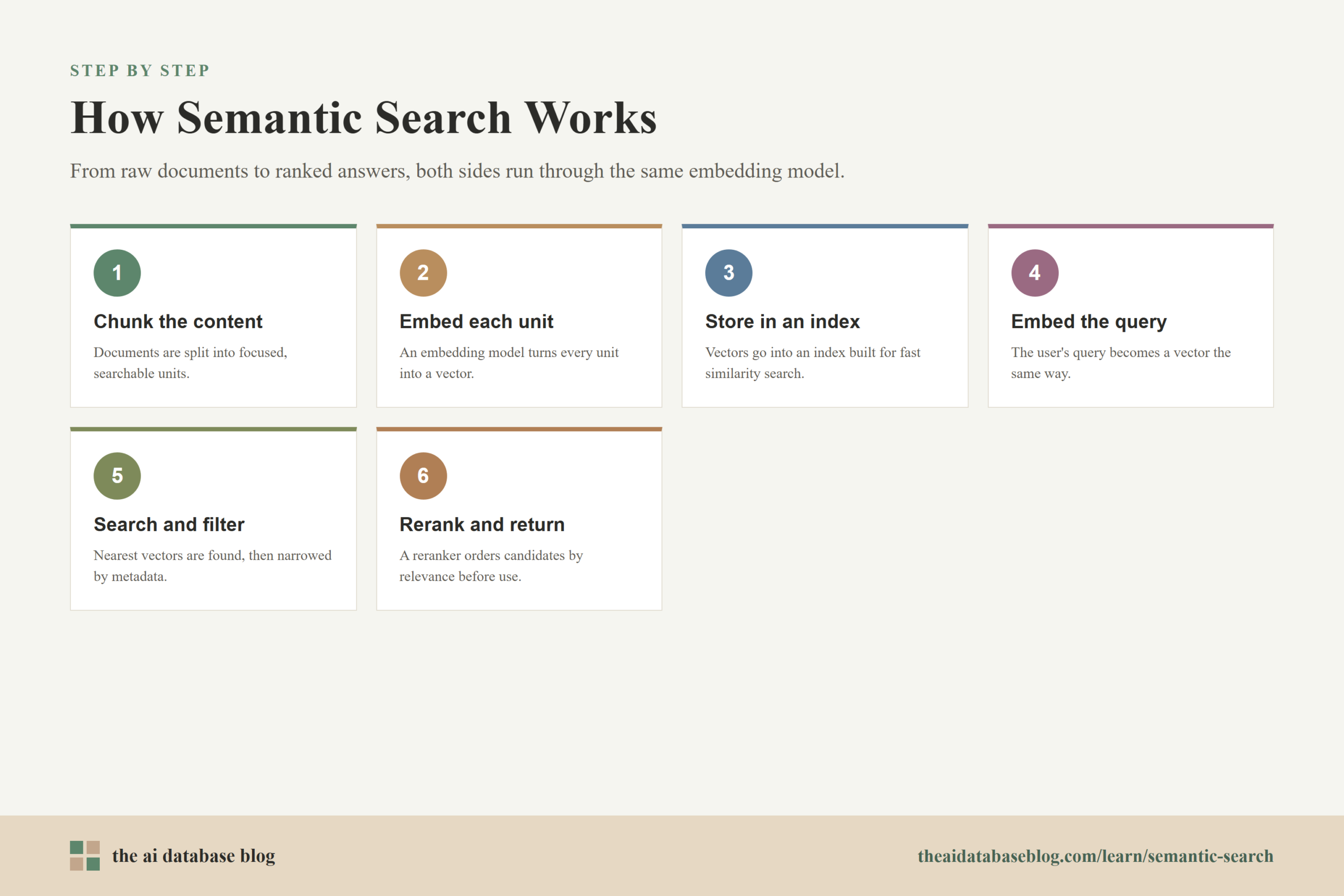
In an AI database or vector search system, semantic search usually follows a pipeline. First, content is prepared and divided into searchable units. These units might be full documents, paragraphs, product records, support articles, or smaller chunks of text. Next, an embedding model converts each unit into a vector. The vectors are stored in an index that supports fast similarity search.
When a query arrives, the system converts the query into an embedding using the same or compatible model. It then searches for nearby vectors and returns the most similar items. In many systems, metadata filters are applied before or during retrieval so the user only searches within the right category, tenant, language, time period, permission scope, or document type.
The system may also use re-ranking. Re-ranking takes the initial candidates and applies a more precise model or scoring method to order them. This can improve quality because first-stage vector search is optimized for fast recall, while re-ranking can focus more carefully on relevance.
For RAG systems, the retrieved passages are then passed to a language model as context. The quality of the generated answer depends heavily on whether the retrieval system found the right evidence. This is why semantic search is not just a search feature in AI applications; it is often part of the knowledge layer that determines what the AI system can accurately use.
Practical Guidance for Choosing Semantic, Keyword, or Hybrid Search
The best search method depends on the type of query, the data, and the consequence of a wrong result. Semantic search is usually a strong default for exploratory, natural-language, and concept-heavy retrieval. Keyword search is usually a strong default for exact lookup. Hybrid search is often the safest production choice when the system must handle both.
Use semantic search when users ask questions in natural language, when documents use inconsistent vocabulary, when synonym and paraphrase handling matter, or when cross-lingual retrieval is important. Use keyword search when users search for exact phrases, identifiers, structured fields, short terms, compliance language, or domain-specific strings. Use hybrid search when your application has both kinds of queries, which is common in real AI database workloads.
It is also important to evaluate search with real user behavior. Synthetic examples can help explain the concept, but production search quality depends on actual queries and actual content. A good evaluation set should include easy exact matches, hard paraphrases, synonym-heavy queries, multilingual queries if relevant, short ambiguous queries, and known failure cases.
Once the retrieval method is chosen, the work is not finished. Chunking, metadata, embedding model selection, index configuration, ranking, re-ranking, and feedback loops all affect whether semantic search feels helpful or noisy.
Common Mistakes to Avoid
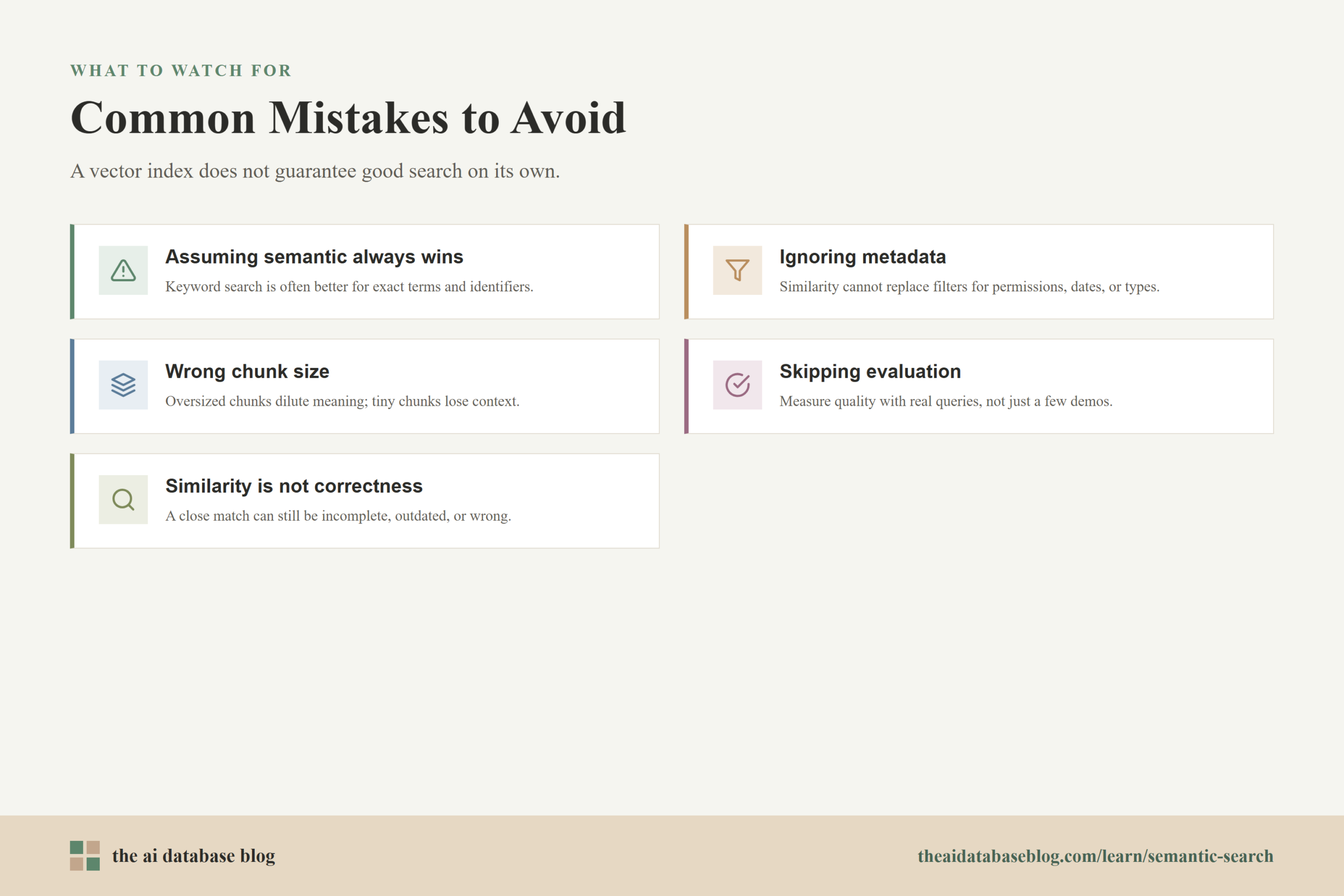
Semantic search is powerful, but it is easy to overestimate what it does automatically. A vector index does not guarantee good search quality by itself. It only makes it possible to retrieve nearby embeddings. The quality of those embeddings and the design of the retrieval pipeline determine whether the results are useful.
- Assuming semantic search always beats keyword search: Semantic search is better for many intent-based queries, but keyword search is often better for exactness.
- Ignoring metadata: Meaning-based similarity cannot replace filters for permissions, dates, categories, languages, or document types.
- Using chunks that are too large or too small: Oversized chunks may dilute meaning, while tiny chunks may remove the context needed for retrieval.
- Skipping evaluation: Search quality should be measured with real queries, not judged only by a few demos.
- Confusing similarity with correctness: A semantically similar result can still be incomplete, outdated, or wrong for the user’s task.
A reliable semantic search system treats embeddings as one important signal, not as the entire answer. The strongest systems usually combine embeddings with good data modeling, metadata, keyword signals, ranking, and human review of search failures.
FAQs
1. What is semantic search in simple terms?
Semantic search is search that tries to match the meaning of a query instead of only matching the exact words. If a user searches for “fix duplicate customer records,” semantic search may retrieve a document about “entity resolution” because the ideas are related.
2. Is semantic search the same as vector search?
They are closely related, but not exactly the same. Vector search is the technical method of finding nearby vectors in an embedding space. Semantic search is the retrieval goal: finding results based on meaning. Many modern semantic search systems use vector search, but semantic search can also include other techniques such as re-ranking, metadata filtering, and query understanding.
3. Why does semantic search handle synonyms better than keyword search?
Semantic search handles synonyms better because embedding models represent related meanings near each other. A keyword system sees “buy” and “purchase” as different strings unless it has a synonym rule. A semantic system can often connect them because the model has learned that they appear in similar contexts.
4. Can semantic search work across languages?
Yes, semantic search can work across languages when it uses a multilingual embedding model that maps similar meanings from different languages into a shared vector space. The quality depends on the model, language pair, domain vocabulary, and the clarity of the query and documents.
5. When is keyword search better than semantic search?
Keyword search is usually better for exact matches, short identifiers, error codes, product SKUs, names, quoted phrases, compliance terms, and structured fields. In those cases, the exact text matters more than broad conceptual similarity.
6. Should AI database applications use semantic search or hybrid search?
Many AI database applications should consider hybrid search because user queries are mixed. Some queries are conceptual and benefit from semantic search, while others require exact keyword matching. Hybrid search combines both signals and is often more reliable for production retrieval systems.
Final Takeaway
Semantic search retrieves information by meaning, which makes it valuable when users ask natural-language questions, use synonyms, paraphrase a problem, or search across languages. It is especially useful for AI database applications such as RAG, internal knowledge search, customer support, and document discovery. At the same time, semantic search does not replace keyword search for exact terms, identifiers, structured fields, or highly specialized language. The most useful lesson is that semantic search, keyword search, and hybrid search are different tools for different retrieval needs, and the strongest systems choose based on real queries, real content, and measurable search quality.
Watch this video to learn more