Retrieval-augmented generation, or RAG, is a way to make a generative AI system answer with information retrieved from an external knowledge source instead of relying only on what the model learned during training. A RAG system usually works in three broad phases: index useful data, retrieve the most relevant pieces when a user asks a question, and generate an answer grounded in that retrieved context. This pattern helps with common limits of large language models, including stale knowledge, lack of access to private data, weak citation support, and hallucinated answers, although it does not remove those risks automatically.
This guide explains how RAG works from end to end, why the index/retrieve/generate pipeline matters, what problems RAG is designed to solve, and how a minimal example fits together. By the end, you should understand the basic architecture well enough to discuss where an AI database fits, what the language model is responsible for, and what design choices affect answer quality.
Why RAG Exists
Large language models are powerful text generators, but they are not complete knowledge systems by themselves. Their internal knowledge is learned from training data, which means it may be incomplete, out of date, too general for a specific organization, or unavailable for a private dataset that was never part of training. When a user asks about a policy, a support article, a product catalog, a research note, or an internal procedure, the model needs access to the actual source material, not just a broad statistical memory of language.
RAG addresses that gap by adding a retrieval layer before generation. Instead of asking the model to answer from memory alone, the system searches a database or knowledge index for relevant passages, adds those passages to the model’s prompt, and asks the model to produce an answer using that evidence. The model still generates the response, but the retrieval system gives it a current, task-specific foundation.
This is why RAG is common in AI database applications. The database is not just storing documents for later display. It is storing searchable knowledge that can be retrieved at the moment a model needs context. That makes data modeling, indexing, retrieval quality, metadata filtering, and freshness central parts of the AI application, not background infrastructure.
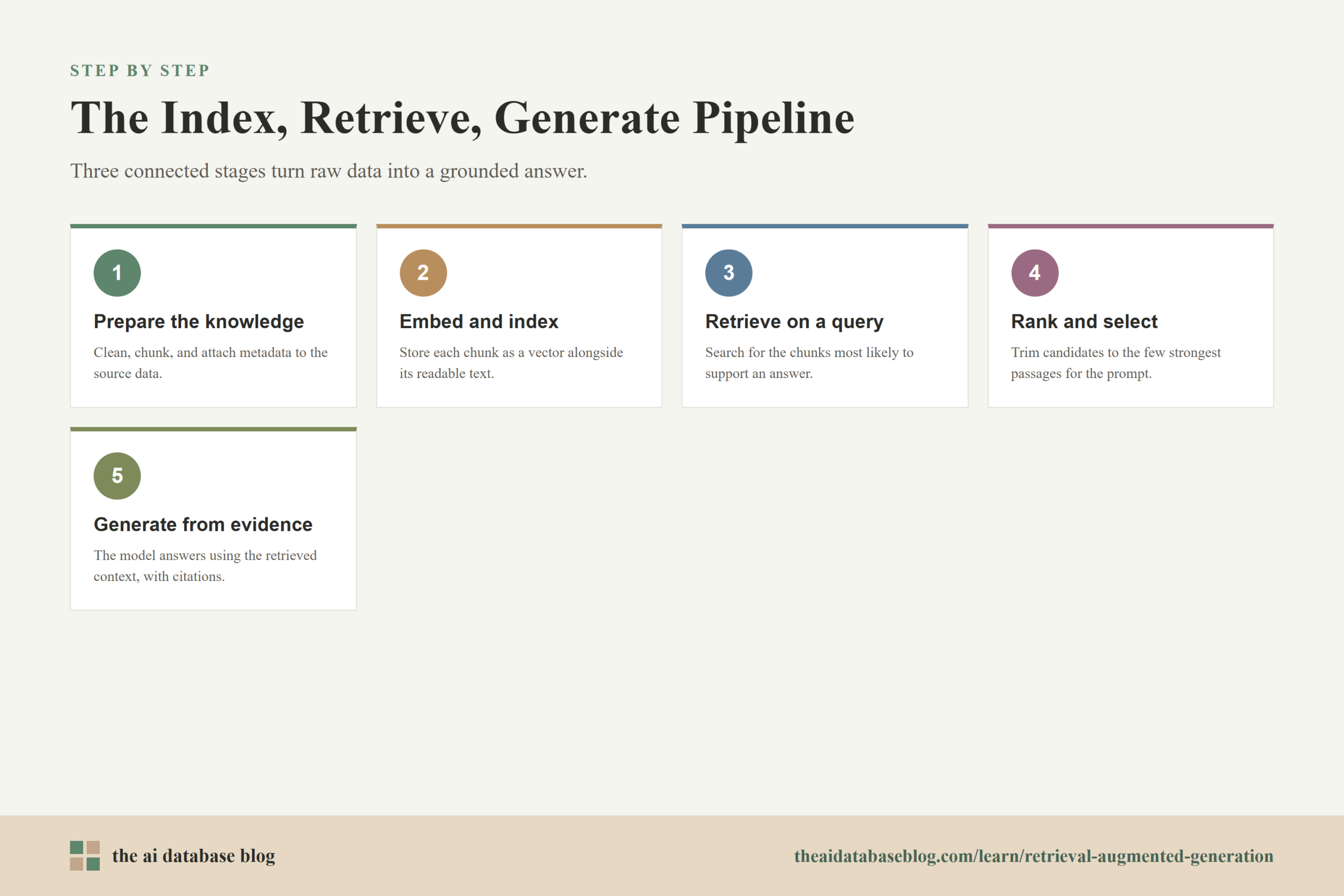
Once the reason for RAG is clear, the next question is how the system actually moves from raw data to an answer. The simplest useful way to understand it is as a pipeline with three connected stages: index, retrieve, and generate.
The Index/Retrieve/Generate Pipeline
A RAG system is easiest to reason about when each stage has a distinct job. Indexing prepares knowledge so it can be searched. Retrieval selects the pieces that look most relevant to the user’s question. Generation turns the retrieved context into a readable answer. If any stage is weak, the final answer can be weak even if the other stages are well designed.
Index: Prepare Knowledge for Search
The index stage starts with source data. This may include web pages, documentation, PDFs, customer support tickets, product records, meeting notes, database rows, or other domain-specific content. The system extracts text, cleans it, breaks it into chunks, attaches metadata, and stores it in a searchable index. In many RAG systems, each chunk is converted into an embedding, which is a numeric representation that helps the database compare meaning rather than only exact words.
Chunking is one of the most important indexing decisions. If chunks are too large, retrieval may return broad passages that contain irrelevant text. If chunks are too small, the system may lose the surrounding context needed to answer accurately. Good chunking keeps related ideas together while still making each stored unit specific enough to retrieve precisely.
Metadata also matters. A document chunk may include fields such as source title, author, department, creation date, update date, access permissions, product name, region, or document type. Metadata allows the retrieval system to filter results before or during search. For example, a system can retrieve only current policies, only documents the user is allowed to see, or only support articles for a specific product version.
Retrieve: Find the Most Relevant Context
When a user asks a question, the system turns the query into a search request. In vector search, the question is embedded and compared with stored document embeddings. The database returns chunks that are semantically close to the query. In keyword search, the system matches terms and phrases. In hybrid search, it combines semantic and keyword signals, which can be useful when users ask about exact names, error codes, clauses, or technical terms.
Retrieval is not only about finding similar text. It is about finding the context most likely to support a correct answer. Many systems use metadata filters, reranking, recency rules, or source-quality signals to improve the final set of passages. A search result that is semantically similar but outdated, unauthorized, or too general may be less useful than a narrower passage from a current source.
The retrieved context is usually limited because the language model can only process a certain amount of input at once. This makes ranking important. The system must decide which few passages are worth sending into the prompt. Poor ranking can cause the model to miss the correct evidence, mix conflicting sources, or answer with an unsupported claim.
Generate: Answer Using Retrieved Evidence
After retrieval, the system builds a prompt that contains the user’s question, the selected context, and instructions for the model. The instructions may tell the model to answer only from the provided sources, include citations, say when the context is insufficient, or use a specific tone or format. The language model then generates an answer using the retrieved passages as grounding material.
Generation is where the user sees the final response, but it should not be treated as the only important stage. A model cannot reliably cite a source that was never retrieved, and it cannot use a policy update if the index still contains an old version. The generation step depends heavily on the retrieval step, and retrieval depends heavily on the index.
This pipeline also explains why RAG is not a single feature. It is an architecture made from several choices: how data is parsed, how chunks are created, how embeddings are generated, how search is performed, how results are ranked, how permissions are enforced, and how the final prompt is constructed. Each choice affects whether the answer is useful, current, and grounded.
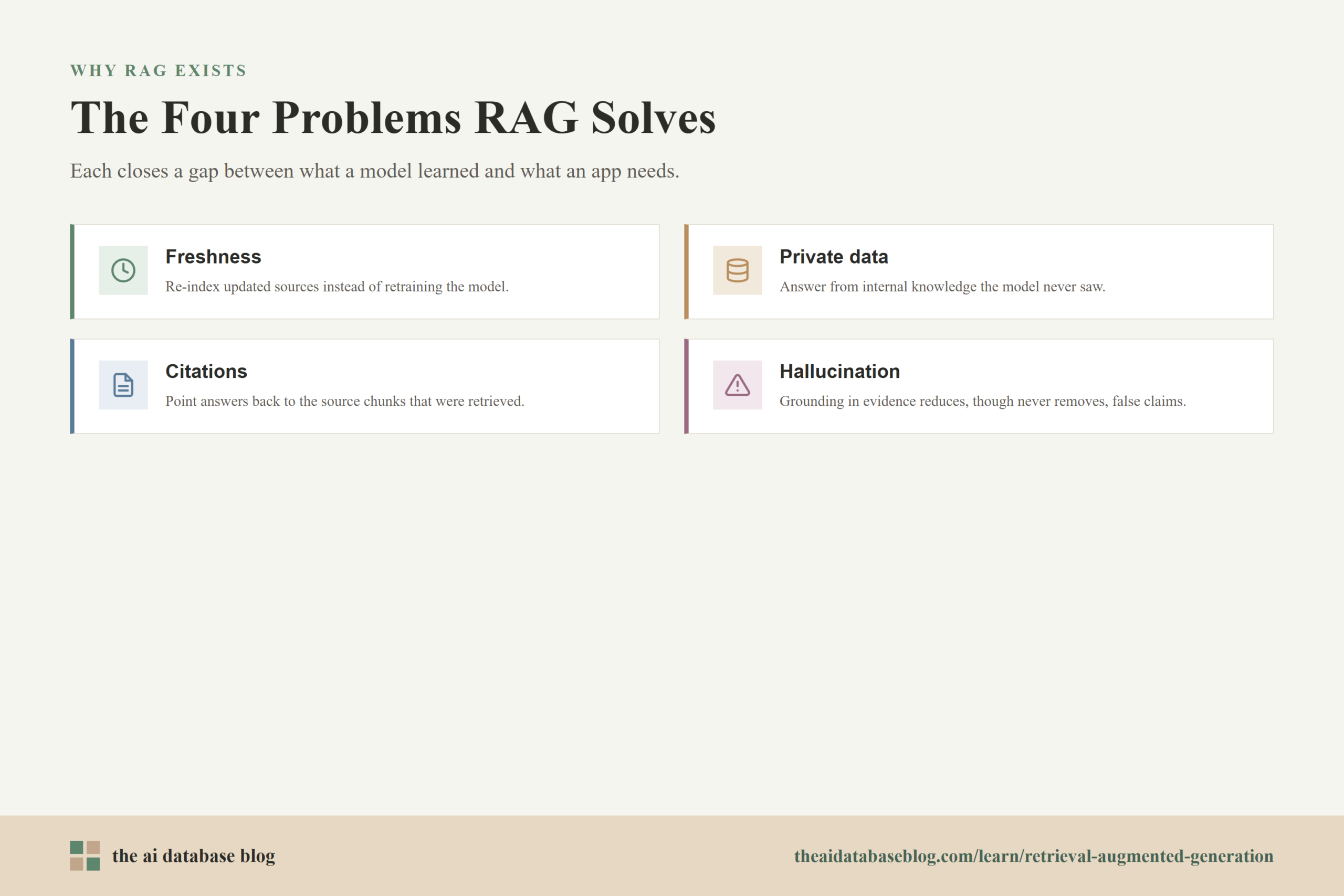
With the pipeline in place, it becomes easier to see the practical problems RAG is meant to solve. Most of those problems come from the difference between what a model knows internally and what an application needs to know at the moment of use.
The Problems RAG Solves
RAG is useful because many AI applications need answers grounded in specific information. A general model can draft, summarize, and reason across text, but it may not know the latest facts, the contents of a private knowledge base, or the exact source behind an answer. RAG gives the system a way to bring external knowledge into the model’s context at query time.
Freshness: Using Current Information
Model training is not the same as live knowledge access. Even when a model is strong, its learned information may lag behind current policies, prices, schedules, product specifications, regulations, or internal procedures. RAG helps by retrieving from an index that can be updated independently of the model.
Freshness depends on how the index is maintained. If documents are updated daily but the RAG index is updated monthly, the system may still answer with stale information. Production systems often need ingestion schedules, change detection, version metadata, and rules that prefer current documents over older ones. RAG makes freshness possible, but the data pipeline has to support it.
Private Data: Answering from Information the Model Was Not Trained On
Many useful AI applications depend on private or domain-specific data: internal documentation, customer records, contracts, incident reports, engineering notes, or proprietary research. A public model will not know that information by default, and training a new model for every knowledge update is usually expensive and slow. RAG lets an application retrieve private context when needed while keeping the base model separate from the knowledge store.
This does not mean private data handling is automatic. A RAG system still needs access controls, permission-aware retrieval, careful logging policies, and secure data processing. The retrieval layer should only return information the user is allowed to access. Otherwise, the system can expose sensitive content through an answer even if the language model itself was not trained on that content.
Citations: Showing Where Answers Came From
RAG can support citations because the system knows which chunks were retrieved and which documents they came from. If the application stores source metadata, the final answer can point back to document titles, sections, URLs, page numbers, or record identifiers. This makes the response easier to verify and more useful in workflows where users need evidence.
Citations are not guaranteed simply because retrieval happened. The system has to preserve source metadata, pass enough source information into the prompt, and design the answer format so claims can be tied to retrieved evidence. Some systems also check whether each cited source actually supports the sentence it is attached to. Without that discipline, citations can become decorative rather than trustworthy.
Hallucination: Reducing Unsupported Answers
A hallucination occurs when a model presents an unsupported or false answer as if it were true. RAG can reduce this risk by grounding the model in retrieved evidence. When the model has relevant source material in the prompt, it is less likely to rely only on broad patterns from training.
However, RAG does not eliminate hallucination. The system can still retrieve the wrong passage, retrieve outdated information, include conflicting context, or prompt the model in a way that encourages overconfident answers. A stronger RAG design includes retrieval evaluation, source-quality checks, refusal behavior when context is insufficient, and answer validation for high-stakes use cases.
These problem areas show why RAG is both powerful and easy to oversimplify. The basic idea is straightforward, but the quality of the final system depends on practical engineering choices. A minimal example can make the moving parts more concrete without hiding the tradeoffs.
A Minimal End-to-End RAG Example
Imagine a small internal assistant that answers employee questions about a company’s travel policy. The source material is a short policy document. The goal is not to train a new model. The goal is to let the assistant retrieve the relevant policy section and answer using that text.
Step 1: Create the Source Content
The system starts with a few policy passages. For example, one passage might explain meal reimbursement limits, another might explain hotel approval rules, and another might explain receipt requirements. Each passage is stored with metadata such as the policy title, effective date, section name, and source URL or document identifier.
A simplified record might look like this:
{
  "id": "travel-policy-meals-2026",
  "text": "Employees may expense meals during approved business travel up to the daily limit listed in the current travel policy. Alcohol is not reimbursable.",
  "metadata": {
    "title": "Travel Policy",
    "section": "Meals",
    "effective_date": "2026-01-01"
  }
}
Step 2: Index the Content
Next, the system converts the passage into an embedding and stores it in an AI database along with the original text and metadata. If there are many passages, each one gets its own embedding. The database can now search for passages based on semantic similarity, metadata filters, or a combination of semantic and keyword signals.
At this stage, the important point is that the index contains both machine-searchable representations and human-readable source text. The embedding helps the system find relevant passages. The stored text gives the model something concrete to use when generating the answer. The metadata supports filtering, citations, and freshness rules.
Step 3: Retrieve Context for a User Question
Suppose a user asks, “Can I expense alcohol during a client dinner?” The system embeds the question and searches the travel policy index. The meal reimbursement passage is likely to rank highly because it discusses meals, travel expenses, and alcohol reimbursement.
The retrieval result might include the passage text and metadata:
Retrieved context:
Source: Travel Policy, Meals, effective 2026-01-01
Text: Employees may expense meals during approved business travel up to the daily limit listed in the current travel policy. Alcohol is not reimbursable.
Step 4: Generate the Answer
The application then builds a prompt that includes the user’s question and the retrieved passage. It may instruct the model to answer only from the provided context and include the source section. The model can now generate a grounded answer:
User question:
Can I expense alcohol during a client dinner?

Retrieved context:
Employees may expense meals during approved business travel up to the daily limit listed in the current travel policy. Alcohol is not reimbursable.

Answer:
No. The travel policy says alcohol is not reimbursable, even when the meal occurs during approved business travel. Source: Travel Policy, Meals.
This example is intentionally small, but it shows the essential shape of RAG. The answer is not produced from the model’s general memory alone. It is produced from a retrieved policy passage, and the source metadata makes the answer easier to verify.
Once a minimal RAG flow works, the next challenge is improving reliability. Real systems often have many documents, overlapping versions, messy formatting, incomplete metadata, and users who ask vague or multi-part questions. That is where design decisions become more important.
Key Design Choices in a RAG System
RAG quality depends on how well the system handles the messy details between source data and generated answers. The most common mistake is to treat RAG as a simple wrapper around a language model. In practice, the retrieval system, data pipeline, and evaluation process often matter as much as the model choice.
Chunking Strategy
Chunking determines what the system can retrieve. A good chunk should contain enough context to answer a likely question but not so much unrelated material that it confuses retrieval or generation. Some systems chunk by paragraph, section, heading, token count, or semantic boundary. The right choice depends on the source material and the questions users ask.
Search Method
Vector search is useful for semantic similarity, while keyword search is useful for exact terms. Hybrid search often works well when users may ask both conceptual and exact-match questions. For example, a support assistant may need semantic search for “login problem” and keyword search for a specific error code. Combining signals can make retrieval more robust.
Metadata Filtering
Metadata helps the system retrieve the right subset of information. Filters can enforce permissions, prefer current documents, limit results to a product line, or exclude deprecated sources. Without metadata, the system may retrieve a passage that looks relevant but is not appropriate for the user, region, version, or time period.
Reranking and Context Selection
Initial retrieval often returns more candidates than the model should receive. A reranking step can reorder results based on a deeper comparison between the query and each candidate passage. This helps the system send the strongest evidence into the prompt instead of simply passing the first few approximate matches.
Prompt Construction
The prompt should tell the model how to use retrieved context. For many knowledge tasks, useful instructions include answering from the provided sources, identifying uncertainty, avoiding unsupported claims, and citing source metadata. Prompt construction cannot fix bad retrieval, but it can help the model behave more consistently when the right context is available.
Evaluation
RAG systems need evaluation at both retrieval and generation levels. Retrieval evaluation asks whether the system found the right passages. Generation evaluation asks whether the answer is faithful to those passages, complete enough for the user, and properly cited. Evaluating only the final answer can hide whether failures came from the index, the search process, or the model.
These design choices show why RAG is a practical architecture rather than a magic accuracy switch. To use it well, teams need to understand what RAG can and cannot do. That distinction helps set realistic expectations for AI database projects.
What RAG Does Not Automatically Solve
RAG improves a model’s access to external knowledge, but it does not guarantee correctness. If the source documents are wrong, the system can ground the answer in wrong information. If the index is stale, the model may answer from outdated passages. If retrieval returns irrelevant context, the generated answer may still sound confident while missing the point.
RAG also does not replace data governance. Private data still needs permission controls. Sensitive documents still need careful handling. Logs, prompts, retrieved passages, and generated answers may all contain information that requires protection. The retrieval layer should be designed with the same seriousness as any other system that touches internal data.
Finally, RAG does not remove the need for user experience design. A helpful RAG application should show when it used sources, expose citations clearly, handle insufficient context gracefully, and avoid making unsupported claims look authoritative. The best systems make it easy for users to understand not only the answer, but why the answer should be trusted.
Understanding these limits makes RAG more useful, not less. It shifts the focus from expecting the model to know everything to building a retrieval system that supplies the right context at the right time.
FAQs
1. What does retrieval-augmented generation mean?
Retrieval-augmented generation means a generative AI system retrieves relevant information from an external source before generating an answer. The retrieved information is added to the model’s context so the response can be grounded in specific documents, records, or knowledge sources instead of relying only on the model’s training data.
2. Is RAG the same as a vector database?
No. A vector database can be part of a RAG system, but RAG is the broader architecture. The database stores and retrieves searchable knowledge, while the RAG workflow also includes data ingestion, chunking, metadata, prompt construction, generation, citations, and evaluation.
3. Why does RAG help with fresh information?
RAG helps with fresh information because the knowledge index can be updated without retraining the language model. If a policy, product detail, or support article changes, the system can re-index the updated source and retrieve it during future questions. The benefit depends on keeping the index current.
4. Can RAG answer questions about private data?
Yes, RAG can answer questions about private data if that data is available to the retrieval system and the user has permission to access it. The system should enforce access controls during retrieval so private passages are not shown or used in answers for unauthorized users.
5. Does RAG prevent hallucinations?
RAG can reduce hallucinations by giving the model relevant evidence, but it does not prevent them completely. Hallucinations can still happen when retrieval fails, context is outdated, sources conflict, or the model makes claims that go beyond the provided evidence.
6. What is the simplest RAG architecture?
The simplest RAG architecture has a document collection, an indexing process, a searchable database, a retriever, and a language model. Documents are chunked and indexed, the retriever finds relevant chunks for a user question, and the model generates an answer using those chunks as context.
Takeaway
Retrieval-augmented generation is a practical way to connect language models with current, private, and source-backed knowledge. It is most useful for teams building AI assistants, search experiences, support tools, research workflows, and internal knowledge systems where answers need to be grounded in real data. The core idea is simple: index the knowledge, retrieve the most relevant context, and generate an answer from that context. The quality of the result depends on how carefully the AI database, retrieval logic, metadata, freshness process, citations, and evaluation workflow are designed.
Watch this video to learn more