Replication helps an AI database stay available, handle more read traffic, and recover from node failures by keeping multiple copies of the same data on different nodes. In practice, replicas improve read scaling and fault tolerance, but they also introduce important design questions around consistency, replica lag, shard placement, and failover. A reliable high-availability design treats replication, sharding, routing, monitoring, and recovery as one connected system rather than separate configuration choices.
This guide explains how replication works in AI databases, why replicas matter for vector search and retrieval systems, how read scaling and failure tolerance depend on replica behavior, what consistency tradeoffs teams need to understand, how replication combines with sharding, and what should happen when a node or replica becomes unavailable. By the end, you should be able to reason more clearly about the architecture behind highly available AI data systems.
What Replication Means in an AI Database
Replication means storing more than one copy of the same logical data so the database can continue serving requests when one copy is unavailable. In an AI database, that data may include vectors, source object records, metadata fields, inverted indexes, collection definitions, and other operational state. The exact objects being replicated vary by system, but the goal is the same: keep enough copies available that search and retrieval can continue through routine failures.
For AI applications, replication is especially important because retrieval is often part of a user-facing workflow. A chatbot, recommendation system, semantic search product, fraud workflow, or knowledge assistant may depend on database results before it can produce an answer. If the retrieval layer is unavailable, the AI application may fail even when the language model or application server is still running.
Replication is not the same as backup. A backup is a recovery copy that can restore data after corruption, deletion, or disaster. A replica is an active or near-active copy that can participate in serving production traffic. Replication also differs from caching. A cache may hold frequently used results, but it is usually not the source of truth. A replica is part of the database’s durability and availability design.
Once replication is in place, the next question is how the extra copies are used. The most immediate benefit is read scaling, because replicas can share query load instead of forcing every read through a single node.
Read Scaling Through Replicas
Read scaling is one of the clearest reasons to add replicas. Many AI database workloads are read-heavy: they ingest documents, compute embeddings, store vectors, and then serve a much larger number of search or retrieval requests. If every query goes to one node, that node becomes a bottleneck. If the same data is replicated across multiple nodes, the system can distribute read traffic across those copies.
For vector search, read scaling can improve throughput by letting more queries run in parallel. Each replica may hold its own copy of the vector index for a shard or collection. A query router can send a request to an available replica, often choosing based on load, latency, locality, or health. This can reduce queueing and make traffic spikes easier to absorb.
Read scaling is strongest when the database can answer a query from one replica without coordinating with every other replica. This is common for workloads that can tolerate a short delay between a write and its visibility on all copies. For example, if a newly ingested support article takes a few seconds to become searchable everywhere, that may be acceptable for many knowledge retrieval systems.
However, read scaling is not automatic. Replicas consume CPU, memory, storage, and network bandwidth. A replica that stores a vector index may need enough memory to serve nearest-neighbor search efficiently. It may also need to keep metadata filters, keyword indexes, or segment files available. Adding replicas can increase read capacity, but it also increases the cost of keeping copies current.
Replica Routing for Search Requests
A highly available AI database usually needs a routing layer that understands which replicas are healthy and ready to serve traffic. The router may be built into the database cluster, handled by a client library, or managed by a load balancer. The router’s job is not just to spread traffic evenly. It must avoid replicas that are down, overloaded, still catching up, or recovering after restart.
For semantic search, the router also needs to preserve query correctness. If a query must search several shards, the router may send subqueries to one replica of each shard, collect the partial results, and merge them into a final top-k result set. This is different from a simple key-value lookup, because the final answer may depend on scores from multiple partitions.
Read scaling gives a cluster more room to serve user traffic, but availability depends on what happens when something fails. That is where fault tolerance becomes the second major role of replication.
Fault Tolerance Through Replicas
Fault tolerance means the database can continue operating when a node, disk, network path, process, or availability zone fails. Replication supports fault tolerance by making sure there is another copy of the affected data somewhere else. If one node disappears, requests can be routed to a replica on another node instead of failing immediately.
The amount of fault tolerance depends on the replication factor, which is the number of copies maintained for a piece of data. A replication factor of one means there is only one copy, so the data is unavailable if that node is down. A replication factor of two can tolerate one unavailable copy for some read patterns, but it may not be enough for strong quorum-based writes. A replication factor of three is common because a majority of two replicas can still agree when one replica is unavailable.
Placement matters as much as replica count. Three replicas on the same physical machine are not highly available. Three replicas in the same rack may still share power, network, or hardware risks. A stronger design places replicas across different nodes, failure domains, and sometimes availability zones. The goal is to avoid a single local failure taking out all copies of the same shard.
Fault tolerance also depends on how quickly the system notices unhealthy replicas. A cluster should track node health, replica freshness, queue depth, disk pressure, and network reachability. If a replica is technically online but far behind on updates, it may not be safe for all kinds of reads. If a replica is online but overloaded, routing more traffic to it can make recovery worse.
Replication Does Not Remove Every Failure Mode
Replication protects against many infrastructure failures, but it does not make a system immune to every problem. If an application writes incorrect data, replicas may faithfully copy the mistake. If a schema migration breaks query behavior, every replica may serve the same bad result. If a network partition separates parts of the cluster, different nodes may disagree about which writes are visible or which leader is valid.
That is why high availability needs backups, monitoring, tested recovery procedures, and careful operational controls in addition to replication. Replication keeps traffic moving through common failures, while backups and recovery planning help with corruption, deletion, and larger disasters.
Once replicas are used for both read scaling and fault tolerance, the most important technical question becomes consistency. The system must decide how fresh, synchronized, and authoritative each replica needs to be for different operations.
Consistency Considerations With Replicated Data
Consistency describes what guarantees the database gives about the relationship between writes and later reads. In a replicated AI database, consistency is not a single setting that magically covers every case. It is a set of choices about write acknowledgment, read routing, replica synchronization, conflict handling, and what the application is allowed to observe during failures.
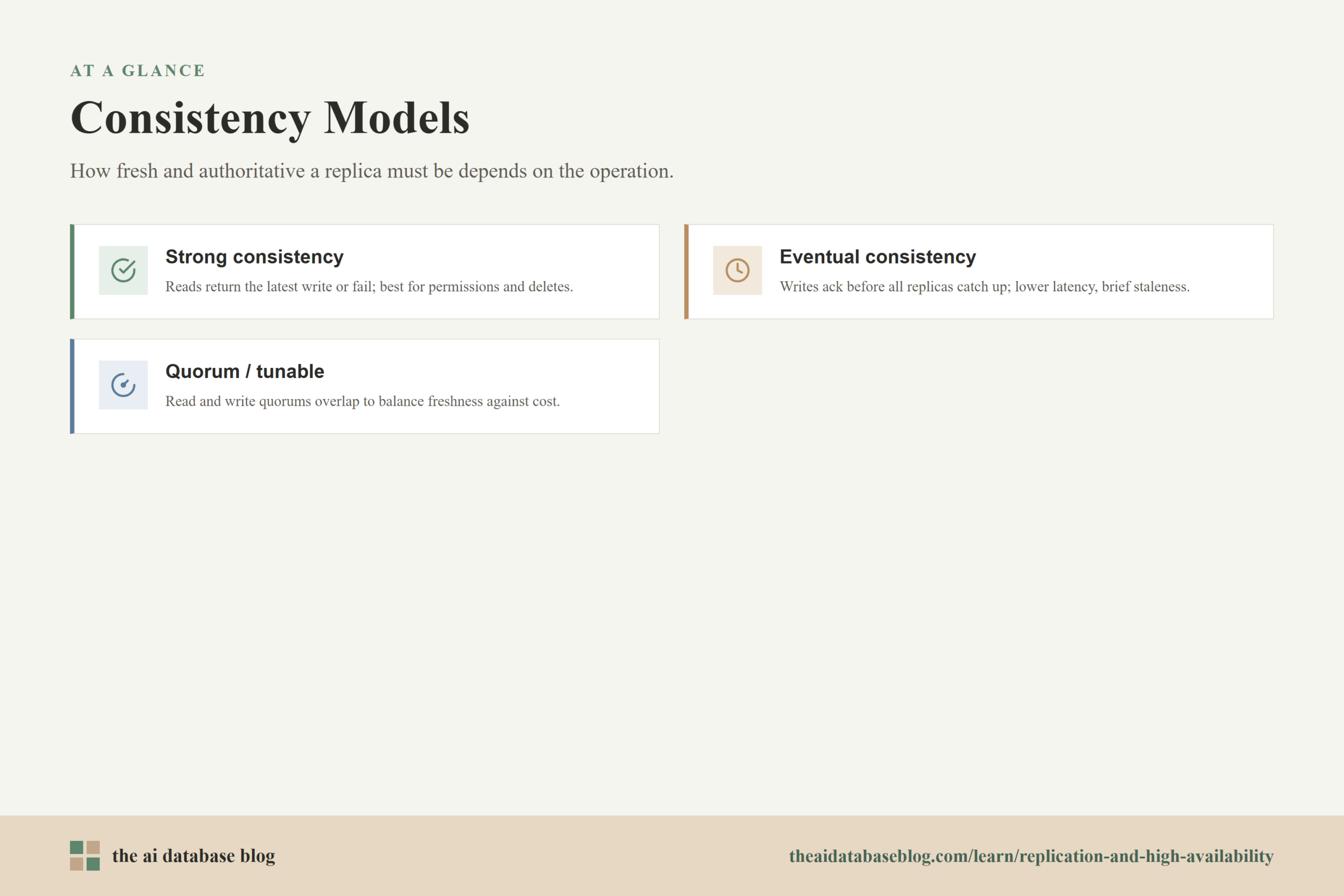
The simplest consistency model is strong consistency: after a write is acknowledged, later reads should return that write or fail rather than return stale data. This is useful when correctness matters more than maximum availability. For example, if an AI system retrieves access-controlled records, deleted documents, or compliance-sensitive content, serving stale data may be unacceptable.
Eventual consistency takes a different approach. A write may be acknowledged before every replica has the latest copy, and lagging replicas catch up later. This can improve availability and latency, especially in distributed systems where replicas are spread across nodes or regions. The tradeoff is that a read may temporarily return older data.
Many AI database workloads can tolerate some eventual consistency, but not all of them can. A product recommendation system may accept a short delay before a new item appears in search results. A customer support assistant may tolerate a brief delay after a document update. A legal, medical, permission-sensitive, or security-sensitive retrieval system may need tighter guarantees.
Replica Lag and Read-After-Write Behavior
Replica lag is the delay between a write being accepted by one part of the system and becoming visible on another replica. In AI databases, lag may involve more than copying a record. The system may need to update vector indexes, metadata indexes, keyword indexes, segment files, or background compaction structures. As a result, “the write exists” and “the write is searchable everywhere” may not happen at exactly the same time.
Read-after-write consistency means a client can write data and then immediately read it back. If an application uploads a document, embeds it, stores it, and then expects the next retrieval query to include it, read-after-write behavior matters. Some systems handle this by routing a user’s immediate follow-up reads to the primary or freshest replica. Others use quorum reads or wait until indexing has reached a safe point.
Quorums and Tunable Consistency
Some distributed databases use quorum rules. A write may need acknowledgment from a certain number of replicas, and a read may need responses from a certain number of replicas. If the read and write quorums overlap, the system has a better chance of seeing the latest acknowledged value. This can improve consistency, but it also increases coordination cost.
Tunable consistency lets teams choose different levels for different workloads. A low-latency semantic search query might read from one healthy replica. A sensitive update or delete might require agreement from a majority of replicas. This flexibility is useful, but it requires clear application-level decisions. Teams need to know which queries can tolerate stale data and which operations must be conservative.
Consistency choices become more complex when replication is combined with sharding. Replication copies data for availability, while sharding divides data for scale. Most production AI databases need both, so it is important to understand how they interact.
Combining Replication With Sharding
Sharding splits a dataset into partitions so the database can scale beyond the capacity of one node. Replication copies each partition so the database can survive failures and serve more reads. In a combined design, each shard has its own replica set. The full dataset is spread across shards, and each shard is copied across multiple nodes.
This distinction is important because sharding and replication solve different problems. Sharding helps with storage size, write throughput, indexing work, and parallel query execution. Replication helps with availability, read throughput, rolling maintenance, and failure recovery. A database that is only replicated may still hit storage or write limits. A database that is only sharded may lose availability when a shard’s only copy fails.
In vector search, sharding can affect query behavior in a direct way. If vectors are hash-sharded or locally partitioned, a similarity search may need to fan out across many shards and merge the best candidates from each one. If each shard is also replicated, the query planner must choose one suitable replica for each shard, not just one node for the whole query. This makes health-aware routing essential.
Shard placement also affects resilience. A good placement strategy avoids putting all replicas of the same shard on the same node or in the same failure domain. If shard A has three replicas, those replicas should be spread so that a single node failure does not remove the entire shard. The system may also need to rebalance replicas when nodes are added, removed, or replaced.
Per-Shard Availability
In a sharded database, availability is often determined per shard. If one shard is unavailable, queries that need that shard may fail or return incomplete results. For vector retrieval, this can be subtle. A query might still return results from available shards, but those results may not represent the true top-k across the whole dataset if one shard was skipped.
Because of this, AI applications should be careful about silent partial results. If a retrieval system omits a shard during search, the application may produce an answer that looks confident but is based on incomplete evidence. Depending on the use case, it may be better to return an explicit degraded-result signal, retry, or fail the request rather than hide the missing shard.
Replication Factor Across Shards
Replication factor can sometimes vary by collection, tenant, workload, or shard. Hot shards may need more replicas to handle read traffic. Critical shards may need stronger placement rules. Less active archival data may use fewer replicas if cost is more important than low-latency availability. The right choice depends on query volume, freshness requirements, cost constraints, and the acceptable risk of downtime.
After replication and sharding are designed together, the next practical question is what actually happens during a failure. High availability is not only about having replicas; it is about routing, promotion, repair, and recovery behavior under pressure.
Failover Behavior in Replicated AI Databases
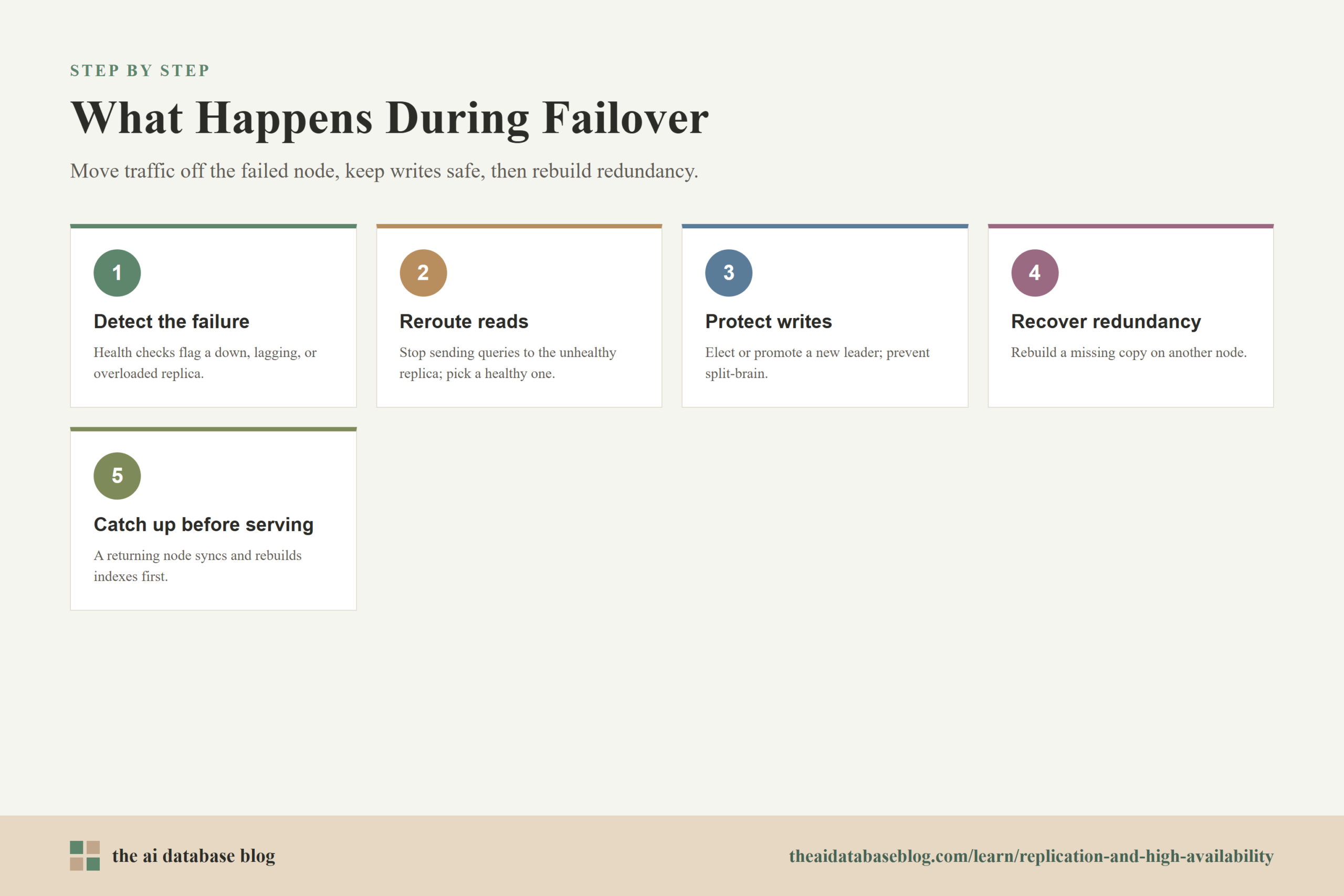
Failover is the process of moving traffic or responsibility away from a failed component and toward a healthy one. In a replicated AI database, failover may involve redirecting reads, electing a new leader, promoting a replica, rebuilding a missing copy, or rebalancing shard ownership. The details depend on whether the system uses leader-based replication, leaderless replication, quorum protocols, or another architecture.
For read traffic, failover is often a routing problem. If one replica becomes unavailable, the query router should stop sending reads to it and choose another healthy replica. This sounds simple, but the system must avoid routing to replicas that are still booting, rebuilding indexes, catching up on writes, or failing health checks. A replica should be considered ready only when it can serve correct results for the workload assigned to it.
For write traffic, failover can be more complex. In a leader-based system, one node or replica group may accept writes for a shard. If that leader fails, the cluster may need to elect or promote a new leader. Consensus protocols are often used to prevent split-brain behavior, where two nodes both believe they are the valid writer. Stronger safety usually requires majority agreement, which means the system may reject writes if too many replicas are unavailable.
Leaderless or quorum-based systems have a different failure pattern. They may continue accepting writes as long as enough replicas can acknowledge the operation. This can improve availability, but it still requires conflict resolution, read repair, anti-entropy repair, or background synchronization to bring replicas back into alignment after failures.
Recovery After Failover
Failover is not complete when traffic moves away from a failed node. The system also needs to recover the lost redundancy. If a node is gone for a long time, the database may create a new replica elsewhere. If a node returns, it may need to catch up on missed writes, rebuild local indexes, or compare its state with other replicas before it can serve traffic again.
This recovery phase is especially important in AI databases because rebuilding vector indexes can be expensive. A node may have the raw objects but still need time to rebuild or hydrate the searchable index. During that window, routing the node into production too early can cause poor latency, missing results, or inconsistent behavior.
Failover Testing and Operational Readiness
High availability should be tested before it is needed. Teams should know how long failover takes, whether reads continue during node loss, whether writes pause or continue, how clients behave during retries, and how the cluster reports degraded health. A configuration that looks highly available on paper may still fail in production if clients cache bad endpoints, load balancers do not remove unhealthy nodes, or replicas take too long to rebuild.
Useful failover tests include stopping a node, isolating a node from the network, filling a disk, restarting a replica during heavy query load, and removing a node that owns hot shards. The purpose is not to create chaos for its own sake. The purpose is to reveal whether the application, client library, routing layer, and database agree on what “healthy” means.
Understanding failover leads naturally to design practice. A highly available AI database is not built by turning on replication alone. It needs a set of choices that fit the workload’s consistency, latency, freshness, and recovery requirements.
Practical Design Guidance for AI Database High Availability
A practical high-availability design starts with the workload. Different AI applications have different tolerance for stale reads, incomplete search results, delayed indexing, and write downtime. The right replication strategy for a low-risk content discovery system may be too loose for a permission-sensitive internal knowledge system. The right strategy for a small collection may be too expensive for a billion-vector retrieval layer.
Start by deciding which operations require fresh results. New document ingestion, permission changes, deletions, and compliance-sensitive updates often need stronger guarantees than ordinary search queries. If a user revokes access to a document, it may be unacceptable for a lagging replica to keep returning that document. If a new blog article takes a few seconds to appear in search, the same delay may be harmless.
Next, choose replica placement that matches the failure you want to survive. If the goal is node-level fault tolerance, place replicas on different nodes. If the goal is availability-zone fault tolerance, spread replicas across zones and make sure the remaining zones have enough capacity to absorb traffic. If the goal is regional disaster recovery, local replication may not be enough; the system may need cross-region replication, backups, or a standby cluster.
Then define routing behavior. The application should know whether it can accept stale reads, whether it should retry failed shard queries, whether it should show degraded results, and whether certain reads must go to a primary or quorum path. For retrieval-augmented generation, it is often better to make degraded retrieval visible to the application than to let the model answer from incomplete context without warning.
Finally, monitor the signals that reveal replication health. Useful signals include replica lag, unavailable shards, under-replicated shards, failed repair jobs, index build progress, query error rates, tail latency, failover duration, and recovery time. Replication is only useful if teams can see when it is falling behind.
Common Tradeoffs
Replication improves availability and read capacity, but it introduces real tradeoffs. More replicas usually mean more storage cost and more background synchronization. Stronger consistency usually means more coordination and sometimes higher write latency. Wider geographic placement can reduce user-facing read latency in different regions, but it may increase replication lag or write coordination costs.
The main tradeoff is not simply speed versus reliability. It is about choosing the right reliability behavior for the job. Some systems should prefer returning a slightly stale result rather than failing a query. Other systems should prefer failing clearly rather than returning data that may violate permissions or correctness rules. The database architecture should match that decision instead of hiding it.
Another tradeoff is operational complexity. Combining sharding and replication can scale large retrieval systems, but it also creates more moving parts: shard maps, replica placement, repair workflows, routing decisions, and rebalancing. Teams should document how the cluster behaves during node loss, shard unavailability, and replica rebuilds so application developers know what to expect.
These tradeoffs are why high availability is best understood as an architecture property, not a single feature. The FAQ section below answers common questions that come up when teams apply these ideas to AI database systems.
FAQs
1. Does replication make an AI database fully highly available?
Replication is necessary for high availability, but it is not sufficient by itself. The database also needs healthy replica placement, routing, monitoring, failover behavior, recovery workflows, and enough spare capacity to handle traffic when a node is lost. Without those pieces, replicas may exist but still fail to protect the application during real outages.
2. How many replicas does an AI database need?
The right number depends on the failure model and consistency requirements. A replication factor of three is common because it can support majority-based decisions while tolerating one unavailable replica. Some lower-risk workloads may use fewer copies to reduce cost, while critical or high-traffic workloads may use more replicas for read capacity, placement flexibility, or regional resilience.
3. Can replicas improve vector search performance?
Yes, replicas can improve read throughput by allowing search traffic to be distributed across multiple copies of the same shard or collection. They do not automatically make an individual query faster, especially if the query still needs to search many shards. The main benefit is usually higher concurrent query capacity and better tolerance for traffic spikes.
4. What is the difference between replication and sharding?
Replication copies the same data to multiple places, while sharding splits different portions of the data across multiple places. Replication improves availability and read scaling. Sharding improves storage scale, write scale, and parallelism. Production AI databases often use both: each shard is stored on multiple replicas.
5. Why can replicas return stale results?
Replicas can return stale results when updates have not reached every copy yet or when index updates are still being applied. In AI databases, freshness may involve both object storage and searchable index structures. If the application needs immediate visibility after a write, it may need stronger consistency settings, primary reads, quorum reads, or explicit indexing completion checks.
6. What should happen during failover?
During failover, the system should stop routing traffic to unhealthy replicas, redirect reads to healthy copies, preserve safe write behavior, and begin recovery of lost redundancy. If a new leader must be selected, the system should prevent split-brain writes. After failover, rebuilt or restarted replicas should not serve production traffic until they are caught up and ready.
Takeaway
Replication and high availability in AI databases are about keeping retrieval systems useful when traffic grows or infrastructure fails. Replicas can scale reads and protect against node loss, but they also require clear consistency choices, careful shard placement, health-aware routing, and tested failover behavior. This guidance is most useful for teams building vector search, retrieval-augmented generation, recommendation, or knowledge retrieval systems where downtime, stale results, or incomplete context can affect the user experience. A good design starts by deciding what must be fresh, what can be eventually consistent, and how the system should behave when part of the database is unavailable.