Quantization reduces the memory cost of AI database search by storing vectors in a lower-precision form instead of keeping every embedding as full 32-bit floating point values in the search index. In practice, scalar quantization is usually the simpler and safer first option because it compresses each vector dimension independently, often cutting raw vector memory by about 4x with modest recall impact. Product quantization can reduce memory much more aggressively by representing chunks of a vector with learned codebook entries, but it usually needs more tuning and can affect recall more noticeably. Re-scoring helps recover accuracy by using compressed vectors to find a wider candidate set, then ranking those candidates again with the original full-precision vectors.
This guide explains how scalar and product quantization work in AI database systems, what memory savings teams can realistically expect, how recall can change after compression, and why re-scoring is often the difference between a cheap index and a useful retrieval system. By the end, you should understand when quantization is worth applying, how to choose between common methods, and how to test whether the savings are worth the retrieval tradeoff.
Why Quantization Matters for AI Databases
AI database workloads often become expensive because vector search stores and compares high-dimensional embeddings. A single 1,536-dimensional embedding stored as 32-bit floats uses 6,144 bytes before accounting for index graph data, metadata, payload storage, deleted records, allocator overhead, and any duplicated vectors needed for re-ranking or re-scoring. At millions or billions of objects, the vector portion alone can become a major memory and infrastructure cost.
Quantization addresses this problem by changing how vector values are represented inside the search system. Instead of storing every dimension as a full-precision floating point number, the database stores a compressed approximation. The compressed representation is smaller, often faster to scan, and friendlier to CPU cache. The tradeoff is that the database is no longer comparing exact original vectors during the first search pass.
That tradeoff is acceptable in many retrieval systems because vector search is already approximate. Approximate nearest neighbor indexes are designed to find highly similar candidates without exhaustively comparing every item in the database. Quantization adds another approximation layer, so the practical question is not whether it changes the math. It does. The practical question is whether the saved memory is worth the possible drop in recall, and whether re-scoring can recover enough quality for the application.
Once the basic reason for quantization is clear, the next question is which kind of quantization fits the workload. Scalar quantization and product quantization both reduce vector memory, but they do it in different ways and behave differently under real retrieval constraints.
Scalar Quantization in Practice
Scalar quantization compresses each dimension of a vector separately. A common version maps 32-bit floating point values to 8-bit integer values. If a vector originally has 1,536 float values, scalar quantization still keeps 1,536 values, but each value is represented with fewer bits. This is why scalar quantization is often easy to understand: it changes precision per dimension, not the shape of the vector itself.
In raw vector terms, 8-bit scalar quantization can reduce memory by about 4x because each dimension moves from 4 bytes to 1 byte. A 1,536-dimensional vector that used about 6 KB as float32 becomes about 1.5 KB as int8. The total system savings may be lower because the search index may still need graph links, metadata structures, payload storage, and sometimes the original vectors for re-scoring. Still, for memory-heavy vector search, reducing the index-side vector footprint by roughly a factor of four is meaningful.
Scalar quantization tends to preserve retrieval quality better than more aggressive compression methods because it keeps a value for every dimension. The distance calculation becomes less precise, but the compressed vector still carries much of the same shape as the original embedding. For many text embedding workloads, scalar quantization is a strong default candidate when the goal is to reduce RAM pressure without dramatically changing relevance behavior.
Where Scalar Quantization Works Well
Scalar quantization is a good fit when the system needs predictable behavior, moderate memory reduction, and low operational complexity. It is especially useful when the current index is memory-bound but retrieval quality is already acceptable. If the system is serving RAG queries, semantic search, support knowledge retrieval, or recommendation candidates, scalar quantization can often lower cost while keeping enough recall for the downstream ranking or generation step.
It also works well as a first compression experiment because its failure modes are easier to measure. If recall drops, the team can increase the candidate pool, enable re-scoring, tune the search breadth, or fall back to full precision for the most sensitive collections. The method is not free, but it is usually easier to reason about than a deeper compression scheme.
Scalar quantization gives teams a practical middle ground: substantial memory savings without rewriting the retrieval architecture. Product quantization, by contrast, is usually chosen when that 4x raw vector reduction is not enough and the database needs a more aggressive compression strategy.
Product Quantization in Practice
Product quantization compresses vectors by splitting each vector into smaller subvectors and representing each subvector with an entry from a learned codebook. Instead of storing every original dimension or every quantized dimension directly, the database stores compact codes that point to representative centroids. During search, the system estimates distances using those codes and codebooks.
The main advantage is much higher compression. Depending on the number of subvector segments and bits per code, product quantization can reduce vector storage far beyond scalar quantization. For example, a high-dimensional float32 vector that takes several kilobytes can be represented by a small set of code bytes plus shared codebooks. In large indexes, this can move memory needs from prohibitive to manageable.
The tradeoff is that product quantization introduces more approximation. Each subvector is represented by the nearest learned codebook entry, so the compressed version may lose more detail than scalar quantization. The quality depends on the embedding distribution, the number of segments, the codebook size, the training sample, and the search index around it. It can be excellent for some large-scale workloads, but it usually deserves more careful testing than scalar quantization.
Where Product Quantization Works Well
Product quantization is useful when memory reduction is the dominant constraint. It is commonly considered for very large collections, high-dimensional embeddings, or systems where keeping full vectors in memory is too expensive. It can also be useful when storage and bandwidth limits matter as much as RAM, because smaller codes are cheaper to move and compare.
Product quantization is less attractive when the application needs very high recall at a small top-k, when the dataset changes constantly, or when there is not enough time to train and tune the compression well. The method can still work in those situations, but the margin for error is smaller. A poorly tuned product quantized index can look cheap on memory and expensive in missed results.
At this point, the choice is not simply about which method compresses more. The right choice depends on the savings target, the acceptable recall loss, and how much latency the system can spend on re-scoring.
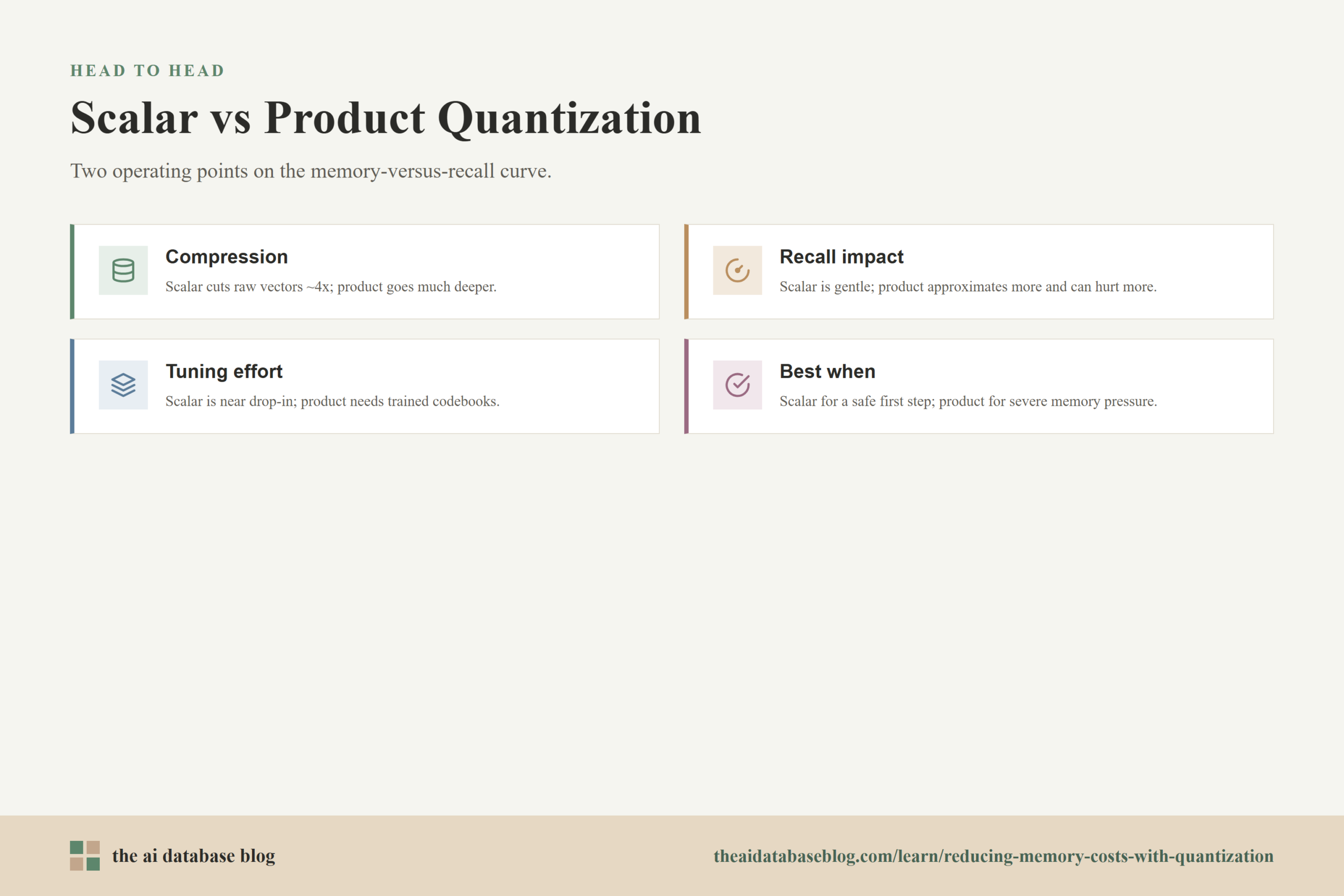
Scalar vs Product Quantization: Practical Tradeoffs
Scalar quantization and product quantization serve different operating points. Scalar quantization is often the practical first step because it is simpler, usually preserves recall better, and delivers a clear memory reduction. Product quantization is the stronger compression tool when memory pressure is severe, but it tends to require more evaluation and more careful candidate recovery.
| Factor | Scalar Quantization | Product Quantization |
|---|---|---|
| How it compresses | Reduces precision for each vector dimension, often from float32 to int8. | Splits vectors into subvectors and stores compact codes that point to learned codebook entries. |
| Typical raw vector savings | Often about 4x with 8-bit values. | Often much higher, commonly ranging from single-digit multiples to dozens of times depending on configuration. |
| Recall impact | Usually modest when embeddings are well behaved and re-scoring is available. | Can be larger because more information is approximated, especially with aggressive compression. |
| Operational complexity | Lower. It is easier to enable, test, and reason about. | Higher. It may require codebook training, parameter tuning, and closer recall evaluation. |
| Best fit | General-purpose memory reduction with controlled relevance risk. | Large-scale indexes where memory savings matter enough to justify deeper tuning. |
A useful rule of thumb is to start with scalar quantization when a 3x to 4x raw vector memory reduction would solve the problem. Consider product quantization when the system needs much deeper compression or when the dataset is large enough that small per-vector savings compound into major infrastructure savings. In both cases, measure recall rather than assuming that the compression ratio tells the whole story.
The comparison also reveals why memory savings should not be evaluated in isolation. A smaller index is only useful if it still retrieves the right candidates often enough. That is where recall testing becomes the central part of a quantization rollout.
Expected Savings and Recall Impact
Expected memory savings depend on what is being measured. If the measurement is only the raw vector representation, scalar quantization from float32 to int8 is roughly a 4x reduction. Product quantization can be much smaller than that, because each vector may be represented by a compact code rather than one stored value per original dimension. But a full AI database deployment includes more than vector values.
An in-memory graph index may store neighbor links and other search structures. The database may also store metadata indexes, object payloads, deleted or tombstoned records, and original full-precision vectors for re-scoring. If original vectors are retained outside the compressed index, total storage may not shrink as much as the compressed search structure. The benefit is still important because the hottest part of vector search is often the index memory used during candidate generation.
Recall impact also varies by workload. A clean text embedding collection with broad semantic neighborhoods may tolerate scalar quantization well. A collection with many near-duplicate items, subtle ranking differences, or high-stakes top-one retrieval may be more sensitive. Product quantization can save more memory, but it may make these edge cases more visible because many distinct vectors can be approximated through the same or similar codebook entries.
How to Measure Recall After Quantization
The best way to measure recall is to compare quantized retrieval against a full-precision baseline. Select a representative query set, run exact or high-quality full-precision retrieval, and treat those results as the reference set. Then run the quantized index and measure how often the same relevant neighbors appear in the top-k results.
For RAG systems, recall should be measured at the candidate depth that the application actually uses. If the generator sees five chunks, recall at five matters. If a re-ranker sees the top fifty and chooses the final five, recall at fifty may be more important for the first retrieval stage. The goal is to evaluate the pipeline, not just the index in isolation.
Teams should also measure latency and cost at the same time. Quantization may reduce memory and improve cache efficiency, but re-scoring can add extra work. A good rollout compares full precision, quantized search without re-scoring, and quantized search with re-scoring at several candidate depths. That makes the tradeoff visible instead of theoretical.
Once recall is measured, the next practical question is how to recover quality when the compressed index misses or misorders some results. Re-scoring is the most common answer because it separates cheap candidate generation from accurate final ranking.
How Re-scoring Recovers Accuracy
Re-scoring is a two-stage retrieval pattern. In the first stage, the database searches the compressed vectors and retrieves more candidates than the user ultimately needs. In the second stage, the system recalculates distances for those candidates using the original full-precision vectors, then returns the best final results. This helps because the compressed index only needs to find a good candidate pool; it does not need to perfectly order every result.
For example, suppose an application needs the top 10 results. A quantized index might retrieve the top 100 or 200 candidates using compressed vectors. The database then computes exact or higher-precision similarity for those candidates using the original vectors and returns the best 10 after re-scoring. If the true best results are present somewhere in the larger candidate pool, re-scoring can correct their order.
Re-scoring does not fix every recall problem. If the compressed first stage fails to retrieve a relevant item at all, the re-scoring stage cannot rank it. This is why over-fetching matters. The candidate pool must be wide enough to include the likely true neighbors, but not so wide that latency becomes unacceptable. The right setting depends on the query volume, embedding model, index type, compression method, and application tolerance for latency.
Choosing a Candidate Pool for Re-scoring
A practical starting point is to retrieve several times more candidates than the final result count. If the final top-k is 10, try re-scoring 50, 100, or 200 candidates and measure recall and latency at each level. Scalar quantization may need a smaller candidate pool than aggressive product quantization because the first-stage distances are usually closer to the original distances.
For RAG, the candidate pool should be large enough to protect answer quality. If the system sends only the final five chunks to the language model, the retrieval stage needs enough over-fetching to avoid losing useful context before the final selection. For recommendation or semantic browsing, a smaller recall loss may be acceptable if the returned items remain useful and diverse.
Re-scoring turns quantization from a blunt compression tool into a controlled retrieval design choice. With that in mind, teams can follow a rollout process that reduces memory while keeping relevance risk measurable.
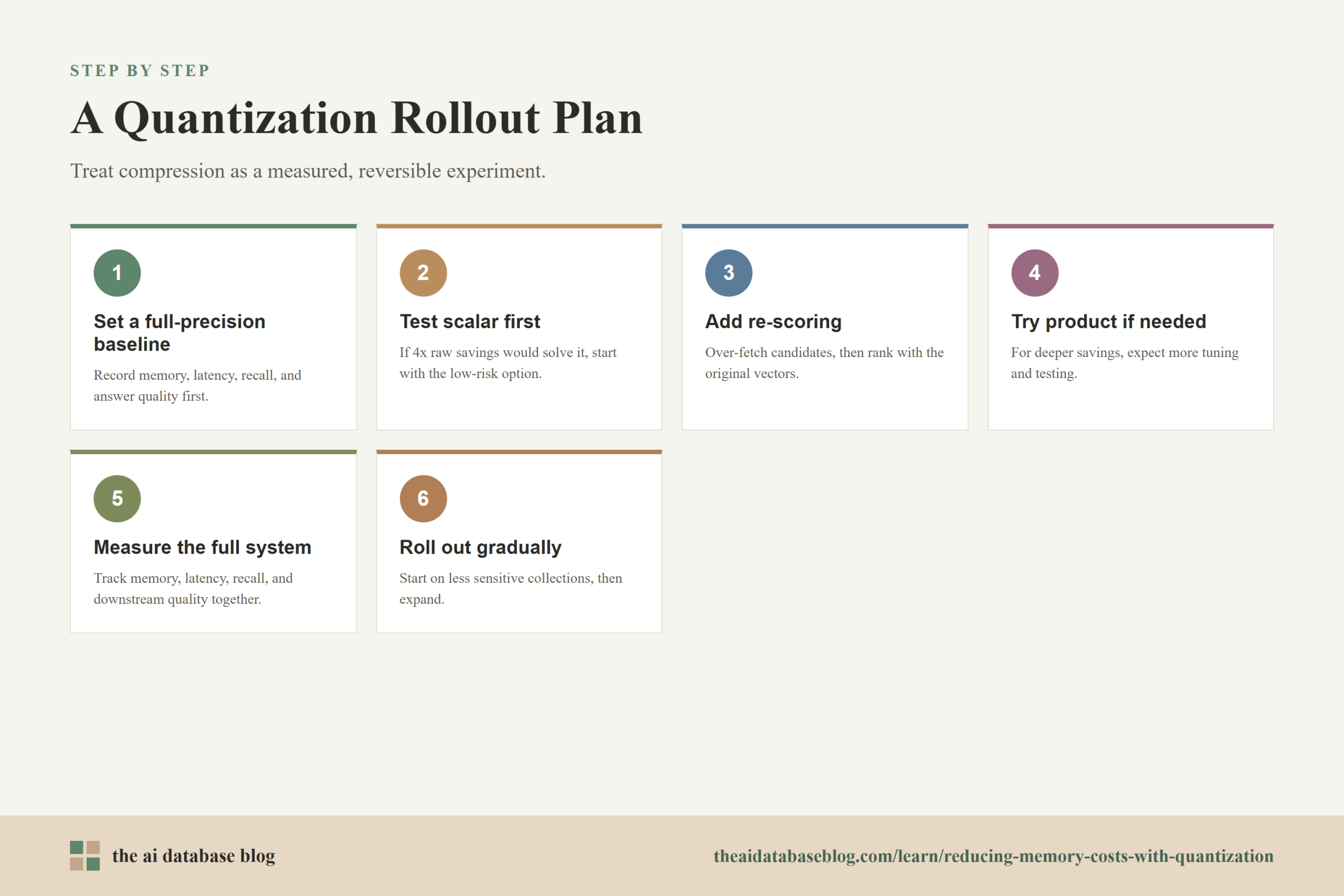
A Practical Rollout Plan
Quantization should be rolled out with the same care as any relevance-changing search optimization. The safest approach is to treat it as an experiment with baselines, metrics, and rollback criteria. The goal is not to prove that compression works in general. The goal is to prove that it works for this dataset, this embedding model, this index, and this application.
- Establish a full-precision baseline. Measure current memory usage, latency, recall, and application-level quality before compression. Without a baseline, savings and recall impact are hard to interpret.
- Test scalar quantization first. If a 4x raw vector reduction would solve the cost problem, scalar quantization is often the lowest-risk place to start.
- Add re-scoring and over-fetching. Compare several candidate pool sizes so the team can see where recall improves and where latency becomes too expensive.
- Evaluate product quantization when deeper savings are needed. Use the same query set and quality metrics, but expect more tuning around code size, segment count, and candidate depth.
- Measure the full system, not only the index. Include memory, storage, latency, throughput, recall, and downstream answer quality if the database powers RAG.
- Roll out gradually. Start with less sensitive collections or a traffic slice, then expand once the quality and cost tradeoff is clear.
This process keeps quantization tied to measurable retrieval outcomes. It also helps avoid a common mistake: choosing the most compressed configuration before checking whether the resulting candidate set still contains the answers users need.
Common Mistakes to Avoid
The first mistake is treating compression ratio as the only goal. A product quantized index that saves a large amount of memory but drops important results may cost more in user trust than it saves in infrastructure. Compression should be judged against the quality target of the application.
The second mistake is measuring recall only at the final top-k when the system has multiple retrieval stages. If a re-ranker or re-scoring step receives 100 candidates, then first-stage recall at 100 matters. If the system only retrieves 10 candidates and sends them directly to a model, recall at 10 matters more. The metric should match the retrieval architecture.
The third mistake is forgetting that original vectors may still be needed. Re-scoring usually requires access to full-precision vectors, so the system may compress the in-memory search index while retaining original vectors elsewhere. That is still useful, but it means the total storage picture is different from the raw compressed-code size.
The fourth mistake is assuming one quantization setting will work equally well across all collections. Different embedding models, dimensions, domains, and similarity functions can respond differently to compression. A setting that works for broad documentation search may not work for fine-grained legal, medical, or catalog retrieval where small differences matter.
Avoiding these mistakes makes quantization a disciplined search optimization rather than a guess. The final decision should come from the shape of the workload and the acceptable balance between memory, latency, and recall.
FAQs
1. What is quantization in an AI database?
Quantization is a way to store vector embeddings in a smaller, lower-precision format. Instead of keeping every vector dimension as a full 32-bit floating point value in the search index, the database stores an approximation that uses fewer bits. This reduces memory cost and can improve search efficiency, but it may slightly change nearest neighbor results.
2. Is scalar quantization safer than product quantization?
Scalar quantization is often safer as a first step because it preserves one compressed value per original dimension. It usually produces moderate memory savings with a smaller recall impact. Product quantization can compress much more aggressively, but it introduces more approximation and usually needs more careful tuning and testing.
3. How much memory can scalar quantization save?
For raw vector values, 8-bit scalar quantization can reduce memory by about 4x compared with float32 storage. The total system savings may be lower because the database also stores index structures, metadata, payloads, and sometimes original vectors for re-scoring.
4. How much memory can product quantization save?
Product quantization can often save much more memory than scalar quantization because it stores compact codes for vector segments rather than a compressed value for every original dimension. The exact savings depend on the number of segments, codebook size, vector dimension, and whether original vectors are retained for re-scoring.
5. Does quantization always reduce recall?
Quantization usually introduces some risk to recall because compressed vectors are approximations of the original embeddings. The impact may be small with scalar quantization and a well-chosen re-scoring setup, or larger with aggressive product quantization. The only reliable answer comes from testing against a full-precision baseline on representative queries.
6. Why does re-scoring help after quantization?
Re-scoring helps because the compressed index can retrieve a wider candidate set quickly, then the system can rank those candidates again using original full-precision vectors. This often restores much of the ranking accuracy lost during compression, as long as the relevant items are included in the candidate pool.
Takeaway
Quantization is one of the most practical ways to reduce memory costs in AI database systems, but it works best when treated as a measured tradeoff rather than a simple storage switch. Scalar quantization is usually the best first experiment for teams that need meaningful savings with limited recall risk, while product quantization is better suited to large-scale indexes that need deeper compression and can support more tuning. Re-scoring makes both approaches more useful by letting the system search cheaply with compressed vectors and rank carefully with original vectors. This guidance is most useful for teams building RAG, semantic search, or recommendation systems where vector memory is becoming expensive and retrieval quality still matters.
Watch this video to learn more