Real-time indexing makes new or changed data searchable as quickly as possible, while batch indexing processes data in larger groups to improve throughput, consistency, and cost efficiency. The practical tradeoff is freshness versus throughput: real-time indexing favors up-to-date retrieval, and batch indexing favors efficient processing at scale. Many AI database systems need both because user-facing applications often require fresh results for recent events while still relying on batch jobs for large backfills, embedding refreshes, offline quality improvements, and historical data loads.
This guide explains how real-time and batch indexing work in AI databases, when each approach is useful, how they can coexist in one retrieval system, and why the indexing strategy directly affects how quickly new data becomes searchable. It also covers the operational tradeoffs that matter for vector search, hybrid search, metadata filtering, and retrieval-augmented generation.
What Indexing Means in an AI Database
In an AI database, indexing is the process that makes stored data searchable by a retrieval system. For a vector database, this often means storing embeddings and arranging them in a data structure that can find similar vectors quickly. For hybrid search, indexing may also include keyword indexes, sparse vectors, metadata fields, filters, timestamps, document identifiers, and other signals that help the system return useful results.
Indexing is not only a one-time setup step. In many AI applications, data changes constantly. New support tickets are created, product descriptions are edited, documents are uploaded, user behavior is recorded, and knowledge bases are revised. Each change raises a practical question: when should the new data become available to search?
That question is especially important for retrieval-augmented generation systems. If a chatbot, search assistant, or internal knowledge tool retrieves outdated information, the generated answer may be incomplete or wrong even when the language model itself is working correctly. The database layer has to decide how fast it can absorb changes without making search slow, unstable, or too expensive.
Once indexing is understood as an ongoing operational process, the difference between real-time and batch indexing becomes clearer. The two approaches are not just different schedules. They represent different assumptions about how urgent freshness is, how much data must be processed, and how much load the system can absorb at once.
How Real-Time Indexing Works
Real-time indexing updates the searchable index shortly after data is created, changed, or deleted. In practice, “real time” usually means near real time rather than instantaneous. The system receives an event, computes or receives the embedding, stores the object, updates relevant indexes, and makes the record available to queries after a short delay. That delay may be measured in seconds, minutes, or another service-level target depending on the architecture.
This approach is common when users expect search results to reflect recent activity. For example, a customer support assistant may need to retrieve a ticket that was opened a few seconds ago. A compliance review tool may need newly uploaded documents to appear quickly. A personalization system may need recent interactions to influence retrieval while the user is still active.
Real-time indexing usually depends on event-driven ingestion. A source system emits a change event, a pipeline transforms the record, an embedding model converts relevant text into vectors, and the database updates its indexes. The system may use queues or streaming infrastructure to smooth bursts of updates, because indexing every change immediately can create uneven load.
The main benefit is freshness. New data can be searched quickly, which makes applications feel responsive and reduces the risk that retrieval misses important recent information. The main cost is operational complexity. The system has to handle partial failures, duplicate events, delayed embeddings, index update pressure, and query performance while ingestion is still happening.
Real-time indexing solves the freshness problem, but it does not remove the cost of indexing. When data volume grows or when embeddings are expensive to compute, teams need to ask whether every update truly deserves immediate indexing. That question leads naturally to batch indexing.
How Batch Indexing Works
Batch indexing processes many records together on a schedule or as part of a planned job. Instead of updating the search index after every individual change, the system collects data and indexes it in larger groups. A batch may run every few minutes, hourly, nightly, weekly, or whenever a large import or rebuild is needed.
Batch indexing is often used for large data loads, historical backfills, periodic embedding refreshes, and index rebuilds. It is also useful when data does not need to be searchable immediately. For example, a company might index a large archive of documentation overnight, refresh an analytics knowledge base once per day, or rebuild embeddings after changing a chunking strategy.
The main benefit is throughput. Processing records in groups can make better use of compute resources, reduce per-record overhead, and allow the system to optimize indexing work. Batch jobs can also be easier to validate because the input set is defined, the job can be measured, and the output can be checked before it replaces or supplements an existing index.
The tradeoff is freshness. If a batch job runs every hour, a document created just after one run may not become searchable until the next run finishes. If the batch job is large, new data may wait even longer. This delay may be acceptable for archival search or offline knowledge bases, but it can be frustrating or risky for applications where users expect immediate results.
Batch indexing is not a weaker version of real-time indexing. It is a different fit for workloads where scale, predictability, and processing efficiency matter more than immediate visibility. The core design decision is not whether batch is modern enough, but whether the application can tolerate the freshness delay.
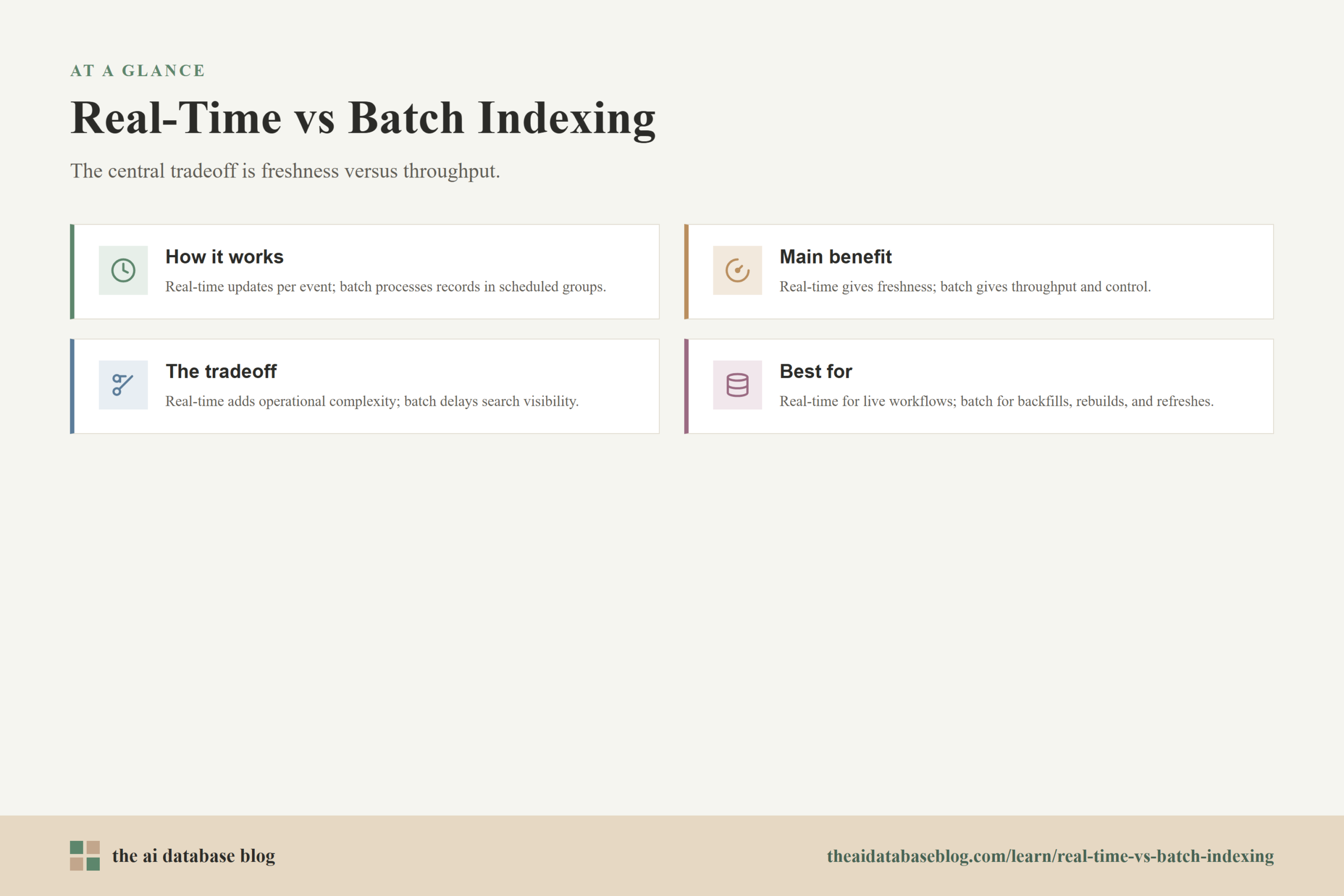
Freshness vs Throughput Tradeoff
The freshness versus throughput tradeoff is the central difference between real-time and batch indexing. Freshness describes how soon new or changed data becomes searchable. Throughput describes how much data the system can ingest, transform, embed, index, and make queryable within a given time period. Improving one can put pressure on the other because the same system resources are often used for writes, index maintenance, embedding generation, compaction, and queries.
Real-time indexing improves freshness by shrinking the delay between a data change and search visibility. However, it can reduce throughput if the system must perform many small updates, recompute embeddings frequently, or maintain index structures under constant write pressure. It can also increase tail latency for queries if ingestion and search compete for the same CPU, memory, disk, or network resources.
Batch indexing improves throughput by grouping work. Larger jobs can be scheduled during quieter periods, parallelized, retried, and monitored as units. The system can optimize bulk writes and reduce repeated overhead. But batch indexing increases the time between data creation and searchability, especially when the batch interval is long or the job takes a long time to complete.
A useful way to think about the tradeoff is to separate business freshness from technical freshness. Technical freshness asks how quickly the index can update. Business freshness asks how quickly the data needs to appear for the application to remain useful and trustworthy. A news monitoring assistant, an incident response tool, and an internal policy search system may all use AI retrieval, but they do not need the same freshness target.
After weighing freshness and throughput, the next practical question is where each indexing mode actually belongs. The right answer depends less on abstract architecture preferences and more on the user experience, data volume, and consequences of stale retrieval.
When Real-Time Indexing Is Used
Real-time indexing is most useful when recent information changes the value of the answer. In AI database applications, that usually means the retrieval system is part of a live workflow. Users are asking questions, making decisions, or taking actions based on the assumption that the system has seen the latest relevant data.
Common use cases include customer support search, operational monitoring, fraud or risk investigation, collaboration tools, chat-based knowledge assistants, and systems that retrieve recent user activity. In these settings, stale results are not just a minor inconvenience. They can cause users to miss a new ticket, cite an old policy, overlook an urgent event, or repeat work that has already been done.
Real-time indexing is also useful when updates are small but frequent. If each change is modest, the system may be able to index it quickly without overwhelming resources. This is common for event streams, short documents, status updates, and metadata changes. The challenge grows when each update requires expensive embedding generation or when many updates arrive in bursts.
Teams should choose real-time indexing when the freshness requirement is explicit. A helpful test is to ask what happens if the data appears in search five minutes late, one hour late, or one day late. If the delay breaks the user experience or creates operational risk, real-time indexing is likely worth the added complexity.
Still, real-time indexing is not always the best default. If every update is treated as urgent, the system may spend too much effort maintaining freshness for data that nobody needs immediately. That is where batch indexing continues to play an important role.
When Batch Indexing Is Used
Batch indexing is most useful when the system needs to process large amounts of data efficiently and the application can tolerate a delay before search visibility. This does not mean the data is unimportant. It means the data does not need to appear in search the moment it changes.
Typical batch indexing scenarios include initial database loads, historical document archives, scheduled knowledge base refreshes, embedding model migrations, chunking strategy changes, and full index rebuilds. These jobs can involve millions or billions of vectors, large text corpora, or expensive transformations that would be inefficient to handle one record at a time.
Batch indexing is also useful when quality control matters before data becomes searchable. A team may want to validate extracted text, remove duplicates, check metadata, evaluate embedding quality, or compare retrieval results before exposing a new index to users. A batch workflow gives the team a defined processing window and a clearer point for review.
The main risk is stale search. If an application relies only on batch indexing, users may not find new information until the next job completes. This can be perfectly acceptable for a monthly research archive, but it is a poor fit for a live incident response assistant. The acceptable delay should be defined in operational terms, not left as an assumption.
Because real systems often contain both urgent and non-urgent data, many AI database architectures avoid treating real-time and batch indexing as mutually exclusive. Instead, they combine them so each type of indexing handles the work it is best suited for.
Supporting Real-Time and Batch Indexing in One System
A single AI database system can support both real-time and batch indexing by separating ingestion paths while keeping the retrieval experience unified. The common pattern is to use a real-time path for fresh updates and a batch path for large, scheduled, or corrective work. Queries can then search across both sets of indexed data or search a merged index after the system reconciles the two paths.
One approach is to maintain a fresh index and a main index. The fresh index receives recent updates quickly and may be smaller or simpler. The main index is built or optimized through batch jobs for high-throughput search across the larger corpus. At query time, the system can search both indexes, merge the results, and rank them together. Later, batch processing can fold the fresh data into the main index.
Another approach is to use a shared index that accepts streaming writes while also supporting bulk imports and rebuilds. This can be simpler for application developers because queries go to one logical database. The database still has to manage background work such as segment creation, compaction, index optimization, and consistency between stored objects and searchable representations.
Systems that support both modes need clear rules for identity and versioning. If the same document appears in a real-time update and a batch rebuild, the database must avoid duplicate results and must know which version is current. Metadata such as document ID, source timestamp, version number, deletion marker, and indexing status can help the retrieval layer return the right result.
Supporting both modes also requires monitoring. Teams should track how long records spend in each stage: source event received, embedding generated, object stored, index updated, and result visible to queries. These measurements help distinguish a slow embedding pipeline from a slow database update or a delayed batch job.
Once both indexing paths exist, the most important user-facing question becomes concrete: how soon can someone search for a new record and actually find it? The answer depends on more than the label “real time” or “batch.”
How Indexing Strategy Affects Searchable Freshness
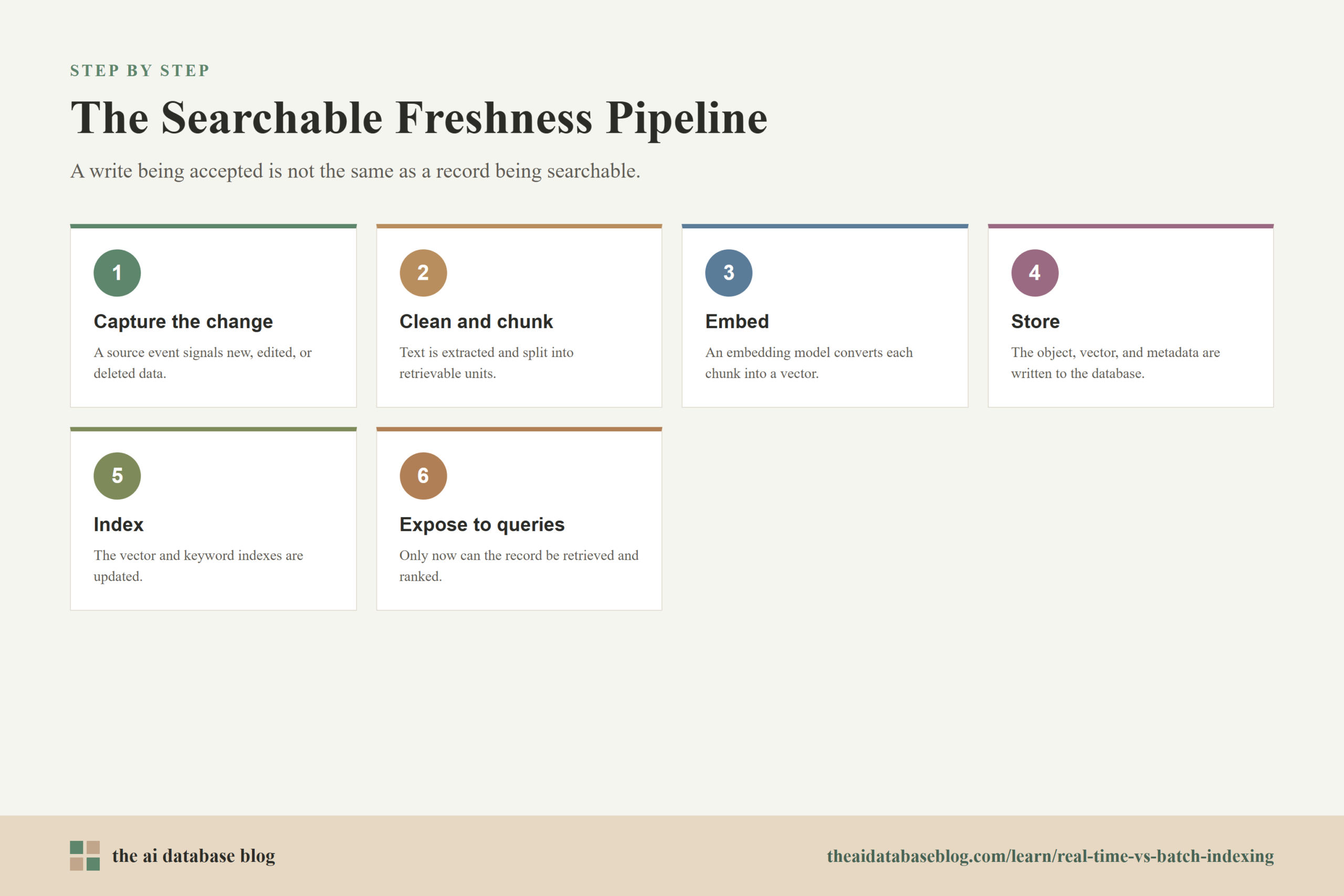
Searchable freshness is the time between a data change and the moment that change can be retrieved by search. In an AI database, this includes several steps. The source data must be captured, cleaned, chunked if needed, embedded, stored, indexed, and exposed to the query layer. A delay in any one of those steps can prevent new data from appearing in results.
With real-time indexing, searchable freshness can be short, but it is still not automatic. If embedding generation is queued, if the index update is asynchronous, or if the system uses background optimization before new vectors are fully queryable, the record may not appear immediately. Teams should measure end-to-end visibility rather than only measuring whether a write request succeeded.
With batch indexing, searchable freshness is shaped by the batch schedule and job duration. If data is collected for an hourly batch and the batch takes twenty minutes to run, some records may become searchable quickly while others may wait more than an hour. If the batch fails and must be rerun, freshness can degrade further.
Hybrid systems can offer a useful compromise. A new document can enter a small real-time index quickly, making it searchable soon after arrival. Later, a batch process can move it into a larger optimized index. This gives users fast access to new information while still preserving the throughput and search efficiency benefits of batch processing.
The key is to define freshness as a user-visible outcome. A system is not fresh because it accepted a write. It is fresh when the new or updated data can be retrieved, ranked appropriately, filtered correctly, and used by the application. For retrieval-augmented generation, this also means the retrieved item is available in time to influence the generated answer.
Understanding searchable freshness makes it easier to design practical indexing policies. Instead of choosing one indexing mode for all data, teams can map different data types to different freshness targets and processing paths.
Practical Design Guidelines
The best indexing strategy starts with the application’s freshness requirement. A team should decide how quickly each type of data must become searchable, then choose the indexing mode that meets that target without wasting resources. This is more reliable than choosing real-time indexing because it sounds faster or batch indexing because it sounds cheaper.
- Use real-time indexing for high-urgency data that affects live decisions, active user sessions, alerts, or recently changed knowledge.
- Use batch indexing for large imports, historical records, full rebuilds, embedding refreshes, and data that can wait before appearing in search.
- Use both when the application needs fresh results for recent data and efficient processing for the full corpus.
- Measure freshness from the source change to query visibility, not only from write acceptance to storage completion.
- Protect query performance by isolating heavy ingestion work, using queues, scheduling batch jobs carefully, and monitoring index update lag.
- Track document identity and versioning so real-time updates and batch rebuilds do not create duplicate or stale search results.
These guidelines are especially important for AI systems because retrieval quality depends on more than storing vectors. The system also has to keep embeddings current, metadata accurate, filters consistent, and ranking signals aligned with the latest version of the data.
With those design principles in place, real-time and batch indexing become complementary tools. The remaining questions usually come down to operational details, such as how to measure freshness, how to avoid duplicate results, and how to decide whether the extra complexity of real-time indexing is justified.
FAQs
1. Is real-time indexing always better than batch indexing?
No. Real-time indexing is better when freshness is critical, but batch indexing is often better for large-scale processing, full index rebuilds, embedding refreshes, and data that does not need to appear immediately. The better choice depends on the freshness requirement, data volume, cost constraints, and user expectations.
2. How quickly does real-time indexed data become searchable?
Real-time indexed data may become searchable within seconds or minutes, depending on the system. The actual delay depends on event delivery, transformation, embedding generation, database writes, index updates, and query-layer visibility. Teams should measure the full path from data change to retrievable result.
3. Why can batch indexing have higher throughput?
Batch indexing can have higher throughput because it processes many records together. This reduces per-record overhead, allows better scheduling, supports parallel processing, and can make bulk writes or index rebuilds more efficient. The tradeoff is that new data may wait for the next batch before it becomes searchable.
4. Can one AI database use both real-time and batch indexing?
Yes. Many systems use a real-time path for recent updates and a batch path for large or scheduled work. The retrieval layer can search both a fresh index and a main index, or the database can expose one logical index while managing streaming writes and batch jobs in the background.
5. What is the biggest risk of relying only on batch indexing?
The biggest risk is stale retrieval. If the batch interval is long or the job is delayed, users may not find newly added or updated information. This can be acceptable for archives, but it can be harmful for live support, monitoring, compliance, or RAG applications that need current knowledge.
6. What should teams measure when comparing indexing strategies?
Teams should measure searchable freshness, ingestion throughput, embedding latency, indexing lag, query latency during ingestion, failure recovery time, and retrieval quality. Searchable freshness is especially important because it reflects the user-visible result: whether new data can actually be found by the application.
Takeaway
Real-time indexing and batch indexing solve different problems in AI databases. Real-time indexing helps new information become searchable quickly, which is useful for live workflows, current knowledge, and retrieval-augmented generation systems that depend on fresh context. Batch indexing improves throughput and control for large imports, rebuilds, and scheduled updates. The most useful architecture often supports both: a fast path for recent changes and an efficient path for large-scale processing. This guidance is most useful for teams building AI search, knowledge assistants, and RAG applications where the timing of searchable data directly affects answer quality and user trust.