Query rewriting and expansion improve retrieval by transforming a user’s original question into search inputs that better match the language, structure, and intent of the data stored in an AI database. Instead of sending one raw query directly to vector search, keyword search, or hybrid retrieval, the system may rewrite the query, generate sub-queries, add related terminology, or ask a language model to produce clearer retrieval-focused versions of the request. The goal is usually better recall: finding more of the relevant information before ranking, filtering, and answer generation decide what to use.
This guide explains how query rewriting and expansion work in AI database systems, why they matter for retrieval-augmented generation, and how to use them without drifting away from the user’s intent. It covers transformations before retrieval, sub-query generation, terminology expansion, LLM-assisted rewriting, practical tradeoffs, and ways to evaluate whether the changes are improving the retrieval pipeline.
What Query Rewriting Means in AI Database Retrieval
Query rewriting is the process of changing a user’s input before it is sent to the retrieval layer. In an AI database application, the original query may be too short, ambiguous, conversational, or mismatched with the way documents are written. A user might ask, “Why did the pipeline fail yesterday?” while the stored documents use terms such as “job timeout,” “orchestration error,” “ETL retry,” or “failed batch execution.” A direct search may still work if the embedding model understands the meaning well enough, but it can miss useful matches when the wording gap is too large.
Rewriting gives the retrieval system a better search expression. The rewritten query may be more specific, more complete, more domain-aware, or more closely aligned with document language. In vector retrieval, this can improve the embedding representation of the query. In keyword or hybrid retrieval, it can add terms that help lexical matching. In RAG systems, it can increase the chance that the answer generator receives the right evidence instead of trying to reason from incomplete context.
Query rewriting is not the same as changing the user’s goal. A good rewrite preserves the user’s intent and constraints while making the request easier for the database to retrieve against. If the user asks about refund policy exceptions for enterprise contracts, the rewrite should not broaden the query into general refund policy content. It should keep the enterprise-contract constraint visible because that constraint is part of the retrieval target.
Once the role of rewriting is clear, the next question is where it belongs in the retrieval flow. The most useful placement is usually before candidate retrieval, where it can influence which documents, chunks, or records are considered in the first place.
Transforming User Queries Before Retrieval
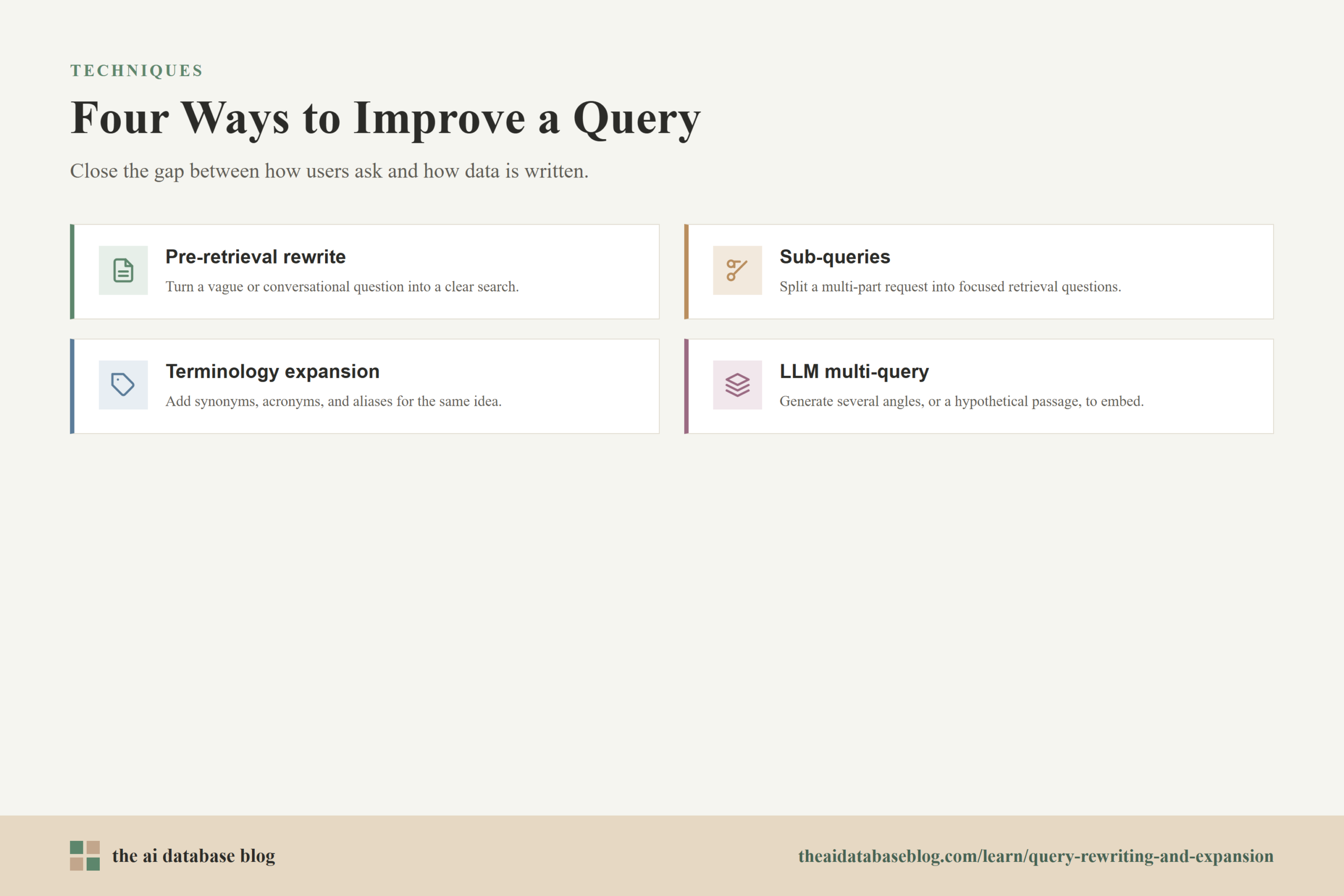
Transforming the query before retrieval means the system modifies or enriches the search input before asking the AI database for matching results. This is an early-stage recall strategy. If the first retrieval step misses relevant records, later reranking or answer generation cannot reliably recover them because the missing evidence never enters the candidate set. That is why query transformation often sits near the front of a RAG or semantic search pipeline.
Common transformations include turning a conversational question into a more searchable statement, separating intent from filters, normalizing vague references, and making implicit context explicit. For example, if a user asks, “How do we handle this for private docs?” after a previous question about embeddings, the system might rewrite the retrieval query as “embedding storage, access control, and retrieval permissions for private documents.” If the system has reliable conversation context, this makes the query more complete without requiring the user to repeat themselves.
Another useful transformation is preserving structured constraints separately from semantic meaning. A query such as “Find customer support issues about invoice matching from March in Europe” contains both semantic content and filters. The semantic part might become “customer support issues related to invoice matching and billing reconciliation,” while the metadata filters remain region equals Europe and month equals March. This separation helps the AI database avoid burying precise filters inside an embedding where they are harder to enforce.
Transformation can also adapt a query to different retrieval channels. A vector search query may use a full natural-language rewrite, while a keyword search query may use expanded terms, acronyms, and exact phrases. In hybrid retrieval, both forms can be used at the same time and then merged, often followed by reranking to reduce noise.
After the query has been rewritten into a clearer search input, the next improvement is to ask whether one query is enough. Many user questions contain multiple intents, hidden comparisons, or sequential reasoning needs. In those cases, generating sub-queries can produce a more complete candidate set.
Generating Sub-Queries for Complex Questions
Sub-query generation breaks a complex request into smaller retrieval questions. This is especially useful when one user query asks about several entities, compares alternatives, requires multiple facts, or depends on information spread across different documents. Instead of forcing one embedding or keyword query to represent the whole request, the system retrieves evidence for each part and then combines the results.
Consider the question, “How should we choose between vector search and hybrid search for a compliance chatbot?” A single query may retrieve broad content about search methods, but it may not retrieve enough detail about compliance requirements, exact-term matching, auditability, and domain-specific vocabulary. A sub-query approach might generate separate retrieval requests for “vector search strengths and limitations for chatbots,” “hybrid search for compliance terminology and exact matches,” and “retrieval evaluation for regulated-domain question answering.” These narrower searches can improve coverage across the concepts that matter.
Sub-queries are also helpful for multi-hop questions, where the answer depends on connecting facts. If a user asks which policy applies to a product in a specific region, the system may need one query to identify the product category, another to retrieve regional rules, and another to find exceptions. The final answer can then be assembled from evidence retrieved across those smaller steps.
A practical sub-query system should keep the original query in the retrieval mix. The original wording is an important signal because it preserves the user’s full intent. Sub-queries add coverage, but they can over-fragment the request if they become too narrow or if the system retrieves many low-value candidates from loosely related angles. A common pattern is to retrieve from the original query and several sub-queries, merge the candidates, remove duplicates, and rerank the combined set.
Sub-query generation improves coverage across concepts, but it does not solve every vocabulary problem. Even a well-decomposed query can miss documents when the user and the source material use different terms for the same thing. That is where terminology expansion becomes important.
Expanding Terminology to Improve Recall
Terminology expansion adds related words, synonyms, acronyms, aliases, and domain-specific phrases to the retrieval query. This is a long-standing information retrieval technique, and it remains useful in AI database systems because embedding search does not remove every lexical mismatch. Dense embeddings are good at capturing semantic similarity, but exact terms still matter for product names, error codes, abbreviations, legal phrases, medical terminology, and internal business language.
For example, a user searching for “access permissions” may need documents that use “authorization,” “entitlements,” “role-based access control,” or “RBAC.” A user asking about “bad search results” may need documents that mention “low relevance,” “poor recall,” “ranking drift,” or “retrieval evaluation.” Expansion helps the retrieval layer see more of the vocabulary that represents the same underlying idea.
There are several ways to expand terminology. A simple approach uses a curated synonym or alias dictionary, which works well for stable domain language such as acronyms, product codes, departments, or regulated terms. A more adaptive approach uses search logs, clicked results, or previous successful queries to discover common language gaps. An LLM can also propose expansions, but those expansions should be constrained by the domain and checked against the user’s intent.
The main tradeoff is recall versus precision. Adding more terms can retrieve more relevant candidates, but it can also retrieve loosely related documents. The expansion should be selective, especially in domains where similar words have different meanings. For example, “model,” “index,” and “schema” may mean different things depending on whether the content is about machine learning, databases, search infrastructure, or application design.
Terminology expansion works best when it is treated as one layer in the retrieval process rather than a standalone fix. The next layer is LLM-assisted rewriting, which can combine intent clarification, sub-query creation, and vocabulary expansion in a more flexible way.
Using an LLM to Improve Query Recall
An LLM can improve recall by generating retrieval-focused query variants that preserve the user’s intent while exploring different ways relevant documents may be written. This is often called multi-query retrieval, query transformation, or LLM-based query expansion. The system asks the model to produce several useful search formulations, then sends them to the AI database and merges the results.
One common approach is multi-query generation. The LLM creates multiple versions of the same request, each emphasizing a slightly different wording or angle. For example, a query about “why retrieval misses good documents” might produce variants about recall failure, embedding mismatch, chunking problems, metadata filters, and hybrid search tuning. This can uncover relevant chunks that a single query would not rank highly enough.
Another approach is hypothetical document retrieval, where the model writes a short imagined answer or document passage and the system embeds that generated text for search. This can help when user questions are short or abstract because the hypothetical passage may look more like the documents in the database. However, it requires care: if the generated passage invents details, those details can steer retrieval in the wrong direction. It is safer when used for conceptual topics than for precise facts, names, dates, numbers, or private operational data.
LLMs can also rewrite conversational queries into standalone questions. In chat-based RAG, users often ask follow-ups such as “What about the second option?” or “Can it do that at scale?” The retrieval layer needs enough context to understand what “second option” or “that” means. A rewrite can turn the follow-up into a complete retrieval query using the relevant prior context, while still keeping the user’s current request as the center of the search.
LLM-assisted rewriting is powerful, but it adds cost, latency, and another possible source of error. The system should give the model clear instructions: preserve user intent, keep constraints, avoid adding unsupported facts, generate a small number of focused variants, and return structured output that the retrieval pipeline can use. In many production systems, LLM rewrites are paired with reranking so that expanded recall does not overwhelm the final context with weak matches.
Because LLM rewriting can both help and harm retrieval, the next practical question is how to design a pipeline that uses it only where it earns its place. A good design connects query transformation to retrieval strategy, ranking, filtering, and evaluation rather than treating it as an isolated prompt.
How Query Rewriting Fits Into a Retrieval Pipeline
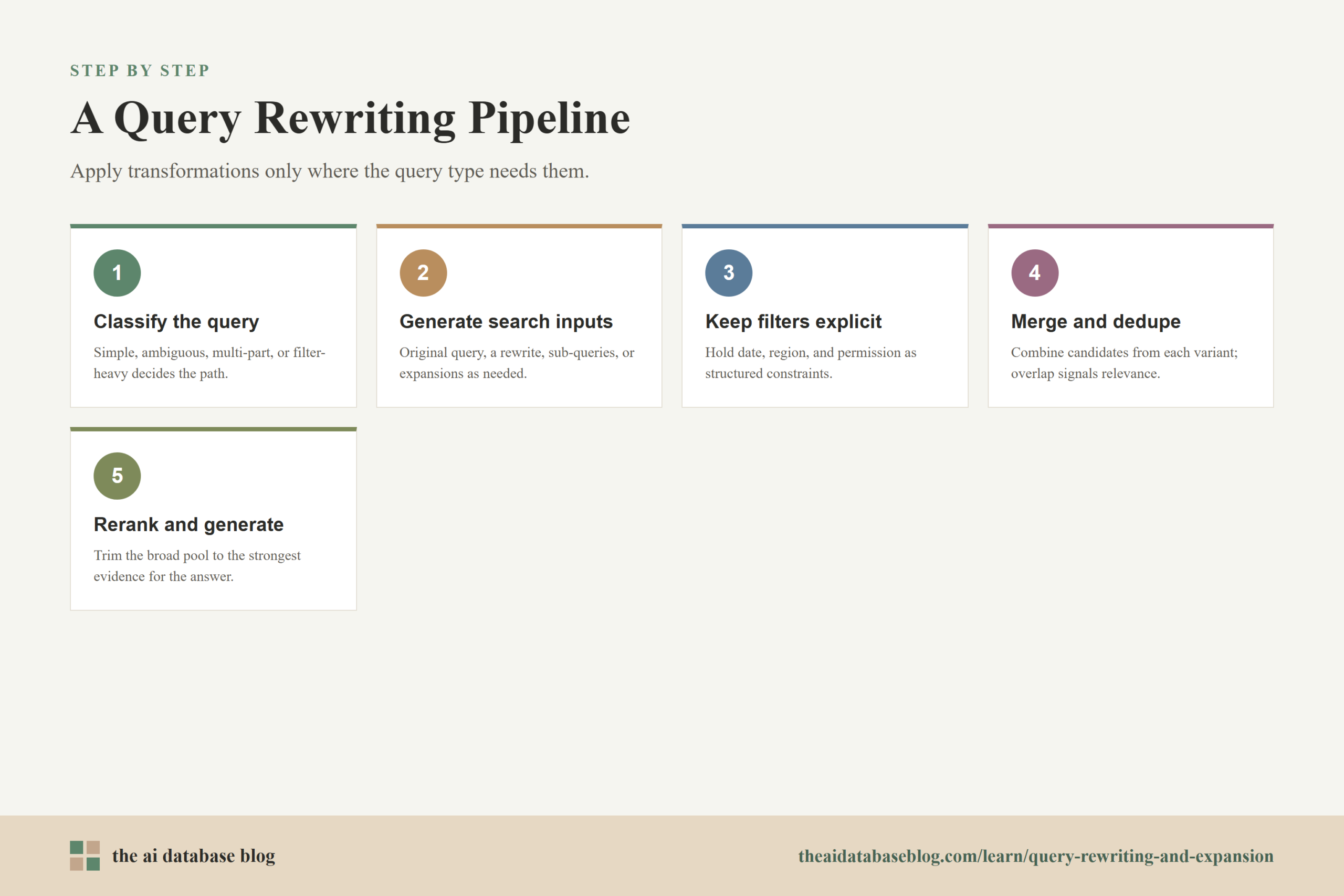
A query rewriting pipeline usually starts by classifying the user’s request. The system can decide whether the query is simple, ambiguous, conversational, multi-part, or filter-heavy. A simple factual lookup may only need the original query and strict filters. A complex comparison may need sub-queries. A vague conceptual question may benefit from expansion or a hypothetical passage. This routing prevents every query from paying the cost of every transformation.
After classification, the pipeline generates the needed search inputs. These may include the original query, a standalone rewrite, several sub-queries, a keyword expansion, or a hypothetical document. The retrieval system then searches one or more indexes, such as vector, keyword, and hybrid indexes. Metadata filters should remain explicit wherever possible so the database can enforce them directly.
The retrieved candidates are then merged and deduplicated. If several query variants retrieve the same document, that overlap can be a relevance signal. If different variants retrieve different but related documents, the system may keep a broader candidate pool before reranking. Reranking is important because expanded retrieval intentionally brings in more possibilities, and the system still needs to choose the most useful evidence for the final context window.
The final step is answer generation or result presentation. At this point, the generator should receive the best available evidence, not the entire noisy candidate set. Query rewriting improves the upstream chance of finding useful material, while reranking and context selection protect the downstream answer from being diluted by irrelevant results.
This pipeline view makes it easier to see the tradeoffs. Rewriting can improve recall, but every extra query variant, sub-query, or model call has a cost. The best implementation is measured against real retrieval outcomes, not assumed to be better because it is more elaborate.
Tradeoffs and Failure Modes
Query rewriting and expansion can improve retrieval, but they introduce new failure modes that teams need to manage. The most common problem is query drift, where the transformed query no longer matches the user’s actual intent. This can happen when an expansion adds related but incorrect terms, when an LLM resolves ambiguity too aggressively, or when a hypothetical passage invents details that were not present in the user’s request.
Another risk is over-retrieval. If the system generates too many variants, it may retrieve a large candidate set with uneven quality. This can increase latency, raise retrieval costs, and make reranking harder. In some systems, more search does not mean better answers because the extra candidates add noise instead of useful evidence.
Ambiguous queries are especially delicate. If a user asks about “index performance,” the system may need to know whether they mean vector index speed, keyword index tuning, database indexing, or model evaluation indexes. An LLM may choose one interpretation too early. A better approach is sometimes to retrieve across likely interpretations, ask a clarifying question, or use conversation context and metadata to narrow the search.
LLM-based expansion can also fail when the model lacks domain knowledge. In specialized domains, the model may propose terms that sound plausible but do not match the actual corpus. A curated domain dictionary, search-log analysis, or constrained expansion prompt can reduce this risk. The system should prefer expansions that are grounded in known terminology from the data rather than general associations.
These risks do not mean query rewriting should be avoided. They mean it should be evaluated and bounded. The next section explains how to measure whether rewriting is actually improving retrieval quality.
How to Evaluate Query Rewriting and Expansion
Evaluation should focus on whether rewriting helps the system retrieve better evidence for real user tasks. The most direct measure is recall: did the relevant document, passage, or record appear in the retrieved candidate set? Teams can evaluate this with a test set of queries and known relevant results, then compare retrieval with and without rewriting.
Precision and ranking quality matter too. A rewrite that retrieves the right answer but pushes it below many irrelevant candidates may not help the final system. Metrics such as recall at a fixed candidate count, mean reciprocal rank, and answer-grounding quality can show whether the best evidence appears early enough to be useful. In RAG systems, the final answer should also be checked for faithfulness to retrieved context.
Latency and cost should be measured alongside quality. Multi-query retrieval, sub-query generation, and LLM rewriting can add model calls and database searches. Some applications can afford this because accuracy matters more than speed. Others need routing rules that only apply rewriting to queries that are likely to benefit, such as ambiguous, multi-part, or low-confidence searches.
A practical evaluation loop uses production search logs, user feedback, and offline test sets together. Search logs reveal common language mismatches. User feedback shows where retrieval feels wrong in real workflows. Offline tests make it possible to compare changes before shipping them. Over time, this gives teams a clearer picture of which transformations improve recall and which merely add complexity.
Once evaluation is in place, query rewriting becomes easier to use responsibly. The final design question is not whether rewriting is useful in general, but which form of rewriting fits the query type, corpus, and user experience.
Practical Patterns for AI Database Applications
The best query rewriting pattern depends on the shape of the application. A customer support assistant may benefit from terminology expansion because users and support articles often describe the same issue in different words. A research assistant may benefit from sub-queries because questions often involve comparisons or multiple concepts. A compliance or legal assistant may need conservative rewriting that preserves exact terms and metadata filters more carefully than a general knowledge assistant.
For many AI database systems, a balanced starting point is to use the original query, a single standalone rewrite, and a small number of targeted expansions. If the query is complex, add sub-queries. If the query is short and conceptual, consider a hypothetical passage or multi-query variant. If the query includes strict constraints, keep those constraints outside the rewrite as structured filters.
Hybrid retrieval is often a strong partner for rewriting because it can use both semantic meaning and exact wording. Expanded terminology can help keyword search, while rewritten natural-language queries can help vector search. Reranking then helps decide which results are genuinely useful after the broader retrieval step.
The most important practical rule is to keep the transformation accountable to the user’s intent. Rewriting should make the query easier to retrieve, not more impressive or more elaborate. A small, well-constrained rewrite that consistently improves recall is usually more valuable than a complex transformation chain that is hard to debug.
These patterns are useful because they connect query rewriting to everyday retrieval problems: short questions, vague wording, domain-specific terms, multi-part requests, and mismatched document language. The FAQ section below answers common implementation questions that come up when teams start applying these ideas.
FAQs
1. What is the difference between query rewriting and query expansion?
Query rewriting changes the form of the query while preserving the user’s intent. For example, it may turn a conversational follow-up into a standalone search question. Query expansion adds related terms, synonyms, aliases, or alternate phrasings so the retrieval system can match more relevant documents. In practice, many systems use both together.
2. Does query rewriting matter if the system already uses vector search?
Yes. Vector search can capture semantic similarity, but it can still miss relevant content when the user query is short, ambiguous, too conversational, or missing domain-specific terms. Rewriting can create a better query embedding, while expansion and hybrid retrieval can help with exact terminology that embeddings may not handle reliably.
3. How many query variants should an LLM generate?
A small number is usually better than a large set. Many systems start with two to five variants, then evaluate whether the added recall is worth the cost and noise. The right number depends on latency budget, corpus size, reranking quality, and how complex the user’s queries tend to be.
4. When should a system generate sub-queries?
Sub-queries are most useful when the user’s request has multiple parts, requires comparison, depends on several facts, or asks for reasoning across different documents. They are less useful for simple lookups where the original query already expresses a clear retrieval target.
5. What is the biggest risk of LLM-based query expansion?
The biggest risk is drift. The LLM may add terms or assumptions that sound related but change the meaning of the query. This can retrieve plausible but irrelevant results. To reduce drift, preserve the original query, keep important constraints explicit, limit the number of expansions, and evaluate results against known retrieval examples.
6. Should query rewriting happen before or after metadata filtering?
Metadata constraints should usually be identified before retrieval and enforced during retrieval whenever possible. The semantic query can be rewritten or expanded, but filters such as date, region, document type, permission level, or customer segment should remain structured so the AI database can apply them precisely.
Takeaway
Query rewriting and expansion help AI database applications retrieve better evidence by closing the gap between how users ask questions and how information is stored. Readers should now understand how pre-retrieval transformations, sub-queries, terminology expansion, and LLM-generated query variants can improve recall, as well as the tradeoffs around drift, latency, cost, and precision. This guidance is most useful for teams building RAG systems, semantic search tools, support assistants, research workflows, or knowledge retrieval applications where missing the right document is more damaging than retrieving a slightly broader candidate set.
Watch this video to learn more