Maximum Inner Product Search, usually shortened to MIPS, is the task of finding the stored vectors that produce the largest dot product with a query vector. It is related to nearest-neighbor search, but it is not always the same problem because inner product scores depend on both direction and vector magnitude. This makes MIPS especially important in recommendation systems, ranking models, attention mechanisms, and AI database workloads where a larger vector norm can carry useful meaning rather than noise.
This guide explains how MIPS differs from ordinary nearest-neighbor search, why vector magnitude matters, where inner products appear in real AI systems, and when normalization makes MIPS equivalent to cosine-style nearest-neighbor retrieval. By the end, you should be able to decide when MIPS is the right retrieval objective and when a normalized similarity metric is a safer fit.
What Maximum Inner Product Search Means
Maximum Inner Product Search asks a simple question: given a query vector and a collection of stored vectors, which stored vectors have the highest inner product with the query? The inner product is computed by multiplying matching dimensions and adding the results. If two vectors point in similar directions and also have large magnitudes, their inner product can be high.
In an AI database, this usually means a query embedding is compared against many stored embeddings. The database returns the top results according to the inner product score. Unlike keyword search, the comparison happens in embedding space, where numerical coordinates represent learned patterns such as semantic meaning, user preference, product affinity, or model attention.
MIPS is often discussed alongside approximate nearest-neighbor search because both involve finding top vector matches efficiently. The difference is the scoring objective. Nearest-neighbor search usually tries to find the closest vectors under a distance function, while MIPS tries to find the largest dot product.
That distinction sounds small, but it changes how results behave. To understand why, the next step is to separate distance-based closeness from score-based alignment.
How MIPS Differs From Nearest-Neighbor Search
Nearest-neighbor search usually means finding vectors that are closest to a query under a distance metric such as Euclidean distance, angular distance, or cosine distance. These metrics treat retrieval as a question of proximity: which stored point sits nearest to the query point? MIPS treats retrieval as a question of score: which stored point produces the largest inner product with the query?
The two ideas can agree in some cases, especially when all vectors are normalized to the same length. But without normalization, they can rank results differently. A vector that points in a fairly similar direction but has a much larger magnitude may beat a shorter vector that points more directly toward the query. That is because the inner product grows when either directional alignment or vector length grows.
This is why MIPS is not always a metric nearest-neighbor problem in the strict sense. Many distance-based indexing methods rely on geometric assumptions such as triangle inequality or stable notions of local proximity. Inner product search can violate the intuition that the best match must be the geometrically closest point, because a farther but longer vector may receive a higher score.
For AI database users, the practical difference is simple: nearest-neighbor search is usually best when similarity should mean closeness in direction or distance, while MIPS is best when the score itself should reward magnitude. The choice depends on what the embedding model uses vector length to represent.
Once that difference is clear, the natural question is why anyone would want magnitude to matter. The answer appears in several important AI workloads where vector length is part of the signal.
Where MIPS Appears in AI Systems
MIPS appears anywhere a model represents two things as vectors and scores their match with a dot product. In these systems, the database or retrieval layer may need to find the highest-scoring candidates quickly rather than merely finding the closest vectors by distance. This is common in ranking, recommendation, and model-internal attention because dot products are fast, expressive, and easy to optimize during training.
Recommendation Systems
In a recommendation system, users and items can be represented as vectors in the same embedding space. A user’s vector may represent their preferences, and an item’s vector may represent attributes learned from behavior such as clicks, purchases, ratings, or engagement. The inner product between the user vector and item vector becomes a predicted affinity score.
In this setting, a high inner product does not only mean that the user and item point in similar directions. It may also reflect item popularity, user activity level, confidence in the representation, or another magnitude-related signal learned by the model. MIPS is useful because the retrieval system can ask for the items with the highest predicted score for a given user vector.
Attention Mechanisms
Attention mechanisms in transformer-style models also use dot products. A query vector is compared with key vectors, and the resulting scores help determine which value vectors should influence the output. In scaled dot-product attention, the scores are adjusted by a scaling factor before being passed through a softmax operation.
This is not always implemented as a database search, because attention usually happens inside the model during inference or training. Still, it illustrates the same core idea: inner products are used to rank or weight relationships between vectors. In long-context retrieval, memory systems, and retrieval-augmented model architectures, similar scoring ideas can appear at the boundary between model computation and external vector search.
Retrieval and Ranking Pipelines
MIPS can also appear in retrieval pipelines where a first-stage search collects candidate documents, passages, images, products, or entities for a second-stage ranker. If the model was trained with dot product scoring, using MIPS in the retrieval layer preserves the scoring behavior the model learned. Replacing it with cosine distance or Euclidean distance without checking the training objective can change the ranking.
These examples show that MIPS is useful because magnitude may encode real information. But that same feature can also create surprising results when the embedding space was not designed for magnitude-sensitive retrieval.
Why Magnitude Sensitivity Matters
Magnitude sensitivity is the most important practical concept in MIPS. The inner product becomes larger when vectors are more directionally aligned, but it also becomes larger when one or both vectors have greater length. This means MIPS combines two effects that cosine similarity deliberately separates: direction and magnitude.
For some systems, that is exactly what you want. A recommendation model might learn that higher-norm item vectors represent stronger or more confident item signals. A ranking model might encode popularity, certainty, or intensity in vector length. In those cases, removing magnitude through normalization can erase useful information and reduce ranking quality.
For other systems, magnitude can be a source of bias. In semantic text retrieval, for example, users often care about whether two embeddings point in a similar semantic direction. If vector length mostly reflects incidental properties of the embedding model or input, raw inner product search may over-rank long-norm vectors even when their meaning is less relevant.
This is why metric choice should not be treated as a minor configuration detail. If the vectors were trained or generated for cosine similarity, normalize them and search accordingly. If they were trained for dot product scoring and the norms are meaningful, MIPS may be the correct choice.
Magnitude sensitivity also explains why normalization is such a common topic in vector databases. Normalization can turn inner product search into a direction-only similarity problem, but it changes what the scores mean.
Normalization Equivalence: When MIPS Becomes Nearest-Neighbor Search
Normalization means rescaling vectors so they all have the same length, usually length one. When both query vectors and stored vectors are normalized this way, the inner product between them is equivalent to cosine similarity. In that normalized space, maximizing the inner product gives the same ranking as maximizing cosine similarity.
This equivalence is useful because many vector indexes and database engines can optimize dot product operations efficiently. If the goal is cosine-style retrieval, one common approach is to normalize vectors before storing them and normalize query vectors before searching. Then an inner product index can return the same order of results that cosine similarity would return.
There is also a relationship between normalized inner product and nearest-neighbor search by distance. For unit-length vectors, vectors with higher cosine similarity are closer in angular terms, and their Euclidean distance has a fixed relationship to that similarity. In practical terms, once all vectors have the same norm, direction becomes the main ranking signal.
The important caveat is that normalization is not just a performance trick. It is a modeling decision. If vector norms carry useful information, normalization removes that information. If vector norms are unwanted noise, normalization can make retrieval more stable and easier to interpret.
With that equivalence in mind, choosing between MIPS and normalized nearest-neighbor search becomes less about terminology and more about the meaning of the embedding space.
How to Choose Between MIPS, Cosine Similarity, and Distance Search
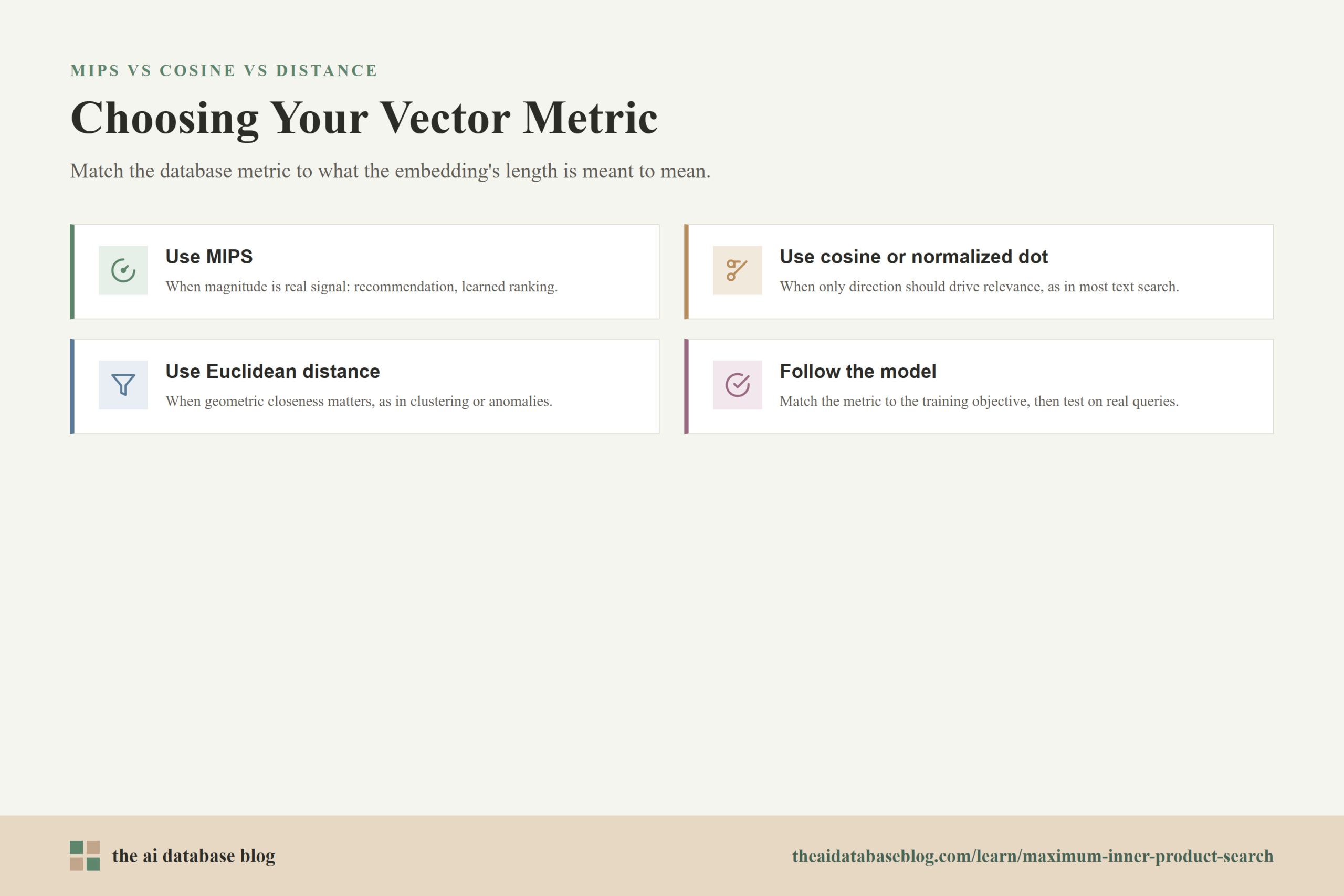
The best choice depends on the scoring behavior your application needs. If you are using embeddings from a model or training process that expects dot product scoring, MIPS usually preserves that intent. If you are using embeddings for semantic retrieval and want similarity to depend mostly on direction, cosine similarity or normalized dot product is often easier to reason about.
Use MIPS when vector magnitude is meaningful. This is often true in recommendation, learned ranking, and models where the training objective directly optimized dot product scores. In these systems, a larger vector norm may represent strength, confidence, or popularity, and removing it can change the model’s behavior.
Use normalized dot product or cosine similarity when magnitude should not influence relevance. This is common in many text, document, and question-answering retrieval systems. Normalization helps prevent high-norm vectors from winning simply because they are long rather than because they are more relevant.
Use Euclidean or other distance-based nearest-neighbor search when physical or geometric distance is meaningful in the embedding space. Some clustering, anomaly detection, image, and signal-processing workloads are more naturally framed as distance problems than score-maximization problems.
The safest workflow is to match the database metric to the embedding model’s intended scoring function, then evaluate retrieval quality with real queries. Theoretical equivalence helps you avoid obvious mistakes, but application-level relevance testing tells you whether the chosen metric actually works.
Once the metric is chosen, the remaining challenge is operational: making the search fast enough while preserving enough ranking quality for the application.
Indexing and Retrieval Implications for AI Databases
AI databases often support approximate vector indexes so applications can search large embedding collections without scanning every vector. For MIPS, the index needs to retrieve high inner product candidates efficiently. Some systems support inner product directly, while others use transformations or normalized-vector approaches to map the problem into a form handled by nearest-neighbor indexes.
Approximation introduces a tradeoff between speed and recall. A faster index may miss some exact top-scoring vectors, especially when the ranking boundary is tight or the vector distribution is difficult. This matters for MIPS because high-norm vectors can create score distributions that differ from cosine-based search.
Filtering also matters. In many AI database applications, vector search is combined with metadata filters such as category, permissions, geography, recency, or tenant boundaries. A MIPS query may first restrict the candidate set with filters and then rank the remaining vectors by inner product, or it may use an index strategy that combines filtering and vector scoring more tightly.
For retrieval-augmented generation, MIPS is useful when the embedding and ranking setup was designed for dot product scoring. However, many RAG systems use normalized embeddings and cosine-style retrieval because the goal is often semantic match rather than magnitude-sensitive affinity. The right choice should follow the embedding model, the dataset, and the evaluation results rather than a default assumption.
These implementation details bring the discussion back to the same principle: MIPS is powerful when its score matches the meaning of the vectors. When that meaning is unclear, normalize, test, and compare before committing to a metric.
Common Mistakes When Using MIPS
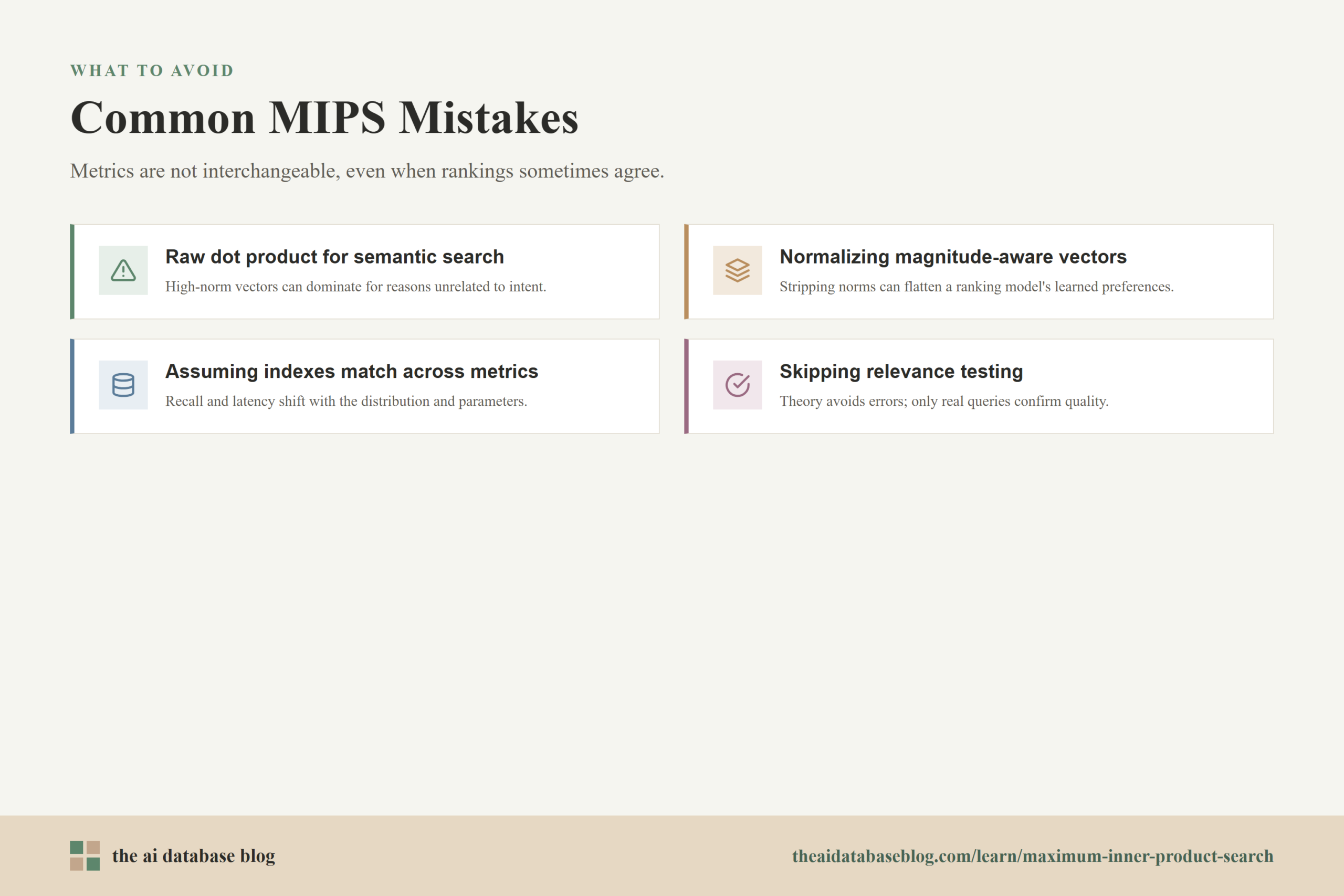
MIPS errors usually happen when teams treat all vector similarity metrics as interchangeable. Dot product, cosine similarity, and Euclidean distance can produce similar rankings under specific conditions, but they are not generally the same. A retrieval system can look technically correct while quietly ranking the wrong results because the metric does not match the embeddings.
One common mistake is using raw inner product for semantic search without checking whether vector norms are meaningful. If high-norm vectors dominate the results, the system may favor certain documents, passages, or items for reasons unrelated to user intent. Normalization can help when this behavior is unwanted.
Another mistake is normalizing vectors from a recommender or ranking model that learned to use magnitude. In that case, normalization may flatten useful score differences. The system may still return plausible results, but it may no longer reflect the model’s learned preference structure.
A third mistake is assuming that an approximate nearest-neighbor index will behave identically across metrics. Index parameters, vector distributions, dimensionality, and filtering can all affect recall and latency. MIPS workloads should be evaluated with the same care as cosine or distance workloads.
Understanding these mistakes makes the main lesson easier to apply: MIPS is not better or worse than nearest-neighbor search in general. It is better only when the application needs inner product ranking.
FAQs
1. What is Maximum Inner Product Search?
Maximum Inner Product Search is the task of finding the stored vectors that have the largest inner product, or dot product, with a query vector. In AI databases, it is used to retrieve top-scoring embeddings from a large collection.
2. Is MIPS the same as nearest-neighbor search?
MIPS is related to nearest-neighbor search, but it is not always the same. Nearest-neighbor search usually finds the closest vectors by distance, while MIPS finds the vectors with the highest dot product score. They become equivalent in some normalized settings.
3. Why does vector magnitude affect MIPS results?
The inner product increases when vectors are more aligned, but it also increases when vectors have larger norms. This means a longer vector can receive a higher score even if it is not the closest vector by distance or direction alone.
4. When should I normalize vectors before search?
You should normalize vectors when you want similarity to depend mainly on direction rather than vector length. This is common in semantic retrieval, where cosine similarity or normalized dot product is often easier to interpret than raw inner product.
5. Why is MIPS common in recommendation systems?
Recommendation models often represent users and items as vectors and use their inner product as a predicted preference score. MIPS lets the system quickly retrieve the items with the highest predicted affinity for a given user vector.
6. How does MIPS relate to attention in transformers?
Transformer attention uses dot products between query and key vectors to compute attention scores. Although this usually happens inside the model rather than in an external database, it relies on the same basic idea of scoring vector relationships with inner products.
Takeaway
Maximum Inner Product Search is a vector retrieval method for finding the highest dot product matches, and its main difference from ordinary nearest-neighbor search is magnitude sensitivity. It is most useful for AI database workloads where vector length is part of the learned signal, such as recommendations, ranking, and some model-driven retrieval systems. For teams building semantic search or RAG systems, the key decision is whether magnitude should influence relevance; if not, normalized vectors make inner product search equivalent to cosine-style retrieval and often produce more interpretable results.
Watch this video to learn more