ACORN is a filtered vector search approach designed to keep graph-based nearest neighbor search fast when metadata filters are applied. Instead of treating the filter as an afterthought, ACORN makes traversal filter-aware: it tries to move through the part of the graph that can actually return valid results, uses nearby nodes to predict where filter-matching neighbors are likely to be, adapts its behavior based on filter selectivity, and avoids the sudden latency and recall failures that can happen when a fixed traversal strategy meets a difficult filter.
This guide explains why filtered vector search is hard, how ACORN changes graph traversal, what adaptive filtered traversal means in practice, and why selectivity-aware strategies matter for AI databases. By the end, you should understand how ACORN-style search differs from simple pre-filtering or post-filtering, why multi-hop neighbor exploration helps, and how these ideas make retrieval systems more predictable for RAG, semantic search, recommendation, and authorization-scoped search workloads.
Why Filtering Breaks Simple Graph Traversal
Many vector databases use graph-based approximate nearest neighbor search, often with an HNSW-style index. In this kind of index, each object is a node, and edges connect it to nearby objects in vector space. A query starts from an entry point and moves through the graph toward nodes that are closer to the query vector. This works well when the query only needs semantic similarity, because the graph is built to make nearby vectors easy to reach without scanning the whole dataset.
Metadata filters change the problem. A user might ask for documents similar to a query, but only within a date range, tenant, language, product category, access-control scope, or compliance label. The vector graph was built from semantic proximity, not from every possible filter. If the search walks the full graph and only checks the filter at the end, it can waste time scoring many candidates that cannot be returned. If it refuses to visit nodes that fail the filter, it can cut off useful paths through the graph and miss good results.
This is the core tension in filtered vector search: non-matching nodes may be bad result candidates, but they may still be useful navigation points. A node can fail the filter while still connecting the search to a region full of valid neighbors. A naive filtered traversal that drops every non-matching node too aggressively can make the filtered subgraph sparse or disconnected. A naive post-filtered traversal can preserve navigability, but it may do too much work before finding enough eligible results.
Once filters enter the query path, the database has to answer two questions at the same time: which vectors are nearest to the query, and which of those vectors satisfy the structured predicate. ACORN is important because it treats those questions as one combined retrieval problem rather than two isolated steps.
What ACORN Is Trying to Solve
ACORN, short for ANN Constraint-Optimized Retrieval Network in the original research, was introduced as a way to support hybrid search over vector embeddings and structured predicates. The goal is not only to make filtering possible, but to make filtered search efficient across many kinds of filters without building a separate vector index for every predicate. That matters because real applications often have open-ended filters: user IDs, document permissions, timestamps, tags, regions, product attributes, and combinations that are not known in advance.
Traditional approaches each have a weakness. Pre-filtering first finds every object that passes the filter and then searches only those vectors. This can be effective when the filtered candidate set is very small, but it becomes expensive when many objects pass the filter because the search may approach a large brute-force scan. Post-filtering searches the vector index first and removes non-matching results afterward. This can be fast when the filter is broad or highly correlated with the query, but it can fail or slow sharply when the nearest vector region contains many objects that do not pass the filter.
ACORN addresses the gap between these extremes. Its central idea is predicate subgraph traversal: during search, the algorithm tries to move through the graph induced by nodes that pass the query predicate. In simpler terms, it attempts to behave as if there were a useful HNSW-like graph built only over the valid objects, without actually building a separate graph for every possible filter.
This distinction is subtle but important. ACORN is not just a faster filter check. It is a change in how the vector graph is explored. The filter influences which neighbors are scored, which candidate paths are expanded, and when the search should use a different strategy altogether.
Filter-Aware Graph Traversal
Filter-aware graph traversal means the search uses the filter while deciding how to move through the graph, not only while deciding which final results to return. In a standard HNSW traversal, the algorithm follows neighbors that look closer to the query vector. In a filtered traversal, closeness alone is not enough. A neighbor that is close but fails the filter cannot be returned, while a slightly farther neighbor that passes the filter may be much more useful.
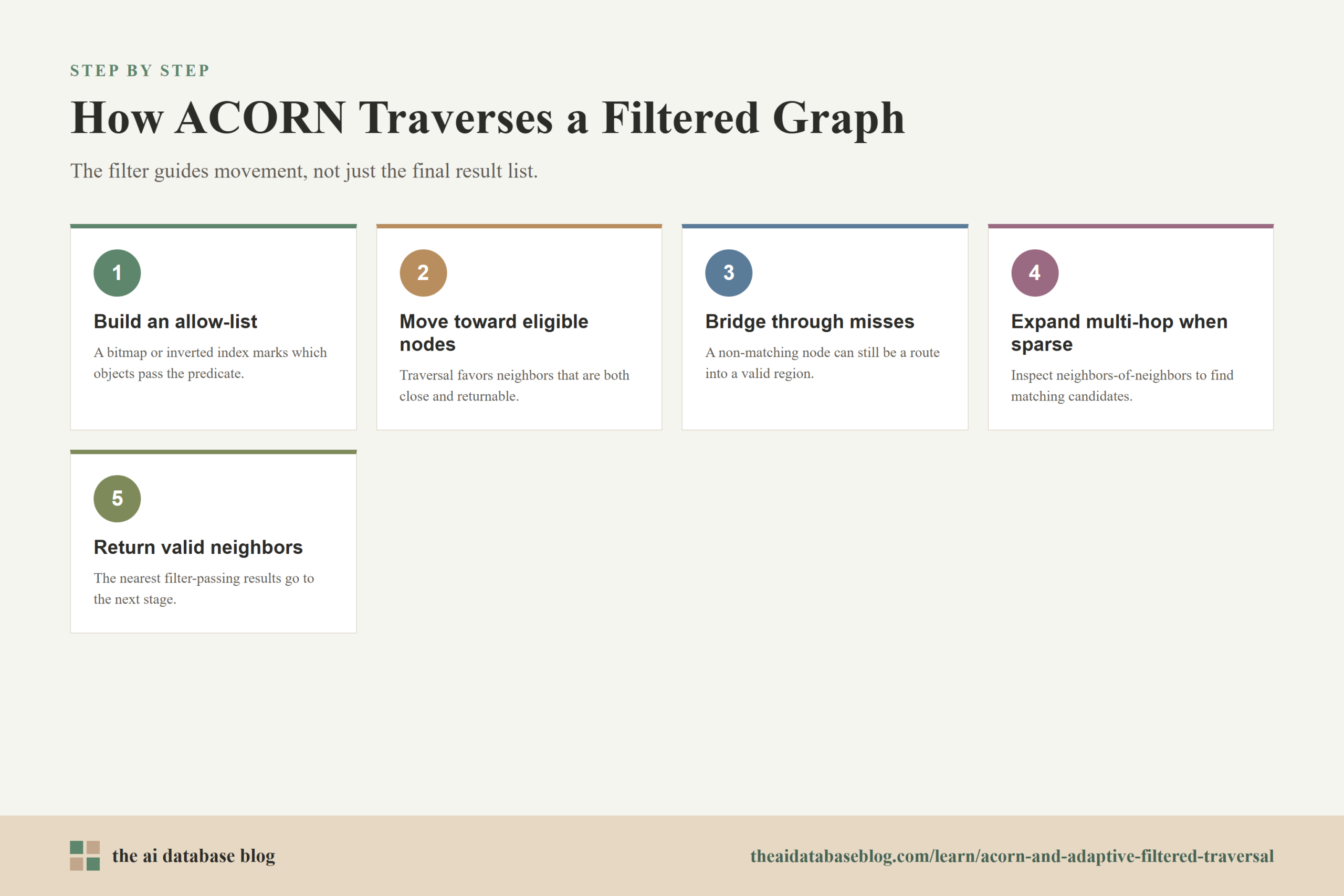
ACORN-style traversal changes the role of non-matching nodes. Instead of always scoring them as ordinary candidates or always ignoring them completely, the search can use them as signals about where to go next. If a node fails the filter, its neighborhood may still contain nodes that pass. That makes the failed node a possible bridge into a valid region of the graph.
The practical effect is that ACORN tries to reduce unnecessary distance calculations for objects that cannot be returned, while still preserving enough graph connectivity to reach good filtered results. This is a careful balance. If the algorithm is too strict, recall can suffer because it loses paths. If it is too loose, latency can rise because it behaves like ordinary HNSW plus a filter check.
In production systems, this idea is often combined with an allow-list from an inverted or bitmap filter index. The filter index quickly identifies which object IDs are eligible. The graph traversal then uses that eligibility information while exploring the vector index. The filter index answers “can this object be returned?” while the graph traversal answers “is this object useful for moving toward the nearest eligible results?”
Predicting Which Neighbors Pass the Filter
A key intuition behind ACORN is that the neighborhood around a node contains information about the filtered search space. When the current node or its direct neighbor does not pass the filter, the search should not immediately conclude that the region is useless. Nearby neighbors, and sometimes neighbors-of-neighbors, may pass the filter and provide a better route into the predicate subgraph.
This is where multi-hop expansion matters. In a plain graph traversal, the search usually considers direct neighbors of a visited node. ACORN-style traversal can look beyond the immediate neighbor list when the filter makes the local graph sparse. If a direct neighbor fails the predicate, the algorithm can inspect that neighbor’s neighborhood to find candidates that do pass. The failed neighbor becomes a stepping stone rather than a dead end.
This does not mean ACORN predicts filter membership with a machine learning classifier. The “prediction” is more structural and local: based on the current graph neighborhood and the known filter allow-list, the algorithm estimates whether expanding through a nearby node is likely to reveal valid candidates. If the neighborhood contains enough filter-matching nodes, it is worth exploring. If it does not, the search can avoid spending too much work there.
For example, imagine a vector graph of support tickets where the query is semantically close to billing-related tickets, but the filter asks only for tickets from one customer account. The nearest billing tickets may belong to many accounts. A simple post-filtered search may examine many irrelevant tickets before finding enough from the target account. A strict filtered traversal may get stuck if the target account’s tickets are not densely connected to each other. ACORN-style multi-hop expansion helps by using nearby non-matching tickets to reach matching tickets in the same semantic region.
The deeper lesson is that filtered vector search is a navigation problem. The search does not only need to know which nodes pass the filter; it needs to find a path through the graph that reaches those nodes efficiently.
Adaptive Strategies by Selectivity
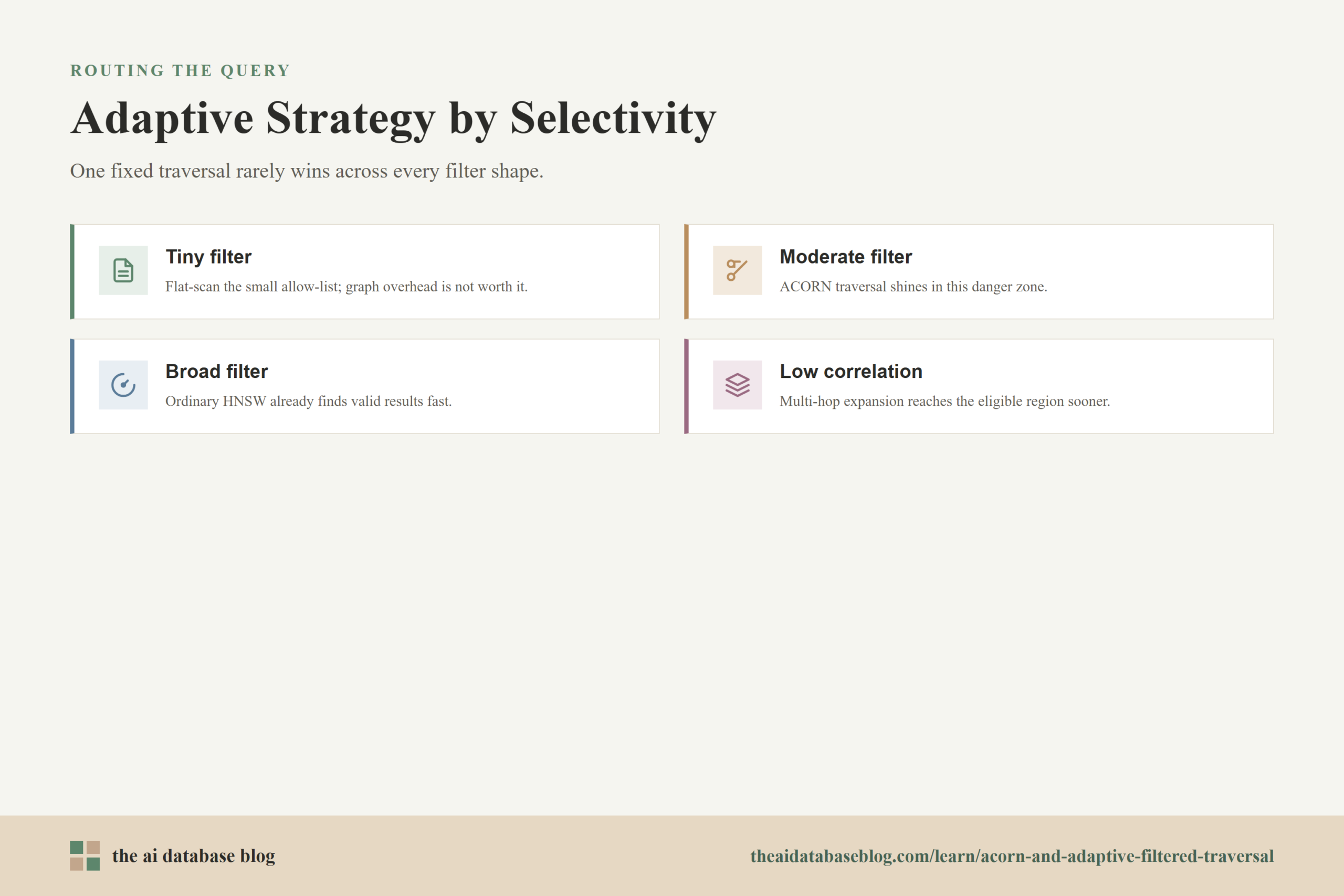
Filter selectivity describes how much of the dataset passes a filter. A highly selective filter returns a small fraction of objects. A broad filter returns a large fraction. This single property changes which search strategy is likely to perform well. That is why adaptive filtered traversal is so useful: one fixed strategy is rarely optimal across all selectivity levels.
When a filter is very small, a flat scan over the filtered candidate set can be cheaper and more predictable than graph traversal. If only a few hundred or a few thousand objects pass the filter, the database may be better off comparing the query vector against those objects directly. Graph search has overhead, and that overhead is not always justified when the eligible set is tiny.
When a filter is moderately selective, ACORN-style traversal can be valuable. There are enough eligible nodes that graph navigation can work, but not so many that ordinary traversal is guaranteed to find them quickly. This is the danger zone where post-filtering can waste many distance calculations and strict filtering can damage recall. Multi-hop expansion and filter-aware neighbor evaluation are especially useful here.
When a filter is broad, ordinary HNSW-style traversal may already work well. If most nodes pass the filter, the filtered search space resembles the full graph. In that case, aggressive ACORN behavior can add overhead without much benefit. A good adaptive system can recognize this and use a simpler traversal path when the filter is dense enough.
Selectivity is not the only factor. Correlation between the filter and the vector query also matters. If the filter matches the same semantic region as the query, standard traversal may find valid results quickly. If the filter is weakly correlated or negatively correlated with the query, the graph may lead toward semantically close objects that mostly fail the filter. ACORN is especially helpful in those low-correlation cases because it has mechanisms for reaching the relevant filtered region faster.
How ACORN Avoids Performance Cliffs
A performance cliff happens when a query strategy works well for one filter shape but degrades sharply when the filter changes. In vector search, this often appears when a system performs well with broad filters but slows dramatically with restrictive filters, or when it handles tiny filters through brute force but becomes expensive as the filtered set grows. These cliffs are painful in production because application filters are rarely uniform.
ACORN avoids performance cliffs by reducing dependence on one brittle assumption. A simple post-filtered search assumes that the ordinary vector graph will quickly encounter enough valid results. That assumption fails when many nearby nodes do not pass the filter. A simple pre-filtered scan assumes the eligible set is small enough to search directly. That assumption fails when the filter still leaves a large candidate set. ACORN-style traversal adds a middle path for cases where the filter is selective enough to matter but not small enough for flat search.
The multi-hop behavior helps avoid recall cliffs by keeping the filtered graph navigable. If direct filtered edges are too sparse, expanding through nearby neighborhoods can reveal valid nodes that would otherwise be hidden behind non-matching connectors. The strategy selection helps avoid latency cliffs by changing tactics when the filter is too small, moderately selective, or broad.
This is why adaptive filtered traversal is best understood as a query planning problem, not just an index feature. The system needs to estimate the cost of each option: flat search over the allow-list, standard graph traversal with filtering, or ACORN-style filter-aware expansion. The right choice depends on the number of eligible objects, how filters correlate with vector neighborhoods, the requested top-k, and the latency-recall target.
For AI applications, this predictability matters as much as raw speed. RAG systems, recommendation engines, and search interfaces often apply filters for permissions, recency, tenant isolation, or content type. Users expect those filters to narrow the answer, not randomly make retrieval slow or incomplete. ACORN-style traversal helps the database maintain more consistent behavior when those filters vary from query to query.
Where ACORN Fits in an AI Database Architecture
ACORN is one part of a larger retrieval architecture. A filtered vector query usually involves several layers: metadata indexes to build an allow-list, a vector index to retrieve semantically close candidates, optional hybrid ranking with keyword scores, and sometimes a reranker or generator after retrieval. ACORN improves the vector traversal layer, especially when HNSW is used and filters interact strongly with the graph search path.
It is useful to separate three responsibilities. The metadata index should evaluate the structured filter efficiently. The vector index should navigate toward semantically close candidates. The filtered traversal strategy should combine those signals without wasting work or losing good paths. ACORN lives in that third responsibility.
In a RAG system, this can affect answer quality directly. Suppose a user asks a question that should only retrieve documents from a specific customer, department, time period, or access-control scope. If the retrieval layer under-finds relevant filtered chunks, the language model may answer from incomplete context. If the retrieval layer over-expands to compensate, latency and cost may rise. ACORN-style traversal helps maintain the quality of the candidate set while keeping the search efficient.
ACORN is not a reason to ignore data modeling. If every query is naturally scoped to a tenant or partition, physical partitioning or separate small indexes may still be useful. If filters are almost always tiny, flat filtered search may be enough. If filters are broad and highly correlated with vectors, ordinary traversal may already be efficient. The value of ACORN is strongest when filters are dynamic, moderately selective, high-cardinality, or weakly correlated with the vector query.
Practical Design Lessons
The first practical lesson is that filtered vector search should be tested with realistic filters, not only with unfiltered nearest neighbor benchmarks. A system can look fast on ordinary vector queries and still struggle when production filters are added. Benchmark filters should include broad filters, narrow filters, compound filters, tenant or permission filters, and filters that are weakly correlated with the query embedding.
The second lesson is that selectivity-aware routing matters. A robust system should be able to use flat search for very small allow-lists, graph traversal for normal vector search, and ACORN-style expansion when the filtered graph needs help staying navigable. This does not have to be exposed to end users, but it should be part of the database’s query execution path or the application’s retrieval design.
The third lesson is that metadata indexing still matters. ACORN can make graph traversal smarter, but it still benefits from fast knowledge of which objects pass the filter. Bitmap, inverted, or range indexes can make allow-list generation efficient, while ACORN can use that allow-list during vector graph exploration.
The fourth lesson is to measure both recall and latency. A filtered vector search strategy that is fast but misses relevant eligible results is not good enough for retrieval-heavy AI applications. A strategy that preserves recall by scanning too much may also be unsuitable. The right evaluation should compare recall at top-k, tail latency, distance computations, and behavior across filter selectivity bands.
These design lessons point toward the same conclusion: filtered vector search is not a checkbox feature. It is a retrieval behavior that depends on how the database combines structured filtering, vector graph navigation, and adaptive query execution.
FAQs
1. What is ACORN in vector search?
ACORN is a filtered approximate nearest neighbor search approach for graph-based vector indexes. It is designed to make vector search with structured filters faster and more reliable by traversing the filter-matching part of the graph more intelligently instead of relying only on pre-filtering or post-filtering.
2. How is ACORN different from post-filtering?
Post-filtering searches the vector index first and removes non-matching results afterward. ACORN uses filter information during traversal, so the search can avoid wasting as much work on candidates that cannot be returned while still preserving paths through the graph that lead to valid results.
3. Why does filter selectivity matter?
Filter selectivity determines how many objects pass the filter. Very small filters may be best handled by direct search over the eligible set, broad filters may work well with ordinary graph traversal, and moderately selective filters often need smarter filter-aware traversal to avoid latency or recall problems.
4. Does ACORN use machine learning to predict matching neighbors?
Not in the usual sense. ACORN-style traversal uses graph structure and filter eligibility information to decide whether expanding through a neighborhood is likely to reveal useful matching candidates. The prediction is based on local graph exploration, not on a separate trained classifier.
5. What are performance cliffs in filtered vector search?
Performance cliffs are sudden drops in speed or recall when filter conditions change. For example, a search system may work well when half the dataset passes a filter but become much slower when only a small percentage passes. Adaptive filtered traversal reduces this risk by choosing a strategy that better matches the filter shape.
6. When is ACORN most useful?
ACORN is most useful when filters are selective, dynamic, high-cardinality, or weakly correlated with the vector query. Common examples include permission-scoped RAG, multi-tenant search, time-windowed retrieval, category filters, and recommendation systems where metadata constraints vary by user or request.
Takeaway
ACORN and adaptive filtered traversal show why filtered vector search is a graph navigation problem, not just a metadata lookup. The main idea is to make traversal aware of which nodes can pass the filter, use nearby neighborhoods to reach valid candidates, and adapt the strategy based on selectivity so the system avoids sharp latency and recall cliffs. This is most useful for engineers and technical teams building AI databases, RAG systems, semantic search, or recommendation pipelines where metadata filters are common and query behavior changes from one request to the next.
Watch this video to learn more