Episodic memory helps an AI agent remember what happened, in what order, and in what context. Semantic memory helps the agent remember general facts, stable preferences, concepts, relationships, and rules that remain useful beyond one specific event. A coherent agent usually needs both: episodic memory preserves the timeline of experience, while semantic memory turns repeated or confirmed experience into reusable knowledge.
This guide explains how episodic and semantic memory differ in agent systems, how each type of memory is stored and retrieved, and why combining them is important for reliable long-term behavior. It also connects these ideas to AI database design, because memory quality often depends less on the model alone and more on how events, facts, metadata, embeddings, timestamps, and retrieval policies are organized.
What Memory Means in an AI Agent
Memory in an AI agent is not the same thing as the model’s built-in training data. It is the external or persistent information the agent can store, search, update, and use across interactions. Without memory, an agent can only rely on the current prompt, the immediate context window, and whatever general knowledge is already encoded in the model. That may be enough for a single short conversation, but it is not enough for agents that need to follow projects over time, remember user preferences, avoid repeated mistakes, or reason about previous decisions.
In practical systems, agent memory is often built with databases, search indexes, metadata stores, knowledge graphs, logs, and retrieval pipelines. The agent observes something, decides whether it should be written to memory, stores it in a structured or semi-structured form, and later retrieves relevant records when a new task requires them. This turns memory into an infrastructure problem as much as a reasoning problem.
The first important design question is what kind of memory is being stored. A transcript, a user preference, a policy rule, a tool result, and a conclusion drawn from multiple conversations are not the same kind of information. Treating them all as generic text chunks can work for simple retrieval, but it often breaks down when the agent needs to understand sequence, source, confidence, or whether a fact is still valid.
That is where the distinction between episodic and semantic memory becomes useful. It gives builders a clearer way to decide what should be stored as an event and what should be stored as a general fact. Once that distinction is clear, retrieval can also become more precise.
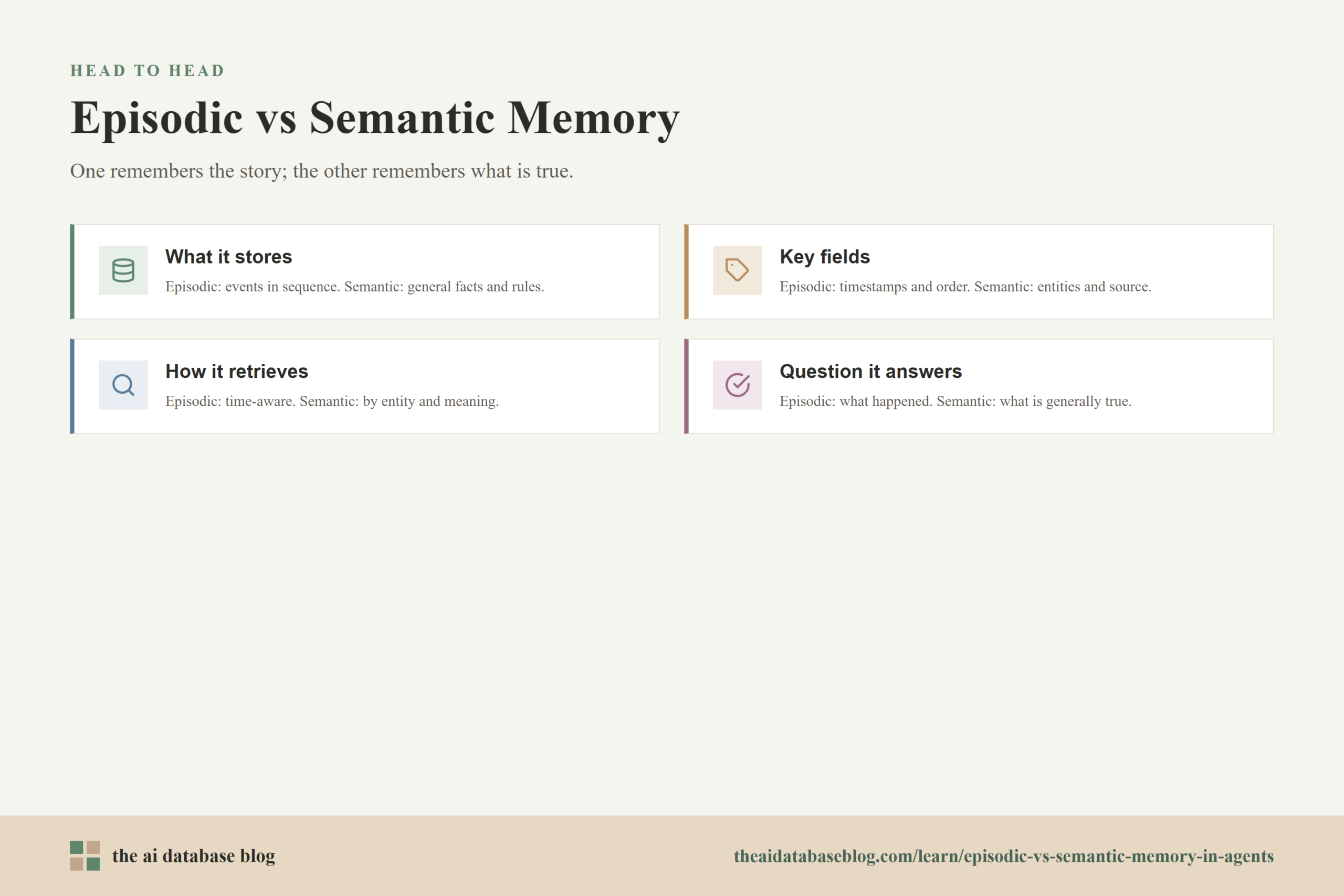
Episodic Memory Stores Events in Sequence
Episodic memory is memory of specific experiences. For an AI agent, an episode might be a user request, a tool call, a retrieved document, a failed action, a decision made during a workflow, or a sequence of steps that led to a final result. The key point is that episodic memory preserves the event as something that happened at a particular time, in a particular context, with particular participants, inputs, outputs, and consequences.
This kind of memory is especially important when the order of events matters. If an agent helped a user debug a system over several days, it should not only remember the final fix. It may need to remember that the first hypothesis failed, that a configuration was changed before a test passed, or that the user rejected one approach because it created a deployment risk. Those details are not just facts. They are parts of a timeline.
What Gets Stored in Episodic Memory
An episodic memory record usually benefits from more structure than a plain text note. A useful event record may include the raw event text, a concise summary, timestamp, actor, task identifier, tool used, result, confidence, linked artifacts, and metadata about the environment. It may also include references to previous and next events so the agent can reconstruct a chain of activity rather than retrieve isolated fragments.
For example, an agent working on a customer support workflow might store that a user asked about a billing error on Monday, the agent checked two systems, the first system showed no issue, the second system showed a duplicate charge, and the user asked to be notified after the refund was complete. The sequence matters because it explains why the next step is notification rather than investigation.
AI databases can support episodic memory by storing each event as an object or row with a searchable text representation, an embedding, and structured metadata. The embedding supports similarity search, while metadata such as time, user, project, session, tool, outcome, and entity identifiers supports filtering and chronological reconstruction.
Why Episodic Memory Is Harder Than a Chat Log
A chat log is not automatically good episodic memory. Logs preserve raw history, but they can be too long, noisy, repetitive, and difficult to search. Good episodic memory requires event segmentation, which means deciding where one meaningful event ends and another begins. It also requires summarization, source tracking, temporal ordering, and enough context to explain why the event mattered.
For long-running agents, storing every token forever is usually inefficient and can make retrieval worse. The agent may retrieve irrelevant old details simply because they are semantically similar to the current request. A better approach is to store meaningful episodes with metadata and then retrieve them using both semantic similarity and time-aware constraints.
Once episodic memory captures what happened, the next question is how an agent remembers general knowledge that should remain useful even when the original episode is no longer needed. That is the role of semantic memory.
Semantic Memory Stores General Facts and Concepts
Semantic memory is memory of general knowledge. In an AI agent, it stores facts, concepts, relationships, preferences, definitions, rules, and durable conclusions that are not tied to one specific moment. If episodic memory says, “The user changed the reporting schedule on May 12 after reviewing the dashboard,” semantic memory might say, “The user’s preferred reporting schedule is monthly.” The first preserves the event. The second stores a reusable fact.
Semantic memory helps an agent avoid relearning the same information every time. It allows the system to remember stable user preferences, domain rules, project definitions, entity relationships, and frequently used assumptions. It is also the memory type most closely associated with conventional retrieval-augmented generation, where a system retrieves relevant knowledge from an external store and inserts it into the model’s context.
What Gets Stored in Semantic Memory
Semantic memory records are usually more compact and normalized than episodic records. They may store a fact statement, entity identifiers, relationship fields, source references, confidence level, last-updated timestamp, and validity conditions. Good semantic memory also distinguishes between confirmed facts, inferred facts, preferences, and temporary assumptions.
For example, an agent might store that a team uses a particular naming convention, that a product catalog has a parent-child category relationship, or that a user prefers concise status updates. These records are useful because they can guide future behavior without requiring the agent to replay every conversation where the information appeared.
AI databases support semantic memory through vector search, keyword search, hybrid search, metadata filtering, and sometimes graph-like relationship modeling. A semantic record should be easy to retrieve by meaning, by exact term, and by entity. This matters because factual memory often fails when the retrieval system only understands vague similarity and cannot reliably filter by the right person, project, document, or time period.
Why Semantic Memory Needs Maintenance
Semantic memory can become stale or contradictory if it is treated as an append-only fact list. People change preferences, policies change, projects evolve, and earlier conclusions may be corrected by later evidence. A memory system should therefore track provenance and freshness. It should know where a fact came from, when it was last confirmed, and whether newer information conflicts with it.
Some systems update semantic memory through consolidation. Instead of storing every event as a permanent fact, the agent periodically reviews episodic records and extracts stable conclusions. This is useful when repeated episodes point to the same pattern. For instance, if a user repeatedly asks for examples before implementation details, the agent may store a semantic preference that examples should come first.
With both memory types defined, the practical difference becomes clearest at retrieval time. The agent does not ask the same kind of question when it needs a fact as when it needs a remembered sequence.
How Episodic and Semantic Memory Are Retrieved
Retrieval is where memory becomes useful or harmful. A memory that exists but is not retrieved at the right time might as well be absent. A memory that is retrieved too often, with too little relevance, can distract the agent and cause confusing behavior. Episodic and semantic memory need different retrieval strategies because they answer different questions.
Episodic retrieval asks questions such as: What happened last time? What steps led to this outcome? What did the user say after the agent made a suggestion? Which action failed before the successful one? These questions require temporal awareness, event boundaries, and contextual cues.
Semantic retrieval asks questions such as: What does this term mean? What preferences should guide this answer? What rule applies here? Which facts are known about this entity? These questions require precise factual retrieval, entity matching, and relevance ranking.
Episodic Retrieval Patterns
Episodic retrieval often combines several signals. Semantic similarity can find events related to the current request. Metadata filters can narrow results by user, session, project, tool, or task. Time filters can prioritize recent or period-specific events. Chronological expansion can retrieve neighboring events before and after the initially matched event, which helps the agent understand the sequence rather than a single isolated moment.
For example, if a user asks, “Can we continue from the last failed deployment?”, the agent should retrieve the failed deployment episode, the surrounding steps, the error output, the attempted fix, and any later decision about rollback. A pure similarity search might retrieve only the error message. A time-aware episodic retrieval strategy can reconstruct the workflow.
Semantic Retrieval Patterns
Semantic retrieval usually emphasizes meaning, exact terminology, and entity constraints. Vector search helps when the current query uses different wording from the stored fact. Keyword search helps when exact names, codes, or domain terms matter. Metadata filtering keeps the agent from applying a fact from the wrong user, organization, project, or environment.
For example, if an agent needs to answer a question about a data retention policy, it should retrieve the current policy fact, its scope, its source, and its last update. It should not retrieve an old episode where someone discussed a possible policy change unless that episode is needed to explain the history behind the current rule.
These retrieval differences explain why a single memory collection is often not enough. A unified store can work, but only if the schema and retrieval pipeline know which records are episodes, which records are facts, and how each should influence the agent.
Combining Both for Coherent Agent Behavior
Coherent agent behavior comes from using episodic and semantic memory together rather than choosing one over the other. Episodic memory gives the agent continuity. Semantic memory gives the agent stable knowledge. When combined well, the agent can remember what happened, generalize what it learned, and still check the original context when a fact needs explanation or verification.
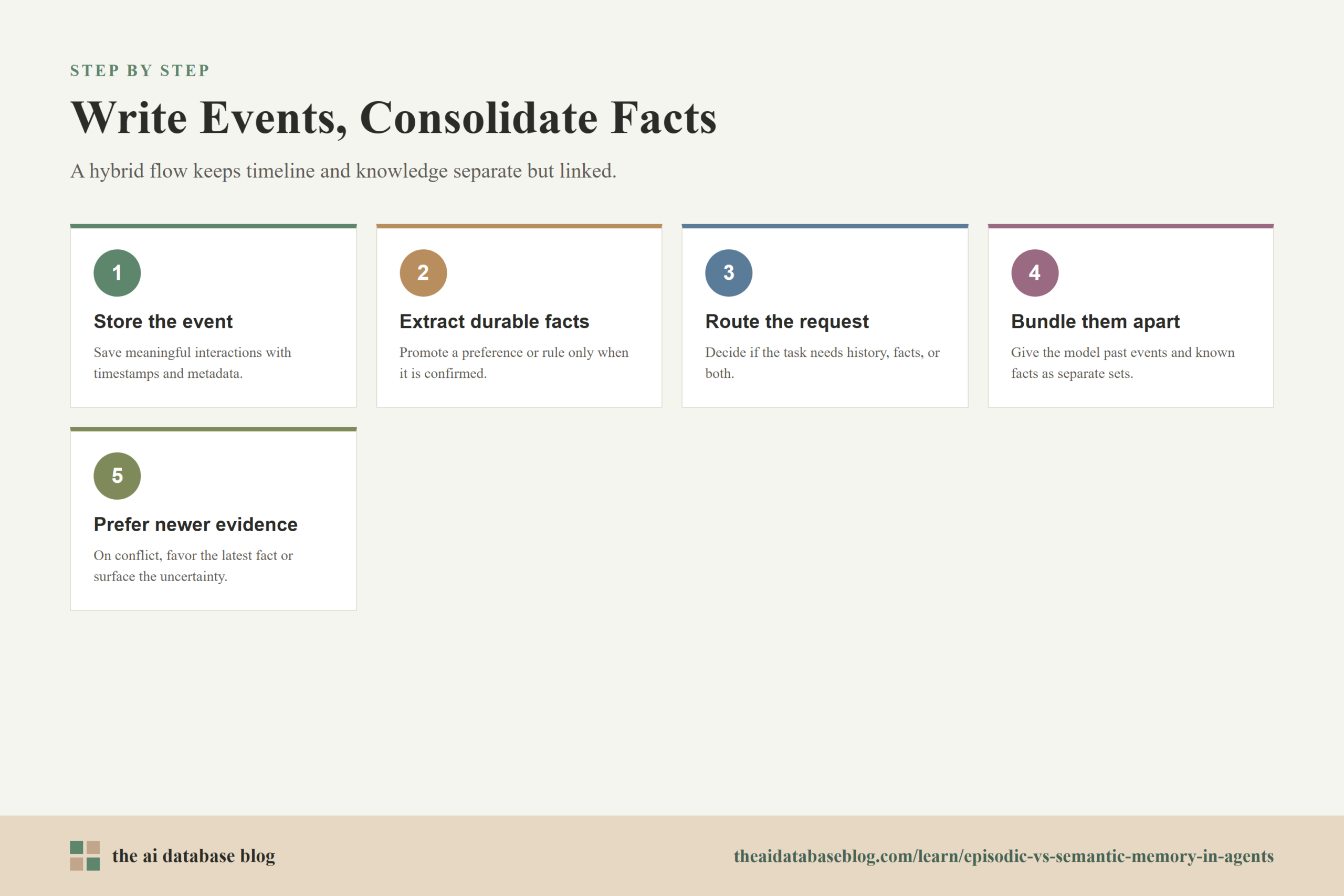
A common pattern is to write events first and consolidate facts later. The agent stores important interactions as episodic records, then extracts semantic memories only when information appears durable, confirmed, or useful for future behavior. This reduces the risk of turning one ambiguous event into a permanent rule. It also gives the system a way to trace a semantic fact back to the episodes that support it.
A Practical Hybrid Memory Flow
A hybrid memory system can follow a simple flow. First, the agent observes an interaction or tool result and stores meaningful events with timestamps and metadata. Second, it evaluates whether any durable fact, preference, relationship, or rule should be extracted into semantic memory. Third, when a new request arrives, the retrieval layer decides whether the task calls for event history, general knowledge, or both. Fourth, the agent receives a compact memory bundle that separates timeline evidence from generalized facts.
This separation helps the model reason more cleanly. The prompt can tell the agent, in effect, “Here are relevant past events” and “Here are current known facts.” The agent can then use events to understand continuity and facts to guide action. If the two conflict, the system can prefer newer evidence, ask for clarification, or surface the uncertainty rather than silently blending incompatible memories.
Example: A Project Assistant
Consider an AI project assistant that helps a team manage technical decisions. Its episodic memory might store meeting notes, design discussions, decisions, objections, test results, and deployment incidents in sequence. Its semantic memory might store the current architecture choice, naming conventions, owner assignments, accepted constraints, and team preferences.
When a team member asks, “Why did we choose this indexing strategy?”, the agent should retrieve both memory types. Semantic memory can provide the current decision. Episodic memory can show the sequence of tradeoffs, rejected alternatives, benchmark observations, and approval context that led to the decision. The answer becomes more coherent because it includes both the fact and the story behind the fact.
Designing this well requires more than adding a vector index. The memory schema, write policy, retrieval policy, and consolidation logic all influence whether the agent behaves consistently over time.
AI Database Design Considerations
AI databases are central to agent memory because they determine what can be stored, searched, filtered, updated, and explained. A memory system should be designed around access patterns rather than around storage alone. The question is not only “Where can we put memories?” but “How will the agent find the right memory at the right moment and use it safely?”
For episodic memory, the database should support time-aware retrieval, metadata filtering, event grouping, and links between related events. For semantic memory, it should support precise entity lookup, hybrid search, relationship-aware retrieval, deduplication, and updates when facts change. In both cases, the database should preserve provenance so the agent can explain where a memory came from.
- Use separate memory types or explicit type fields. The system should know whether a record is an event, a fact, a preference, a rule, or a derived summary.
- Store metadata at write time. User, project, source, timestamp, tool, confidence, and validity fields make retrieval more controllable later.
- Combine vector and keyword retrieval. Embeddings help with meaning, while keyword search protects exact names, identifiers, and domain terms.
- Use temporal logic for events. Episodic memory should support retrieving neighboring events, recent events, and events within a specific time window.
- Track freshness and conflicts. Semantic facts should be updateable, source-backed, and checked against newer evidence.
- Keep retrieved memory compact. The agent should receive the most relevant memory bundle, not an unfiltered dump of everything that might be related.
These design choices make memory more reliable because they preserve the difference between evidence, interpretation, and stable knowledge. That difference is especially important when agents take actions rather than simply answer questions.
Common Failure Modes
Many agent memory failures happen because the system stores information without enough structure or retrieves it without enough context. The result can look like a reasoning failure, but the root cause is often a memory design problem. If the agent sees the wrong memories, stale memories, or disconnected fragments, even a strong model can produce inconsistent behavior.
One common failure is over-generalization. The agent observes one event and converts it into a semantic rule too quickly. For example, if a user asks for a short answer once, the agent should not permanently assume that every future answer must be short. The safer approach is to store the event first, then promote a preference only after confirmation or repeated evidence.
Another failure is timeline collapse. The agent retrieves relevant events but loses their order, causing it to treat an early rejected idea as if it were the final decision. This is why episodic memory needs timestamps, event links, and chronological reconstruction. Similarity alone does not tell the agent what happened first or what superseded what.
A third failure is stale semantic memory. A fact that was correct last month may be wrong today. If the memory system does not track freshness, source, and replacement rules, the agent may confidently apply outdated information. This is especially risky in operational workflows where policies, system states, and user preferences can change.
The way to reduce these failures is to make memory explicit. Store events as events, facts as facts, and assumptions as assumptions. Retrieve them with policies that match their type, then give the agent enough context to reason about source, sequence, and confidence.
FAQs
1. What is the main difference between episodic and semantic memory in AI agents?
Episodic memory stores specific events and experiences, including when they happened and what context surrounded them. Semantic memory stores general knowledge, such as facts, preferences, rules, and relationships. In simple terms, episodic memory remembers the story of what happened, while semantic memory remembers what is generally true or useful.
2. Why does episodic memory need timestamps and sequence information?
Episodic memory depends on order because many agent tasks require understanding cause, consequence, and progression. A deployment failure, customer request, or planning discussion may only make sense when the agent knows what happened before and after it. Timestamps and sequence links help the agent reconstruct the timeline rather than retrieve disconnected fragments.
3. Can semantic memory be stored in a vector database?
Yes, semantic memory can be stored in a vector database, especially when facts and concepts need to be found by meaning rather than exact wording. However, vector search is usually stronger when combined with keyword search and metadata filters. Semantic memory often needs entity boundaries, source tracking, freshness checks, and conflict handling, not just similarity ranking.
4. Should an agent store every conversation as episodic memory?
Not necessarily. Storing everything can increase cost, noise, and retrieval confusion. A better approach is to store meaningful events, summaries, decisions, tool results, and user signals with enough metadata to retrieve them later. Raw logs may still be kept for audit or debugging, but they are not the same as curated episodic memory.
5. How do episodic memories become semantic memories?
Episodic memories can become semantic memories through consolidation. The agent reviews events and extracts durable facts, preferences, rules, or relationships when there is enough evidence. For example, several episodes showing the same user preference may become a semantic memory that guides future responses. The original episodes should remain available as supporting evidence when the fact needs to be checked.
6. Why do agents need both memory types for coherent behavior?
Agents need episodic memory to maintain continuity across time and semantic memory to apply stable knowledge efficiently. If an agent has only episodic memory, it may remember details but fail to generalize. If it has only semantic memory, it may know facts but lose the context behind them. Combining both helps the agent act consistently while still respecting history, source, and change.
Takeaway
Episodic and semantic memory solve different but connected problems in AI agents. Episodic memory stores events in sequence so an agent can understand what happened, why it happened, and what changed over time. Semantic memory stores general facts, rules, preferences, and relationships so the agent can act on reusable knowledge without replaying every past interaction. This guidance is most useful for teams building retrieval systems, long-running assistants, workflow agents, and AI database architectures where coherent behavior depends on combining timeline-aware event retrieval with well-maintained factual memory.
Watch this video to learn more