Keeping an AI database index fresh means making sure search results reflect the current state of the source data, not just the state of the data on the day the index was first built. Most production systems do this with incremental updates, real-time or near-real-time ingestion, change-data-capture pipelines, and explicit delete handling. Full rebuilds still matter, but they are usually reserved for major schema, embedding, chunking, or index-configuration changes rather than everyday content updates.
This guide explains how index freshness works in AI database systems, why stale indexes create retrieval quality problems, when to update incrementally, when to rebuild, how source-system changes should flow into the index, and how deletes should be handled so outdated content does not continue appearing in retrieval results.
Why Index Freshness Matters
An AI database index is useful only if it represents the content users are allowed and expected to retrieve. In a retrieval system, stale data can create several kinds of failure at once: a user may receive an outdated policy, a support agent may cite a removed article, a recommendation system may surface unavailable items, or a RAG application may answer from content that no longer exists in the source system. These failures are not always obvious because the system can still return confident-looking results even when the underlying index is behind.
Freshness is especially important for AI applications because retrieval often sits between a user and a language model. If the retriever sends old or incorrect context to the model, the model may summarize it fluently and make the error harder to detect. In that sense, keeping the index fresh is not just a data engineering concern. It directly affects answer quality, trust, access control, compliance, and operational usefulness.
Freshness should be treated as a measurable property of the retrieval system. Teams often track source-to-index lag, failed ingestion jobs, record-count mismatches, delete propagation, and retrieval tests for recently changed content. These checks help separate two different questions: whether the source data changed, and whether those changes are actually visible through search.
Once freshness is framed as an operational requirement, the next question is how updates should enter the index. The main decision is whether to apply changes incrementally or rebuild the index from a clean source snapshot.
Incremental Updates vs Rebuilds
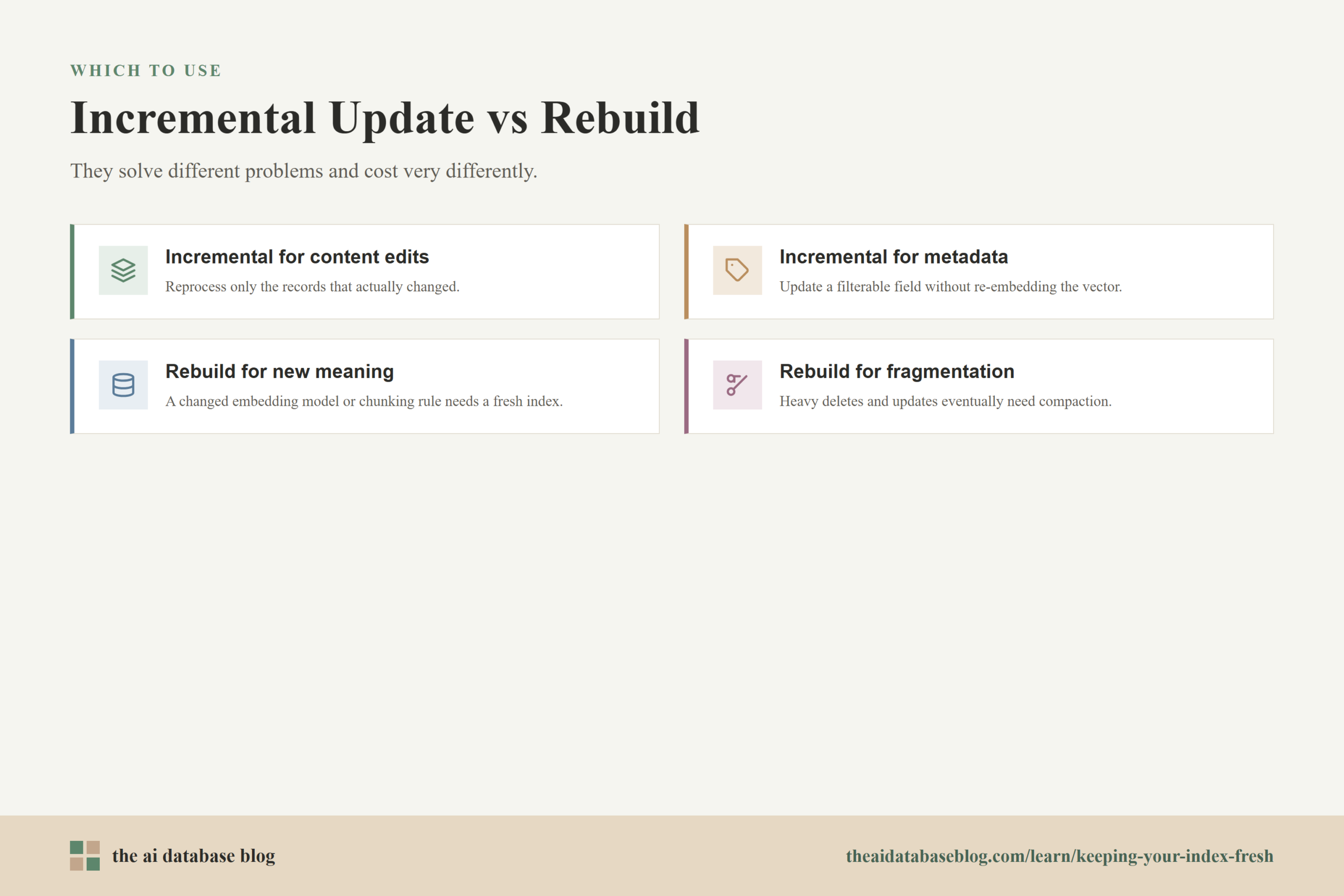
Incremental updates and rebuilds solve different problems. An incremental update changes only the records, chunks, embeddings, or metadata affected by a source-system change. A rebuild recreates a larger part of the index, often the whole index, from source data. Both approaches are useful, but they have different costs, risks, and operational patterns.
When Incremental Updates Are the Better Fit
Incremental updates are usually the right choice when source content changes continuously and the retrieval system needs to stay current without downtime. For example, if a product catalog receives new items throughout the day, a support knowledge base has small article edits, or a user-permission field changes often, the system should update only the affected objects rather than rebuild the entire index.
The main advantage is efficiency. The pipeline can reprocess only changed records, regenerate embeddings only for changed text, and update metadata without touching the vector representation when the semantic content has not changed. This keeps ingestion cost, compute use, and indexing pressure lower than repeated full rebuilds.
Incremental updates work best when every indexed object has a stable identifier. Stable IDs let the system upsert the same logical record instead of creating duplicates. In chunk-based retrieval systems, the identifier should usually include the source document ID and chunk identity, so changed chunks can replace older versions cleanly.
When a Rebuild Is the Better Fit
A rebuild is better when the meaning of the index has changed, not just the contents of a few records. Common reasons include changing the embedding model, changing chunking rules, adding a new vector representation for existing content, changing the index type or major index configuration, correcting a serious ingestion bug, or cleaning up accumulated drift from many partial updates.
Rebuilds are also useful when deletes and updates have left too much internal fragmentation. Many vector indexes can mark deleted entries before physically removing or compacting them. That behavior is useful for fast deletes, but over time a heavily updated index may need optimization, compaction, or rebuild work to recover query speed and reduce storage waste.
The tradeoff is that rebuilds can be expensive. They may require re-reading source data, re-chunking documents, regenerating embeddings, bulk-loading records, testing relevance, and switching traffic to the new index. For large collections, that work can take hours or days unless the system is designed for parallel ingestion and safe cutover.
A Practical Hybrid Approach
Most mature systems use both approaches. Incremental updates keep the index current during normal operation, while scheduled or event-driven rebuilds handle larger changes. The practical pattern is to keep a reliable incremental pipeline running, then rebuild when the retrieval contract changes or when operational metrics show that the index has drifted too far from its desired structure.
A hybrid approach also reduces risk. Instead of choosing between always rebuilding and never rebuilding, teams can define clear triggers. For example, small source edits use incremental upserts, permission changes update metadata, document removals issue deletes, embedding-model upgrades create a new index, and high delete ratios trigger compaction or rebuild work.
Incremental updates answer how the system should handle ordinary change. The next issue is speed: how quickly should those changes become searchable after they happen?
Real-Time Ingestion and Freshness Expectations
Real-time ingestion means the index receives and processes changes continuously rather than waiting for a large batch job. In practice, many AI database systems are near real time rather than instant. A source update may need to be captured, queued, transformed, chunked, embedded, written to the index, and made visible to queries. Each step adds latency, and each step can fail independently.
The right freshness target depends on the use case. A customer support assistant that answers from policy documents may need updates visible within minutes. A security-sensitive access-control filter may need permission changes reflected much faster. A research archive or static documentation library may be fine with hourly or daily refreshes. The important point is to define the freshness expectation explicitly instead of assuming that ingestion and search visibility happen at the same time.
Real-time ingestion usually has several moving parts:
- Change detection: The system must know that a source record was inserted, updated, or deleted.
- Event ordering: The pipeline should process changes in a way that prevents old events from overwriting newer ones.
- Embedding work: Changed text may need to be embedded before it can be searched semantically.
- Index writes: The vector database must receive upserts, metadata updates, or delete requests.
- Observability: Operators need to see lag, failures, retries, and whether indexed counts match expectations.
Because ingestion can compete with query traffic, real-time systems need backpressure and retry behavior. If a burst of updates arrives, the pipeline should avoid overwhelming embedding services or indexing workers. Queues, worker pools, rate limits, idempotent writes, and dead-letter handling help keep the system stable while still moving toward freshness.
Real-time ingestion depends on reliable change detection. For many source databases, the strongest pattern is change data capture, because it observes actual database changes rather than relying only on periodic scans.
Change Data Capture From Source Systems
Change data capture, often shortened to CDC, is a pattern for capturing inserts, updates, and deletes from a source system and sending them downstream as events. In an AI database pipeline, those events tell the indexing system what needs to be added, changed, or removed. CDC is useful because the source database remains the system of record, while the AI database index becomes a searchable projection of that source.
CDC is usually preferable to naive polling when freshness and correctness matter. Polling asks the source system what changed since the last run, often using timestamps. That can work for simple systems, but it can miss deletes unless the source has explicit deletion markers. It can also struggle with clock issues, late updates, schema quirks, or records whose content changes without a reliable updated timestamp.
Log-based CDC reads from database transaction logs or replication streams. This lets the pipeline observe row-level changes in commit order and capture deletes as first-class events when the source and connector are configured correctly. For indexing, that means the downstream system can update the AI database based on the same changes that modified the source database.
How CDC Maps to an AI Database Index
A CDC event is not always ready to write directly into a vector index. The event usually needs to pass through an indexing worker that understands the source record, the retrieval schema, and the chunking rules. For an insert, the worker may load or assemble the full document, split it into chunks, generate embeddings, attach metadata, and upsert the resulting objects. For an update, it may compare the changed fields and decide whether to update metadata only or re-embed affected chunks. For a delete, it should remove or invalidate every indexed object derived from the deleted source record.
This mapping is easier when the pipeline stores lineage metadata. Each indexed chunk should know its source system, source record ID, document version, chunk position, and any access-control or lifecycle metadata needed at query time. Without that lineage, a delete or update may leave orphaned chunks behind because the system cannot confidently find every derived vector.
Designing CDC Events for Idempotency
CDC pipelines should assume that events can be retried. A safe pipeline can process the same event more than once without creating duplicate indexed records or resurrecting old content. Idempotency usually comes from stable IDs, source versions, event offsets, and write logic that checks whether the incoming event is newer than the currently indexed version.
Ordering matters as well. If an older update arrives after a newer delete, the system should not restore the deleted content. Version fields, event timestamps, transaction positions, or source log offsets can help the indexing worker reject stale events. This is especially important when events are processed in parallel across multiple workers.
CDC gives the indexing pipeline a reliable stream of what changed. But the hardest part of freshness is often what should disappear, because deletes are easier to overlook than inserts.
Handling Deletes Without Leaving Stale Results
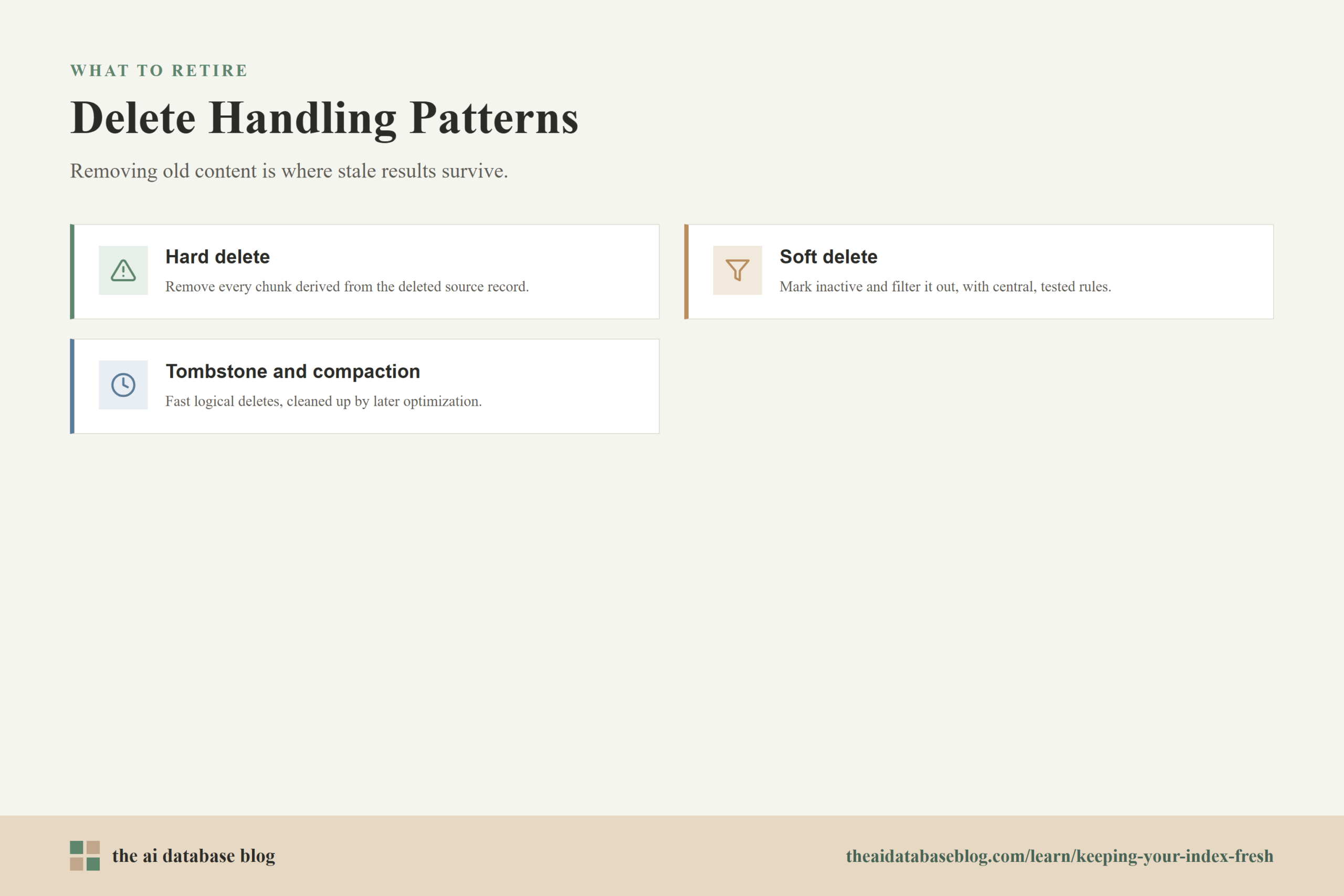
Deletes need explicit design. In many retrieval systems, adding new content is straightforward, but removing old content is where stale results often survive. A document may be deleted in the source system, but its chunks may remain in the AI database if the pipeline only processes inserts and updates. The result is a search system that appears functional while quietly returning content that should no longer be retrievable.
There are several delete patterns, and the right one depends on the source system, compliance needs, and index behavior.
Hard Deletes
A hard delete removes the indexed object from the AI database. This is appropriate when the source content is gone and should not appear in future search results. For chunked documents, the delete operation should target all chunks associated with the source document or source record, not just one object.
Hard deletes require reliable source-to-index lineage. If the pipeline cannot identify all derived chunks, some stale fragments may remain searchable. This is why source IDs, chunk IDs, and document-version metadata are not optional details in a serious retrieval system.
Soft Deletes
A soft delete marks content as inactive, hidden, expired, or deleted without immediately removing the underlying object. This can be useful when the system needs auditability, recovery, or delayed physical deletion. Query filters can exclude soft-deleted records from normal retrieval, while background jobs later remove or compact them.
The main risk is filter failure. If a query path forgets to apply the soft-delete filter, removed content can reappear. Soft deletes work best when the retrieval layer has centralized filtering rules, strong tests, and monitoring that checks whether deleted records can still be retrieved.
Tombstones and Compaction
Some vector indexes do not physically remove deleted entries immediately. They may mark entries as deleted and clean them up later through optimization or compaction. This helps keep deletes fast, but it means operators should monitor delete ratios, storage growth, and query latency. If too many deleted entries accumulate, the index may spend work avoiding records that are no longer valid.
Compaction or rebuild work turns logical deletion into physical cleanup. The timing depends on the database, index type, workload, and operational constraints. A system with frequent deletes should plan for this maintenance instead of treating delete calls as the end of the story.
Delete handling protects the index from old content, but freshness also depends on knowing whether the pipeline is healthy. The next step is to define the signals that show whether updates, rebuilds, and deletes are actually working.
Operational Checks for a Fresh Index
A fresh index is not just an index that has an ingestion job attached to it. It is an index whose contents can be checked against the source system and whose update path can be observed. Without operational checks, teams often discover freshness problems only after users report bad answers.
Useful checks include source-to-index lag, the age of the newest searchable record, failed event counts, retry counts, dead-letter queue size, indexing throughput, embedding failure rate, and delete propagation tests. Record counts can also help, but they are not enough by themselves because metadata updates or vector changes may not change the total number of indexed objects.
Retrieval tests are especially valuable. A simple test suite can insert or update a known source record, wait for the expected freshness window, and verify that the changed content is retrievable. A matching delete test can remove or hide a known record and verify that normal queries no longer return it. These tests measure the behavior users actually experience, not just whether a pipeline task reported success.
Teams should also distinguish ingestion freshness from retrieval freshness. A record may be written to storage but not yet visible through the optimized search path. Depending on the database and index configuration, there may be a delay between write acknowledgment and searchable availability. Monitoring should account for that difference.
With the operational pieces in place, the design choices become easier to apply. The goal is not to make every system fully real time, but to match the freshness architecture to the risk and pace of the application.
Practical Design Recommendations
The best freshness strategy is usually simple to describe but disciplined in execution: keep the source system authoritative, capture changes reliably, process only what changed when possible, delete deliberately, and rebuild when the index definition changes. This gives the retrieval system a clear contract with the rest of the application.
For most AI database projects, these recommendations are a good starting point:
- Use stable IDs for indexed objects. IDs should let the pipeline replace the right object instead of creating duplicates. For chunked content, include both the source document identity and the chunk identity.
- Separate metadata updates from embedding updates. If only a filterable field changes, the system may not need to regenerate the vector. If the searchable text changes, affected chunks usually need new embeddings.
- Capture deletes as first-class events. A pipeline that handles inserts and updates but ignores deletes will eventually return stale content.
- Track source lineage in every indexed object. Source IDs, versions, timestamps, and access metadata make updates and deletes safer.
- Define freshness service levels. Decide whether the use case needs seconds, minutes, hours, or daily refreshes, then monitor against that target.
- Plan rebuilds for structural change. Rebuild when chunking, embedding models, index configuration, or schema assumptions change enough that incremental updates cannot make the old index correct.
These practices keep the index aligned with the source without turning every small edit into a costly rebuild. They also make failures easier to diagnose because each part of the pipeline has a clear responsibility.
FAQs
1. What does it mean to keep an AI database index fresh?
It means keeping the searchable index aligned with the current source data. New content should become searchable, changed content should replace older versions, metadata changes should affect filtering, and deleted content should stop appearing in results within the expected freshness window.
2. Should I update my index incrementally or rebuild it?
Use incremental updates for normal inserts, edits, metadata changes, and deletes. Use a rebuild when the structure or meaning of the index changes, such as after changing the embedding model, chunking strategy, schema, or major index configuration. Many production systems use incremental updates day to day and rebuild only for larger changes or maintenance.
3. Does real-time ingestion mean updates are instantly searchable?
Not always. Real-time ingestion usually means changes are captured and processed continuously, but there can still be latency from event capture, transformation, embedding generation, index writes, and search visibility. The practical goal is to define and monitor an acceptable source-to-search freshness window.
4. Why is change data capture useful for AI database indexing?
Change data capture is useful because it turns source-system inserts, updates, and deletes into downstream events. This lets the indexing pipeline update the AI database based on actual source changes rather than relying only on periodic scans or manual refresh jobs.
5. What is the biggest delete-handling mistake in retrieval systems?
The biggest mistake is treating deletes as an afterthought. If the source document is removed but its indexed chunks remain, the retrieval system can continue returning stale or unauthorized content. Deletes should be captured, mapped to all derived indexed objects, tested, and monitored like any other important data change.
6. How often should a vector index be rebuilt?
There is no universal schedule. A rebuild is usually needed when the index definition changes, when accumulated deletes or updates hurt performance, when an ingestion bug needs correction, or when relevance testing shows that incremental maintenance is no longer enough. For stable systems, rebuilds may be occasional; for rapidly evolving systems, rebuilds may be part of a planned release or maintenance cycle.
Takeaway
Keeping an index fresh is about more than adding new vectors. A reliable AI database system needs incremental updates for ordinary change, rebuilds for structural change, real-time or near-real-time ingestion when the use case requires it, CDC when source systems can provide trustworthy change events, and explicit delete handling so old content does not linger in search results. This guidance is most useful for teams building RAG systems, semantic search, recommendations, support assistants, or knowledge retrieval tools where source data changes over time and users expect the retrieval layer to reflect the current truth.