IVF-PQ is a vector search indexing approach that combines inverted file clustering with product quantization so large embedding collections can be searched without keeping every full-precision vector in memory. IVF narrows the search to a small set of likely clusters, while PQ compresses vectors into short codes that can be scanned quickly and stored compactly. The result is a disk-friendly index pattern for very large approximate nearest neighbor search, but it comes with recall tradeoffs because the system both skips many clusters and compares compressed approximations instead of full vectors.
This guide explains how IVF and product quantization work together, why the combination is useful for billion-scale AI database workloads, how it affects recall, and when IVF-PQ is a good fit. By the end, you should understand the practical design choice: IVF-PQ is not simply a faster version of exact search, but a controlled compromise among memory footprint, disk access, latency, and retrieval quality.
What IVF-PQ Means
IVF-PQ stands for inverted file with product quantization. The name sounds dense, but the idea is practical: organize vectors into coarse groups, then store compact approximations of the vectors inside those groups. During search, the system first decides which groups are worth checking, then scans compressed vector codes inside those groups to find candidates that are probably close to the query.
An IVF-PQ index usually has two main layers. The IVF layer uses a coarse quantizer, often trained with clustering, to divide the vector space into many partitions. Each partition has an inverted list containing the vectors assigned to that cluster. The PQ layer then compresses each vector, or commonly the residual between the vector and its assigned cluster center, into a short code made from smaller sub-vector codebooks.
This two-layer structure matters because billion-scale search has two separate problems. First, scanning every vector is too expensive. Second, storing every vector in full precision can exceed available memory by a wide margin. IVF helps with the first problem by reducing the number of vectors considered per query. PQ helps with the second problem by shrinking the data that must be stored, moved, and compared.
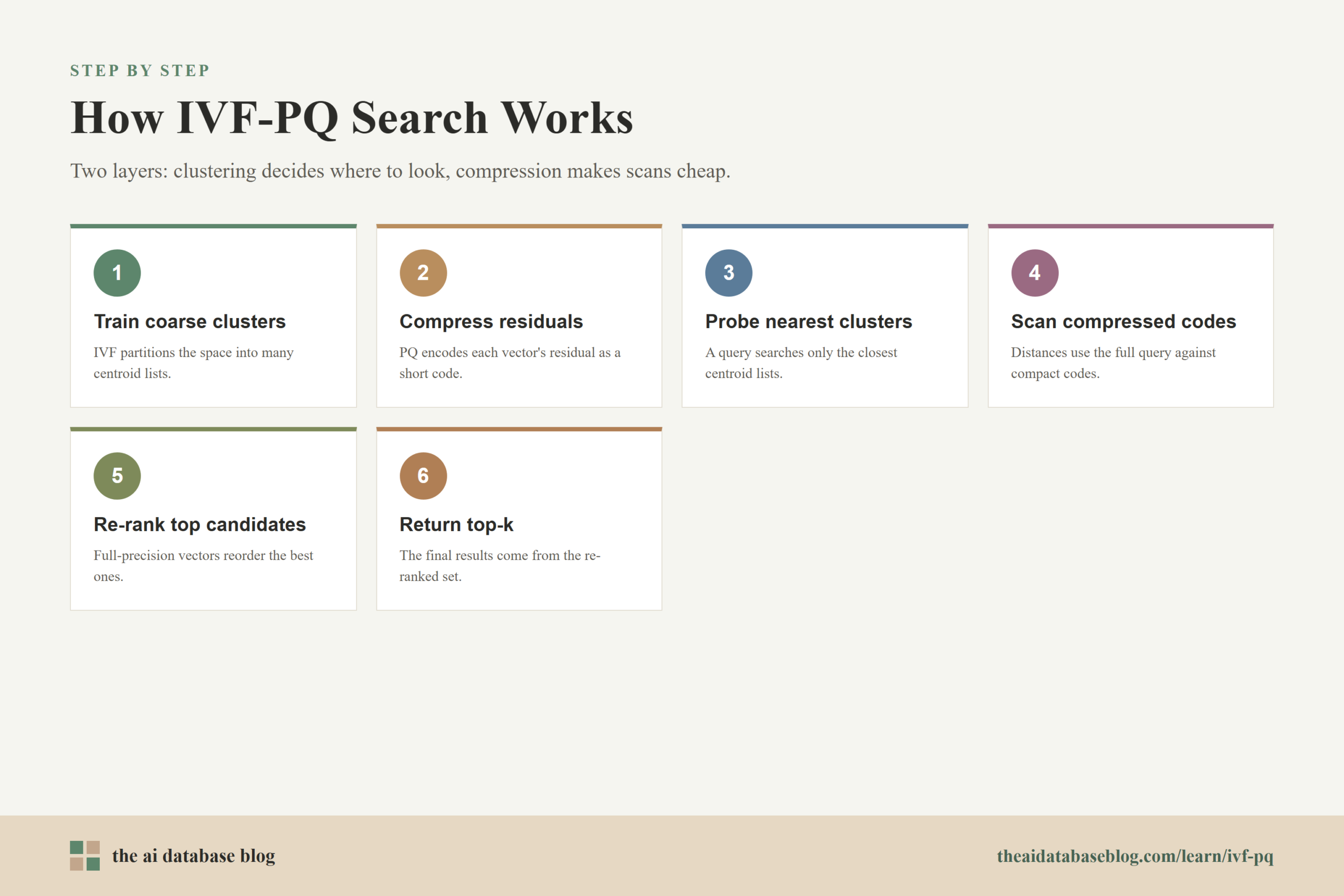
Once those two roles are clear, the natural next question is how the two methods actually fit together during indexing and query execution. IVF-PQ is easiest to understand as a pipeline: train coarse clusters, encode vectors into compact representations, then probe only the most promising parts of the index at query time.
How IVF Clustering Narrows the Search Space
Inverted file indexing starts by training a set of coarse centroids over a sample of the embedding collection. Each centroid represents a region of the vector space. When a database vector is inserted into the index, the system finds the closest centroid and places the vector identifier, and its encoded representation, into that centroid’s inverted list.
At query time, the query vector is compared against the centroids first. Instead of searching every list, the system searches only the closest lists. The number of lists searched is usually controlled by a parameter often called the probe count. A low probe count checks fewer clusters and is faster, while a high probe count checks more clusters and is more likely to find the true nearest neighbors.
This is the clustering side of the approximation. IVF assumes that the nearest vectors are likely to live in clusters near the query. That is often true, but not always. If a relevant vector was assigned to a cluster just outside the probed set, it may never be considered, even if the compressed distance calculation would have ranked it highly.
Clustering therefore reduces work by replacing one very large search with several smaller scans. However, clustering alone does not solve the memory problem. If each vector inside each inverted list is still stored as a full 768-dimensional or 1,536-dimensional floating-point embedding, the index can remain too large for memory-friendly operation. That is where product quantization enters the design.
How Product Quantization Compresses Vectors
Product quantization compresses a high-dimensional vector by splitting it into several lower-dimensional sub-vectors and quantizing each sub-vector separately. For each sub-vector position, the system learns a small codebook of representative values. A vector can then be represented by the codebook entry chosen for each sub-vector rather than by all of its original floating-point values.
For example, a 768-dimensional embedding stored as 32-bit floats uses 3,072 bytes before accounting for identifiers, metadata, or index overhead. A PQ code might represent that vector with dozens of bytes rather than thousands. The exact compression ratio depends on the number of sub-quantizers and the number of bits used for each code, but the basic effect is the same: the system trades exact vector storage for compact approximate storage.
In IVF-PQ, product quantization is often applied to residuals rather than raw vectors. A residual is the difference between the original vector and the coarse centroid assigned by IVF. Since the centroid already captures the broad location of the vector, the residual captures the more local detail. Compressing the residual can improve accuracy compared with compressing the full vector directly, because the PQ code is modeling a smaller remaining error.
At search time, the query is not usually compressed in the same lossy way. Instead, the system uses asymmetric distance computation: it compares the full query vector, or the query’s residual relative to a probed centroid, against the compressed database codes. This is faster and often more accurate than comparing two lossy compressed vectors, while still avoiding full-precision scans across the whole collection.
With IVF narrowing the candidate region and PQ shrinking the vectors inside that region, the index becomes much more practical at very large scale. The next step is to connect that mechanics to disk behavior, because the major reason IVF-PQ remains important is that it makes large indexes easier to store, move, and search under tight memory budgets.
Why IVF-PQ Is Disk-Friendly at Billion Scale
Billion-scale vector search is constrained by memory bandwidth, storage capacity, and random access patterns. A single billion-vector collection can require terabytes of memory if stored as full-precision embeddings. Even when storage capacity is available on SSDs, repeatedly reading large full vectors from disk during search can make latency unpredictable and expensive.
IVF-PQ addresses this by reducing both the number of vectors touched and the amount of data read per vector. IVF lets the system read only the inverted lists associated with the closest coarse clusters. PQ keeps the contents of those lists compact, so scanning candidate vectors requires reading short codes instead of full floating-point arrays. For workloads that can tolerate approximate results, this is often the difference between an index that must live mostly in RAM and an index that can operate with a much smaller memory footprint.
The approach can also support a two-stage search pattern. The system first uses compressed codes to produce a candidate set. Then it may re-rank a smaller number of candidates using full-precision vectors, if those vectors are stored on disk or in a separate data layer. This helps recover some quality because the final ordering is based on exact or higher-fidelity distances for a much smaller candidate pool.
Disk-friendly does not mean disk access is free. IVF-PQ works best when inverted lists are organized so reads are reasonably sequential, candidate scans are compact, and the system avoids fetching full vectors until late in the query. If a workload requires heavy random access to full vectors for every candidate, the storage advantage can shrink quickly.
Storage efficiency is only useful if the retrieval quality is acceptable. The main engineering work with IVF-PQ is therefore not just building the index, but tuning it so the recall loss remains within the needs of the application. Understanding where recall is lost makes that tuning much more concrete.
Recall Implications of IVF-PQ
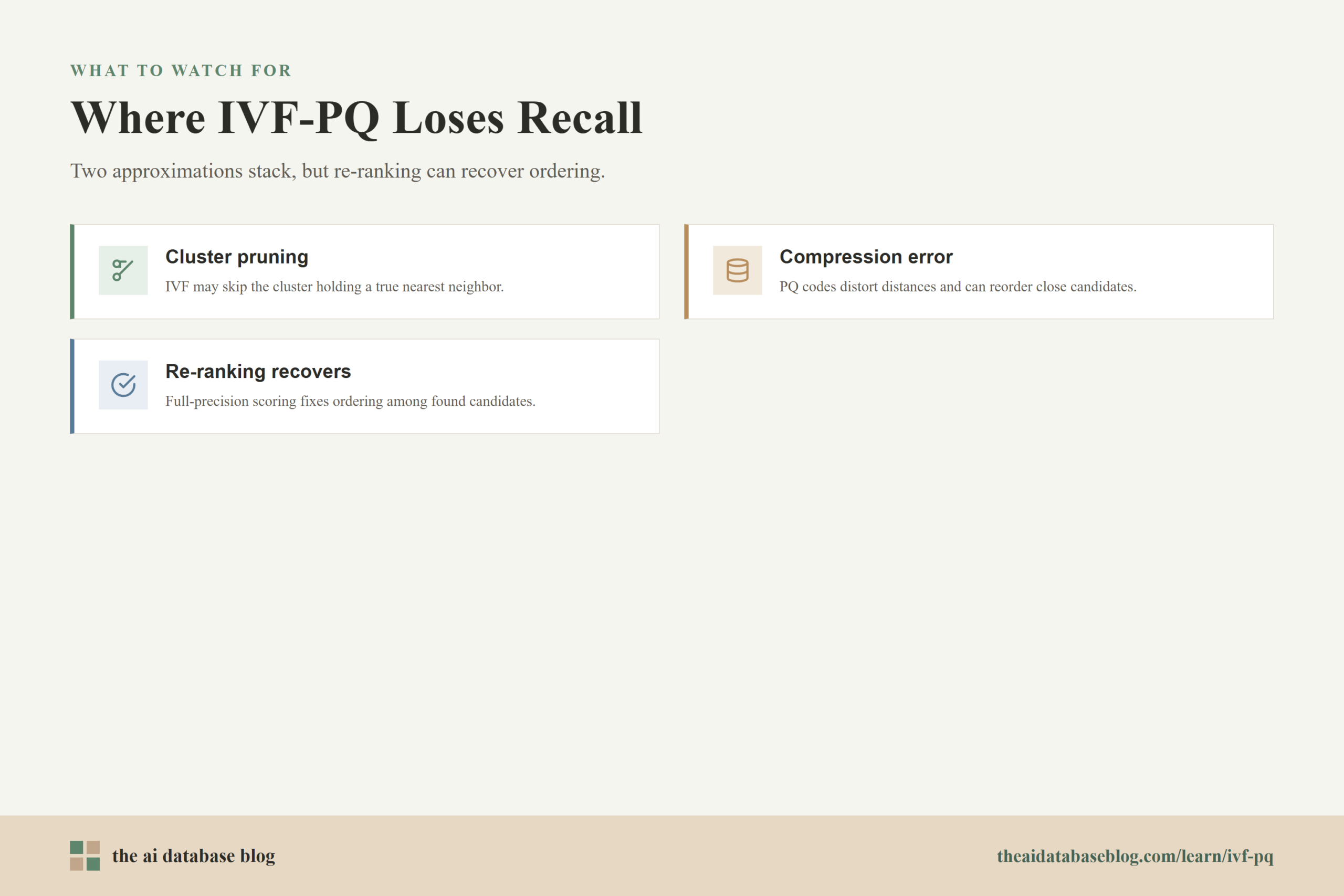
IVF-PQ affects recall in two main ways. IVF can lose recall by failing to probe the cluster that contains a true nearest neighbor. PQ can lose recall by distorting distances because compressed codes approximate the original vectors. These two sources of error are separate, and a production system has to manage both.
Cluster Pruning Can Miss Relevant Vectors
The IVF layer chooses a limited number of clusters to search. If the true nearest neighbor is assigned to an unsearched cluster, it cannot appear in the result set. Increasing the probe count improves the chance that the right cluster is searched, but it also increases latency and disk reads because more inverted lists must be scanned.
This recall tradeoff is especially important when embeddings have uneven density. Some clusters may contain many vectors while others contain fewer. Queries near cluster boundaries may need more probes than queries that fall clearly inside one dense region. This is why recall evaluation should use realistic queries rather than only synthetic or average-case examples.
Compression Can Distort Distance Ordering
The PQ layer introduces quantization error. Two vectors that are close in the original embedding space may not look as close after compression, and two vectors that are not truly close may appear closer than they are. This can change candidate ordering, especially when several candidates have very similar true distances.
More PQ code capacity usually improves recall because the compressed representation can preserve more detail. That may mean more sub-quantizers, more bits per sub-code, optimized rotations, residual quantization, or a higher-quality training sample. The cost is larger codes, more computation, more memory or disk bandwidth, and sometimes longer index training.
Re-Ranking Can Recover Some Quality
A common way to reduce the recall impact is to retrieve more compressed candidates than the final result count and re-rank them with full-precision vectors. For example, a system might use IVF-PQ to find a few hundred likely candidates, then compute exact distances for the top candidates before returning the final top results.
Re-ranking cannot recover vectors that IVF never searched, but it can correct ordering errors among candidates that were found. This makes the relationship between probe count, candidate pool size, PQ code size, and re-ranking depth central to IVF-PQ tuning.
Once recall loss is understood as a combination of missed clusters and compressed-distance error, the decision about whether to use IVF-PQ becomes less abstract. It is not the right index for every AI database workload, but it is very useful when scale and memory pressure dominate the design.
When to Use IVF-PQ
IVF-PQ is a strong option when the vector collection is very large, memory is expensive or limited, and the application can tolerate approximate retrieval after careful tuning. It is especially relevant when the goal is to search hundreds of millions or billions of embeddings while keeping the index compact enough for practical deployment.
Use IVF-PQ when storage footprint is a first-order constraint. If full-precision vectors make the index too large to fit in memory, PQ compression can reduce the working set enough to make the system feasible. IVF then limits how much of that compressed data must be scanned per query.
Use IVF-PQ when latency targets are moderate and tunable. The index gives operators several knobs, including the number of coarse clusters, the number of clusters probed, the PQ code size, and the re-ranking depth. That makes it useful when the application can balance recall and speed based on measured requirements.
Use IVF-PQ when the workload is mostly read-heavy or changes in controlled batches. Training coarse clusters and PQ codebooks requires representative data, and major distribution shifts may require retraining or rebuilding parts of the index. It can support updates depending on implementation, but it is usually easiest to reason about when the embedding distribution is relatively stable.
For example, IVF-PQ can be a practical fit for a large document retrieval system where the first stage only needs to identify a high-quality candidate pool for downstream ranking. It can also fit large image or product embedding collections where approximate nearest neighbors are acceptable and memory cost matters more than exact ordering at the first stage.
Knowing when to use IVF-PQ also means knowing when to avoid it. The same compression and clustering that make it efficient can be the wrong tradeoff when the dataset is small, recall requirements are unforgiving, or update patterns are too dynamic.
When IVF-PQ May Be the Wrong Choice
IVF-PQ may be unnecessary for small or medium-size collections that can be searched accurately with simpler indexes. If full vectors fit comfortably in memory and exact or high-recall search meets latency goals, the added complexity of training centroids, tuning probes, and managing compressed codes may not be worth it.
It may also be a poor fit when recall must be extremely high and missing a relevant item is costly. In legal discovery, medical retrieval, safety review, or other high-sensitivity applications, approximate first-stage retrieval may still be useful, but the system needs careful evaluation, fallback paths, and possibly broader candidate generation than a heavily compressed IVF-PQ setup provides.
Highly dynamic datasets can also complicate IVF-PQ. If new embeddings arrive continuously and their distribution shifts over time, older clusters and codebooks may become less representative. That does not make IVF-PQ impossible, but it does mean the system needs a strategy for retraining, merging, rebuilding, or routing fresh vectors through a separate index until compaction occurs.
Finally, IVF-PQ can be a weak choice if metadata filtering is the dominant query constraint. When a query first narrows the search to a small filtered subset, the benefits of a large coarse vector partition may be less useful. The system then needs an indexing strategy that handles filters and vector similarity together rather than treating vector search as the only access pattern.
These limits do not make IVF-PQ less valuable. They clarify that IVF-PQ is a scale and efficiency tool, not a universal replacement for every vector index. The best results come from tuning it against the actual retrieval task rather than choosing it only because the dataset is large.
Practical Tuning Considerations
IVF-PQ tuning starts with the retrieval objective. The right settings depend on whether the application needs the single closest item, a diverse top-k set, a broad candidate pool for re-ranking, or enough relevant chunks for a retrieval-augmented generation pipeline. Each goal places a different weight on recall, latency, and storage footprint.
The number of IVF clusters affects both list size and routing precision. More clusters create smaller inverted lists, which can reduce scan cost, but they also make cluster assignment more granular and may require probing more lists to maintain recall. Too few clusters can make each list large and expensive to scan. Too many clusters can create overhead and make queries more sensitive to cluster-boundary errors.
The probe count is one of the most important recall knobs. Higher probe counts search more lists and usually improve recall, but they increase work per query. In a disk-backed design, probing more lists can also increase I/O, so the best setting is usually found through measurement under realistic concurrency and cache conditions.
PQ code size controls how much information is preserved in each compressed vector. Smaller codes save memory and disk bandwidth, but they increase quantization error. Larger codes improve distance estimates, but they reduce the compression advantage. Residual encoding and optimized transformations can improve the quality of the compressed representation, but they add training and implementation complexity.
Re-ranking depth should be tuned alongside probe count and code size. If the system retrieves too few candidates from the compressed stage, re-ranking has little room to correct errors. If it retrieves too many, the final stage may become expensive because it must fetch and compare more full-precision vectors. The useful target is not maximum recall at any cost, but enough recall for the application at a stable latency and storage budget.
The most reliable way to choose settings is to evaluate recall against an exact-search ground truth sample. Measure recall at the final top-k size, but also measure candidate recall before re-ranking. That distinction shows whether quality is being lost because IVF did not find the right candidates or because PQ and re-ranking did not order them well enough.
With tuning in place, IVF-PQ becomes easier to place inside a broader AI database architecture. It is usually only one part of retrieval, alongside filtering, metadata design, ranking, caching, and evaluation.
How IVF-PQ Fits Into AI Database Architecture
In an AI database, IVF-PQ is usually a first-stage retrieval mechanism. It narrows a massive vector collection to a manageable candidate set. The application may then apply metadata filters, business rules, full-vector re-ranking, cross-encoder scoring, freshness constraints, or diversity logic before returning final results.
This architecture is especially common in retrieval-augmented generation systems. The vector index does not need to make every final decision by itself. It needs to retrieve enough good candidates that later ranking and context assembly stages have the right material to work with. In that setting, IVF-PQ’s compactness can be valuable because it makes large knowledge collections searchable without requiring memory-heavy infrastructure.
However, the database still needs observability. Teams should monitor recall on evaluation sets, latency under load, cache hit behavior, filtered-query quality, and the quality of generated answers or downstream recommendations. Compression settings that work for one embedding model or document mix may not work after the model, chunking strategy, or data distribution changes.
The practical lesson is that IVF-PQ should be treated as an index strategy inside a retrieval system, not as the whole retrieval system. Its job is to make massive vector search feasible. The surrounding architecture decides how much approximation is acceptable and how to compensate for it when quality matters.
FAQs
1. What is IVF-PQ in vector search?
IVF-PQ is an approximate nearest neighbor indexing method that combines inverted file clustering with product quantization. IVF groups vectors into coarse clusters and searches only a selected set of clusters for each query. PQ compresses vectors into compact codes so the system can scan candidates with much lower memory and storage cost.
2. Why is IVF-PQ useful for billion-scale search?
It is useful because billion-scale vector collections are often too large to keep as full-precision embeddings in memory. IVF reduces the number of candidates searched per query, and PQ reduces the size of each stored vector representation. Together, they make very large approximate search more practical on memory-constrained systems.
3. How does IVF-PQ affect recall?
IVF-PQ can reduce recall because it introduces two approximations. The IVF layer may skip clusters that contain relevant vectors, and the PQ layer may distort distance estimates through compression. Recall can usually be improved by probing more clusters, using larger or better-trained PQ codes, retrieving more candidates, and re-ranking with full-precision vectors.
4. Is IVF-PQ the same as exact vector search?
No. IVF-PQ is approximate search. It is designed to avoid scanning and comparing every full vector in the database. That makes it more efficient at large scale, but it also means results can differ from exact nearest neighbor search unless the system uses enough probes, candidates, and re-ranking to close the quality gap.
5. When should an AI database avoid IVF-PQ?
An AI database may avoid IVF-PQ when the dataset is small enough for simpler high-recall indexing, when exactness is critical, when the embedding distribution changes too quickly for stable codebooks, or when metadata filtering dominates the query pattern. In those cases, another index strategy or a hybrid architecture may be easier to operate.
6. Does IVF-PQ remove the need to store full vectors?
Not always. Some systems store only compressed codes for the first-stage search, while others also keep full vectors on disk or in a separate store for re-ranking and auditing. Keeping full vectors increases storage requirements, but it can improve final result quality because the system can re-check the best candidates with exact distances.
Final Takeaway
IVF-PQ combines clustering and compression to make very large vector collections searchable under real memory and storage constraints. IVF decides where to search, PQ makes each candidate compact, and tuning controls how much recall the system gives up for lower latency and smaller indexes. This guidance is most useful for engineers and technical teams building AI databases, retrieval systems, or RAG pipelines where hundreds of millions or billions of embeddings must be searched efficiently; a typical use case is retrieving a strong candidate pool from a massive document or product embedding collection before applying full-vector re-ranking or downstream relevance logic.