Hybrid search for retrieval-augmented generation combines dense vector retrieval with keyword retrieval so a RAG system can find both semantically related passages and passages that contain exact terms, names, codes, acronyms, or identifiers. Dense retrieval helps when users ask in natural language or use different wording from the source material, while keyword retrieval helps when precision depends on literal text. The strongest hybrid systems do not simply run two searches and hope for the best; they tune how results are fused, evaluate retrieval quality by query type, and often add reranking after the first retrieval step.
This guide explains how hybrid search works in a RAG pipeline, why dense and keyword retrieval solve different parts of the relevance problem, when hybrid search clearly wins, and how to configure fusion so the final ranking is useful rather than noisy. By the end, you should understand how to reason about hybrid search as an AI database design choice, not just as a feature toggle.
What Hybrid Search Means in a RAG System
In a RAG system, retrieval is the step that selects the context an AI model will use to answer a question. If retrieval misses the right passage, the generator may produce an incomplete answer, cite weak evidence, or rely on its own internal knowledge instead of the source data. Hybrid search improves that retrieval step by using two complementary search signals: dense retrieval for meaning and keyword retrieval for exact text.
Dense retrieval represents queries and documents as embeddings, which are numeric vectors that encode semantic similarity. This makes it useful when a user asks, “How do I stop duplicate customer records?” and the relevant document says “deduplication workflow” or “entity resolution.” The words are different, but the meaning is close enough for vector search to find the right material.
Keyword retrieval, often implemented with BM25 or a similar sparse retrieval method, scores documents based on term matching and term importance. This matters when the query contains exact strings such as an API parameter, error code, invoice number, regulation name, product model, table field, or internal acronym. In those cases, the literal term may be the strongest relevance signal.
Hybrid search runs both approaches and then combines the results into a final ranked list. The AI database or retrieval layer may retrieve candidates from a vector index and a keyword index in parallel, then merge them using a fusion method. The generated answer only sees the final selected context, so the quality of that fusion step directly affects answer quality.
Once the two retrieval paths are understood, the next question is why both are needed. The answer is that each path fails in a different way, and RAG systems are especially sensitive to those retrieval failures because generation depends on the retrieved evidence.
Why Dense Retrieval Alone Is Not Enough
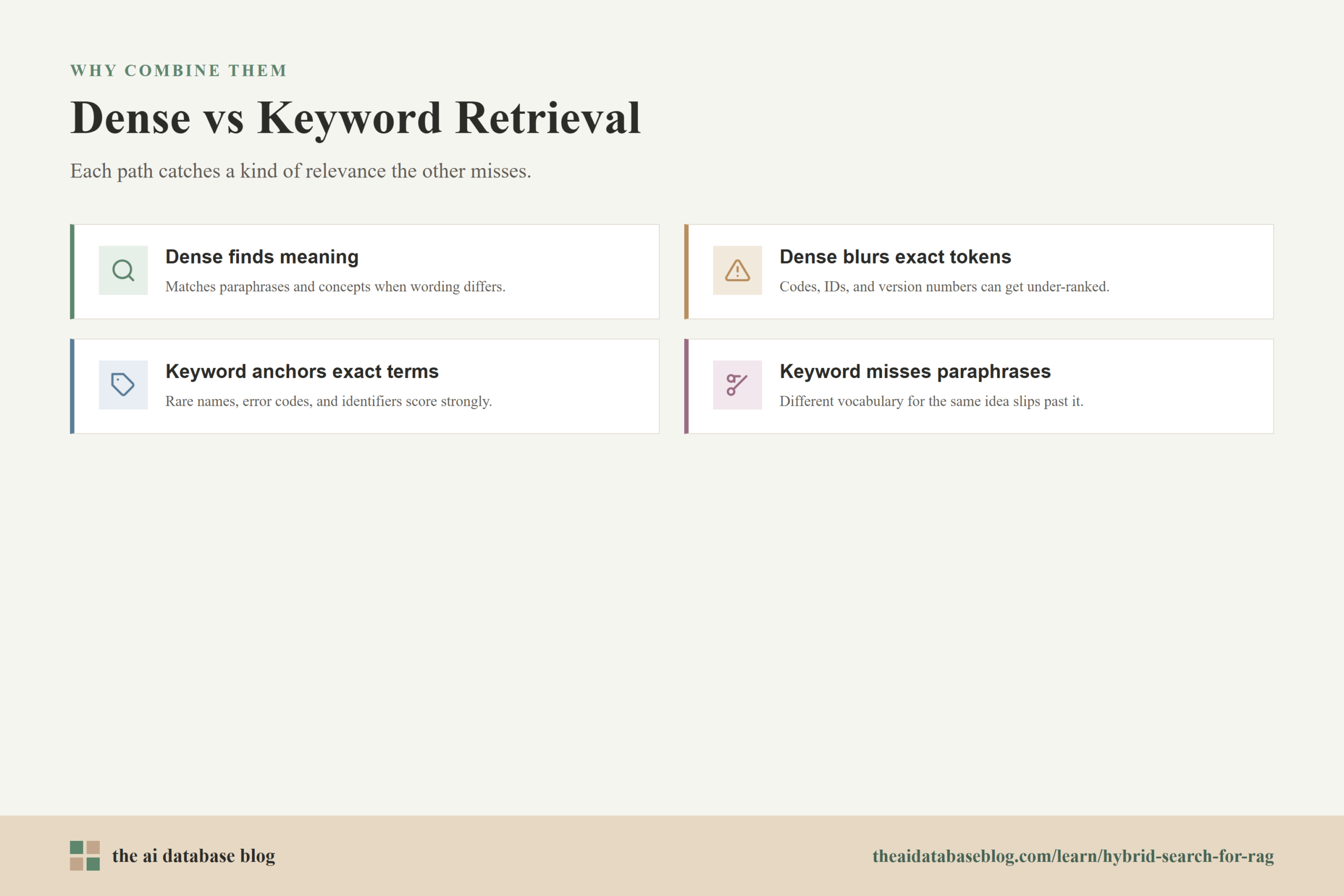
Dense retrieval is powerful because it can match ideas instead of only matching words. It is often the right baseline for open-ended questions, natural language queries, and content where the user may not know the exact vocabulary used in the source material. This is why vector databases became central to many RAG architectures: they make it possible to search by meaning across large bodies of text.
However, dense retrieval can blur details that should not be blurred. An embedding model may treat similar concepts, related products, nearby version numbers, or semantically adjacent policies as close matches. That behavior is helpful for broad discovery, but risky when the answer depends on exact evidence. A chunk about “OAuth token refresh” may be semantically close to a chunk about “API key rotation,” even though only one answers the user’s question.
Dense retrieval can also struggle with rare tokens and identifiers. Embeddings are trained to represent meaning, not to behave like exact string matchers. A specific error code, database column, legal clause, SKU, ticker symbol, function name, or customer account ID may not have much semantic meaning on its own. If that token is essential, the dense retriever may under-rank the passage that contains it.
This limitation becomes more visible in enterprise RAG systems than in simple demos. Real knowledge bases often contain structured labels, mixed tables and prose, versioned documentation, internal abbreviations, and domain-specific names. In those settings, “close enough” retrieval may not be good enough because the generated answer needs the exact supporting text.
Dense retrieval gives RAG systems semantic reach, but semantic reach does not replace lexical precision. To see why hybrid search works, it helps to look at the opposite retrieval path and understand what keyword search contributes.
Why Keyword Retrieval Still Matters
Keyword retrieval remains important because many user questions contain words that should be treated as hard evidence rather than loose semantic hints. BM25-style retrieval rewards documents that contain the query terms, especially terms that are relatively rare in the corpus. That makes it useful for matching exact language in documentation, logs, contracts, policies, transcripts, and technical support content.
For example, a user might ask, “Why does error 429-EDGE-RATE appear after the retry policy changed?” A dense retriever may understand that this is about rate limiting and retry behavior, but the exact error code is the most important clue. Keyword retrieval can surface the chunk that contains the literal code, while dense retrieval may bring in related background material about throttling or request quotas.
Keyword retrieval also supports transparency. When a result is retrieved because it contains an exact term, it is easier to explain why that result appeared. This is useful when teams debug RAG systems, inspect failed answers, or tune relevance. If a dense-only system retrieves a passage because the embedding is close, the reason may be harder to interpret.
Still, keyword retrieval has its own weakness: it depends heavily on shared vocabulary. If the user asks for “canceling a subscription” and the documentation says “terminate recurring billing,” a strict keyword retriever may miss the relevant passage. It can also over-prioritize documents that repeat the right words without actually answering the question.
The practical lesson is not that dense retrieval is better than keyword retrieval or that keyword retrieval is better than dense retrieval. The practical lesson is that each one catches a different kind of relevance. Hybrid search is useful because RAG queries often need both kinds at the same time.
How Hybrid Search Combines Meaning and Exact Terms
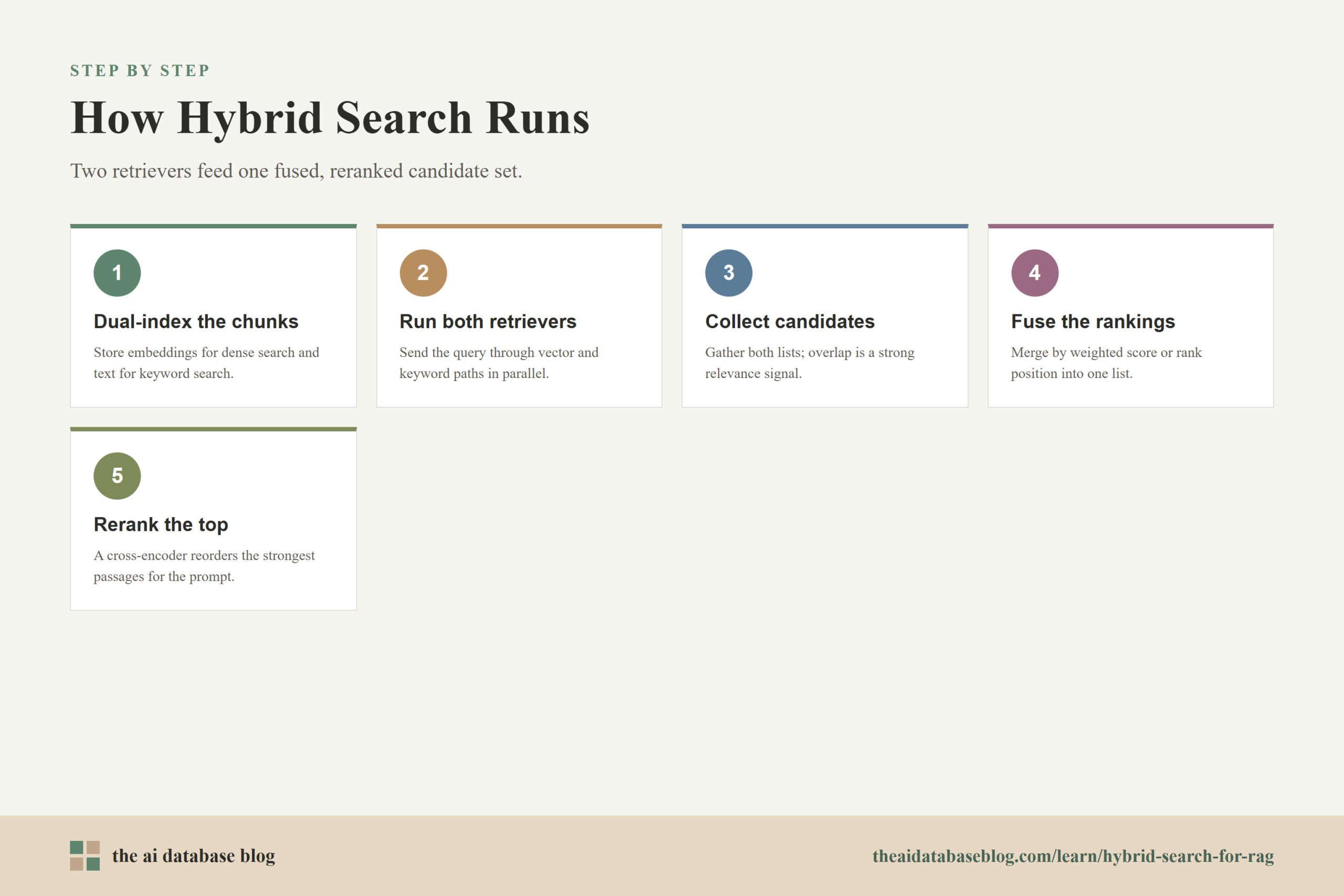
A typical hybrid RAG pipeline starts by preparing the same content for two kinds of search. The system chunks the source documents, stores each chunk with metadata, creates embeddings for dense retrieval, and also indexes the chunk text for keyword retrieval. At query time, the system sends the user’s question through both retrieval paths and collects candidate chunks from each one.
The dense path returns chunks that are semantically similar to the query. The keyword path returns chunks that match the query terms. Some chunks may appear in both lists, which is often a strong signal. Other chunks may appear in only one list, which can still be useful: a dense-only result may capture a paraphrase, while a keyword-only result may contain a rare identifier that the embedding model did not prioritize.
After candidate retrieval, the system applies fusion. Fusion is the process of merging the dense and keyword result lists into one final ranking. The simplest version gives each candidate a combined score based on its dense score and keyword score. Another common version uses rank position instead of raw scores, which can be helpful because dense similarity scores and BM25 scores are not naturally comparable.
Many production RAG systems then add a reranking step. A reranker, often a cross-encoder or similar relevance model, examines the query and candidate passages together and produces a more precise ordering. This two-stage approach is common because first-stage retrieval should maximize recall, while reranking can spend more computation on a smaller candidate set to improve precision.
Understanding the mechanics makes hybrid search sound straightforward, but the real value depends on the query mix. Hybrid search clearly wins in some situations, offers modest gains in others, and can even disappoint if one retrieval path is weak or poorly tuned.
When Hybrid Search Clearly Wins
Hybrid search is most valuable when the corpus and query set contain both conceptual questions and exact-match requirements. In these environments, dense retrieval and keyword retrieval cover different relevance gaps. The win is not simply that the system has more signals; the win is that the signals are complementary enough to improve recall without losing too much precision.
Technical Documentation and Support Knowledge Bases
Technical documentation is one of the clearest use cases for hybrid search. Users often ask natural language questions that include exact terms such as function names, configuration keys, version numbers, error messages, or command output. Dense retrieval can find explanatory passages that use related wording, while keyword retrieval can anchor the result set to the literal technical details.
For support knowledge bases, hybrid search helps with issue descriptions that mix symptoms and identifiers. A query such as “uploads fail after changing region on storage policy archive_cold_2” contains a broad concept, a behavior, and a precise policy name. Dense retrieval may capture the general failure pattern, while keyword retrieval ensures the policy identifier is not ignored.
Legal, Regulatory, and Policy Content
Legal and policy retrieval often requires exact terms, clause references, section names, and defined language. Dense retrieval can help users find relevant material when they ask in plain English, but keyword retrieval is critical when the answer depends on a specific phrase or citation. A RAG system that answers policy questions should not treat similar wording as interchangeable when the source text makes a precise distinction.
Hybrid search is also useful when documents contain repeated concepts across many sections. Dense retrieval may find several semantically similar passages, while keyword retrieval can help separate the one that contains the specific rule, threshold, date, or exception mentioned in the query.
Data With Tables, Fields, Codes, and Identifiers
Hybrid search often wins when documents include structured or semi-structured data. Financial reports, product catalogs, database schemas, logs, and operational manuals may include tables, field names, measurements, and identifiers. These details are easy for a human reader to recognize, but they can be difficult for dense retrieval to prioritize unless the chunks and embeddings are carefully designed.
In these cases, keyword retrieval can recover exact fields and values, while dense retrieval brings in explanatory context around them. The combination is especially useful when the generated answer must connect a precise value to a broader interpretation.
Queries With Mixed Intent
Many RAG queries are mixed-intent queries. They ask for an explanation, but they also include exact constraints. A user may ask, “What changed in the timeout behavior for connector v3.2?” The word “timeout” is conceptual, “connector” may be broad, and “v3.2” is exact. A hybrid retriever can handle all three signals better than either retrieval method alone.
Hybrid search is less likely to show a clear improvement when the query set is almost entirely conceptual, the keyword index is weak, the chunks are poorly extracted, or the corpus does not contain many exact-match signals. That is why evaluation matters: hybrid search should be tuned against the actual questions users ask, not against a generic assumption that two retrievers always outperform one.
Configuring Fusion in Hybrid Search
Fusion is the part of hybrid search that decides how much influence each retrieval path has on the final result. It is also where many hybrid RAG systems become either useful or frustrating. A good fusion setup preserves the strength of each retriever, while a poor setup lets one path dominate, introduces irrelevant candidates, or hides the exact-match results the system was supposed to protect.
Weighted Score Fusion
Weighted score fusion combines normalized dense and keyword scores. A simple version might calculate a final score from 70 percent vector similarity and 30 percent keyword relevance, or from an even 50 and 50 split. The weighting parameter controls whether the system leans toward semantic matching or exact term matching.
This approach is intuitive, but it requires care because dense scores and BM25 scores are not naturally on the same scale. Normalization helps, but score distributions can still behave differently across queries. If one retriever produces a very sharp score distribution and the other produces many nearly tied results, the normalized scores may affect the final ranking in surprising ways.
Rank-Based Fusion
Rank-based fusion combines results based on their positions in each ranked list rather than their raw scores. Reciprocal rank fusion is a common example. It gives more credit to documents that appear near the top of one or more result lists, and it can work well when raw scores from different retrieval systems are hard to compare.
The strength of rank-based fusion is robustness. It can merge BM25 and dense results without requiring score calibration. The tradeoff is that it may ignore useful differences in raw score strength. A document that barely ranks first and a document that strongly ranks first may receive similar treatment if the fusion method only cares about position.
Choosing the Dense-to-Keyword Balance
Many hybrid systems expose a parameter that controls the balance between dense and keyword retrieval. In Weaviate, for example, the alpha parameter controls this blend: lower values lean toward keyword search, higher values lean toward vector search, and a middle value weights them more evenly. The exact setting should depend on the corpus and query set rather than a universal default.
A practical starting point is to test several settings, such as keyword-heavy, balanced, and vector-heavy configurations. If users often search for identifiers, field names, error codes, or version numbers, keyword influence usually needs to be stronger. If users ask broad conceptual questions, dense retrieval may deserve more weight. If both patterns are common, dynamic weighting by query type may work better than one fixed setting.
Choosing a Fusion Method
The fusion method should match the reliability of the underlying scores. If raw scores are reasonably stable and well normalized, weighted score fusion can preserve meaningful score differences. If the scores are hard to compare, rank-based fusion may be safer. Some AI database systems support both, and the right answer is usually found through evaluation rather than preference.
There is also a broader design question: whether fusion should be the final ranking step or only a candidate-generation step before reranking. For many RAG systems, hybrid fusion is best used to collect a strong candidate pool, then a reranker selects the passages most likely to answer the question. This keeps hybrid search focused on recall while using a more precise model for final ordering.
After fusion is configured, the system still needs operational guardrails. The next step is to evaluate whether hybrid search is improving the answers users actually receive, not just whether it returns more documents.
How to Evaluate Hybrid Search for RAG
Evaluation should begin with retrieval, not generation. If the retriever does not surface the right evidence, the generator cannot reliably produce a grounded answer. A useful evaluation set should include real or realistic user questions, expected relevant chunks or documents, and examples of the query types the system must support.
Measure recall at different candidate depths, such as whether the right evidence appears in the top 5, top 10, or top 20 results. For RAG, recall is important because the system needs the relevant evidence to enter the context window. Also measure ranking quality with metrics such as mean reciprocal rank or nDCG when you have graded relevance judgments. These metrics help show whether the best evidence is near the top rather than buried in the candidate list.
Evaluation should be segmented by query type. Do not only look at one overall score. Compare performance for conceptual questions, exact identifier questions, mixed-intent questions, short queries, long descriptive queries, and table-heavy questions if those exist in your domain. Hybrid search may be excellent for one segment and unnecessary for another.
Finally, evaluate generated answers separately. Check whether answers are grounded in retrieved evidence, whether citations support the claims, and whether the model avoids using irrelevant retrieved passages. A retrieval configuration that improves recall but floods the generator with weak context may still hurt the final user experience.
Evaluation often reveals that hybrid search is not a single setting but a set of choices: chunking, indexing, weighting, fusion, filtering, reranking, and answer generation all interact. That makes implementation discipline just as important as the retrieval idea itself.
Practical Implementation Guidance
A strong hybrid RAG implementation starts with clean content preparation. Chunks should preserve enough context to be meaningful while staying focused enough for retrieval. Section titles, table captions, field names, and document metadata should be retained when possible because they often carry the exact terms that keyword retrieval needs and the context that dense retrieval needs.
Use metadata filtering before or during retrieval when the user’s query includes clear constraints such as product area, document type, date range, region, customer segment, or permission boundary. Hybrid search should not be expected to fix a search space that is too broad. Filtering can reduce noise before fusion and improve both relevance and efficiency.
Keep candidate sizes large enough for fusion to work. If each retriever only returns a tiny number of candidates, the final fused set may miss useful documents from one path. A common pattern is to retrieve more candidates than the generator will ultimately see, fuse and rerank them, then pass only the strongest passages into the model context.
Be careful with duplicate or near-duplicate chunks. Hybrid retrieval can surface the same information through both dense and keyword paths, which is useful as a relevance signal but wasteful if the generator receives several redundant passages. Deduplication and diversity controls can help preserve context space for distinct evidence.
Most importantly, keep tuning tied to observed failures. If the system misses exact codes, increase keyword influence or improve tokenization. If it misses paraphrases, improve dense retrieval or embeddings. If it retrieves the right documents but in the wrong order, adjust fusion or add reranking. If it retrieves irrelevant chunks with matching terms, improve chunking, filters, or reranker behavior.
Common Mistakes to Avoid
The first mistake is assuming hybrid search automatically improves every RAG system. Hybrid retrieval is powerful when the two retrieval paths are complementary, but it is not a guarantee. If BM25 is poorly configured, if text extraction breaks tables, or if dense embeddings are weak for the domain, fusion can combine bad signals instead of improving relevance.
The second mistake is using one fixed dense-to-keyword balance for every query without testing. A query with an error code and a query asking for a conceptual explanation should not always be treated the same way. Some systems use simple heuristics, such as increasing keyword weight when the query includes rare tokens, quoted strings, numbers, or code-like patterns.
The third mistake is evaluating only generated answers without inspecting retrieval. Generation quality can hide retrieval problems because the model may produce plausible text even with weak evidence. A good debugging workflow looks at the retrieved chunks, the fused ranking, the final context, and the answer together.
The fourth mistake is ignoring latency and cost. Hybrid search runs more retrieval work than a single retrieval method, and reranking adds additional computation. For many systems the quality gain is worth it, but the architecture should still be measured under realistic traffic, candidate sizes, and response-time requirements.
Avoiding these mistakes keeps hybrid search grounded in its real purpose: improving evidence selection for RAG. The goal is not to use every retrieval technique at once, but to retrieve the right context for the question in front of the system.
FAQs
1. What is hybrid search in RAG?
Hybrid search in RAG is a retrieval approach that combines dense vector search with keyword search before sending context to a language model. Dense search finds passages with similar meaning, while keyword search finds passages with matching terms. The results are fused into one ranked list so the generator has a better chance of seeing the right evidence.
2. Why combine dense retrieval and keyword retrieval?
Dense retrieval and keyword retrieval solve different relevance problems. Dense retrieval is good at matching paraphrases and concepts, while keyword retrieval is good at matching exact terms, rare words, codes, and identifiers. Combining them helps a RAG system handle both natural language questions and precision-sensitive queries.
3. When does hybrid search clearly outperform dense-only search?
Hybrid search often outperforms dense-only search when the corpus includes technical documentation, policy text, tables, field names, error codes, product versions, or other exact-match signals. It is especially useful when user questions mix a broad concept with a specific identifier. The gain is usually smaller when queries are purely conceptual and exact terms are not important.
4. What is fusion in hybrid search?
Fusion is the process of combining the dense retrieval results and keyword retrieval results into a single ranking. Fusion can use normalized scores, rank positions, or a combination of both. The fusion method determines whether the final ranking leans more toward semantic similarity, exact term matching, or a balanced blend.
5. Is reciprocal rank fusion better than weighted score fusion?
Reciprocal rank fusion is often useful when raw scores from dense and keyword systems are hard to compare because it relies on result positions rather than score scales. Weighted score fusion can be useful when scores are well normalized and score differences carry meaningful information. Neither method is always better; the right choice depends on evaluation results for the corpus and query set.
6. Should hybrid search be used with reranking?
Hybrid search often works well with reranking. The hybrid retriever can gather a broad candidate set from both semantic and keyword signals, and the reranker can then reorder the most promising passages with more precise query-document comparison. This is especially helpful when answer quality depends on selecting a small number of highly relevant chunks.
Takeaway
Hybrid search for RAG is useful because it combines the semantic flexibility of dense retrieval with the exact-match precision of keyword retrieval. It is most valuable for teams building RAG systems over technical, operational, legal, financial, or structured knowledge where users ask both conceptual questions and detail-sensitive questions. A practical use case is a support assistant that must understand a user’s natural language issue while also retrieving the exact error code, configuration key, or product version that determines the correct answer. The key is to tune fusion, evaluate by query type, and treat hybrid search as an evidence-selection strategy rather than a one-size-fits-all switch.
Watch this video to learn more