Fine-tuning an embedding model for your domain means teaching a general-purpose model which pieces of text should be close together, which should be far apart, and which distinctions matter in your specific retrieval system. It is most useful when your corpus contains specialized vocabulary, unusual document formats, repeated phrases with different meanings, or search behavior that a general model does not capture well. The goal is not to make the model memorize your documents, but to reshape the embedding space so your AI database retrieves more relevant chunks for real user queries.
This guide explains when domain-specific embedding fine-tuning is worth doing, what training data you need, how the process works, how to evaluate the result, and how the fine-tuned model fits into an AI database or retrieval-augmented generation system. By the end, you should understand the practical tradeoffs between using a strong base embedding model, adding reranking or hybrid search, and training a model that better matches your own domain.
What Embedding Fine-Tuning Actually Changes
An embedding model converts text into vectors, which are numerical representations that allow an AI database to compare the meaning of queries and documents. A general embedding model is trained to work across many kinds of text, so it often performs well on ordinary language, broad knowledge, and common question-answer patterns. Domain fine-tuning narrows that general ability toward the relationships that matter in one specific environment.
In a retrieval system, fine-tuning usually changes relative similarity. It teaches the model that a query such as “termination clause for delayed delivery” should be closer to the correct contract passage than to another passage that merely contains the same words. In a medical, legal, engineering, support, finance, or internal documentation setting, this can matter because the correct answer may depend on subtle distinctions, domain abbreviations, product names, standards, or workflow-specific terminology.
Fine-tuning does not replace the AI database. The database still stores vectors, metadata, source text, and retrieval indexes. The fine-tuned model changes the vectors that are inserted into that database and the vectors generated at query time. This means the quality of the model, chunking, metadata filters, index settings, and evaluation set all work together.
Once you understand that fine-tuning changes the shape of the vector space rather than simply adding facts, the next question is whether your retrieval problem really needs that extra work. Many systems can improve through simpler changes first, so it helps to know when fine-tuning is the right lever.
When Domain Fine-Tuning Is Worth It
Domain fine-tuning is worth considering when a strong off-the-shelf embedding model retrieves plausible but consistently wrong results. This often happens when your documents use language differently from the public text the model was trained on. The model may understand the words individually but fail to understand how your organization, field, or dataset uses them together.
The clearest sign is a recurring relevance problem. If users ask realistic questions and the correct passage is missing from the top results, buried too low, or displaced by text with superficial keyword overlap, the embedding model may not be representing your domain relationships well enough. Fine-tuning can help the model learn that the correct match is not always the passage with the most shared terms, but the passage that answers the domain-specific intent.
Common situations where fine-tuning can help include:
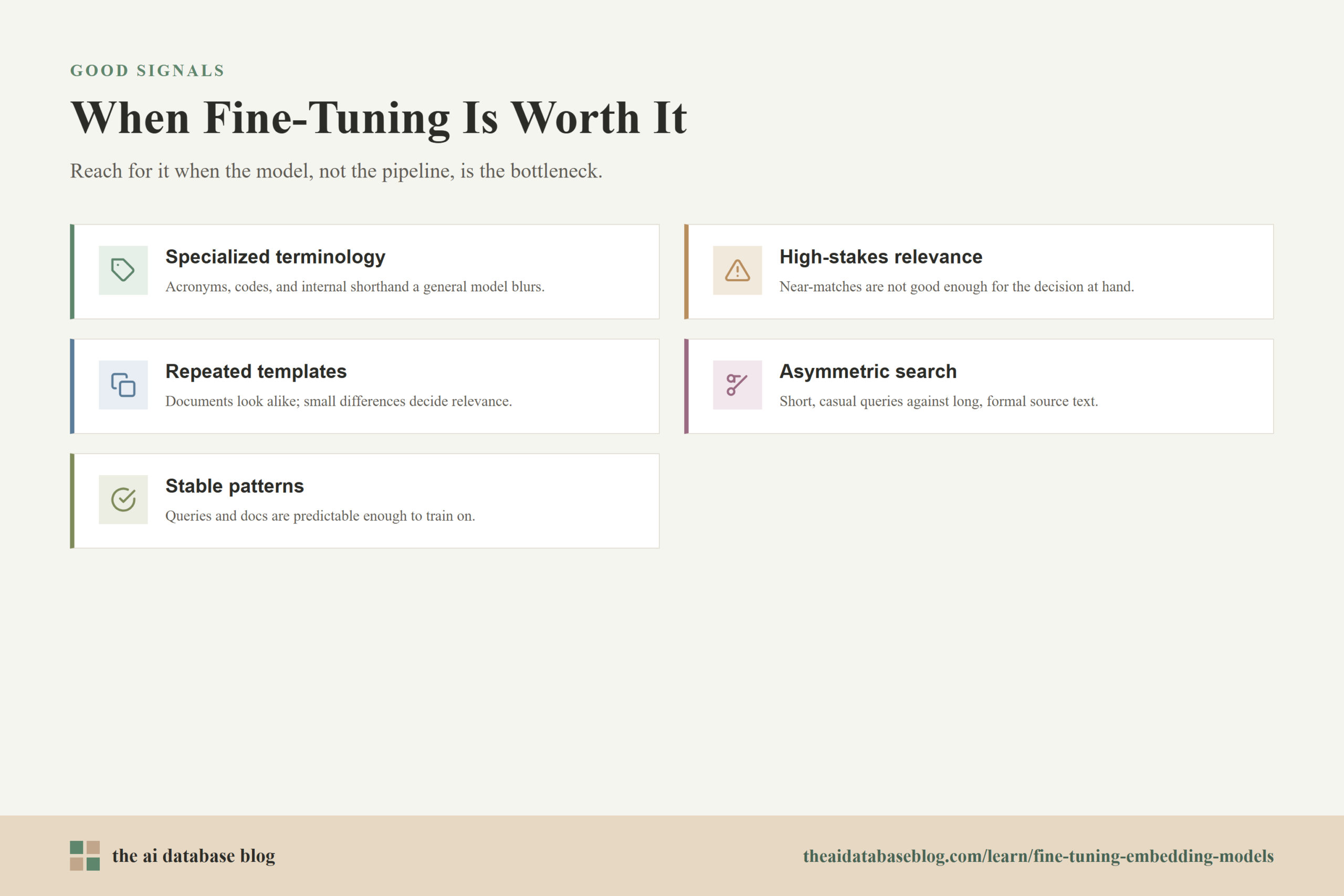
- Specialized terminology: The corpus contains acronyms, codes, product names, clinical terms, legal language, engineering labels, or internal shorthand that general models may treat too loosely.
- High-stakes relevance: The retrieval system supports decisions where near-matches are not good enough, such as compliance review, technical support, research discovery, or policy lookup.
- Repeated templates: Many documents share similar wording, but small differences determine which passage is relevant.
- Asymmetric search: User queries are short, conversational, or problem-oriented, while source documents are long, formal, and structured differently.
- Stable domain patterns: The kinds of queries and documents are predictable enough that training examples will reflect future retrieval behavior.
Fine-tuning is less useful when the main problem is poor chunking, missing metadata, stale content, or weak query routing. If the correct information is split across chunks, filtered out by metadata, or absent from the corpus, a better embedding model will not solve the underlying issue. In those cases, improving the retrieval architecture should come first.
After deciding that the model itself is a likely bottleneck, the next step is to prepare the right training signal. Fine-tuning depends less on the raw volume of domain text and more on examples that show the model what relevance means in your environment.
What Training Data You Need
The most useful training data for domain-specific embedding models is a set of examples that connect queries to relevant documents or passages. In retrieval language, these are often called query-document pairs. A query is something a user might ask, and the positive document is the chunk or passage that should be retrieved for that query.
Good training data can come from search logs, support tickets, question-answer pairs, expert annotations, click-through behavior, customer service transcripts, internal documentation tasks, or synthetic queries generated from your own corpus and then reviewed for quality. The important point is that the examples must reflect real retrieval intent. Training on generic summaries or random adjacent sentences may improve surface similarity, but it may not teach the model how people search.
Many fine-tuning workflows also use negative examples. A negative is a passage that should not be retrieved for a given query. Easy negatives are obviously unrelated and provide limited learning value. Hard negatives are more valuable because they look similar to the query but are still wrong. For example, if the query asks about “refund eligibility after annual plan cancellation,” a hard negative might be a billing policy chunk that discusses annual plans but does not answer refund eligibility.
A practical dataset often includes:
- Queries: Realistic user questions, support prompts, search phrases, or task descriptions.
- Positive passages: The document chunks that should be retrieved because they answer the query.
- Hard negatives: Similar but incorrect chunks that teach the model sharper boundaries.
- Validation examples: Held-out query and passage pairs that are never used during training and are used only to measure performance.
The dataset does not need to be enormous to be useful, but it does need to be clean. A smaller set of well-labeled examples can be more valuable than a large set of noisy pairs. If the positives are wrong, too broad, or inconsistently chosen, the fine-tuned model will learn those inconsistencies and may make retrieval worse.
Once the data is ready, fine-tuning becomes a process of repeatedly showing the model what should be close and what should not be close. The specific training method matters because retrieval models need to learn ranking behavior, not just text classification.
How Embedding Fine-Tuning Works
Most domain-specific embedding fine-tuning for text retrieval uses contrastive learning. The model receives an anchor, usually a query, along with a positive passage and one or more negatives. The training objective rewards the model when the query vector is closer to the positive passage vector than to the negative passage vectors.
A common approach is Multiple Negatives Ranking Loss, also known as an in-batch negatives objective. In this setup, each query-positive pair in a training batch treats the other positives in the same batch as negatives. This can be efficient because a batch of examples creates many comparison signals without manually labeling every possible negative. When mined hard negatives are added, the model gets even stronger signals about the confusing cases it must learn to separate.
Some projects use triplet loss, margin-based losses, distillation from a stronger reranker, or adapter-style approaches that transform embeddings without changing the full base model. The right method depends on the model, infrastructure, data volume, and whether you can host a custom model. The underlying goal is the same: improve retrieval ranking for your domain without damaging the model’s broader semantic usefulness.
The usual workflow looks like this:
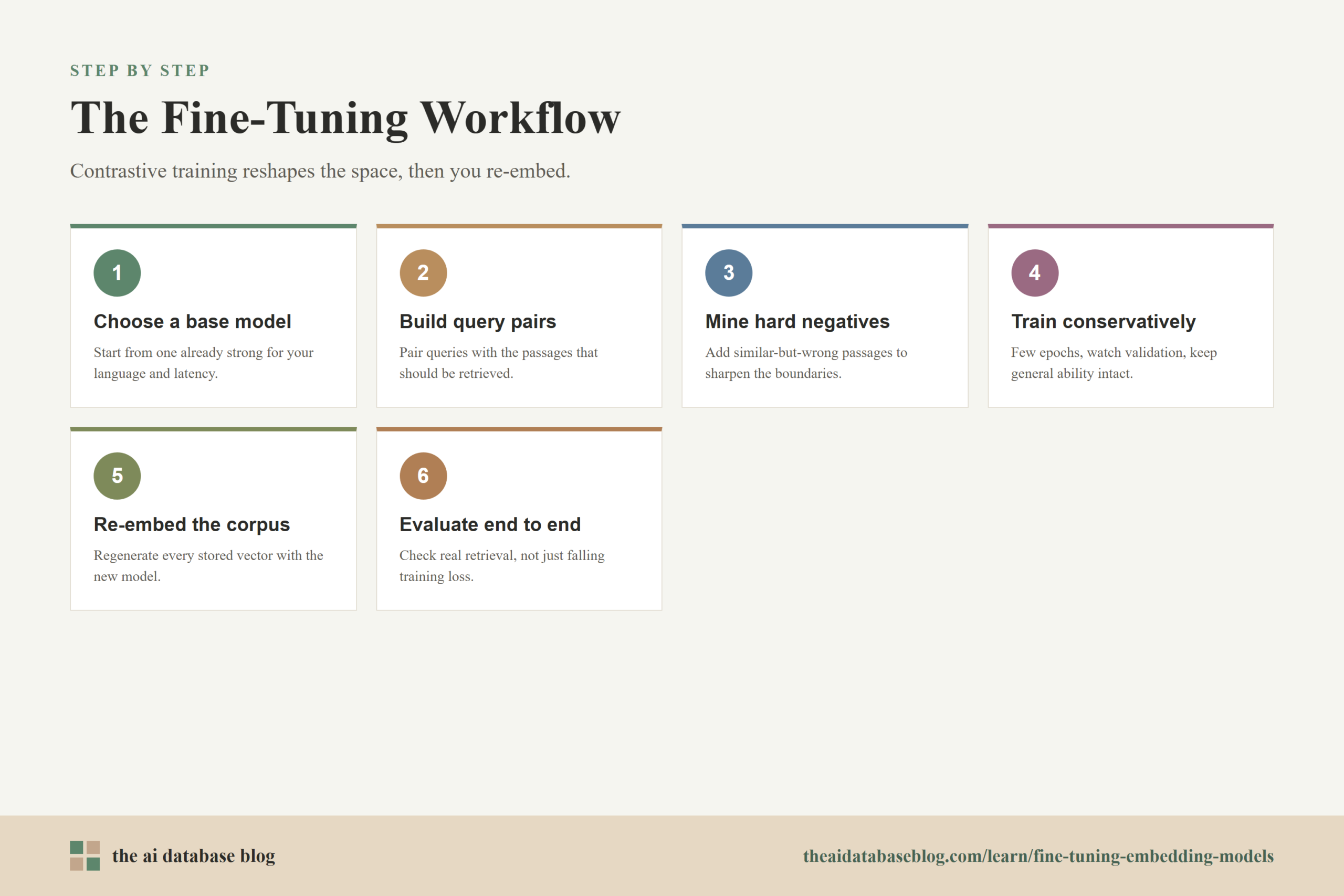
- Choose a base model. Start with a strong embedding model that already performs reasonably well for your language, context length, latency budget, and deployment constraints.
- Create training examples. Build query-positive pairs and add hard negatives where possible.
- Split the data. Keep training, validation, and test sets separate so you can detect overfitting.
- Train conservatively. Use a limited number of epochs, monitor validation metrics, and avoid pushing the model so far that it loses general retrieval ability.
- Re-embed the corpus. After the model changes, regenerate vectors for stored content and update the AI database index.
- Evaluate end to end. Measure whether the retrieval system improves for real queries, not just whether the training loss decreases.
The training step is only one part of the full system. A model that looks better during training can still fail in production if the evaluation set is weak or if the AI database is not updated correctly. That makes evaluation the most important safeguard.
How to Evaluate a Fine-Tuned Embedding Model
Evaluation should answer a practical question: does the fine-tuned model retrieve better results for the queries your users actually care about? General benchmarks such as MTEB and BEIR are useful for understanding broad model quality, but they cannot fully predict performance on a private or specialized corpus. Your own retrieval test set matters most.
A good evaluation set includes realistic queries, known relevant passages, and enough difficult cases to reveal whether the model is learning the right distinctions. If every test query has an obvious answer with unique keywords, almost any retrieval method may look good. The better test is whether the model can find the right passage when several passages use similar words or when the query uses different language from the document.
Useful retrieval metrics include:
- Recall at k: Measures whether the correct passage appears within the top k results, such as top 5 or top 10.
- Precision at k: Measures how many of the top results are actually relevant.
- Mean reciprocal rank: Rewards systems that place the first correct result higher in the ranking.
- nDCG: Helps evaluate ranked results when some passages are more relevant than others.
- Answer-level quality: For RAG systems, measures whether the generated answer becomes more accurate, complete, and grounded after retrieval improves.
Evaluation should compare the fine-tuned model against a baseline. The baseline might be the original embedding model, hybrid search, a reranker, a different chunking strategy, or a combination of these. This comparison matters because fine-tuning is not always the highest-return change. Sometimes adding metadata filters, using hybrid retrieval, or reranking the top results gives a larger improvement with less operational complexity.
Evaluation also protects against overfitting. A model can become very good at the examples it was trained on while becoming less useful for new queries. If validation results improve but production-like test results decline, the training data may be too narrow, too synthetic, or too closely matched to the evaluation set.
After the model is proven to improve retrieval, the remaining question is how to place it inside the AI database workflow without creating new reliability or maintenance problems.
How Fine-Tuning Fits Into an AI Database Architecture
In an AI database system, the embedding model is part of a larger retrieval pipeline. The model creates vectors, the database stores and indexes those vectors, and the query system retrieves candidate results using vector similarity, keyword search, metadata filtering, or a combination of methods. Fine-tuning changes one important component, but the surrounding architecture still determines whether the system is useful.
When you deploy a fine-tuned model, every stored document chunk should be embedded with the same model that will be used at query time. Mixing vectors from different embedding models can make similarity scores unreliable because the vectors may live in different spaces. If you change the model, plan for a full re-embedding job and an index update.
The AI database should also preserve metadata that supports filtering and evaluation. Metadata such as document type, date, source, department, access permissions, language, and product area can prevent irrelevant vectors from competing in the first place. Fine-tuning helps the model understand semantic relevance, while metadata helps the retrieval system respect boundaries that semantics alone may not capture.
Hybrid search often remains useful even after fine-tuning. Dense vectors capture meaning, while keyword or sparse retrieval can catch exact terms, identifiers, error codes, legal citations, and rare phrases. In many domain systems, the best retrieval architecture combines a fine-tuned embedding model with keyword signals and, when needed, a reranker that reviews the top candidates more carefully.
This broader view matters because fine-tuning is not a one-time model project. It becomes part of retrieval operations, which means the team needs a way to monitor quality, refresh data, and decide when another training cycle is justified.
Common Mistakes to Avoid
The most common mistake is fine-tuning before diagnosing the retrieval problem. If the system is failing because documents are poorly chunked, metadata filters are missing, permissions are wrong, or the corpus is incomplete, a fine-tuned model will only improve a small part of the pipeline. Start by reviewing failed queries and identifying whether the model is truly the weak point.
Another mistake is training on weak positives. If each query is paired with an entire document instead of the specific passage that answers it, the model receives a blurry signal. The model may learn that broad topical similarity is enough, even though the retrieval system needs answer-level relevance. Passage-level positives are usually better for RAG because the downstream generator depends on compact, directly useful context.
Teams also underestimate the importance of hard negatives. Without hard negatives, the model may learn to separate unrelated topics but still fail on the near-matches that cause real retrieval errors. Hard negatives make the task more difficult in the right way, because they force the model to learn the distinctions that matter in the domain.
A final mistake is evaluating only with aggregate scores. Metrics are necessary, but they should be paired with qualitative review of representative failures. Look at what moved into the top results, what dropped out, and whether the changes make sense to domain experts. A small metric gain may not be useful if the remaining failures are concentrated in the most important use cases.
With those risks in mind, fine-tuning works best when it is treated as a disciplined retrieval improvement process rather than a generic model upgrade. The next section turns that into a practical decision framework.
A Practical Decision Framework
Before fine-tuning, ask whether the system has already been improved through simpler retrieval changes. If chunking is messy, metadata is thin, or evaluation is missing, fix those first. Fine-tuning is most effective when the retrieval pipeline is already healthy enough that model relevance is the remaining bottleneck.
A practical sequence is to start with a strong base embedding model, build a realistic evaluation set, test vector search, test hybrid search, and inspect failure cases. If failures show consistent domain mismatch, then create query-positive-negative training data and fine-tune. After training, compare the new model against the baseline using the same held-out test set.
Fine-tuning is a good choice when the improvement is measurable, the use case justifies the maintenance cost, and the team can re-embed content whenever the model changes. It is a weaker choice when the corpus changes constantly, labeled examples are unreliable, or a reranker can solve the same ranking problem more simply.
The strongest retrieval systems often combine several techniques. A fine-tuned embedding model can make the first-stage candidate set more relevant. Hybrid search can preserve exact-match behavior. Metadata filters can enforce scope. A reranker can refine the final ordering. The AI database brings these pieces together so the retrieval system can serve both semantic meaning and operational constraints.
FAQs
1. What does it mean to fine-tune an embedding model?
Fine-tuning an embedding model means training it on examples from your domain so it learns which queries and passages should be close together in vector space. For retrieval, this usually means using query-positive pairs and sometimes hard negatives to improve ranking quality for a specific corpus or task.
2. Do I need labeled data to fine-tune embeddings?
Labeled data is strongly preferred, especially query-passage pairs that show what a relevant match looks like. If manually labeled data is limited, teams may use search logs, expert-reviewed examples, or synthetic queries generated from domain documents. Synthetic data should be checked carefully because noisy labels can teach the model the wrong relevance patterns.
3. How is embedding fine-tuning different from fine-tuning a language model?
Embedding fine-tuning improves how text is represented and retrieved, while language model fine-tuning changes how a generative model responds. For RAG systems, embedding fine-tuning helps the system find better context before generation. It does not, by itself, teach the generator a new writing style or make the generator answer differently without retrieved context.
4. Should I fine-tune embeddings before using hybrid search?
Usually, no. Hybrid search is often easier to test first because it combines semantic retrieval with keyword or sparse signals. If hybrid search, chunking improvements, and metadata filters still leave consistent domain-specific failures, then fine-tuning becomes a stronger option.
5. Do I need to re-embed my documents after fine-tuning?
Yes. A fine-tuned embedding model produces vectors in a changed embedding space, so stored document vectors should be regenerated with the same model used for query embeddings. Otherwise, the AI database may compare vectors that are not aligned, which can make similarity scores unreliable.
6. How do I know if fine-tuning worked?
You know fine-tuning worked when it improves retrieval on a held-out test set that reflects real user queries. Metrics such as recall at k, precision at k, mean reciprocal rank, and nDCG are useful, but they should be paired with human review of important examples and RAG answer quality when the retrieved passages feed a generator.
Takeaway
Fine-tuning embedding models for your domain is most useful when a general model understands language broadly but misses the specific relevance patterns your AI database needs. The process depends on good query-passage examples, careful use of hard negatives, conservative training, and evaluation against realistic retrieval tasks. This guidance is especially useful for teams building RAG systems, enterprise search, support knowledge bases, technical documentation retrieval, or other AI applications where the right answer depends on specialized terminology and precise passage ranking.
Watch this video to learn more