Hybrid indexing means maintaining more than one index over the same underlying data so an AI database can answer different kinds of retrieval questions efficiently. In practice, this often means combining dense vector indexes with sparse keyword indexes, or pairing coarse indexes that quickly narrow the search space with fine indexes that improve precision. The benefit is better retrieval coverage across semantic, lexical, filtered, and large-scale search patterns; the tradeoff is additional storage, memory, write amplification, tuning, and operational maintenance.
This guide explains why multiple index types often coexist in AI database systems, how dense and sparse indexes work together, how coarse and fine vector indexes complement each other, and what storage and maintenance costs teams should expect. By the end, you should understand hybrid indexing as an architectural choice rather than a single feature: it is a way to balance relevance, latency, scale, and operational complexity.
What Hybrid Indexing Means In An AI Database
Hybrid indexing is the practice of building several access paths over the same records, documents, chunks, or objects. The underlying data may be one logical collection, but the database stores extra structures that make different retrieval strategies fast. A document chunk, for example, might have a dense embedding for semantic similarity, a sparse representation for keyword matching, metadata fields for filtering, and compressed vector codes for lower-cost approximate search.
This matters because AI retrieval is rarely one-dimensional. A user may ask a broad conceptual question, search for an exact product code, filter by date or tenant, or need a high-recall candidate set for a reranker. One index type can usually handle one of those needs well, but it may be weak at another. Hybrid indexing gives the system more than one way to find candidates before ranking or generating an answer.
It is useful to separate hybrid indexing from hybrid ranking. Hybrid indexing is about the stored structures that make retrieval possible. Hybrid ranking is about how the system combines the results, scores, or candidate lists returned by those structures. They often appear together, but they are not the same thing. A database can maintain dense and sparse indexes, then combine their results through weighted scoring, rank fusion, reranking, or a custom application-level policy.
Once hybrid indexing is understood as multiple access paths over the same data, the next question is why those paths are necessary. The answer is that different indexes preserve different signals, and AI applications usually need more than one signal to retrieve reliably.
Why Multiple Index Types Coexist Over The Same Data
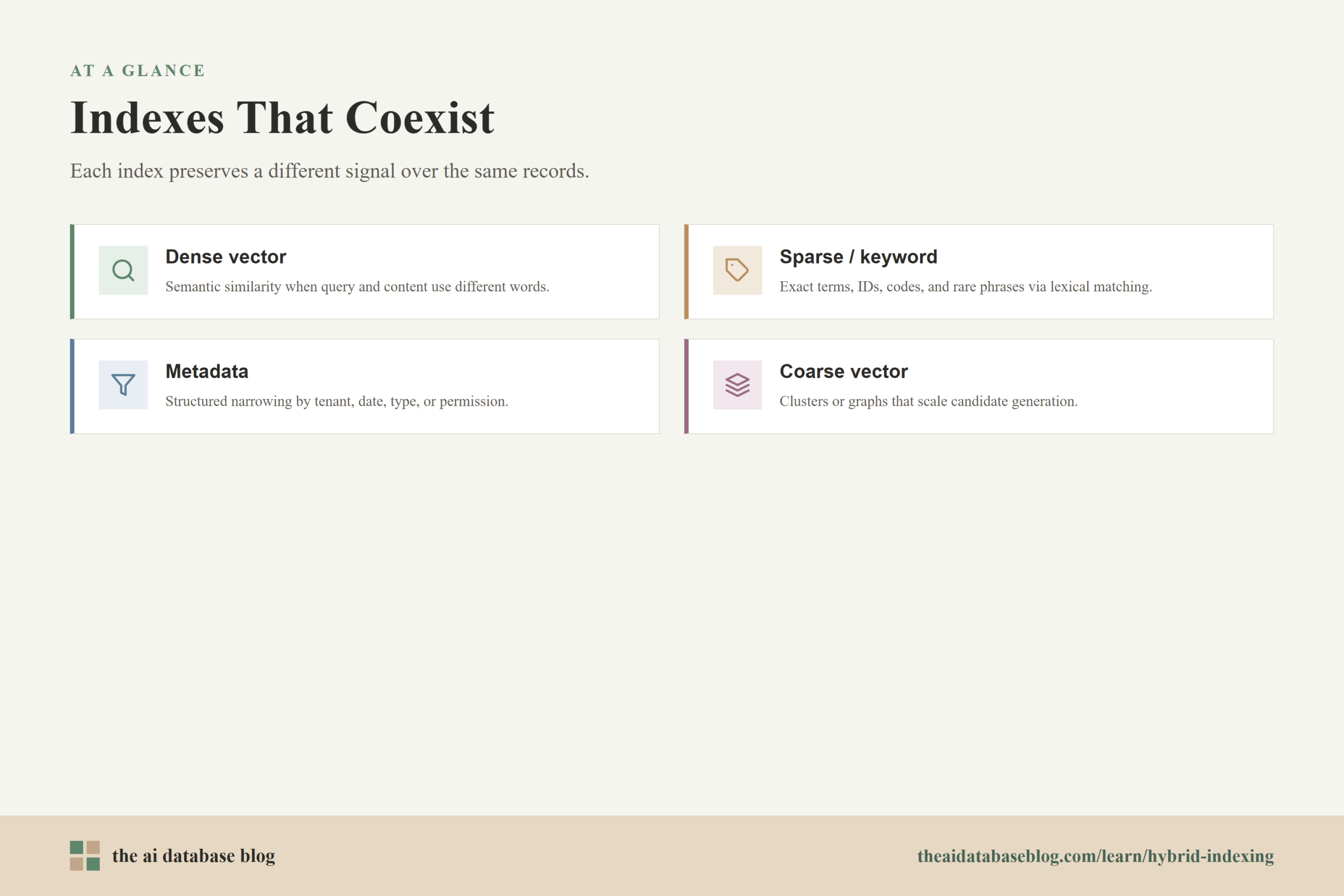
Multiple index types coexist because the same data needs to be searched through different meanings of relevance. Dense vector indexes are strong when the query and content are semantically related even if they use different words. Sparse or inverted indexes are strong when exact terms, identifiers, acronyms, error messages, names, or field-specific language matter. Metadata indexes are strong when the system must restrict results to a tenant, time range, document type, permission scope, or other structured condition.
A single retrieval path can miss important results because it compresses the data into one view. Dense embeddings encode meaning into numeric vectors, but they can blur exact wording and may underweight rare tokens. Sparse indexes preserve term-level evidence, but they can struggle when the user uses different language from the source text. Filter indexes do not usually decide semantic relevance, but they are essential for narrowing the eligible records before or during retrieval.
In AI database workloads, these weaknesses show up quickly. A support search system may need to match the phrase “connection refused” exactly while also finding conceptually related networking guidance. A legal or compliance system may need semantic retrieval, but only inside documents the user is allowed to see. A product knowledge base may need to retrieve by part number, product family, and natural-language description in the same query.
The reason these index types coexist is not redundancy for its own sake. Each index represents a different promise about the data. The dense vector index promises semantic neighborhood search. The sparse index promises lexical evidence. The metadata index promises structured narrowing. The hybrid retrieval layer uses those promises together so the application is less dependent on one imperfect representation.
This is easiest to see in the common dense-plus-sparse pattern. It is the form of hybrid indexing most readers encounter first because it directly addresses the gap between semantic search and keyword search.
Combining Dense And Sparse Indexes
Dense and sparse indexes are often paired because they answer different retrieval questions. A dense vector index stores embeddings produced by a model, where each record is represented as a high-dimensional numeric vector. A sparse index stores term-based signals, often through an inverted index or a sparse vector representation, where most dimensions are zero and the non-zero dimensions correspond to terms or learned lexical features.
Dense retrieval is useful when the query and answer are conceptually similar but do not share many words. If a user searches for “how to keep answers grounded in source documents,” dense search may retrieve content about retrieval-augmented generation even if the exact phrase does not appear. Sparse retrieval is useful when the exact wording carries important meaning. If a user searches for “ERR_AUTH_TOKEN_EXPIRED,” a sparse index is more likely to preserve that exact signal.
Hybrid systems commonly run both retrieval paths and then combine the candidates. One approach is score weighting, where dense and sparse scores are normalized and blended. Another approach is rank fusion, where each index returns a ranked list and the system rewards items that appear near the top of one or both lists. A third approach is staged retrieval, where one index produces a broad candidate set and another signal, model, or reranker refines the order.
The choice depends on the workload. For short keyword-heavy queries, the sparse side may deserve more influence. For broad natural-language questions, dense retrieval may deserve more influence. For technical documentation, code search, product catalogs, financial documents, and enterprise knowledge bases, neither signal should be assumed to dominate every query. The practical goal is not to make dense and sparse retrieval compete, but to let each one catch cases the other might miss.
Dense-plus-sparse indexing improves coverage, but it does not solve every scale problem. At large volumes, vector search itself often needs more than one internal index structure. That leads to the second meaning of hybrid indexing: combining coarse and fine indexes inside the vector search path.
Combining Coarse And Fine Indexes
Coarse and fine indexing is about reducing the amount of vector data the system must inspect for each query. Exact nearest-neighbor search compares a query vector against every vector in the collection, which becomes expensive as data grows. Approximate nearest neighbor indexes avoid this by using structures that quickly rule out most vectors while still returning likely matches.
A coarse index divides the search space into broad regions or entry points. An inverted file style vector index, for example, assigns vectors to clusters and searches only the closest clusters for a query. A graph-based index uses navigable links between vectors so the search can move quickly toward promising neighborhoods. These structures reduce the number of candidates that need deeper inspection.
A fine index or fine scoring step improves accuracy after the coarse stage has narrowed the search. This may involve comparing the query to original vectors, using compressed vector codes, applying product quantization, increasing the number of searched clusters, or reranking a candidate set with a more exact similarity calculation. The coarse stage saves time; the fine stage protects relevance.
This pairing creates a familiar tradeoff. Searching more clusters, visiting more graph neighbors, or reranking more candidates usually improves recall, but it also increases latency and compute. Searching fewer candidates is faster, but it may miss relevant results. Hybrid coarse-and-fine indexing exists because production systems need a controllable middle ground between brute-force accuracy and low-latency approximate search.
Coarse and fine indexes also interact with dense-plus-sparse retrieval. A system might use a sparse index to find exact-term candidates, a vector graph to find semantic candidates, a coarse quantizer to reduce vector comparisons, and a reranker to reorder the merged set. That combination can be powerful, but every extra access path has a cost that must be planned for.
The Storage Cost Of Hybrid Indexing
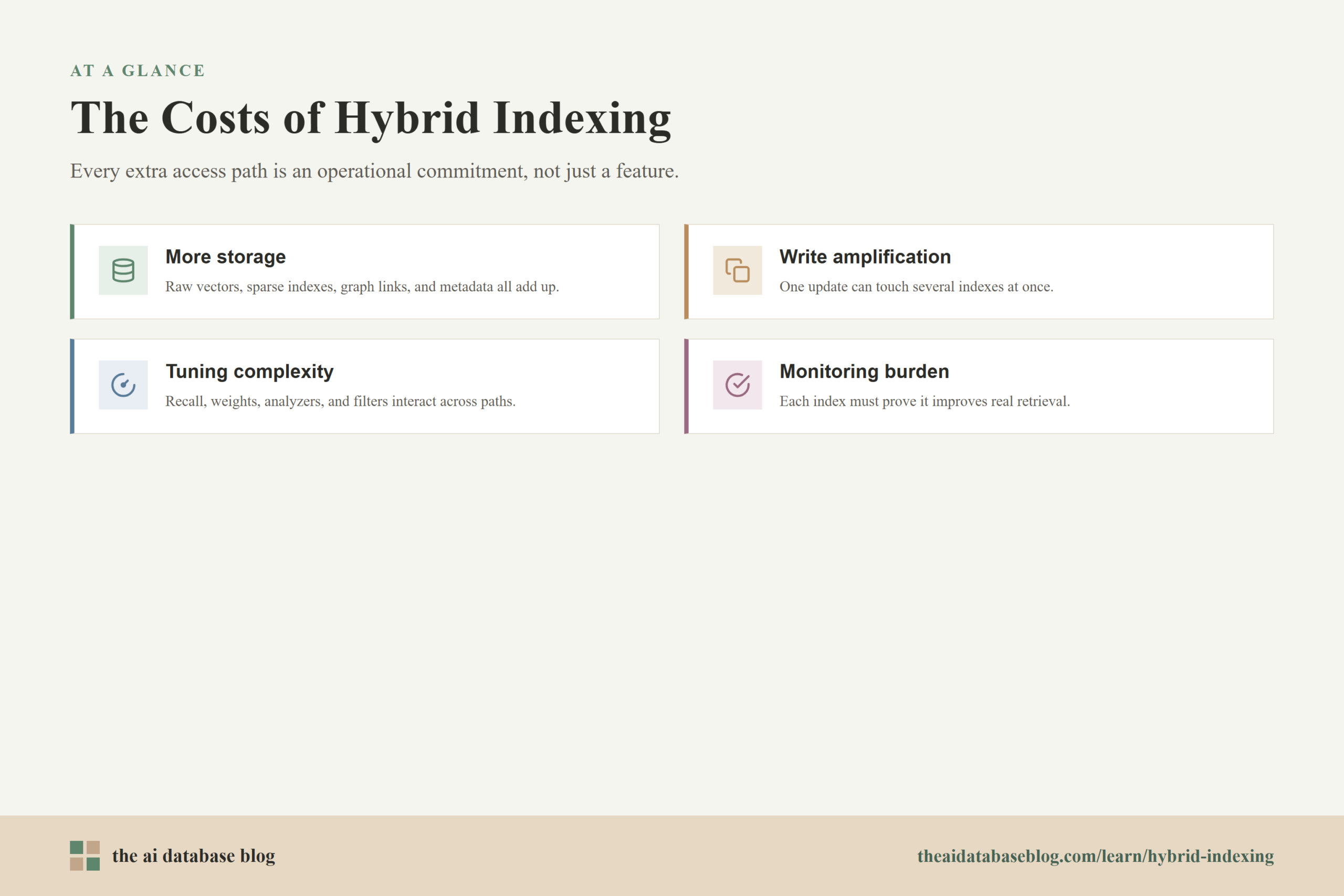
Hybrid indexing increases storage because indexes are additional data structures, not replacements for the original data. The database may store the raw text or object payload, metadata, one or more embeddings, an inverted index, vector graph links, cluster assignments, quantized codes, deletion markers, and auxiliary statistics. Even when compression is used, the system still carries more than one representation of the same logical record.
Dense vectors can be expensive because each embedding contains many numeric values. A 768-dimensional vector stored as 32-bit floats requires roughly 3 KB before index overhead. At millions or billions of records, the vector column alone becomes substantial. ANN indexes add their own overhead: graph indexes store neighbor links, IVF-style indexes store list assignments and centroids, and compressed indexes store codebooks or quantized representations.
Sparse indexes have a different cost profile. They may be compact for short text, but they grow with vocabulary size, token frequency, field count, and the amount of text indexed. They also store statistics needed for scoring, such as document frequency and field-length information. If the system indexes multiple text fields, supports multilingual analysis, or stores learned sparse vectors, the sparse side can become a meaningful part of total storage.
Metadata and filter indexes are often overlooked in cost estimates. Permission filters, tenant IDs, timestamps, categories, and numeric ranges may require separate structures so the system can avoid scanning irrelevant records. These indexes are essential in real applications, but they add disk, memory, and update work. A realistic capacity plan should include payload storage, vector storage, sparse index storage, filter index storage, replicas, backups, and temporary space for rebuilds.
Storage is only the static cost. The dynamic cost appears when data changes. Hybrid indexes must be inserted into, updated, compacted, optimized, and sometimes rebuilt, which makes maintenance just as important as raw disk usage.
The Maintenance Cost Of Hybrid Indexing
Maintenance cost is the operational price of keeping several indexes correct and useful as data changes. Every new record may require text analysis, embedding generation, vector index insertion, sparse index updates, metadata index updates, and replication. Every deletion may leave tombstones or stale references until compaction or cleanup occurs. Every update may behave like a delete plus an insert if the text, embedding, or filterable fields change.
Write amplification is one of the biggest costs. A single document update can touch multiple structures, and each structure may have different update behavior. Some indexes handle incremental inserts well. Others are faster to query after batch building or periodic optimization. If embeddings are regenerated after a model change, the vector index may need large-scale rebuilding even when the source documents have not changed.
Hybrid indexing also increases tuning work. Dense vector indexes have parameters that affect recall, memory, build time, and latency. Sparse search has analyzers, tokenization choices, field weights, and scoring behavior. Fusion has weighting, normalization, and candidate-depth decisions. Filter indexes have selectivity and execution-order concerns. These settings cannot be tuned in isolation because changing one retrieval path affects the final result set.
Operational teams should also account for monitoring and evaluation. It is not enough to know that each index exists; the team needs to know whether each index is improving retrieval quality for real queries. Hybrid indexing can quietly become wasteful if one access path is rarely used, poorly tuned, or returning candidates that never survive reranking. Measuring recall, precision, latency, index size, update lag, and query-specific behavior helps decide whether the extra complexity is justified.
Because hybrid indexing has real costs, it should be designed around use cases rather than added automatically. The next step is to decide when the tradeoff is worthwhile and when a simpler indexing strategy is enough.
When Hybrid Indexing Is Worth It
Hybrid indexing is worth it when the application has diverse query types, strict relevance requirements, large datasets, or structured constraints that cannot be handled well by one index. It is especially useful in retrieval-augmented generation, enterprise search, technical documentation, compliance search, product discovery, customer support, and knowledge systems where exact terms and semantic meaning both matter.
A good signal that hybrid indexing is needed is uneven retrieval performance. If semantic search works for conceptual questions but fails on IDs and exact phrases, add or improve sparse indexing. If keyword search finds exact matches but misses paraphrases, add dense retrieval. If vector search is accurate but too slow at scale, consider approximate, coarse, or compressed vector indexes. If results are relevant but include records the user should not see, improve metadata and permission filtering.
Hybrid indexing may not be worth it for small datasets, narrow query patterns, or low-stakes internal tools where exact search or a single vector index is already good enough. It can also be counterproductive when teams add indexes without evaluation. More indexes do not automatically mean better answers; they mean more candidate sources that must be scored, fused, monitored, and maintained.
The practical approach is to start with the simplest index strategy that meets the application requirement, then add index types when evidence shows a gap. Hybrid indexing should be a response to measured retrieval needs: missed exact terms, missed semantic matches, high latency, poor filtered recall, or unacceptable storage and memory pressure.
Once the decision is made, the architecture should make the tradeoffs explicit. The system should define which index handles which retrieval signal, how candidates are combined, how freshness is maintained, and how success is measured.
Practical Design Guidelines
A good hybrid indexing design begins with the retrieval questions the application must answer. Before choosing index types, identify the common query patterns, the fields that matter, the filters that must be enforced, the acceptable latency, and the cost limits. This prevents the index design from becoming a collection of features that are expensive to run but unclear in purpose.
- Map each index to a job. Use dense indexes for semantic similarity, sparse indexes for lexical matching, metadata indexes for structured narrowing, and coarse vector indexes for scalable candidate generation.
- Keep candidate fusion understandable. Whether the system uses weighted scoring, rank fusion, or reranking, teams should be able to explain why a result appeared and which retrieval path contributed to it.
- Plan for update behavior early. If the dataset changes frequently, choose index structures and ingestion workflows that can handle incremental updates without excessive rebuilds or long freshness delays.
- Measure quality by query type. Hybrid retrieval may help some queries and do little for others. Evaluate exact-term queries, broad semantic queries, filtered queries, and edge cases separately.
- Budget for hidden storage. Include raw vectors, compressed vectors, graph links, inverted indexes, metadata indexes, replicas, backups, and rebuild space in capacity planning.
- Remove unused complexity. If an index does not improve recall, latency, or reliability for real workloads, it may not justify its cost.
These guidelines make hybrid indexing easier to reason about. Instead of asking whether hybrid indexing is good or bad in the abstract, the better question is whether each index earns its place in the retrieval pipeline.
FAQs
1. Is hybrid indexing the same as hybrid search?
No. Hybrid indexing refers to the stored index structures that support multiple retrieval paths. Hybrid search refers to the query-time process of using those paths together, often by combining dense vector results with sparse keyword results.
2. Why not use only dense vector search?
Dense vector search is strong for semantic similarity, but it can miss exact terms, rare identifiers, error codes, names, and highly specific phrases. Many AI applications need both conceptual matching and exact lexical evidence.
3. Why not use only sparse keyword search?
Sparse keyword search is strong when query terms overlap with document terms, but it can miss relevant content that uses different wording. Dense embeddings help retrieve paraphrases, related concepts, and natural-language matches that keyword search may not surface.
4. What is the difference between coarse and fine vector indexing?
A coarse index quickly narrows the search space by routing the query toward likely regions, clusters, or graph neighborhoods. A fine stage then compares, decodes, or reranks a smaller set of candidates to improve accuracy.
5. Does hybrid indexing always improve retrieval quality?
No. Hybrid indexing improves quality when the added index captures useful signals that the existing index misses. If the dataset is small, the query pattern is narrow, or the fusion logic is poorly tuned, extra indexes may add cost without improving results.
6. What is the biggest hidden cost of hybrid indexing?
The biggest hidden cost is usually maintenance. Multiple indexes increase write amplification, rebuild work, monitoring needs, tuning complexity, and storage planning. Teams should treat hybrid indexing as an operational commitment, not just a retrieval feature.
Takeaway
Hybrid indexing helps AI databases retrieve better results by preserving multiple signals over the same data: semantic meaning through dense vectors, exact language through sparse indexes, structured constraints through metadata indexes, and scalable search through coarse and fine vector structures. This guidance is most useful for teams building retrieval-augmented generation, enterprise search, support search, product discovery, or technical knowledge systems where one retrieval path is not reliable enough. The main lesson is that hybrid indexing is a tradeoff: it can improve relevance, latency, and coverage, but only when its storage, maintenance, and tuning costs are justified by the application’s real retrieval needs.