Upserts and updates in vector databases are the operations that keep searchable embeddings aligned with changing source data. An upsert usually means “insert this record if it is new, or replace the existing record with the same ID if it already exists.” Updates can change metadata, text, vectors, or the whole record, but the practical challenge is not only storing the new value. The database also has to keep the vector index, filters, deletion markers, and source-system identity in sync so search results stay fresh without making every small change too expensive.
This guide explains how insert-or-update semantics work, why stable IDs matter, how vector indexes stay synchronized with source data, how soft deletes and tombstones are used, and why frequent updates can be especially costly for graph-based indexes such as HNSW. By the end, you should understand the difference between an easy API call and the deeper index-maintenance work that happens behind it.
Why Updates Are Different in Vector Databases
In a traditional database, an update often changes a row value and modifies one or more secondary indexes. In a vector database, the same idea exists, but the stored record usually includes several connected pieces: a stable object ID, the original or derived text, a high-dimensional embedding, metadata used for filtering, and one or more indexes used for search. When one piece changes, the system has to decide which other pieces must change with it.
The most important distinction is between updating metadata and updating the vector itself. A metadata-only update may change fields such as document status, category, tenant ID, timestamp, or permissions. That can affect filtering and access control, but it may not require a new embedding. A vector update is heavier because the old vector may need to be removed from the approximate nearest neighbor index and a new vector inserted in its place.
This matters because vector search is usually approximate. The index is not just a simple sorted structure. In graph indexes, the database stores connections between nearby vectors so search can move through the graph efficiently. Changing a vector means changing where that item belongs in the vector space, and that can affect its relationships to nearby items. In other words, an update may look like one record changing, but internally it can behave more like a delete followed by an insert.
Once that distinction is clear, the next question is how applications tell the database whether a record is new or already exists. That is where upsert semantics become the basic building block for keeping AI data current.
Insert-Or-Update Semantics
An upsert is a write operation with identity built in. The application sends a record with an ID. If the ID is not present, the vector database inserts a new object. If the ID is already present, the database updates or replaces the existing object associated with that ID. This is useful for ingestion pipelines because the pipeline does not need to check existence before every write.
For vector data, upsert behavior usually affects three parts of the record:
- The object identity. The ID tells the database which object the write refers to. Without stable IDs, repeated ingestion can create duplicates instead of refreshing the same logical item.
- The vector value. If the incoming write includes a new vector, the search index must eventually reflect that new position in embedding space.
- The metadata payload. Fields used for filtering, sorting, access control, freshness checks, and display may be merged, patched, or fully replaced depending on the database API and operation type.
The exact behavior depends on whether the operation is a partial update, a full replacement, or a true upsert. A partial update may preserve unspecified fields. A replacement may overwrite the record so omitted fields disappear. A true upsert often behaves like a replacement for an existing ID, but some systems also support merge-style semantics. For this reason, ingestion code should treat update mode as a schema decision, not just a convenience method.
A practical example is a knowledge base document that is split into chunks. The source document might have a durable ID such as policy-42, while each chunk gets a derived ID such as policy-42:chunk-003. If the third chunk changes, the pipeline can upsert only that chunk. If the whole document is re-chunked, the pipeline may need to upsert new chunk IDs and delete or retire old ones that no longer exist.
Upserts make ingestion simpler, but they do not remove the need for a synchronization model. Once source data changes over time, the application needs a way to know what changed, what did not change, and what disappeared from the source system.
Keeping the Index in Sync With Changing Source Data
A vector database is often downstream from another source of truth, such as a content management system, data warehouse, application database, file store, or event stream. The vector database exists so applications can retrieve semantically relevant records, but it is rarely the only place where the original data lives. Keeping the vector index in sync means the retrieval layer should reflect the latest version of the source data closely enough for the use case.
The first requirement is stable mapping. Each vector record should be traceable back to the source object, source version, and chunk boundary that produced it. Common metadata fields include source ID, source URI, document version, chunk number, last modified time, embedding model, and ingestion timestamp. These fields help the pipeline decide whether to skip, update, replace, or delete a record.
The second requirement is change detection. Some systems use event-driven ingestion, where source changes publish messages that trigger updates. Others use scheduled crawls or batch jobs that compare source timestamps, hashes, or version numbers. Event-driven pipelines can reduce freshness lag, but they require reliable delivery and replay. Batch pipelines are simpler, but they need careful duplicate handling and clear rules for records that vanish from the latest crawl.
The third requirement is index consistency. When a record changes, the object store and the vector index may not update at exactly the same time. With synchronous indexing, a write returns only after the index has been updated. This gives stronger immediate freshness, but it can make writes slower because index maintenance is part of the request path. With asynchronous indexing, the object can be stored first and the vector index updated through a background queue. This improves write throughput, but it introduces a short period where the stored object and vector search results may not be fully aligned.
For many retrieval systems, slight indexing delay is acceptable. A product catalog, support knowledge base, or internal documentation search tool can often tolerate seconds or minutes of lag. Other systems, such as compliance retrieval, permission-sensitive search, or rapidly changing operational data, may need stricter consistency controls. In those cases, applications may combine metadata filters, version checks, or read-after-write safeguards so users do not retrieve stale or unauthorized content.
Synchronization is not only about updating records that still exist. A production system also needs a deletion strategy, because old vectors can keep showing up in search if they are not removed or filtered out correctly.
How Soft Deletes Work
A soft delete marks a record as deleted without immediately removing every trace of it from storage and index structures. In vector databases, this is especially useful because physically removing a vector from an approximate nearest neighbor index can be more complicated than marking it inactive. The database can exclude the deleted record from query results while postponing the expensive cleanup work.
Soft deletes are often implemented with deletion markers, sometimes called tombstones. A tombstone records that a particular object or internal vector ID should no longer be returned. When a search visits that vector during approximate nearest neighbor traversal, the system can skip it or filter it out from final results. Later, a background cleanup or compaction process can reclaim storage and repair index structures.
This pattern is useful for several reasons. It makes deletes faster from the application’s perspective. It allows the database to batch cleanup work rather than repairing the index for every individual delete. It also helps with replication and recovery because delete events can be logged and replayed like other writes. For systems that maintain write-ahead logs or persistent queues, tombstones are part of how the database remembers that a record should remain deleted after restart or replica synchronization.
The tradeoff is that soft-deleted vectors may still consume memory, disk, and graph links until cleanup runs. If many records are deleted or updated, the number of tombstones can grow. Search may have to skip more inactive entries, and the graph may contain links that are no longer useful. Over time, that can reduce recall, increase latency, or increase resource usage unless the system performs regular cleanup, compaction, or rebuilds.
Soft deletes are therefore a practical compromise: they make deletion fast and safe at write time, but they shift some cost into background maintenance. That compromise becomes more visible when the index is a graph, because graph quality depends on the usefulness of neighbor links.
Why Frequent Updates Are Costly on Graph Indexes
Graph-based ANN indexes, especially HNSW-style indexes, are popular because they can deliver fast similarity search at large scale. They work by connecting each vector to a set of nearby vectors, creating a navigable graph. At query time, the search starts from an entry point and moves through neighbor links toward vectors that are closer to the query. This structure is powerful for reads, but it is not free to mutate.
Inserting a new vector requires the index to search for suitable neighbors and create graph links. Updating a vector is usually harder because the old vector’s position is no longer correct. The database may treat the update as a logical delete of the old vector plus an insert of the new vector. Deleting a vector is difficult because other nodes may still point to it. Repairing those links can require finding affected neighbors, pruning old connections, and creating replacement paths that preserve search quality.
The cost appears in several forms:
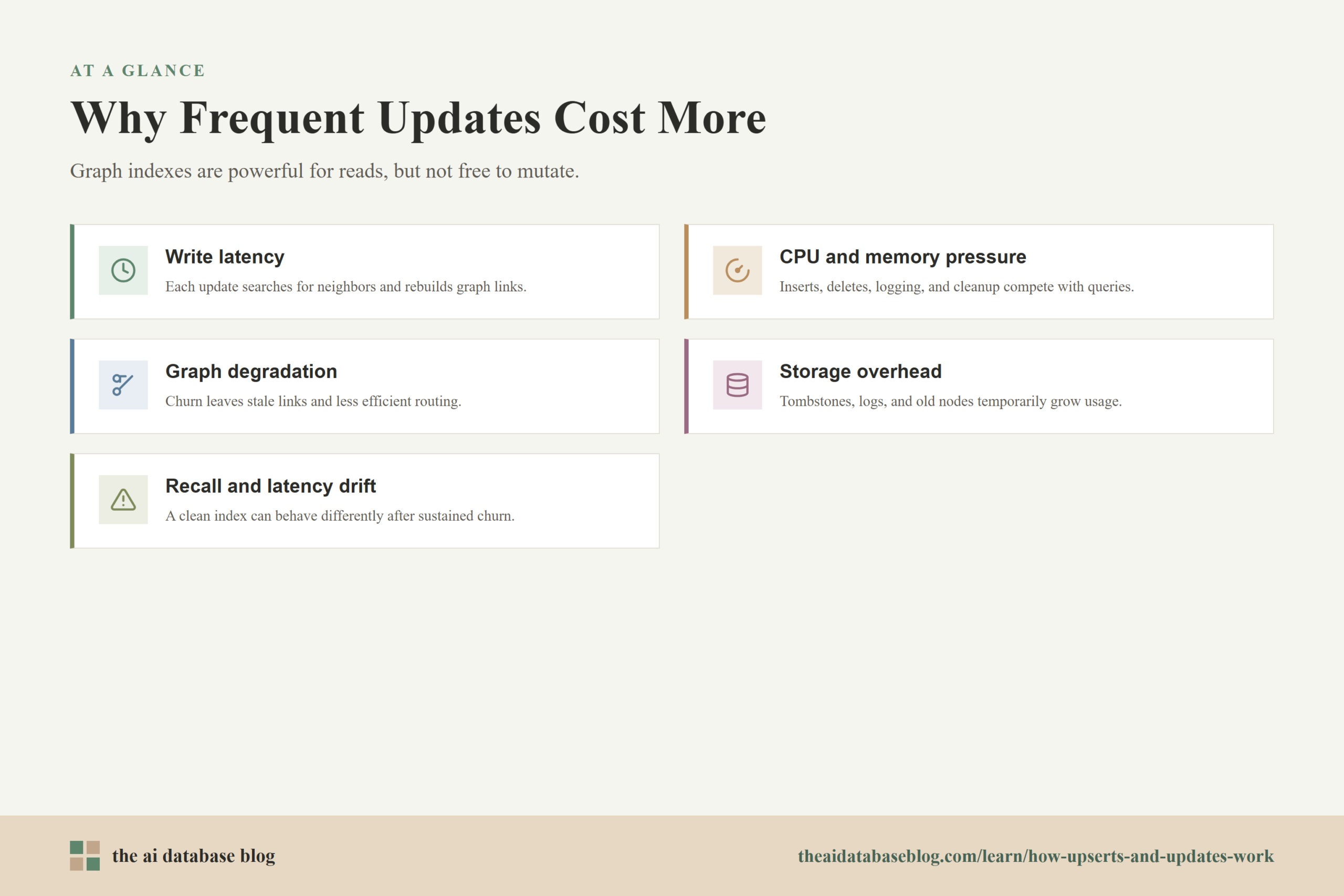
- Write latency. Index maintenance can make each update slower, especially when the graph is large or when high recall settings require more candidate exploration during insertion.
- CPU and memory pressure. Frequent inserts and deletes require searches, neighbor selection, logging, cleanup, and sometimes cache activity. These tasks compete with query traffic.
- Graph degradation. Many logical deletes and reinsertions can leave the graph with stale links, unreachable points, or less efficient routing until cleanup or repair catches up.
- Storage overhead. Tombstones, write-ahead logs, background queues, and old graph nodes can temporarily increase storage or memory usage.
- Recall and latency drift. A graph that performed well after a clean build may behave differently after sustained churn, especially if cleanup is delayed or update patterns are uneven.
Recent research on dynamic vector search continues to focus on this exact problem: how to support high update rates while preserving recall and query speed. Some approaches use in-place graph repair. Others use batch consolidation, segmented indexes, or log-structured designs that avoid rewriting the entire structure for every change. The common theme is that dynamic vector search is not just about accepting writes; it is about preserving the shape and navigability of the index as the dataset changes.
Understanding this cost helps teams choose update patterns that match their data. A mostly static documentation corpus has different needs from a fast-changing marketplace, user memory store, or event-driven recommendation system.
Practical Patterns for Reliable Upserts and Updates
The safest update strategy starts with a clear model of identity and freshness. Each vector record should represent a specific unit of retrievable content, and its ID should be deterministic. If the same source chunk is ingested twice, it should map to the same vector record. If a source chunk is removed, the pipeline should know which vector record to delete or retire.
For most production systems, these practices make updates easier to reason about:
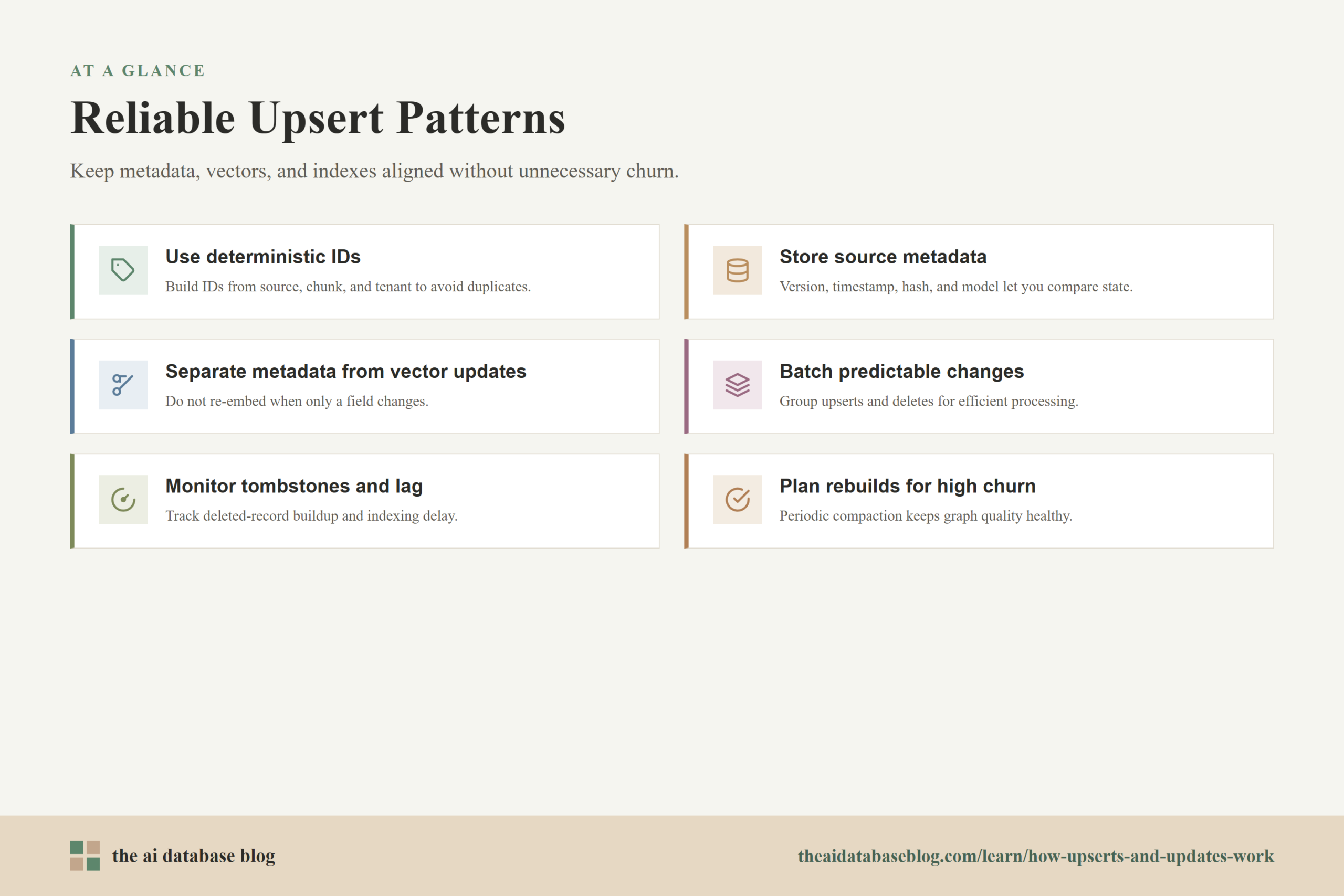
- Use deterministic IDs. Build vector IDs from source ID, chunk ID, tenant ID, and sometimes version. This prevents accidental duplication during repeated ingestion.
- Store source metadata. Include source version, timestamp, content hash, embedding model, and ingestion time so the pipeline can compare the stored vector with the latest source state.
- Separate metadata updates from vector updates. Do not regenerate embeddings when only a non-semantic field changes. This reduces index churn.
- Batch predictable changes. If many records change at once, batch upserts and deletes so the database can process writes and cleanup more efficiently.
- Monitor tombstones and index lag. Track deleted-record buildup, background queue depth, compaction activity, indexing delay, recall, and latency over time.
- Plan rebuilds for high-churn collections. If updates are frequent enough to degrade graph quality, periodic rebuilds or segment compaction may be part of normal maintenance.
It is also useful to classify changes by how much they affect retrieval. A title correction, permissions update, or category change may only require metadata changes. A rewritten paragraph, changed product description, or newly generated embedding requires a vector update. A document deletion requires the old vectors to stop appearing in results immediately, even if physical cleanup happens later.
With these patterns in place, the update path becomes more predictable. The database can handle the mechanical work, while the ingestion pipeline decides which records changed, what kind of update is needed, and how much freshness delay the application can tolerate.
Common Mistakes to Avoid
Many vector update problems come from treating embeddings as if they were ordinary text fields. They are derived representations with their own index cost. A small source change may or may not justify re-embedding, and a large batch of source changes can create a major index-maintenance workload. Teams that plan for this early usually avoid duplicate data, stale results, and unexpected performance drops.
One common mistake is using random IDs for every ingestion run. That makes every run look like new data, so old vectors remain unless they are separately deleted. Another mistake is updating vectors when only metadata changed. This adds unnecessary graph churn and embedding cost. A third mistake is ignoring deleted source records. If a crawler only upserts current files but never deletes missing ones, retired content can remain retrievable long after it should be gone.
Another common issue is assuming that a successful write means the vector index is immediately searchable. That is true in some synchronous configurations, but not in systems that use asynchronous indexing or background compaction. Applications that need read-after-write behavior should verify the database’s consistency model and design around any indexing delay.
Finally, teams sometimes benchmark a freshly built index and assume those numbers will hold under months of updates and deletes. For graph indexes, sustained churn can change recall, latency, and resource usage. Production evaluation should include update-heavy scenarios, not only static search tests.
These mistakes are avoidable when the application treats the vector database as a living index rather than a one-time embedding dump. The final step is to connect the concepts into a simple operating model.
How to Think About Updates as an Operating Model
A healthy vector update workflow has three layers. The source layer decides what changed. The ingestion layer converts those changes into inserts, upserts, metadata updates, vector updates, and deletes. The database layer applies those writes, updates indexes, tracks tombstones, and runs cleanup. Problems usually appear when one of these layers is unclear.
For example, if the source layer does not expose reliable versioning, the ingestion layer may reprocess too much data. If the ingestion layer does not use stable IDs, the database receives duplicate inserts instead of updates. If the database layer cannot keep up with index maintenance, search freshness or performance may drift. Good update design makes each layer explicit.
A useful rule is to update the smallest correct unit. If one chunk changes, update that chunk rather than the whole collection. If only metadata changes, update metadata rather than the vector. If the embedding model changes, treat that as a broader re-indexing event because every vector may need to be regenerated and reinserted. This keeps routine updates cheap while reserving heavier work for changes that truly affect retrieval.
For graph indexes, the operating model should include maintenance windows or background repair capacity. Some systems can absorb steady incremental updates well, while others rely more heavily on compaction, segment merges, or rebuilds. The right answer depends on update rate, query rate, recall requirements, dataset size, and how quickly stale data must disappear from results.
FAQs
1. What does upsert mean in a vector database?
An upsert means the database inserts a new vector record if the ID does not exist, or updates the existing record if the ID already exists. It is useful for ingestion pipelines because the same write operation can handle both new and changed source data. The important requirement is a stable ID, because the database needs to know which existing record should be replaced or updated.
2. Is updating a vector the same as updating metadata?
No. Updating metadata changes fields such as category, timestamp, permissions, or status. Updating a vector changes the record’s position in embedding space and usually requires work in the vector index. Metadata updates are often cheaper, while vector updates can involve deleting or retiring the old vector and inserting a new one into the ANN index.
3. Why do vector databases use soft deletes?
Vector databases use soft deletes because physically removing a vector from an ANN index can be expensive. A soft delete marks the record as inactive so it can be excluded from search results quickly. Later, background cleanup or compaction can remove the deleted record more fully and repair index structures.
4. Can old vectors still affect search after they are deleted?
They can still affect the internal index until cleanup runs, even if they are filtered out of final results. In a graph index, deleted nodes or stale links may remain temporarily. If too many tombstones accumulate, search may become less efficient or graph quality may decline, which is why cleanup and monitoring are important.
5. Why are frequent updates hard for HNSW-style indexes?
HNSW-style indexes are built around graph links between nearby vectors. Inserts require finding and connecting neighbors. Deletes and updates can leave stale links or require graph repair. A high rate of updates can increase write cost, create tombstones, pressure memory and CPU, and gradually affect recall or latency if maintenance does not keep up.
6. When should a vector index be rebuilt?
A rebuild may be useful when sustained updates, deletes, or embedding model changes have made the existing index less efficient or less accurate. Signs include growing tombstone counts, increasing query latency, degraded recall, larger-than-expected storage usage, or cleanup processes that cannot keep pace with churn. Some systems reduce the need for full rebuilds with compaction or in-place repair, but high-churn workloads still need an explicit maintenance plan.
Takeaway
Upserts and updates make vector databases practical for changing data, but they work best when the application has stable IDs, clear source-version tracking, and a realistic view of index maintenance cost. This guidance is most useful for teams building retrieval, RAG, semantic search, recommendation, or knowledge-base systems where source content changes over time. A good update strategy keeps metadata, vectors, and indexes aligned while avoiding unnecessary graph churn, so users retrieve current information without turning every small change into an expensive re-indexing event.