High-dimensional space is the mathematical setting where AI systems place embeddings: long lists of numbers that represent text, images, audio, users, products, documents, or other data. A vector with hundreds or thousands of dimensions is not a physical object with hundreds or thousands of visible directions. It is a coordinate-based representation where each dimension contributes to how the system compares one item with another. We cannot visualize these spaces directly, but distance, direction, neighborhoods, and similarity still work mathematically. Vector search needs purpose-built infrastructure because comparing many high-dimensional vectors is expensive, memory-heavy, and latency-sensitive at production scale.
This guide explains what dimensions mean in embeddings, why human intuition breaks down beyond three dimensions, how nearest neighbors still make sense, why distance metrics matter, and why AI databases use specialized indexing, filtering, and storage patterns for vector search. By the end, you should understand high-dimensional space as a practical retrieval concept rather than an abstract mathematical mystery.
What High-Dimensional Space Means in AI Databases
In an AI database context, high-dimensional space usually means the coordinate space where embeddings are stored and compared. An embedding is a vector, which is simply an ordered list of numbers. A sentence, document chunk, image, product description, or support ticket can be converted into such a list by an embedding model. The resulting vector might have 384, 768, 1,024, 1,536, 3,072, or another number of dimensions depending on the model and design choices.
Each dimension is one position in that list. If a vector has 768 dimensions, it contains 768 numeric values. These numbers are not usually meant to be interpreted one by one. A single dimension might not cleanly mean “price,” “tone,” “topic,” or “intent.” Instead, the whole pattern across all dimensions carries meaning. Similar items tend to produce vectors with similar patterns, while unrelated items tend to land farther apart according to the distance or similarity metric used.
A Simple Way to Think About Dimensions
A two-dimensional point can be described with two coordinates, such as horizontal and vertical position. A three-dimensional point adds depth. A high-dimensional vector follows the same coordinate idea, but with many more numeric positions. The main difference is that the extra dimensions are not visible spatial directions in the everyday sense. They are mathematical degrees of freedom that help the model organize patterns in data.
For example, imagine a document embedding as a coordinate address in a very large meaning space. Documents about similar ideas should have nearby addresses. A user query can be embedded into the same space, and the database can retrieve the stored vectors nearest to that query vector. That is the basic mechanism behind semantic search and many retrieval-augmented generation systems.
Once dimensions are understood as coordinates rather than visible axes, the next natural question is why these spaces cannot simply be drawn. The answer matters because it explains why visual intuition is helpful only up to a point, and why AI database design depends on measurement rather than human inspection.
Why We Cannot Visualize Hundreds or Thousands of Dimensions
Humans experience space through three physical dimensions, and most visual tools are built around two-dimensional screens. We can draw a scatter plot with two coordinates. We can render a 3D scene with three coordinates. But a 768-dimensional embedding cannot be faithfully shown on a page or screen without compressing it into fewer dimensions. Any such visualization is a projection, not the original space.
Dimensionality reduction techniques can help people inspect broad patterns, clusters, or outliers, but they inevitably discard information. A two-dimensional map of embeddings can be useful for exploration, but it should not be treated as a perfect picture of how the database searches. Two points that look close in a projection may not be close in the original high-dimensional space, and points that look separated in a projection may still be meaningful neighbors under the actual similarity metric.
Visualization Is a Translation, Not the Territory
When a high-dimensional embedding set is reduced to two dimensions, the visualization tool is making compromises. It may preserve some local neighborhoods better than global distances, or it may highlight clusters while distorting exact relationships. This is not a flaw in visualization; it is a consequence of trying to translate a complex coordinate system into a human-readable view.
That is why AI database work relies on direct vector comparison, retrieval evaluation, and query behavior rather than visual inspection alone. A chart can suggest that a group of documents forms a cluster, but search quality is proven by whether relevant items are retrieved for real queries, under real filters, within the required latency budget.
If high-dimensional spaces cannot be seen directly, it can feel strange to say that items are still near or far from one another. The important point is that neighborhood does not require visualization. It only requires a consistent way to compare vectors.
How Neighborhoods and Distance Still Apply
A neighborhood in vector search is the set of vectors closest to a query vector according to a chosen similarity function. The database does not need to visualize the space to find neighbors. It only needs the vector values and a mathematical rule for comparing them. In practice, the system calculates or approximates which stored vectors are most similar to the query vector and returns the top results.
This is similar to finding nearby addresses in a coordinate system. In two dimensions, nearby points might be physically close on a map. In high-dimensional embedding space, nearby points are similar according to the embedding model and distance metric. The word “near” therefore means “mathematically close,” not necessarily visually close in a human-drawn chart.
Common Distance and Similarity Measures
Different systems use different ways to compare vectors. The right choice depends on how the embeddings were produced and normalized, as well as what the application needs to retrieve.
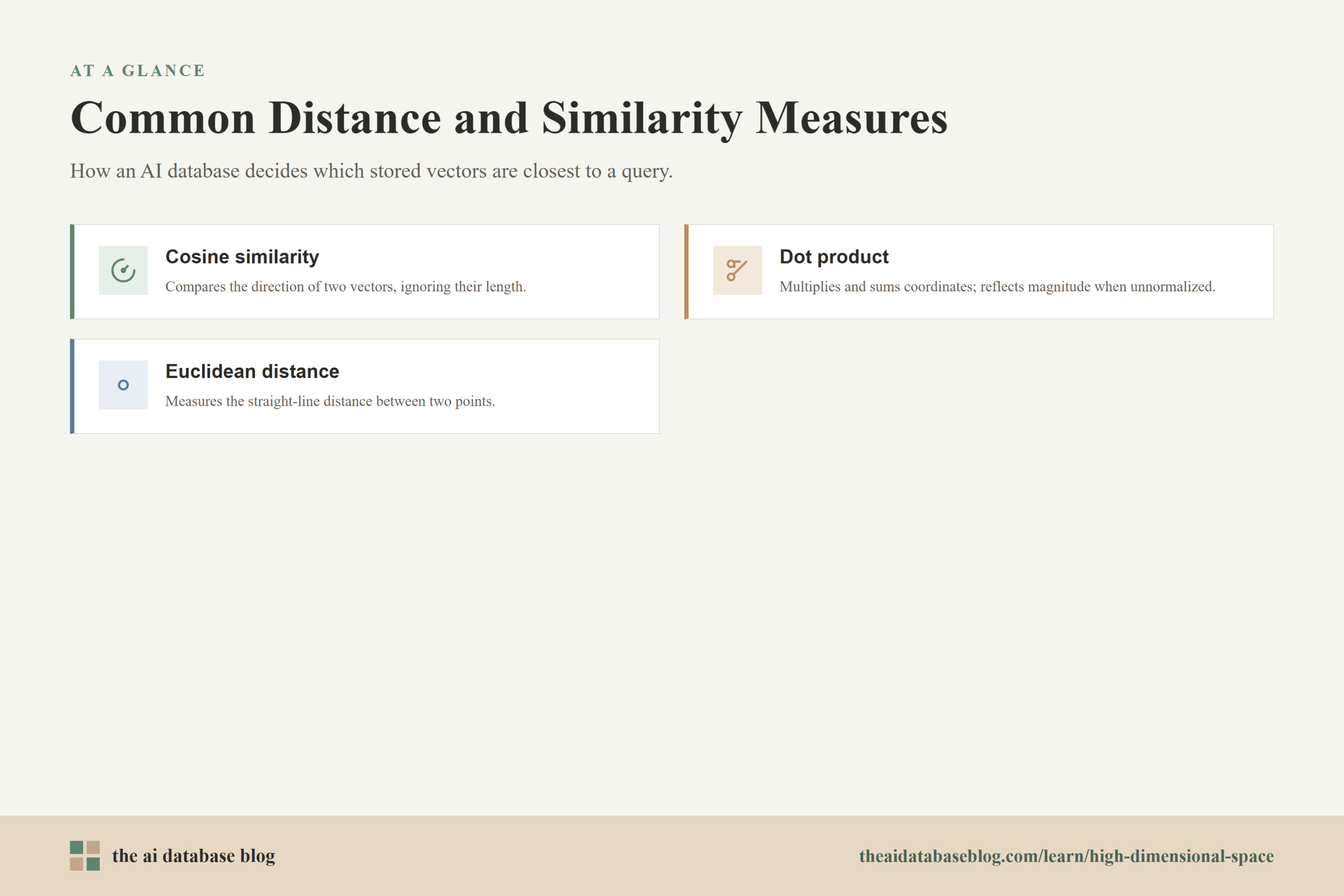
- Cosine similarity compares the direction of two vectors. It is often used when the angle between vectors matters more than their raw length.
- Dot product compares vectors by multiplying and summing their coordinates. It can behave similarly to cosine similarity when vectors are normalized, but it can also reflect magnitude when they are not.
- Euclidean distance measures straight-line distance between coordinates. It can be useful for some embeddings, but it depends heavily on the geometry the model was trained to produce.
These measures are not interchangeable details. If the embedding model was designed for cosine similarity, using a different metric may reduce retrieval quality. Likewise, if vectors are normalized before indexing, dot product and cosine-based ranking may become closely related. Good vector search starts with matching the distance function to the embedding model and retrieval task.
Why Nearest Neighbor Search Works at All
Nearest neighbor search works because embedding models are trained to place related items near each other in the chosen representation space. A question about refund policies should land near document chunks about refunds, returns, and account credits. An image of a product should land near visually or semantically similar product images. The database then uses the vector coordinates to retrieve likely matches.
This does not mean every neighbor is useful. Embeddings are approximations, and high-dimensional spaces can produce surprising results. Similar wording may overpower deeper meaning, short queries may be ambiguous, and unrelated items may appear close if the model captures a shared surface pattern. For this reason, vector search is usually evaluated with recall, precision, relevance judgments, and application-specific tests rather than assumed to be correct because the math is elegant.
Once neighborhood and distance are clear, the next question is why high-dimensional search is hard. The challenge is not that distances are impossible to calculate. The challenge is doing it accurately, quickly, and repeatedly across millions or billions of vectors while still supporting updates, filters, and application constraints.
Why High-Dimensional Search Is Computationally Difficult
The simplest way to find the nearest vectors is brute-force search: compare the query vector with every stored vector, calculate a similarity score for each one, sort the scores, and return the top results. This can work for small collections. But as the number of vectors, dimensions, and queries grows, brute force becomes expensive. A million vectors with 1,536 dimensions means a large number of arithmetic operations for every query, before considering filtering, ranking, network overhead, or concurrent users.
High dimensionality also changes the behavior of distance. In many high-dimensional settings, distances can become less intuitive because many points may appear similarly far away. This is often discussed as part of the curse of dimensionality. It does not make vector search useless, especially when embeddings have meaningful structure, but it does mean indexing and evaluation need care. The system must preserve useful neighborhoods without assuming that low-dimensional search tricks will still work.
The Curse of Dimensionality in Practical Terms
The curse of dimensionality is a group of problems that appear as the number of dimensions grows. Sparse data, distance concentration, larger memory needs, and slower comparisons can all become issues. In lower dimensions, a tree or simple partition might divide space efficiently. In high-dimensional embedding spaces, those simple partitions often become less effective because points do not separate as cleanly.
For AI databases, the practical lesson is straightforward: high-dimensional search needs indexes and storage layouts designed for similarity search. General-purpose indexing methods built for exact values, ranges, or keywords do not automatically solve nearest neighbor retrieval over embeddings.
Exact Search Versus Approximate Search
Exact nearest neighbor search guarantees that the returned results are the closest vectors under the chosen metric. Approximate nearest neighbor search allows a controlled tradeoff: it may return results that are close enough rather than mathematically perfect, in exchange for much lower latency or memory use. This tradeoff is common in vector databases because many AI applications can tolerate a small amount of approximation if retrieval quality remains high.
Approximation does not mean careless guessing. Modern vector indexes are tuned around recall, latency, throughput, memory use, and update behavior. A production system should measure whether approximate search still returns the items the application needs. If the top retrieved documents are relevant and the end-to-end answer quality improves, exactness may be less important than practical retrieval performance.
Because high-dimensional search combines mathematical similarity with system-level constraints, vector databases need infrastructure that treats embeddings as a first-class workload. The next section explains what that infrastructure is doing under the surface.
Why Vector Search Needs Purpose-Built Infrastructure
Vector search needs purpose-built infrastructure because the database must handle more than storing arrays of numbers. It must ingest embeddings, build and maintain specialized indexes, support fast top-k similarity queries, apply metadata filters, manage memory and disk tradeoffs, handle updates, and return results consistently under load. These requirements are different from traditional exact-match lookups or keyword search alone.
A useful way to think about this is that vector search makes similarity an operational database feature. The system is not merely asking whether a value equals another value. It is asking which objects are closest to a query in a high-dimensional representation space, often while also respecting permissions, timestamps, categories, tenants, or other structured constraints.
Specialized Indexes
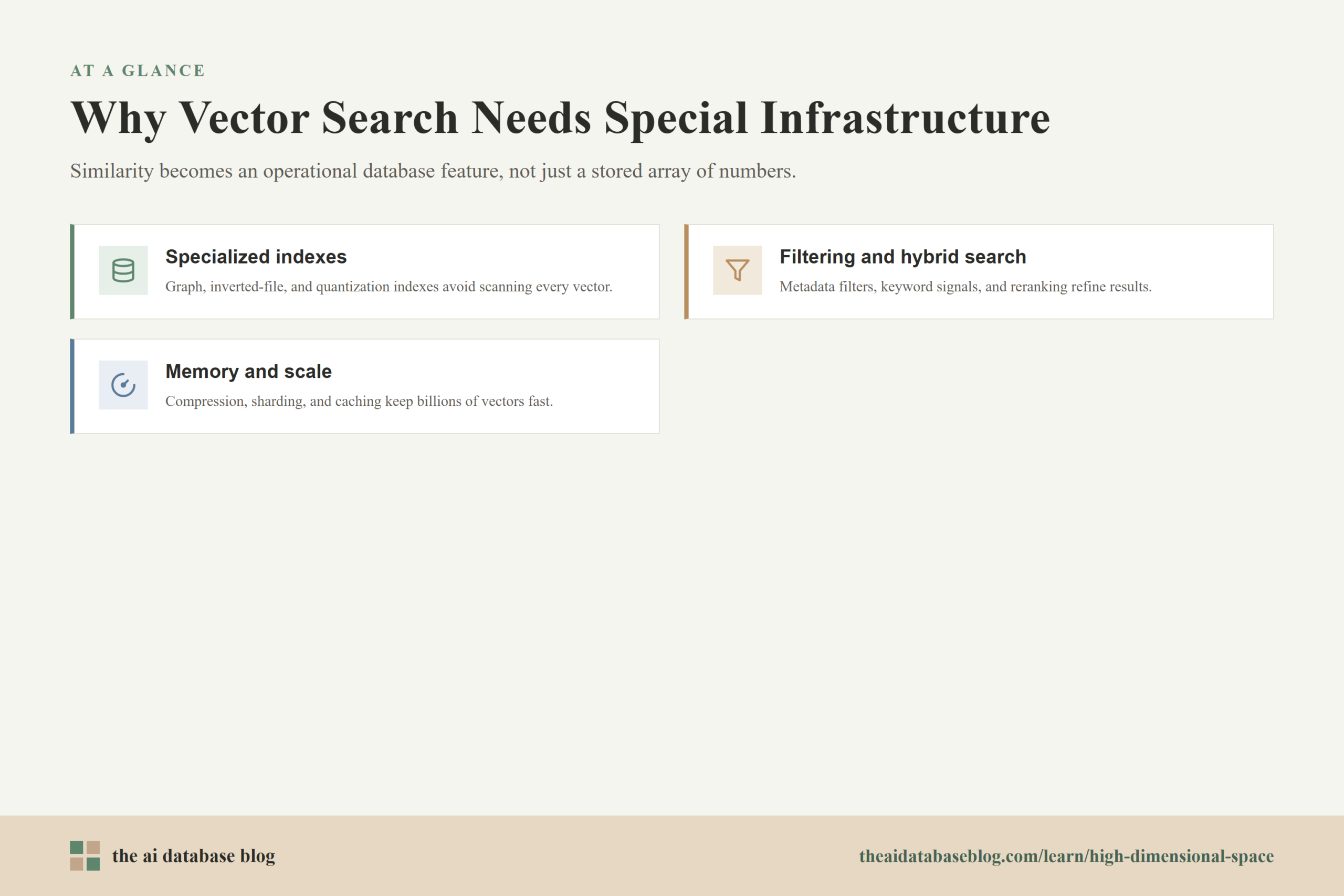
Vector databases commonly use approximate nearest neighbor index families such as graph-based indexes, inverted file indexes, and quantization-based methods. Graph-based approaches connect nearby vectors so search can move through a network of likely neighbors instead of scanning every vector. Inverted file approaches partition the vector space into regions and search selected regions. Quantization compresses vectors or vector components to reduce memory and speed up comparison, usually with some accuracy tradeoff.
These index choices affect recall, latency, memory, build time, and update cost. A search-heavy application may tune for low query latency. A frequently updated application may care more about insert performance and index maintenance. A very large collection may need compression or disk-aware indexing. The right design depends on the workload rather than on a single universally best index.
Filtering, Hybrid Search, and Ranking
Real applications rarely search vectors alone. They often combine vector similarity with metadata filters, keyword matching, recency, access control, or business rules. For example, a support assistant may need semantically similar documents, but only from the correct product line and only from approved documentation. A recommendation system may need similar items, but only those in stock and available in a specific region.
This is one reason AI databases need integrated retrieval infrastructure. Applying filters before, during, or after vector search can change both speed and relevance. Hybrid search, which combines keyword and vector retrieval, can improve results when exact terms, identifiers, names, or domain-specific phrases matter. Ranking may also include reranking models or application-specific scoring after the first retrieval step.
Memory, Storage, and Scale
High-dimensional vectors can consume substantial storage. A single 1,536-dimensional vector stored as 32-bit floating point numbers uses about 6 KB before metadata and index overhead. At millions or billions of vectors, memory and storage become central design concerns. Index structures can add more overhead, and low-latency systems may keep large portions of the index in memory.
Purpose-built infrastructure addresses this with compression, quantization, sharding, caching, disk-aware layouts, batch ingestion, background indexing, and distributed search. These features matter because AI applications often need both relevance and responsiveness. A retrieval system that is accurate but too slow may not work in a user-facing product, while a fast system that misses important context may harm answer quality.
Infrastructure explains how vector search runs at scale, but readers also need to understand how high-dimensional behavior affects day-to-day application design. The best results usually come from treating embeddings, indexes, and evaluation as parts of one retrieval system.
What High-Dimensional Space Means for AI Application Design
For application builders, high-dimensional space is not something to fear. It is a design surface. The embedding model defines the space, the distance metric defines how similarity is measured, the index defines how candidates are found, and the retrieval pipeline defines how results are filtered, ranked, and used. If any part of that chain is mismatched, search quality can suffer.
This is especially important in retrieval-augmented generation. A language model can only use the context it receives. If the vector search retrieves incomplete, outdated, or loosely related chunks, the generated answer may be weak even if the language model itself is strong. High-dimensional search quality therefore depends on practical decisions such as chunking, metadata design, embedding refreshes, index tuning, and relevance testing.
Good Embeddings Need Good Data Modeling
Embeddings work best when the stored items represent meaningful retrieval units. If document chunks are too large, they may mix unrelated ideas into one vector. If chunks are too small, they may lose context. Metadata can help the database narrow the search space by source, category, date, tenant, or access rule. The vector captures semantic similarity, while metadata preserves operational structure.
A practical AI database design usually stores the vector, the original content or a reference to it, metadata fields, and sometimes additional ranking signals. This lets the application retrieve semantically relevant candidates and still return useful, traceable, governed results.
Evaluation Matters More Than Visual Intuition
Because high-dimensional space cannot be inspected directly, retrieval systems need evaluation. Teams should test representative queries, inspect retrieved results, measure recall where ground truth exists, and track whether changes to embeddings, chunking, filters, or index parameters improve the application. Visual cluster maps can help diagnose patterns, but they should not replace retrieval tests.
Evaluation also helps identify when vector search alone is not enough. Some queries need exact keywords. Some need structured filters. Some need freshness or authority ranking. Some need a reranker to reorder the top candidates. High-dimensional similarity is powerful, but it is one component in a complete retrieval architecture.
With these design implications in mind, the core concept becomes much simpler: high-dimensional space is how AI systems arrange meaning for search. The final questions readers often have are about interpretation, reliability, and when specialized infrastructure becomes necessary.
FAQs
1. What does it mean for an embedding to have hundreds or thousands of dimensions?
It means the embedding is represented by hundreds or thousands of numeric coordinates. Each coordinate contributes to the overall pattern that the model uses to represent meaning, similarity, or features. The dimensions are usually not individually interpretable, but the full vector can still be compared with other vectors.
2. Can humans visualize high-dimensional vector space?
Not directly. Humans can visualize two or three dimensions, while embedding spaces often have hundreds or thousands. Visualization tools can project high-dimensional vectors into two or three dimensions, but those projections simplify and distort the original relationships.
3. How can distance still work if we cannot see the space?
Distance works because it is calculated from coordinates, not from visual perception. A database can compare vectors using cosine similarity, dot product, Euclidean distance, or another metric. The system only needs the numbers and the comparison rule to identify nearest neighbors.
4. Does high dimensionality make vector search unreliable?
High dimensionality makes search more challenging, but not automatically unreliable. Embedding models can create useful structure in high-dimensional spaces, and vector indexes can retrieve neighbors efficiently. Reliability depends on the embedding model, data quality, distance metric, indexing method, filtering strategy, and evaluation process.
5. Why not scan every vector exactly?
Exact scanning can work for small datasets, but it becomes expensive as collections grow. Comparing a query against millions or billions of high-dimensional vectors can require too much time and compute for interactive applications. Approximate nearest neighbor indexes reduce the search work while preserving useful retrieval quality.
6. When does an application need a purpose-built vector database?
An application is more likely to need purpose-built vector infrastructure when vector search is central to the product, the dataset is large, latency matters, metadata filtering is important, updates are frequent, or retrieval quality must be tuned and measured carefully. Smaller or secondary vector workloads may sometimes fit inside a general-purpose database with vector indexing, but the tradeoff depends on scale and requirements.
Takeaway
High-dimensional space is the coordinate system behind embedding-based retrieval. Although humans cannot directly visualize hundreds or thousands of dimensions, AI databases can still measure similarity, find neighborhoods, and retrieve useful results by comparing vectors mathematically. This knowledge is most useful for developers, data teams, search engineers, and product teams building semantic search, recommendation, or retrieval-augmented generation systems. A practical use case is a knowledge assistant that embeds document chunks, searches for the nearest relevant context, applies metadata filters, and returns grounded information quickly enough for a user-facing experience.