The curse of dimensionality describes what happens when data is represented with many features, dimensions, or embedding coordinates: the geometry becomes less intuitive, distances become harder to interpret, and search systems need more work to find useful neighbors. In AI databases, this matters because vector search depends on comparing high-dimensional embeddings. As dimensionality grows, nearest-neighbor search can become more expensive, recall can become harder to preserve, and larger embeddings may add cost without improving retrieval quality.
This guide explains how distances converge in high-dimensional spaces, why familiar low-dimensional geometry breaks down, what that means for recall in vector databases, and why bigger embeddings are not automatically better. By the end, you should understand how dimensionality affects retrieval systems and how to think about embedding size as a practical design choice rather than a simple quality dial.
What the Curse of Dimensionality Means for Vector Search
In ordinary physical space, distance feels easy to reason about. Two points can be close, far apart, clustered, isolated, or clearly separated. A database that searches over latitude and longitude, for example, can often use spatial structure efficiently because nearby points are meaningfully nearby and large parts of the space can be ruled out quickly. High-dimensional embedding space behaves differently. Each vector may have hundreds or thousands of coordinates, and the combined effect of all those coordinates changes how distance, density, and neighborhood structure work.
For AI databases, the issue is not just that there are many numbers to store. The deeper issue is that search depends on geometry. A vector database ranks items by a distance or similarity function such as cosine similarity, dot product, or Euclidean distance. If the geometry becomes less discriminative, the database has a harder time deciding which candidates are truly close, which candidates are only slightly less close, and which results are likely to be relevant enough for the application.
The curse of dimensionality does not mean vector search is broken. Modern learned embeddings often have structure that random high-dimensional points do not have. Text, image, and multimodal embeddings usually lie on lower-dimensional patterns or manifolds inside the full vector space. That structure is why nearest-neighbor search can work well in real retrieval systems. Still, dimensionality affects storage, latency, indexing behavior, recall, and evaluation, so it should be treated as a central design factor.
Once we understand that vector search is a geometric operation, the next question is what actually changes when the number of dimensions increases. The most important change is that distance values start behaving in ways that do not match everyday intuition.
How Distances Converge in High Dimensions
Distance convergence means that, in many high-dimensional settings, the distance from a query vector to its nearest neighbor and the distance from that query vector to faraway points become less distinct. The nearest item may still be technically nearest, but the gap between first place, tenth place, and thousandth place can shrink. When that gap is small, similarity scores become less informative, and small changes in data, indexing, normalization, or query wording can alter the ranking.
A simple way to think about this is to imagine comparing documents using hundreds of weak signals at once. In a low-dimensional space, one or two coordinates can create a clear separation. In a high-dimensional space, many coordinates contribute small amounts to the final distance. Those small contributions can add up in similar ways across many points, making many candidates appear almost equally far from the query. The result is a crowded similarity landscape where the difference between “close” and “not close” may be narrower than expected.
This is often called distance concentration. It is especially visible in random or weakly structured high-dimensional data. If points are spread through a high-dimensional space without meaningful semantic structure, most points tend to be far from one another, and the relative contrast between near and far points can decline. In that situation, the nearest neighbor may not feel very near in any useful sense. It is simply the least distant point among many distant points.
Embeddings used in AI applications are not purely random, so distance convergence should not be treated as a universal failure mode. A good embedding model arranges semantically related items so that useful neighborhoods exist. However, even when embeddings are meaningful, the system still has to work inside high-dimensional geometry. Similarity scores can be compressed, neighborhood boundaries can be fuzzy, and the ranking may need support from metadata filters, hybrid search, reranking, or better chunking to produce reliable results.
Distance convergence explains why high-dimensional vector search can still return plausible results while also being fragile in certain cases. To see why, it helps to look at the specific ways familiar geometry stops being a good guide.
Why Naive Geometry Breaks Down
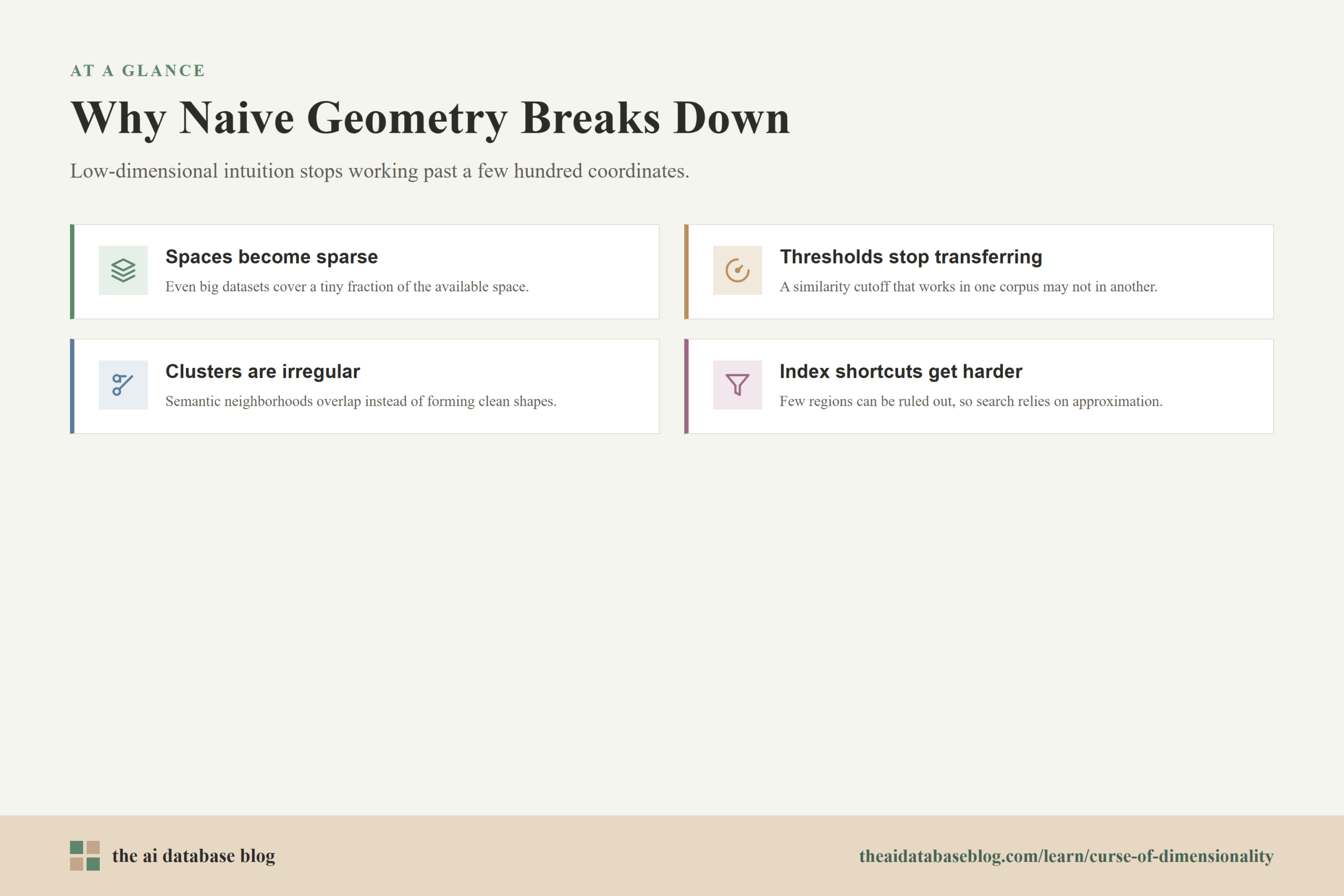
Naive geometry breaks down because many assumptions from two-dimensional or three-dimensional space do not scale cleanly to hundreds or thousands of dimensions. In low dimensions, we can often picture clusters as compact shapes with clear borders. We can imagine a query point sitting near one cluster and far from another. In high-dimensional embedding space, those mental pictures become unreliable because volume, sparsity, and distance behave differently.
High-dimensional spaces are sparse
As dimensions increase, the amount of possible space grows extremely quickly. Even a large dataset may cover only a tiny fraction of the available space. That means the database is not searching through a nicely filled map. It is searching through sparse points embedded in a vast coordinate system. Sparsity makes it harder to rely on simple partitioning strategies that work well in low-dimensional spatial indexes.
Distance thresholds become less portable
In low-dimensional applications, a fixed distance threshold can sometimes have a stable meaning. In embedding search, a threshold such as a cosine similarity cutoff may behave differently across domains, models, query types, and datasets. A score that indicates strong similarity in one corpus may be ordinary in another. This is partly because score distributions depend on the embedding model and the structure of the data, not only on the distance metric.
Clusters may not look like simple shapes
Semantic neighborhoods are often irregular. A set of documents about the same topic may be close in some dimensions and spread across others because they differ in tone, format, domain vocabulary, or intent. Treating a cluster as a clean sphere can hide important retrieval behavior. The database may need to navigate overlapping neighborhoods rather than separated islands.
Index shortcuts become harder
Traditional spatial indexes often work by excluding large regions that cannot contain the nearest result. In high-dimensional spaces, it becomes harder to eliminate candidates confidently because many points share similar distance ranges. This is one reason production vector search often uses approximate nearest neighbor methods. These methods trade exhaustive comparison for graph traversal, clustering, quantization, compression, or other strategies that aim to find good candidates quickly.
These geometric problems are not only theoretical. They show up directly in application behavior, especially when a system cares about whether the right items appear in the returned result set. That brings the discussion from geometry into recall.
The Implications for Recall
Recall measures whether a retrieval system returns the items it should return. In vector search, recall is often discussed as recall at k, which asks whether the true nearest neighbors, or the relevant results, appear in the top k returned items. The curse of dimensionality matters because high-dimensional search can make it harder for an approximate index to find the same neighbors that an exact search would find, especially under tight latency and memory constraints.
Approximate nearest neighbor search exists because exact search is expensive at scale. If a database has millions or billions of embeddings, comparing every query to every stored vector can be too slow. ANN indexes speed up retrieval by searching a smaller portion of the space. The challenge is that when distance gaps are narrow, it is easier for the index to miss a candidate that is only slightly closer than another. The system may still return reasonable-looking results, but the true best candidates may be absent.
Recall is also affected by intrinsic dimensionality, which is the effective complexity of the data distribution rather than simply the number of coordinates in each vector. Two embedding sets can both have 768 dimensions, yet one may be much easier to search than the other because its useful patterns lie in a simpler structure. This is why recall behavior is workload-specific. A benchmark on one dataset does not guarantee the same result on another dataset with different language, document structure, or query intent.
Higher recall usually requires more search effort. In graph-based indexes, that may mean exploring more candidates during traversal. In partition-based indexes, it may mean probing more clusters. In compressed indexes, it may mean using more precise representations or reranking a larger candidate pool with original vectors. Each improvement can increase latency, memory, or compute cost, so recall is best treated as an engineering tradeoff rather than a fixed property of the database.
There is another important wrinkle: exact nearest-neighbor recall and semantic usefulness are not always the same thing. A system can retrieve the mathematically nearest vectors and still miss the document that best answers the user’s question. This happens because embeddings encode similarity, not complete relevance. For RAG and search applications, teams often need to measure both vector recall and task-level retrieval quality, such as whether the returned context actually supports the final answer.
Because recall depends on both geometry and application relevance, dimensionality should be chosen carefully. A larger embedding may help in some cases, but it can also make the system heavier without solving the real retrieval problem.
Why Bigger Embeddings Are Not Always Better
Bigger embeddings can represent more information, but more dimensions do not automatically produce better search. Each additional dimension increases storage, memory bandwidth, distance computation cost, and index size. If the added dimensions capture useful distinctions for the application, the cost may be worth it. If they add weak or redundant signals, they may slow the system without improving recall or relevance.
Embedding dimensionality also changes operational cost in a direct way. A vector with 1,536 float32 dimensions uses twice as much raw vector storage as a vector with 768 float32 dimensions. Index structures add overhead on top of that. At small scale, the difference may not matter. At tens or hundreds of millions of vectors, dimensionality can affect hardware requirements, cache behavior, ingestion speed, query latency, and total infrastructure cost.
Larger embeddings can also make tuning more demanding. If the index has to compare longer vectors or navigate a more complex neighborhood structure, the system may need higher search parameters to maintain recall. That can reduce throughput. In practical terms, bigger vectors may force the database to spend more work per query before the application sees a quality improvement.
There are cases where larger embeddings are useful. A domain with subtle distinctions, multilingual content, complex legal or scientific language, or multimodal retrieval may benefit from a model that represents more nuance. The key is to test this against the actual retrieval task. If a smaller embedding produces the same answer quality with lower latency and lower cost, the smaller embedding is usually the better engineering choice.
The best question is not “What is the largest embedding we can use?” The better question is “What is the smallest embedding that preserves the retrieval quality we need?” That framing keeps dimensionality connected to measurable outcomes instead of treating it as a proxy for intelligence.
How to Choose Embedding Dimensionality in an AI Database
Choosing embedding dimensionality should start with the retrieval problem, not with the model specification sheet. A support chatbot, a product search system, a research assistant, and an image retrieval tool may all need different tradeoffs. The right dimensionality is the one that gives acceptable recall, relevance, latency, and cost for the actual workload.
Start by defining a small evaluation set. Include realistic queries, expected relevant documents, and examples of hard cases such as ambiguous wording, domain-specific terms, and near-duplicate content. Then compare candidate embedding sizes or models using the same corpus and the same index settings. Measure whether the relevant items appear in the top results, whether the answer pipeline improves, and whether latency stays within the application’s budget.
It is also useful to test recall at multiple result depths. For example, a RAG system that reranks the top 50 candidates may not need the same top-5 behavior as a search page that only shows the first 10 results. A retrieval pipeline can sometimes use a smaller embedding for the first-stage search, retrieve a larger candidate set, and then apply a reranker or stricter filtering step to improve final precision.
Metadata and hybrid search can reduce the pressure on embedding dimensionality. If a query should only search within a product category, language, date range, tenant, document type, or access-control boundary, metadata filtering can remove irrelevant candidates before vector ranking. If exact terms matter, hybrid search can combine lexical matching with vector similarity. These methods do not eliminate high-dimensional geometry, but they give the system more signals than vector distance alone.
After dimensionality is chosen, keep evaluating it over time. Data changes, query patterns change, embedding models change, and user expectations change. A dimensionality that works well for an early corpus may not remain optimal after the application adds new content types or expands into more specialized language.
Practical Design Guidelines
The curse of dimensionality is easiest to manage when vector search is designed as an evaluated retrieval system rather than a one-step similarity lookup. The goal is not to avoid high-dimensional embeddings entirely. The goal is to use them with enough measurement and supporting structure that the system remains accurate, efficient, and predictable.
- Use the smallest embedding that meets quality targets. Smaller vectors usually reduce storage and speed up distance computation. Only increase dimensionality when evaluation shows a meaningful retrieval improvement.
- Measure recall on your own data. Recall depends on the corpus, embedding model, index type, and query patterns. Generic benchmarks are useful for orientation, but they cannot replace workload-specific testing.
- Inspect score distributions. If many results have nearly identical similarity scores, distance may not be separating candidates strongly. That may indicate a need for better chunking, metadata filters, hybrid search, or reranking.
- Tune ANN settings deliberately. Higher search effort can improve recall, but it usually costs latency or throughput. Treat index parameters as part of the retrieval design, not as defaults to ignore.
- Use metadata filters where they reflect real constraints. Filtering by tenant, category, language, date, or document type can make the candidate set more relevant before vector ranking begins.
- Evaluate final task quality, not only vector similarity. For RAG, the most important question is whether retrieved context helps answer the user correctly. Nearest-neighbor quality is a means to that end.
These guidelines turn dimensionality from an abstract mathematical concern into a practical retrieval design problem. The final piece is knowing what misconceptions to avoid when discussing high-dimensional vector search.

Common Misconceptions
One common misconception is that the curse of dimensionality means vector databases cannot work. That is too strong. Vector databases work because embeddings are learned representations with useful structure, and because modern indexes are designed for approximate search at scale. The curse of dimensionality means the system has tradeoffs that need to be measured, not that similarity search is doomed.
Another misconception is that cosine similarity solves the problem by itself. Cosine similarity can be a good fit for normalized embeddings because it compares direction rather than raw magnitude, but it does not erase high-dimensional effects. If many vectors point in similar directions or if the embedding model does not separate the relevant concepts well, cosine scores can still be hard to interpret.
A third misconception is that bigger embeddings always increase recall. Bigger embeddings may improve representation quality, but recall in an AI database also depends on indexing strategy, search parameters, data distribution, filtering, chunking, and reranking. A larger vector can even make the system more expensive while producing little or no improvement in application-level relevance.
The most useful view is balanced: high-dimensional embeddings are powerful, but they are not magic coordinates where every semantic question becomes a simple distance calculation. Good retrieval systems combine embeddings with evaluation, index tuning, data modeling, and application-specific relevance checks.
FAQs
1. What is the curse of dimensionality in vector databases?
It is the set of problems that appear when vector data has many dimensions. In vector databases, it affects how distances behave, how indexes search, how much storage is needed, and how much effort is required to preserve recall at scale.
2. Why do distances converge in high-dimensional spaces?
Distances converge because many dimensions contribute to each distance calculation, and those contributions can make many points appear similarly far from a query. The nearest point may still be nearest, but the contrast between near and far points can shrink.
3. Does the curse of dimensionality make embeddings unreliable?
No. Good embeddings often have meaningful structure, which is why vector search works in many AI applications. The curse of dimensionality means that retrieval quality should be measured carefully because high-dimensional distance is not always as intuitive or stable as low-dimensional distance.
4. How does dimensionality affect recall?
Higher dimensionality can make approximate search harder because distance gaps may be narrow and index traversal may need more effort. Recall can improve, stay the same, or degrade depending on the embedding model, data distribution, index settings, and application task.
5. Are larger embeddings better for RAG?
Not always. Larger embeddings may capture more nuance, but they also increase storage, compute, and latency. For RAG, the best embedding size is the smallest one that retrieves enough useful context for the system to answer accurately.
6. How should teams test whether an embedding size is good enough?
Teams should build a realistic evaluation set, compare candidate embedding sizes on the same corpus, measure recall at relevant result depths, inspect latency and cost, and evaluate whether the retrieved context improves the final application outcome.
Takeaway
The curse of dimensionality matters for AI databases because vector search depends on geometry, and high-dimensional geometry behaves differently from the spaces people intuitively understand. Distances can converge, naive clustering assumptions can fail, recall can become more expensive to preserve, and larger embeddings can add cost without improving the user experience. This guidance is most useful for teams building semantic search, RAG, recommendation, or knowledge retrieval systems where embedding size, index tuning, and recall all affect production quality. A practical use case is choosing between smaller and larger embeddings for a RAG system: the right choice should come from measured retrieval quality, latency, and cost rather than from assuming that more dimensions are always better.
Watch this video to learn more