GraphRAG combines vector retrieval with knowledge graph relationships so an AI system can retrieve not only semantically similar text, but also connected facts, entities, and paths across a knowledge base. It is most useful when a question requires multi-hop reasoning, such as linking a policy to an owner, a dependency, a timeline, and a related exception. It can beat plain RAG when the answer depends on relationships that are scattered across documents, but it also adds cost because the graph must be extracted, validated, stored, queried, and maintained.
This guide explains how GraphRAG works, why graph relationships can improve retrieval, when graph-plus-vector systems are worth the added complexity, and what teams should consider before building the graph. By the end, you should understand where GraphRAG fits in an AI database architecture and how to evaluate whether it is a useful upgrade over a simpler vector-based RAG system.
What GraphRAG Means
GraphRAG is a retrieval-augmented generation approach that uses a graph structure as part of the retrieval process. In plain RAG, the system usually breaks documents into chunks, embeds those chunks, stores them in a vector index, and retrieves the chunks that are closest to the user’s query in embedding space. GraphRAG adds another layer: entities and relationships are represented as nodes and edges, so the system can follow connections instead of relying only on similarity.
A knowledge graph might represent entities such as people, products, documents, systems, regulations, teams, locations, or events. Edges describe how those entities relate to each other. For example, a graph might show that a product depends on a component, the component is governed by a policy, the policy changed on a specific date, and a team owns the implementation. Those connections can help retrieval move from one relevant fact to the next.
The important point is that GraphRAG is not simply a graph database attached to a chatbot. It is a retrieval design pattern. The system still needs chunking, embedding, ranking, prompting, answer generation, and evaluation. The graph improves the retrieval step by making relationships explicit and navigable.
Once GraphRAG is understood as a retrieval pattern, the next question is how the vector and graph parts work together. The answer matters because most practical systems do not replace vector search with a graph. They combine both, using each one for the part of retrieval it handles best.
How Vectors and Knowledge Graphs Work Together
Vectors are good at fuzzy matching. If a user asks a question using different wording than the source documents, vector search can still find related chunks because embeddings capture semantic similarity. This is useful for open-ended language, paraphrases, and concepts that are not expressed with exact keywords. However, vectors do not inherently know that one retrieved chunk should lead to another specific chunk through a relationship.
Knowledge graphs are good at relationship traversal. They can represent that one entity is part of another, depends on another, contradicts another, was updated by another, or belongs to the same broader category. This helps when a relevant answer requires a path through connected facts rather than a single similar passage.
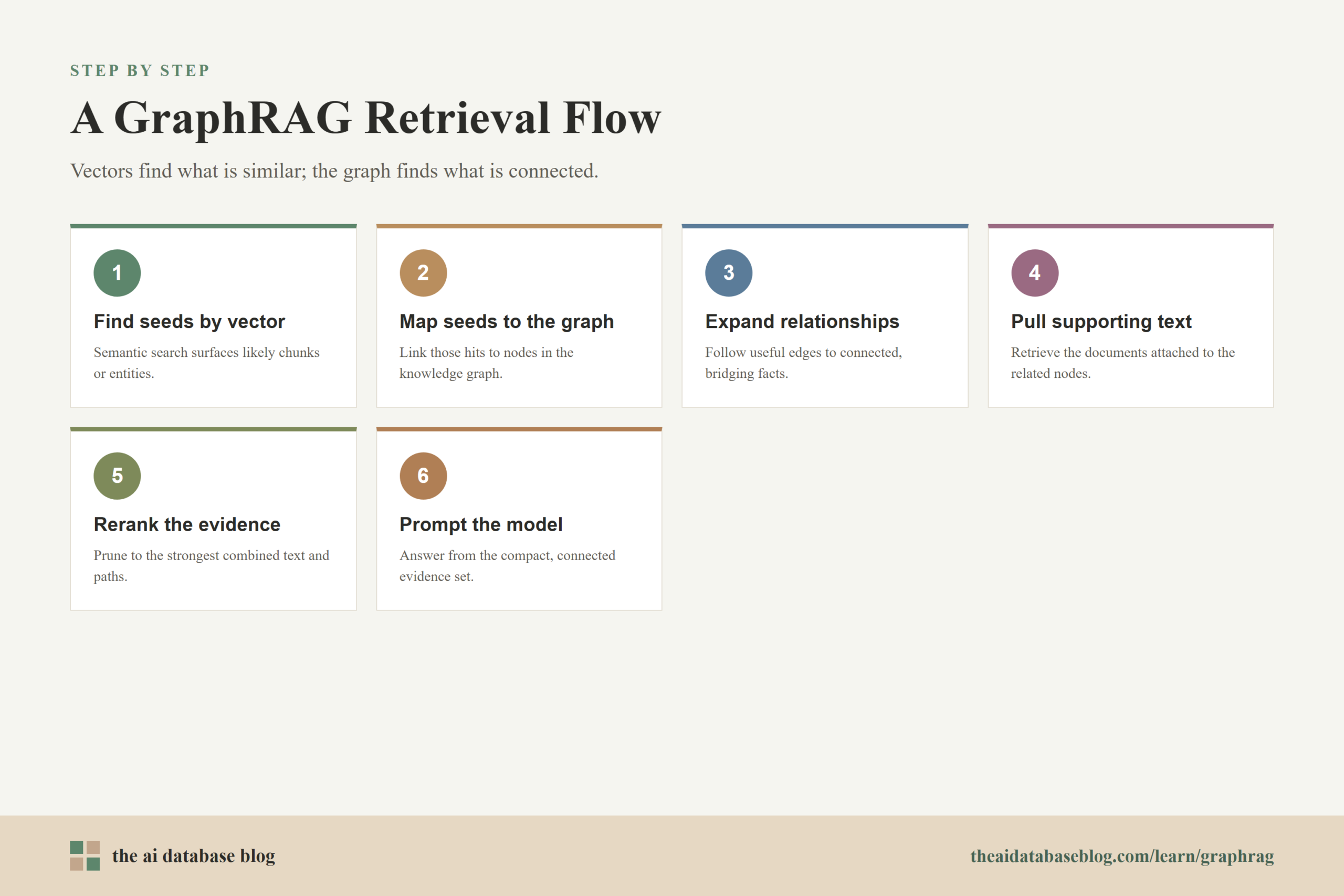
A common GraphRAG flow starts with vector retrieval to find likely seed nodes or text chunks. The system then maps those seeds to graph entities and expands through selected relationships. After that, it may retrieve the supporting text attached to the related nodes, rank the combined evidence, and send a compact context package to the language model. Some systems also embed entities, relationships, community summaries, or graph neighborhoods so both vector similarity and graph structure can influence ranking.
For example, imagine a user asks, “Which internal applications might be affected by the new security rule for third-party integrations?” Plain vector RAG might find chunks about the security rule and chunks about third-party tools. GraphRAG can start from the rule, follow edges to affected integration types, follow those to dependent applications, and then retrieve the policy and application documentation that support the answer.
This combination is useful because vector search answers “what looks semantically related?” while graph traversal answers “what is connected to this, and through what relationship?” Multi-hop reasoning becomes easier when the retrieval system can do both. The next step is to look more closely at why those hops are difficult for plain RAG.
Why GraphRAG Helps With Multi-Hop Reasoning
Multi-hop reasoning means the answer requires more than one retrieval step or more than one fact connection. A single-hop question might ask, “What is the refund period in the policy?” A multi-hop question might ask, “Which customer segments are affected by the refund policy change that applies to subscriptions sold through partners?” The second question requires finding the policy change, understanding which products or sales channels it applies to, connecting those channels to customer segments, and then producing an answer from that chain.
Plain RAG can sometimes handle this if all relevant information appears in the same chunk or if the top retrieved chunks happen to include the full evidence trail. The problem is that vector similarity is often local. It retrieves text that resembles the query, but it may miss bridge facts that do not look semantically similar on their own. A relationship edge can make those bridge facts retrievable because they are connected, not because they share surface-level wording.
GraphRAG helps by giving the retrieval system a memory of structure. Instead of treating every chunk as a mostly independent piece of text, the system can reason over entities and relationships. It can find paths such as policy to exception, service to dependency, account to contract, claim to evidence, or event to timeline. This is why GraphRAG is often discussed for domains where answers depend on networks of facts, such as compliance, scientific literature, software systems, manufacturing documentation, finance, and enterprise knowledge bases.
Graph traversal also makes retrieval more explainable. If a system can show that it reached an answer by following a chain of relationships, reviewers can inspect whether the path makes sense. That does not guarantee correctness, because the graph itself may contain extraction errors or missing edges, but it gives teams a clearer way to debug retrieval than looking only at a similarity score.
The value of multi-hop retrieval depends on the questions users actually ask. If most questions are direct lookups, graph traversal may add little value. If users regularly ask questions that require linked evidence across documents or systems, GraphRAG becomes more attractive.
When GraphRAG Beats Plain RAG
GraphRAG tends to beat plain RAG when the information need is relational, compositional, or spread across many documents. In these cases, the hard part is not simply finding a relevant passage. The hard part is finding the right set of connected evidence and preserving enough structure for the model to answer accurately.
Questions That Need Connected Evidence
GraphRAG is a strong fit when the user asks about dependencies, ownership, lineage, causality, exceptions, sequences, or membership. Examples include “Which services depend on the deprecated component?”, “What risks connect this supplier to this product line?”, or “Which policies apply to this workflow after the latest process change?” These questions need relationship paths, not just related paragraphs.
Large Corpora With Fragmented Context
In large document collections, related facts may be scattered across manuals, tickets, emails, technical notes, contracts, or process documents. Plain RAG can retrieve some of the relevant chunks, but it may miss the less obvious context that connects them. A graph can preserve cross-document links, entity references, and document-level structure so the retrieval process has a better chance of assembling the full answer.
Domains Where Entity Identity Matters
GraphRAG is also useful when entity identity is important. A vector system may retrieve text about similar entities, but a graph can distinguish which system, account, regulation, product version, or team is actually connected to the question. This is especially important when names are reused, abbreviations overlap, or a single entity appears under several labels.
Summaries That Need Global Structure
Some GraphRAG systems use graph communities or clusters to support broader summaries. Instead of summarizing only the top matching chunks, they can summarize communities of related entities and then select the relevant community-level context. This can help with questions such as “What are the main themes in this corpus?” or “What are the largest risk areas across these documents?”
These advantages do not mean GraphRAG is always the right answer. The same structure that improves hard retrieval tasks can introduce latency, token overhead, and graph maintenance work. To decide whether the tradeoff is worthwhile, it helps to compare GraphRAG directly with plain RAG.
When Plain RAG Is Still the Better Choice
Plain RAG is often better for straightforward retrieval tasks. If users mostly ask direct questions and the answer usually appears in one or two well-written chunks, vector search with good chunking, metadata filtering, reranking, and citation handling may be enough. In that situation, adding a graph can make the system harder to operate without improving answer quality.
Plain RAG is also easier to build and update. New documents can be chunked, embedded, and inserted into a vector index with relatively simple ingestion logic. GraphRAG usually needs entity extraction, relationship extraction, deduplication, schema decisions, graph updates, and quality checks. That additional pipeline can slow down iteration, especially when the corpus changes often.
Latency is another practical concern. A simple vector retrieval pipeline can run quickly because it retrieves nearest neighbors, applies filters, optionally reranks, and sends a limited context window to the model. GraphRAG may add entity linking, graph expansion, path scoring, subgraph pruning, community summary retrieval, or multiple retrieval passes. Each step can improve relevance, but each step can also add time and complexity.
Plain RAG remains a sensible baseline even when a team expects to need GraphRAG later. A strong vector RAG system provides a comparison point. Without that baseline, it is difficult to know whether the graph is truly improving retrieval or simply adding an impressive-looking layer.
The clearest way to think about the decision is this: plain RAG retrieves similar evidence, while GraphRAG retrieves connected evidence. If connected evidence is not central to the task, the graph may not earn its cost. If connected evidence is central, the next question is what that cost actually includes.
The Cost of Building the Graph
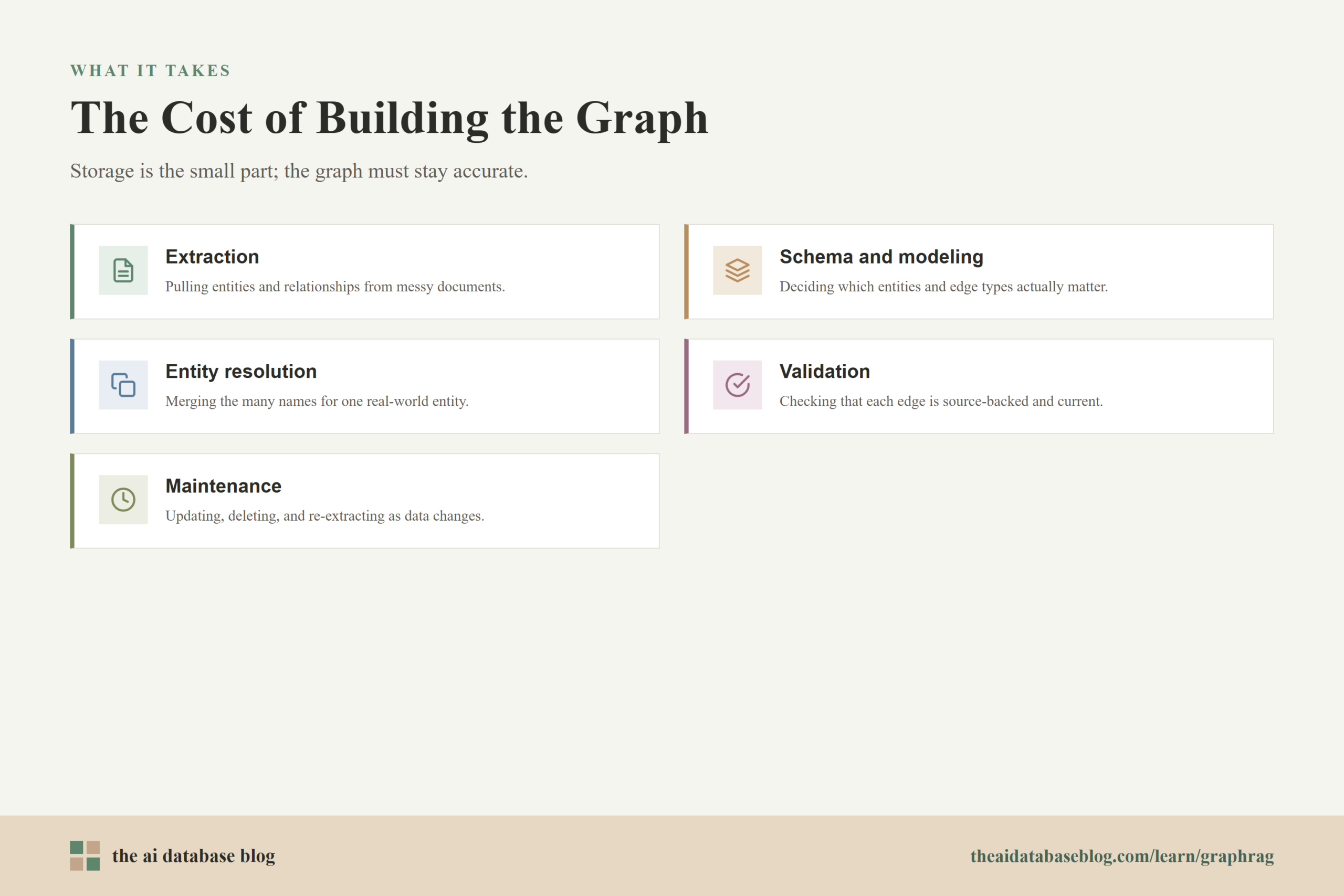
The main cost of GraphRAG is not only graph storage. Storage is usually only one part of the work. The larger cost is building and maintaining a useful graph from messy source data. A graph that is incomplete, noisy, stale, or poorly typed can make retrieval worse, because the system may follow irrelevant paths or miss the relationships that matter.
Extraction Cost
Graph construction starts by extracting entities and relationships from documents or structured records. This may involve rule-based parsing, traditional natural language processing, language model extraction, or a hybrid approach. LLM-based extraction can be flexible, but it can also be expensive at scale because every document or chunk may need to be processed. More efficient extraction methods can reduce cost, but they may require more domain-specific engineering.
Schema and Modeling Cost
A graph needs decisions about what counts as an entity, what relationship types matter, and how granular the nodes should be. If the graph is too shallow, it may not support useful traversal. If it is too detailed, retrieval can become noisy and expensive. Teams often need to decide whether to build a light document graph, a domain-specific entity graph, or a richer ontology with typed entities and relationships.
Deduplication and Entity Resolution Cost
Real corpora often refer to the same entity in several ways. A product may have a formal name, an internal code name, an abbreviation, and a legacy label. If the graph treats these as separate nodes, retrieval paths can break. If it merges distinct entities incorrectly, retrieval can become misleading. Entity resolution is one of the most important and underappreciated costs in GraphRAG.
Validation and Governance Cost
A graph used for retrieval needs quality checks. Teams need to inspect whether extracted relationships are accurate, whether sources support each edge, whether conflicting facts are represented correctly, and whether stale information is removed or marked. This matters because a language model can sound confident even when the graph path that fed it was wrong.
Query and Token Cost
GraphRAG can increase query cost because graph expansion may retrieve more context than a simple vector search. If the system sends large subgraphs, long relationship chains, or many community summaries into the prompt, token usage can rise quickly. Good systems limit this by pruning paths, ranking evidence, compressing graph context, caching common results, and keeping only the most useful relationships in the answer context.
Maintenance Cost
Graphs change as documents, systems, teams, policies, and products change. A GraphRAG system needs a plan for incremental updates, deletion, re-extraction, and conflict handling. Without maintenance, the graph can drift away from the current state of the organization or domain. For fast-changing corpora, maintenance can be a larger long-term cost than the initial build.
These costs are not reasons to avoid GraphRAG. They are reasons to be specific about the problem it is solving. The best GraphRAG projects usually start from a retrieval failure that plain RAG cannot handle well, then build the smallest useful graph for that failure.
A Practical GraphRAG Architecture
A practical GraphRAG system usually has separate but connected retrieval layers. The vector layer stores embeddings for chunks, documents, entities, relationships, or summaries. The graph layer stores nodes and edges that represent the structure of the domain. The generation layer receives a carefully selected set of evidence, not the entire graph.
The ingestion pipeline begins with source documents or records. The system chunks the text, extracts candidate entities, identifies relationships, resolves duplicates, attaches source references, and writes both embeddings and graph records. Some systems also create summaries for graph communities or document sections so that broad questions can be answered without retrieving every underlying chunk.
At query time, the system can use vector search to identify seed chunks or entities, graph traversal to expand through useful relationships, metadata filters to enforce constraints, and reranking to select the strongest evidence. The language model then receives a compact context containing the relevant text, entities, relationships, and source references. The answer should be grounded in that evidence rather than in the model’s memory alone.
This architecture works best when retrieval is measured at multiple levels. Teams should evaluate whether the system retrieves the right evidence, whether graph expansion improves or hurts relevance, whether the final answer is faithful to the retrieved context, and whether latency and token cost remain acceptable. GraphRAG should be judged as a full retrieval pipeline, not as a graph-building exercise by itself.
Once the architecture is in place, the biggest design challenge is controlling graph expansion. Too little expansion can miss the needed reasoning path. Too much expansion can flood the model with loosely related context. The next section explains how teams can make that decision more deliberately.
How to Decide Whether You Need GraphRAG
The best way to decide is to test GraphRAG against a strong plain RAG baseline on real questions. Start with a question set that reflects actual user needs. Label which questions are single-hop, which require multi-hop reasoning, which require broad summarization, and which require strict entity disambiguation. Then compare retrieval quality, answer quality, latency, and cost.
GraphRAG is worth serious consideration when plain RAG repeatedly fails because it cannot connect evidence across documents. It is also worth considering when users need traceable reasoning paths, when entity identity is central to correctness, or when the corpus has a clear relational structure that is currently hidden inside text.
GraphRAG is less compelling when the system mostly handles simple lookup questions, when the corpus is small and easy to search, when latency requirements are strict, or when the team cannot maintain graph quality over time. In those cases, improving chunking, metadata filters, hybrid keyword-vector search, reranking, or prompt design may deliver better results with less operational overhead.
A useful pilot does not need to graph everything. It can focus on one high-value workflow, one document family, or one class of multi-hop questions. The goal is to learn whether relationship-aware retrieval improves the answer in a measurable way. If it does, the graph can expand gradually. If it does not, the team has avoided turning graph construction into an expensive default.
Common GraphRAG Failure Modes
GraphRAG can fail in ways that are different from plain RAG. A vector system may miss a relevant chunk because it is not semantically close enough to the query. A GraphRAG system may retrieve a misleading path because two entities were merged incorrectly, a relationship was extracted too broadly, or graph expansion wandered into a related but irrelevant neighborhood. These failures can be subtle because the answer may appear well structured.
One common failure is context explosion. The graph retrieves many connected nodes, and the system passes too much information to the model. This can increase cost, slow down responses, and make the final answer less focused. Another failure is false connectivity, where weak or inferred relationships make unrelated facts appear connected. A third failure is stale graph state, where old relationships remain active after the source data has changed.
Teams can reduce these risks by keeping relationships source-backed, using confidence scores where appropriate, limiting graph depth, applying metadata constraints, pruning low-value paths, and evaluating evidence recall separately from answer fluency. Human review is especially useful during early graph construction because it reveals whether the model is following meaningful relationships or merely navigating a noisy structure.
These failure modes reinforce the larger lesson: GraphRAG is not a magic upgrade to RAG. It is a retrieval strategy that pays off when relationship structure is central to the task and when the graph is accurate enough to trust.
FAQs
1. What is GraphRAG in simple terms?
GraphRAG is a way to improve retrieval-augmented generation by using both semantic search and relationship data. The vector side finds text or entities that are similar to the user’s question. The graph side follows connections between entities, documents, events, or concepts. Together, they help the system retrieve evidence that is both relevant and connected.
2. How is GraphRAG different from regular RAG?
Regular RAG usually retrieves chunks based on vector similarity, keyword matching, metadata filters, or reranking. GraphRAG adds a knowledge graph so retrieval can follow relationships such as depends on, owned by, caused by, part of, updated by, or related to. This makes GraphRAG more useful for questions that require several connected facts rather than one similar passage.
3. Does GraphRAG always perform better than plain RAG?
No. GraphRAG is usually better for complex relational questions, multi-hop reasoning, entity disambiguation, and broad synthesis across connected documents. Plain RAG can be better for simple fact lookup, low-latency applications, small corpora, or systems where the graph would be too expensive to maintain. A strong plain RAG baseline should be tested before adding graph complexity.
4. Why does GraphRAG help with multi-hop reasoning?
GraphRAG helps because multi-hop reasoning often depends on bridge facts that are not obvious from semantic similarity alone. A graph can connect those bridge facts through explicit relationships. This lets retrieval move from one entity or document to another in a controlled way, giving the language model a more complete evidence path for the answer.
5. What makes GraphRAG expensive to build?
The expensive part is building and maintaining a useful graph. Teams need to extract entities and relationships, resolve duplicates, decide on a schema, validate graph quality, store the graph, design traversal logic, and update the graph as the source data changes. Query-time costs can also rise if graph expansion sends too much context to the model.
6. What is a good first GraphRAG use case?
A good first use case is a workflow where plain RAG fails because the answer depends on connected evidence across several sources. Examples include dependency analysis, policy impact questions, technical documentation across systems, compliance evidence gathering, and domain research where entities and relationships matter. The first pilot should be narrow enough to evaluate clearly.
Takeaway
GraphRAG is useful when an AI database system needs to retrieve connected evidence, not just similar text. By combining vector search with graph relationships, it can support multi-hop reasoning, entity-aware retrieval, dependency analysis, and broad synthesis across fragmented knowledge. This guidance is most useful for teams building RAG systems over complex domains such as technical documentation, policies, research, operations, or compliance, where a question like “which systems are affected by this change?” requires following relationships across multiple pieces of evidence. The tradeoff is that graph construction and maintenance are real costs, so GraphRAG should be adopted when relationship-aware retrieval solves a measurable problem that plain RAG cannot handle well.
Watch this video to learn more