Evaluating RAG quality means measuring whether a retrieval-augmented generation system finds the right information, ranks it well, and uses it to produce an accurate answer. Retrieval metrics such as Recall@K and NDCG show whether the AI database and retrieval layer are surfacing useful context. Generation metrics such as faithfulness and answer relevance show whether the final answer is grounded in that context and actually responds to the user. A strong evaluation process combines both, uses a carefully built eval set, and tracks changes objectively as the pipeline evolves.
This guide explains how to evaluate a RAG pipeline from the retrieval layer through the generated answer. It covers core metrics, how to build an eval set, how to interpret failures, and how evaluation frameworks can help teams compare pipeline versions without relying only on subjective judgment. By the end, you should understand how to measure RAG quality in a practical, repeatable way.
Why RAG Quality Needs More Than One Score
A RAG system has several moving parts, and each one can fail in a different way. The retriever may miss the document that contains the answer. The ranker may bury the best chunk below less useful chunks. The generator may receive the right evidence but ignore it, distort it, or answer a different question. A single accuracy score can hide these differences, which makes debugging slow and uncertain.
Good RAG evaluation separates the pipeline into layers. The retrieval layer is judged by whether it brings back the right material. The ranking layer is judged by whether the most useful material appears early enough for the model to use. The generation layer is judged by whether the answer is grounded, complete, and relevant to the user request. This separation is important because a bad final answer does not always mean the language model is the problem.
For example, imagine a support assistant that answers questions from product documentation. If the assistant gives an outdated answer, the cause might be stale source data, poor chunking, weak metadata filters, low retrieval recall, or a prompt that fails to prioritize the newest document. Without layer-specific evaluation, all of those problems look like the same generic failure: the answer was wrong.
Once the pipeline is broken into measurable parts, the natural next question is which metrics are worth tracking. The most useful metrics are not just abstract numbers. They connect directly to decisions about chunking, embedding models, hybrid search, reranking, prompts, and answer formatting.
Retrieval Metrics: Measuring Whether the Right Context Was Found
Retrieval metrics evaluate the search side of a RAG system before the language model writes an answer. These metrics are especially important for AI database work because retrieval quality depends on how documents are chunked, embedded, indexed, filtered, and ranked. If the right evidence never reaches the model, even a strong generator has little chance of producing a reliable response.
Recall@K
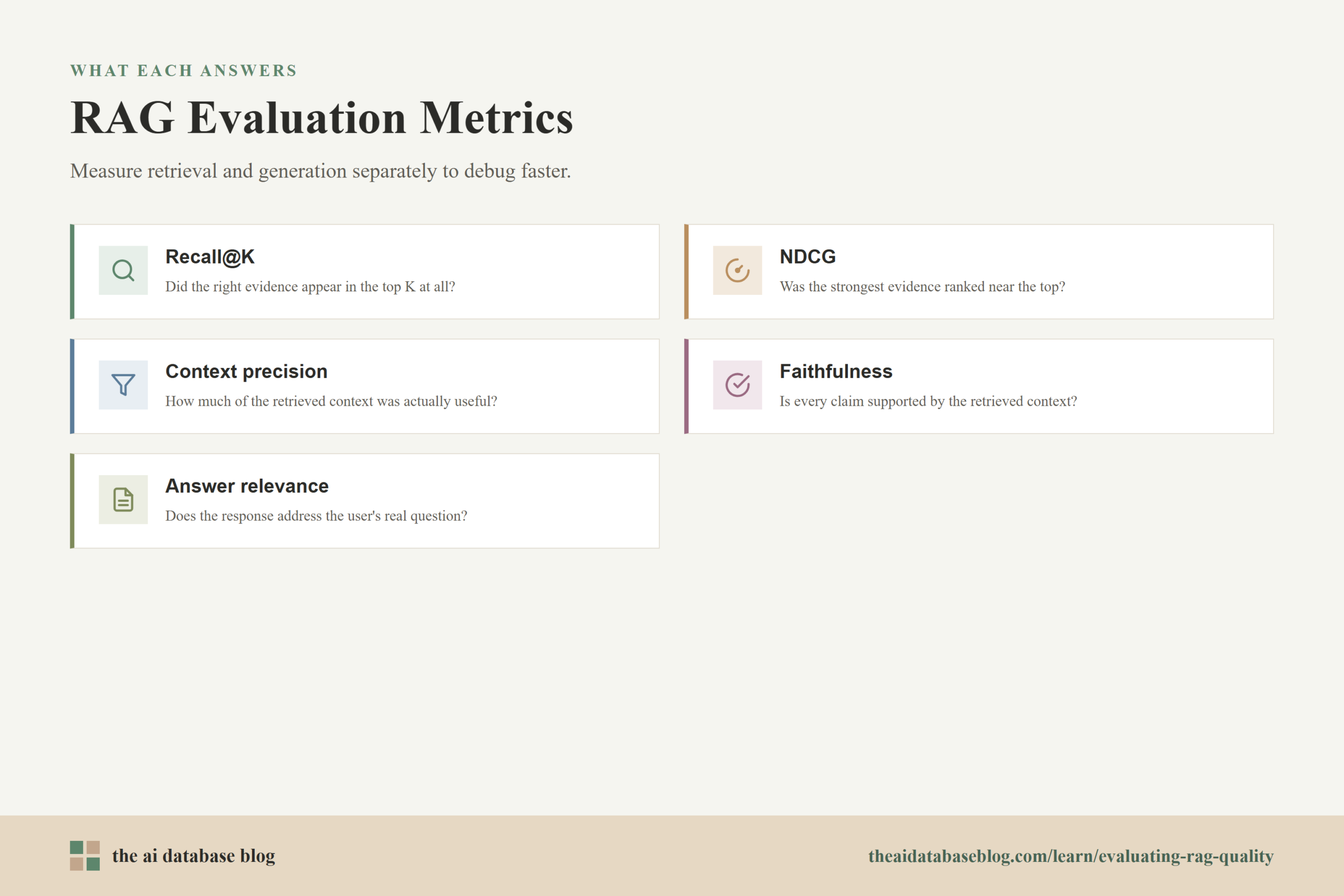
Recall@K measures whether the relevant source material appears within the top K retrieved results. In a RAG pipeline, K might be the top 5, top 10, or top 20 chunks returned before reranking or generation. If the correct chunk appears somewhere in that set, retrieval gets credit for finding it. If the correct chunk is missing, the system has a recall problem.
Recall@K is useful because it answers a direct operational question: did the retrieval layer give the system a chance to answer correctly? A low Recall@K score often points to issues with chunk size, embedding quality, sparse versus dense retrieval strategy, metadata filters, synonym handling, query rewriting, or multilingual support. It is one of the first metrics to inspect when answers are vague, incomplete, or consistently missing important facts.
However, Recall@K does not tell the whole story. A system can retrieve the right chunk at position 10 while filling positions 1 through 9 with weak context. If the generator only receives the top 5 chunks, or if it pays more attention to earlier context, the relevant evidence may still be effectively invisible. That is why ranking-aware metrics matter.
NDCG
NDCG, or normalized discounted cumulative gain, evaluates ranking quality by giving more credit when highly relevant results appear near the top. Unlike simple recall, NDCG can account for graded relevance. A perfect supporting passage can receive a higher relevance grade than a loosely related passage, and the metric rewards systems that place stronger evidence earlier.
NDCG is helpful when not all retrieved chunks are equally valuable. In many RAG applications, several chunks may be related to the question, but only one or two contain the exact answer. A ranking metric helps distinguish a retriever that merely finds related material from one that consistently places decisive evidence where the generator can use it.
For teams tuning hybrid search, rerankers, or metadata filters, NDCG can be more informative than recall alone. Recall answers whether the right material appeared somewhere in the candidate set. NDCG answers whether the system ranked the best material highly enough to matter.
Precision and Context Relevance
Precision-style metrics ask how much of the retrieved context is actually useful. In RAG systems, irrelevant context is not harmless. It consumes context window space, distracts the generator, and can increase the chance of an answer that mixes unrelated details. Context relevance metrics, often judged by a model or human reviewer, estimate whether each retrieved chunk is connected to the user question.
This matters because high recall with low precision can still produce poor answers. A system that retrieves the correct chunk plus many noisy chunks may look acceptable by Recall@K but still perform badly in generation. Evaluating both recall and relevance gives a clearer view of whether the retriever is broad enough to find the answer and focused enough to avoid confusion.
Retrieval metrics explain what evidence entered the answer-generation step. The next layer asks a different question: once the model had that evidence, did it use it correctly?
Generation Metrics: Measuring Whether the Answer Used the Context Well
Generation metrics evaluate the final response produced by the RAG system. They focus on the relationship between the user question, the retrieved context, and the answer. This is where evaluation moves from search quality to answer quality. A good RAG answer should be relevant to the user, faithful to the retrieved evidence, and complete enough for the task.
Faithfulness
Faithfulness measures whether the answer is supported by the retrieved context. A faithful answer does not introduce claims that are absent from the source material, does not contradict the retrieved evidence, and does not overstate what the context says. In practical terms, faithfulness is a grounding metric.
This metric is central to RAG quality because retrieval is often used to reduce hallucination. If a system retrieves the right documents but the model invents unsupported details, the problem is no longer retrieval alone. It may involve the prompt, answer format, model behavior, missing citation requirements, or insufficient instruction to say when the evidence is incomplete.
Faithfulness should not be confused with correctness in the broadest sense. An answer can be faithful to retrieved context but still wrong if the retrieved context is outdated or incomplete. That distinction is important. Faithfulness tells you whether the generator stayed grounded in what it was given. It does not guarantee that the underlying knowledge base is correct.
Answer Relevance
Answer relevance measures whether the response addresses the user’s actual question. A response can be grounded and still be unhelpful if it answers only a nearby question, focuses on the wrong entity, or gives a generic explanation when the user asked for a specific comparison. Answer relevance checks alignment between the query and the final response.
This metric is especially useful for conversational RAG systems, where users often ask follow-up questions, use shorthand, or combine multiple intents in one prompt. A low answer relevance score may point to weak query understanding, poor conversation state handling, overly broad retrieved context, or a prompt that encourages general explanation instead of task completion.
Answer Correctness and Completeness
Answer correctness compares the generated response with a known expected answer or human-labeled ground truth. Completeness asks whether the answer includes the important information needed to satisfy the question. These metrics are harder to automate reliably, but they are valuable when an eval set includes reference answers.
For example, if a user asks, “What are the eligibility requirements for this policy?” a correct but incomplete answer may mention one requirement while omitting two others. Faithfulness might still be high if the answer only uses supported facts. Answer relevance might also be high because the response is on topic. Correctness and completeness help catch missing substance.
These generation metrics reveal whether the final answer is usable, but they are only as meaningful as the examples used to test them. That makes the eval set one of the most important parts of the entire evaluation process.
Building an Eval Set for RAG
An eval set is a collection of test cases used to measure a RAG pipeline consistently over time. For RAG, each test case usually includes a user question, the expected answer or judging criteria, the relevant source documents or chunks, and sometimes metadata such as topic, difficulty, source type, or query category. The goal is to create a benchmark that reflects the real tasks the system must handle.
A useful eval set should include common questions, difficult edge cases, and examples that expose known failure modes. Common questions show whether the system handles everyday usage. Edge cases show whether it breaks under ambiguity, rare terminology, multi-hop reasoning, or conflicting documents. Known failures make it possible to check whether a new version actually fixed the problem.
Start With Real User Questions
The best eval examples often come from production logs, support tickets, search analytics, sales engineering notes, internal users, or domain experts. Real questions preserve the messy phrasing that synthetic examples often miss. They include abbreviations, partial context, unclear intent, and assumptions that users rarely spell out.
When using real questions, remove sensitive information and group similar questions so the eval set does not become repetitive. A balanced set is better than a large set full of near-duplicates. The purpose is not to memorize a few examples but to measure whether the pipeline generalizes across the types of questions users actually ask.
Label the Relevant Evidence
Retrieval metrics require relevance labels. At minimum, each question should identify which document or chunk contains the answer. For stronger ranking evaluation, labels can use graded relevance, such as highly relevant, partially relevant, and not relevant. This makes metrics like NDCG more meaningful because the system can be rewarded for placing the strongest evidence first.
Labeling does not have to start perfectly. Many teams begin with a smaller, carefully reviewed set and expand it over time. What matters is consistency. If one reviewer labels broad background material as relevant and another labels only exact answer passages as relevant, the metric will be noisy. A short labeling guide can improve agreement and make the eval set more stable.
Include Reference Answers When Needed
Reference answers help evaluate answer correctness and completeness. They are especially useful for factual questions, policy interpretation, compliance workflows, and customer support answers where the expected response can be clearly stated. A reference answer does not need to be the only acceptable wording, but it should capture the facts the generated answer must include.
Some RAG evaluations are reference-free, meaning they judge the answer mainly against the retrieved context and user question. That can be useful when writing reference answers is expensive. Still, a reference-free approach should not replace human-reviewed examples entirely. Ground-truth examples remain valuable for regression testing and for calibrating automated judges.
Segment the Eval Set
A single average score can hide important weaknesses, so eval sets should be segmented. Useful segments might include topic, document type, language, query difficulty, customer journey stage, freshness requirement, metadata filter requirement, or whether the answer requires multiple sources. Segmenting results helps teams see where quality is improving and where it is still fragile.
For example, a pipeline might perform well on simple definition questions but poorly on policy questions that require reading exceptions. It might work well in English but struggle with queries that use domain-specific abbreviations. Segmented evaluation turns these patterns into visible signals instead of leaving them buried inside a blended average.
After the eval set is in place, the next step is deciding how to run evaluations repeatedly. This is where frameworks can help, provided they are used as measurement tools rather than as a substitute for judgment.
Frameworks for Measuring a RAG Pipeline Objectively
RAG evaluation frameworks help teams run repeatable tests across many examples, calculate standard metrics, compare pipeline versions, and inspect failures. They can reduce manual effort, but they do not remove the need for a thoughtful eval set or human review. The strongest evaluation setups combine framework-driven scoring with periodic manual inspection and domain expert feedback.
Ragas
Ragas is commonly used for RAG evaluation because it includes metrics such as faithfulness, response relevancy, context precision, and context recall. It is useful when teams want a structured way to evaluate both retrieval and generation behavior across a dataset. Ragas can work with reference-based and reference-free patterns, depending on the metric and available test data.
In practice, Ragas is often useful during experimentation. A team can change chunking, embedding models, reranking, or prompts, then compare metric movement across the same test set. The important habit is to inspect examples behind the scores, especially when a metric improves but user-facing quality does not.
TruLens
TruLens is often associated with the RAG triad: context relevance, groundedness, and answer relevance. This framing is useful because it maps evaluation to the main relationships in a RAG system. The question should match the retrieved context, the answer should be grounded in that context, and the answer should address the question.
This approach is helpful for diagnosing hallucination and tracing quality issues across pipeline steps. If context relevance is low, the retriever or query processing layer may need attention. If groundedness is low, the generator may be adding unsupported claims. If answer relevance is low, the system may be misunderstanding the user request or producing answers that are too broad.
DeepEval
DeepEval provides RAG metrics such as answer relevancy, faithfulness, contextual precision, contextual recall, and contextual relevancy. It is often used in test-oriented workflows because it can fit naturally into automated evaluation and regression testing. This makes it useful when teams want to block or flag changes that reduce measured quality.
For example, a team might run a small critical eval set whenever retrieval settings change, then run a larger suite before deployment. The goal is not to turn automated scores into unquestionable truth. The goal is to catch regressions early and make pipeline changes easier to compare.
Custom Evaluators and Human Review
Standard frameworks are useful, but many RAG systems need custom evaluators. A legal research assistant, medical documentation assistant, financial policy assistant, and developer support assistant may all care about different forms of correctness. Custom rubrics can measure whether the answer includes required caveats, cites the right source, refuses unsupported questions, or follows a domain-specific answer format.
Human review remains important because automated judges can be inconsistent, especially on subtle domain questions. A practical workflow is to use automated metrics for broad coverage, then sample failures and borderline cases for manual review. Over time, those reviews can improve the eval set, judging rubric, prompts, and relevance labels.
Frameworks make measurement easier, but objective evaluation also depends on how results are interpreted. The next step is turning metrics into decisions about the pipeline.
How to Interpret RAG Evaluation Results
RAG evaluation is most useful when metrics are connected to likely fixes. Scores should guide investigation rather than act as a single pass-or-fail verdict. A lower score is not just a sign that the system is worse. It is a clue about which part of the pipeline may need attention.
If Recall@K is low, the system is not finding the right evidence. Possible fixes include improving chunking, adding synonym handling, using hybrid search, adjusting metadata filters, improving embeddings, rewriting queries, or increasing K before reranking. If Recall@K is high but NDCG is low, the system finds the right material but ranks it poorly. That usually points toward reranking, scoring, or query-document matching issues.
If context relevance or precision is low, the retriever may be too broad. The system might be pulling loosely related chunks that crowd out useful evidence. Fixes may include better filters, tighter chunking, stronger reranking, or more careful retrieval routing. If faithfulness is low, the generator is making claims the retrieved context does not support. That may require prompt changes, citation requirements, lower temperature, answer constraints, or better handling when evidence is insufficient.
If answer relevance is low, the system may be answering the wrong question or giving too much generic information. This can happen when conversational context is mishandled, the query is rewritten poorly, or the prompt rewards broad explanations instead of direct answers. Looking at examples is essential because the same metric drop can have different causes in different segments.
Interpreting metrics this way turns evaluation into a development loop. Measure the baseline, change one meaningful part of the pipeline, rerun the same eval set, inspect score changes by segment, and review examples where the system improved or regressed.
Common Mistakes in RAG Evaluation
Many RAG evaluations fail because they measure what is easy instead of what matters. A polished answer can look impressive while being unsupported. A high average score can hide weak performance on the hardest user questions. A synthetic eval set can miss the messy language and constraints found in real usage.
One common mistake is evaluating only the final answer. This makes it difficult to know whether failures come from retrieval, ranking, generation, source quality, or the eval itself. Another mistake is using only generic examples that do not reflect the real domain. RAG systems often fail on domain-specific language, ambiguous terminology, document freshness, exceptions, and questions that require joining information from multiple sources.
Teams also sometimes treat automated judge scores as exact measurements. LLM-based evaluators are useful, but they are not perfect instruments. Their scores can vary based on the judging prompt, model, context length, and domain. For important systems, automated metrics should be calibrated against human review and tracked over time rather than accepted blindly.
A final mistake is changing too many parts of the pipeline at once. If chunking, embedding, reranking, and prompting all change together, it becomes hard to know what caused the improvement or regression. Evaluation works best when experiments are controlled enough that the result teaches something specific.
Avoiding these mistakes makes the evaluation process more trustworthy. It also makes the results easier to explain to product, engineering, and domain teams that need to decide whether a RAG system is ready for production use.
A Practical RAG Evaluation Workflow
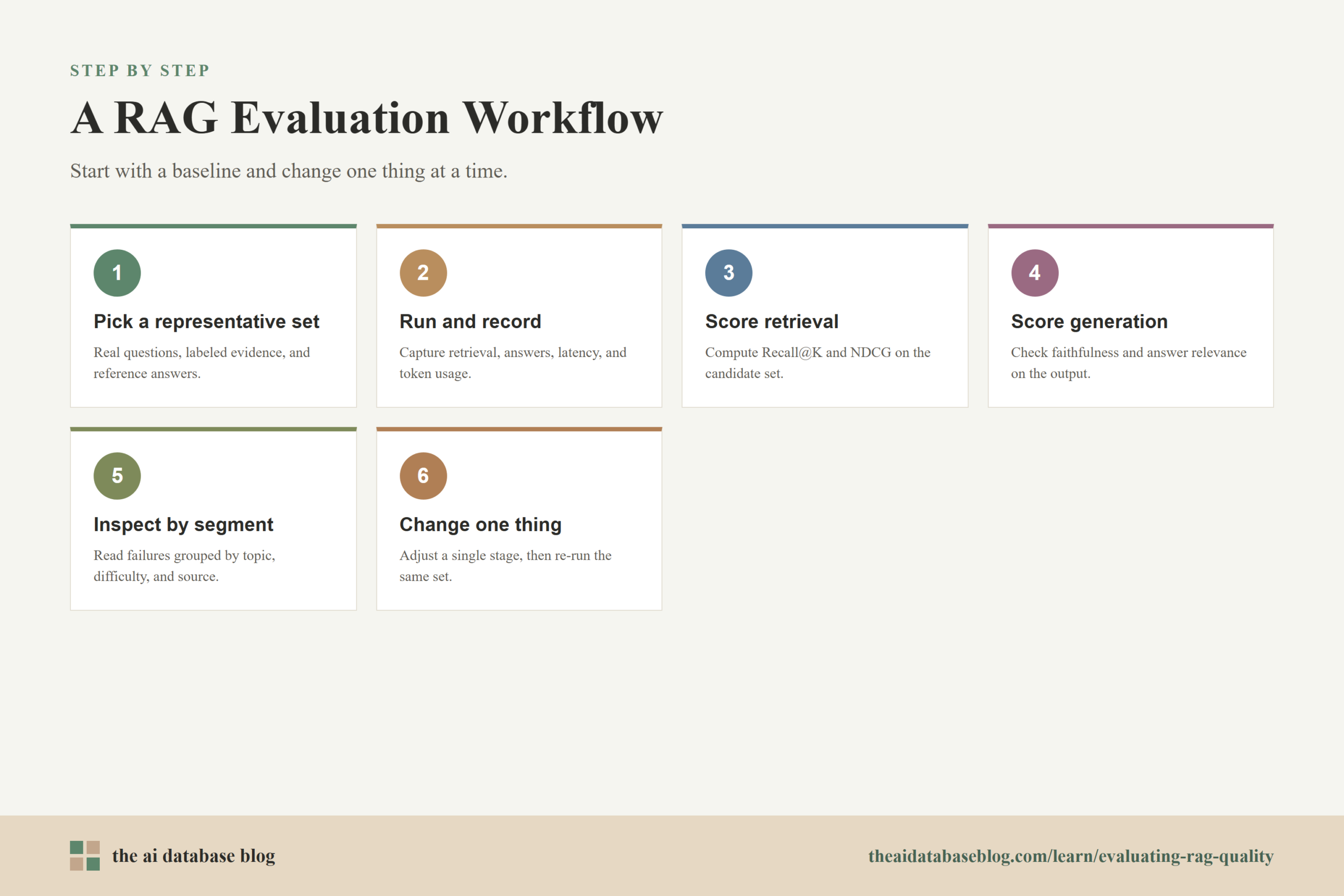
A practical RAG evaluation workflow starts with a baseline and grows in maturity over time. The first version does not need to be perfect. It needs to be consistent, relevant to the use case, and capable of showing whether pipeline changes improve or damage quality.
Start by selecting a representative eval set. Include real user questions, labeled relevant chunks, and reference answers for the examples where correctness and completeness matter. Then run the current pipeline and record retrieval results, generated answers, latency, token usage, and any available user-facing metadata. Keeping these artifacts makes it easier to inspect why a metric moved.
Next, calculate retrieval metrics such as Recall@K and NDCG. These show whether the AI database and ranking strategy are surfacing useful evidence. Then calculate generation metrics such as faithfulness and answer relevance. These show whether the model is using the retrieved evidence well. Review the results by segment, not only as one overall average.
After that, inspect failures manually. Look for patterns such as missing documents, overly large chunks, weak filters, outdated sources, context noise, answer drift, or unsupported claims. Choose one or two changes that target the clearest failure pattern, rerun the eval, and compare results against the baseline.
As the system matures, move evaluation into a repeatable workflow. Small eval suites can run during development. Larger suites can run before major releases. Critical examples can become regression tests. Production feedback can feed new examples into the eval set, especially when users report wrong, incomplete, or confusing answers.
FAQs
1. What is the most important metric for RAG quality?
There is no single most important metric for every RAG system. Recall@K is often the first retrieval metric to check because the system cannot answer reliably if it does not retrieve the right evidence. Faithfulness is often the first generation metric to check because it shows whether the answer is grounded in the retrieved context. Most teams need both, plus answer relevance, to understand quality clearly.
2. How is Recall@K different from NDCG?
Recall@K measures whether relevant evidence appears somewhere in the top K retrieved results. NDCG measures how well the results are ranked, giving more credit when the most relevant evidence appears near the top. Recall@K tells you whether the system found the answer at all, while NDCG tells you whether it placed the best evidence where the generator is most likely to use it.
3. What does faithfulness mean in RAG evaluation?
Faithfulness means the generated answer is supported by the retrieved context. A faithful answer does not add unsupported facts, contradict the evidence, or pretend the context says more than it does. It is a grounding metric, not a complete guarantee of truth, because the retrieved source itself may still be outdated, incomplete, or incorrect.
4. How large should a RAG eval set be?
A useful eval set can start small if the examples are carefully chosen and reviewed. A focused set of real questions, known failures, and important edge cases is often more valuable than a large set of repetitive synthetic questions. Over time, the eval set should grow as production feedback reveals new failure modes, topics, and user behaviors.
5. Can RAG evaluation be fully automated?
RAG evaluation can be partly automated, but it should not be fully trusted without human calibration. Frameworks can score retrieval, faithfulness, answer relevance, and related metrics across many examples. Human review is still needed to validate labels, inspect subtle failures, calibrate automated judges, and decide whether the measured quality is good enough for the use case.
6. Which framework should be used to evaluate a RAG pipeline?
The right framework depends on the workflow. Ragas is useful for standard RAG metrics across datasets. TruLens is useful for tracing and evaluating context relevance, groundedness, and answer relevance. DeepEval is useful when teams want test-style evaluation and regression checks. Many teams combine a framework with custom rubrics and human review for domain-specific requirements.
Takeaway
Evaluating RAG quality means measuring the whole path from user question to retrieved evidence to final answer. Retrieval metrics such as Recall@K and NDCG show whether the AI database finds and ranks the right context, while faithfulness and answer relevance show whether the generated response is grounded and useful. This guidance is most useful for teams building AI search, support assistants, internal knowledge tools, or domain-specific copilots where reliable answers depend on both strong retrieval and careful generation. A good eval set, objective metrics, evaluation frameworks, and regular human review together create a practical way to improve RAG systems over time.
Watch this video to learn more