Context engineering is the practice of deciding what information an LLM should receive, how that information should be compressed, and where it should appear in the context window so the model can use it reliably. For AI database and retrieval systems, the goal is not to fill the largest possible window. The goal is to assemble the smallest useful working set: the user request, relevant retrieved knowledge, necessary instructions, current state, and enough supporting evidence for the model to answer accurately.
This guide explains how to choose what belongs in the context window, how summarisation and compression affect reliability, how ordering changes model behavior, why the lost-in-the-middle problem matters, and how token budgeting turns context from a loose prompt-writing habit into an engineering discipline. By the end, you should understand how to design context for retrieval-augmented generation, agent workflows, document question answering, and other AI applications that depend on structured knowledge.
What Context Engineering Means
Context engineering is broader than prompt engineering. Prompt engineering usually focuses on the wording of instructions and examples. Context engineering focuses on the whole information environment the model sees at inference time. That environment can include system instructions, developer instructions, user input, retrieved documents, conversation history, tool results, memory records, database rows, schema details, reasoning constraints, and output requirements.
In a simple chat interaction, context might look like a conversation transcript plus the latest user question. In an AI database application, context is assembled dynamically from multiple systems. A retriever may find semantically similar chunks, a keyword search may surface exact terms, metadata filters may narrow the candidate set, and a reranker may reorder evidence before the final prompt is built. The quality of the answer depends on all of those decisions, not only on the final wording of the prompt.
This is why context engineering is becoming central to LLM application design. Modern models can accept longer inputs than earlier systems, but a larger window does not automatically mean better use of information. Long inputs can increase cost, latency, and ambiguity. They can also bury the most important evidence in positions where the model is less likely to use it. Context engineering treats the input as a managed resource: selected, compressed, ordered, tested, and improved over time.
Once context is treated as a managed resource, the next question is what actually deserves to be placed in the window. That decision is where AI databases, retrieval systems, and application state become part of the model’s reasoning path.
Choosing What To Put In The Context Window
The best context window is not the one with the most information. It is the one with the highest concentration of useful information for the current task. Every token competes for attention, cost, and space. If the model receives too little context, it may guess or answer from general training knowledge. If it receives too much, it may miss the relevant facts, mix conflicting sources, or spend capacity processing background material that does not help the answer.
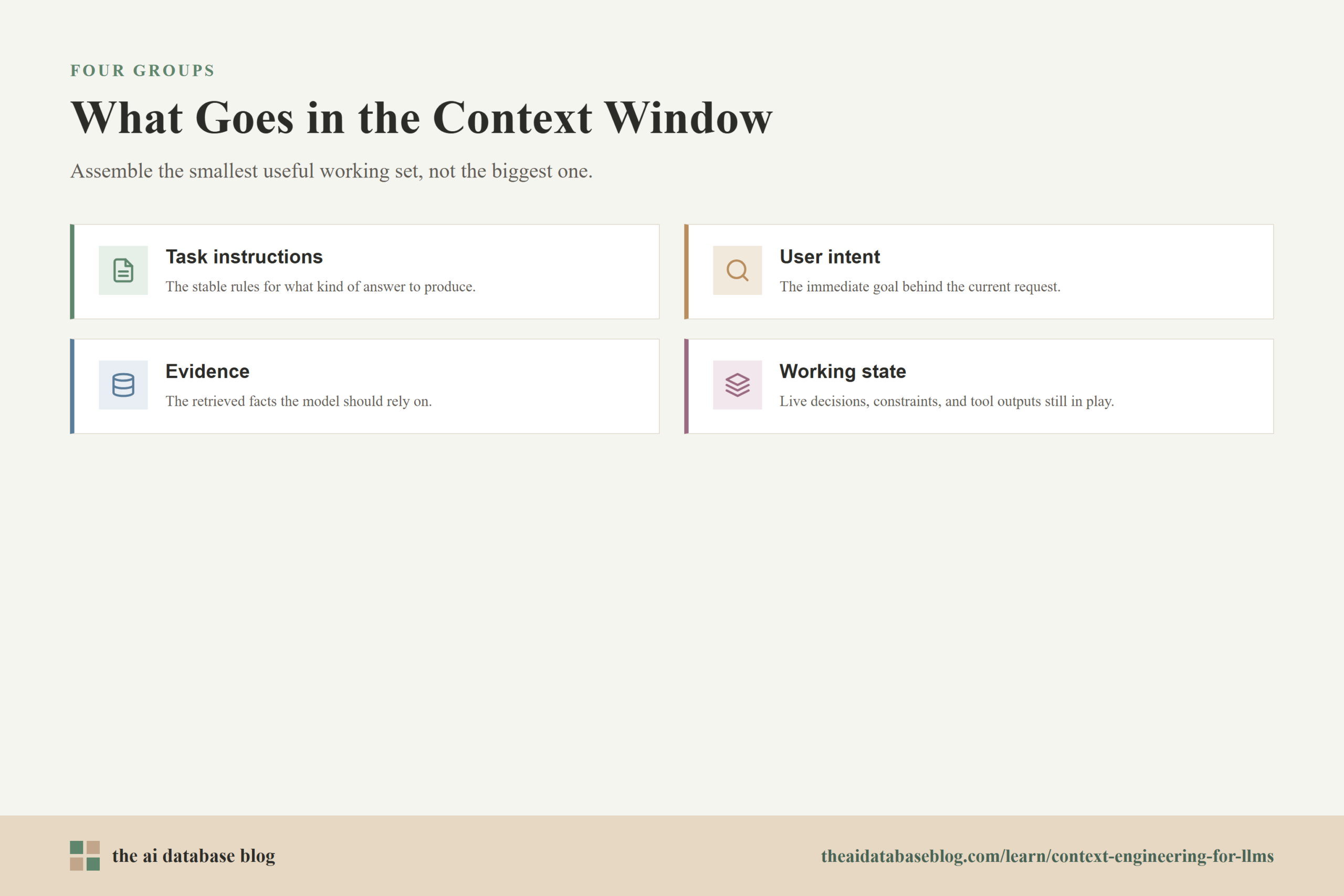
A practical way to choose context is to separate information into four groups: task instructions, user intent, evidence, and working state. Task instructions tell the model what kind of answer to produce. User intent explains the immediate goal. Evidence provides facts the model should rely on. Working state includes previous decisions, constraints, tool outputs, or intermediate results that are still active. Context engineering is the process of deciding which items in those groups are necessary for this specific request.
Use Retrieval To Select Evidence, Not To Dump Documents
Retrieval is most useful when it narrows a large knowledge base into a focused set of evidence. In an AI database system, this usually means storing content as chunks with embeddings, metadata, and sometimes keyword-searchable text. When a user asks a question, the system retrieves candidate chunks, filters them by metadata, and sends only the strongest evidence to the model.
The common mistake is treating retrieval as a way to copy as much source material as possible into the prompt. This can make the context window look comprehensive while making the model’s job harder. A better design retrieves more candidates than the model will receive, then ranks and trims them before context assembly. The model should see enough evidence to answer, compare, and cite or explain its reasoning, but not so much that the signal is diluted.
Prefer Task-Relevant Granularity
Chunk size matters because it shapes what the model can use. Very small chunks may retrieve precise facts but lose surrounding meaning. Very large chunks may preserve context but waste tokens on unrelated material. The right granularity depends on the task. A support assistant may need short policy sections. A legal or compliance workflow may need larger passages so definitions, exceptions, and conditions are not separated from each other. A code assistant may need a function, file excerpt, or dependency relationship rather than a generic paragraph chunk.
Metadata helps make this selection more controlled. Instead of retrieving solely by semantic similarity, a system can filter by document type, date, product area, permission level, jurisdiction, customer segment, or freshness. This is especially important when old and new information coexist. If retrieval returns a highly similar but outdated chunk, the model may produce a fluent answer that is wrong for the current state of the system.
Keep Stable Rules Separate From Retrieved Evidence
Not all context changes at the same rate. Output format rules, safety requirements, and application behavior are usually stable. Retrieved evidence changes with the user’s question. Conversation memory changes as the session develops. Mixing all of these together in a single unstructured block makes context harder to inspect and debug.
A cleaner design keeps stable instructions, user input, retrieved evidence, and active memory in distinct sections. This gives the model clearer boundaries and gives developers clearer logs. If the answer fails, it becomes easier to ask whether the problem came from retrieval, ranking, stale memory, unclear instructions, or an overloaded context window.
After the right information has been selected, the next challenge is fitting it into the available space without destroying the details that make it useful. That is where summarisation and compression become both powerful and risky.
Summarisation And Compression
Summarisation and compression reduce the amount of text sent to the model while trying to preserve the information needed for the task. They are essential when applications deal with long conversations, large document sets, tool logs, or multi-step agent workflows. The important point is that compression is not free. Every compression method makes a tradeoff between token savings and information fidelity.
Summarisation rewrites content into a shorter form. It is useful for conversation history, long background documents, repeated tool output, and exploratory material where the exact wording is less important than the main ideas. Compression can also be extractive, where the system keeps only selected sentences, facts, tables, or fields. In some systems, compression is structured: the original material is converted into entities, claims, decisions, open questions, citations, or key-value records.
Use Summaries For State, Not For Evidence That Requires Exactness
Summaries work well when the model needs continuity rather than exact quotation. For example, a long conversation can be reduced into user preferences, agreed constraints, decisions already made, and unresolved tasks. This keeps the model oriented without replaying every turn. In agent systems, a summary can capture what has already been tried, what succeeded, and what failed.
Summaries are riskier when the answer depends on exact wording. Contract clauses, code, medical notes, financial figures, configuration files, and policy exceptions can lose important meaning when paraphrased. In those cases, the system should retrieve or preserve the original passage, table, or record. A useful rule is to summarize context that provides orientation, but preserve source text for facts that the answer must quote, calculate, compare, or audit.
Compress By Structure When Possible
Structured compression often works better than a plain prose summary because it preserves distinctions the model needs to reason about. Instead of turning a meeting transcript into a vague paragraph, the system can store decisions, owners, deadlines, blockers, and open questions. Instead of sending a full product manual, the system can retrieve the relevant procedure, warnings, version constraints, and troubleshooting steps as separate fields.
This matters for AI databases because structured storage and retrieval can reduce token use before the prompt is ever assembled. Metadata, document hierarchy, extracted entities, and chunk relationships help the system retrieve a compact but meaningful package. The model does not need to infer structure from a wall of text if the application can provide that structure directly.
Keep Compression Reversible When The Stakes Are High
For higher-stakes workflows, compressed context should point back to the original source. A summary can say what appears to matter, but the system should retain source identifiers, document locations, timestamps, or chunk references. This makes it possible to retrieve the original evidence when the model needs more detail or when a user asks where an answer came from.
This is also useful for evaluation. If a compressed prompt produces a bad answer, developers need to know whether the original retrieval was wrong, the compression omitted a key fact, or the final model ignored the evidence. Without traceability, compression turns failures into guesswork.
Once context has been selected and compressed, the remaining information still has to be arranged. Ordering is not cosmetic. It changes which information the model is most likely to follow and which information may be overlooked.
Ordering Context For Better Use
Ordering is one of the most underrated parts of context engineering. LLMs do not use every token equally in every position. Research on long-context behavior has shown that models can perform worse when relevant information is placed in the middle of a long input, even when that information is technically inside the context window. The practical implication is simple: where you put information can matter almost as much as whether you include it.
A good ordering strategy places high-priority instructions and evidence where the model is more likely to use them. The exact best order depends on the model, task, and prompt format, but several patterns are broadly useful. Put durable rules and role constraints near the beginning. Put the user’s current request close to the evidence and close enough to the generation point that the model does not lose the thread. Put the most relevant retrieved evidence before less relevant material. Avoid burying decisive facts inside long undifferentiated context blocks.
Make The Context Easy To Parse
Clear section labels and consistent formatting help the model distinguish instructions from evidence and evidence from conversation history. For example, an application might separate context into sections for task, user request, retrieved evidence, source notes, active constraints, and output requirements. This is not decorative formatting. It is a way to reduce ambiguity about what each part of the input is supposed to do.
When evidence comes from multiple sources, each source should be clearly separated. If sources disagree, the prompt should not hide that disagreement. It should preserve dates, provenance, or confidence signals so the model can reason about which source is more current or relevant. In retrieval systems, this means the context builder should render chunks with enough metadata to make them usable, not just paste raw text.
Place Critical Evidence Near The Task
For many practical workflows, the safest pattern is to keep the user’s current question and the most relevant evidence close together. If the model must answer a specific question from retrieved documents, the evidence should be sorted by relevance and rendered in a compact, readable form. If there is one decisive passage, it should not sit after several pages of background. If the task requires comparing several passages, the prompt should group them in a way that makes the comparison obvious.
Ordering also matters in multi-step systems. Tool results should be placed where they support the next action, not simply appended forever. Old tool output can be summarized into state, while current tool output can remain exact. This keeps the latest decision point visible and prevents the context window from becoming a chronological log that the model has to untangle on its own.
The reason ordering deserves this much attention is that long-context models still have uneven behavior across long inputs. The best-known example is the lost-in-the-middle problem, which turns context placement into a reliability issue rather than a formatting preference.
The Lost-In-The-Middle Problem
The lost-in-the-middle problem describes a pattern where an LLM is less likely to use relevant information when that information appears in the middle of a long context. The issue became widely discussed after research showed that models often performed best when relevant evidence was near the beginning or the end of the input, and worse when the same evidence was placed in the middle. Later work has continued to examine positional bias and methods for improving long-context utilization.
This does not mean every model always ignores the middle. It means developers should not assume that a model will use all parts of a long context equally. A long context window is a capacity limit, not a guarantee of uniform attention or perfect recall. For AI database applications, this distinction is important. A system can retrieve the right document and still fail if that document is buried in a poorly assembled context.
Why The Problem Matters For Retrieval Systems
Retrieval systems are often evaluated by whether they found the right chunks. Context engineering asks the next question: did the model actually use those chunks? If the retriever returns the correct evidence but the context builder places it behind lower-value material, the final answer may still be wrong. This creates a gap between retrieval quality and answer quality.
The lost-in-the-middle problem also affects how developers think about top-k retrieval. Increasing the number of retrieved chunks can improve recall, but it can also push relevant evidence into weaker positions or add distractors that compete with the correct source. More retrieved context is useful only when the additional evidence improves the model’s ability to answer. Otherwise, it is noise dressed up as completeness.
Ways To Reduce Lost-In-The-Middle Risk
There are several practical ways to reduce the risk. First, retrieve and rank evidence carefully so the strongest material appears early in the evidence section. Second, avoid overly long context blocks that mix many unrelated chunks. Third, repeat or restate a small amount of critical task framing near the answer point when the prompt is very long. Fourth, use structured context so the model can quickly identify which passages are evidence, which are constraints, and which are previous state.
Another useful pattern is progressive retrieval. Instead of sending a large set of documents in one prompt, the system can retrieve a focused batch, ask the model to identify what is missing, and retrieve again if needed. This keeps each generation step smaller and more targeted. It also makes failures easier to debug because each step has a narrower context.
Lost-in-the-middle behavior is one reason token budgeting should be treated as an accuracy tool, not only a cost-control technique. The next step is to decide how many tokens each part of the system is allowed to use and what should happen when the budget is tight.
Token Budgeting As A Design Practice
Token budgeting is the practice of allocating space within the context window before the prompt is assembled. A context window has a maximum size, but the application should not treat that maximum as the default target. It needs room for instructions, user input, retrieved evidence, memory, tool outputs, and the model’s response. If the input consumes nearly the whole window, the model may have too little space to produce a complete answer or may operate with unnecessary latency and cost.
A useful budget starts with the output. If the model is expected to produce a long explanation, structured JSON, a report, or a multi-step answer, reserve enough completion tokens first. Then allocate the remaining input budget across the context categories. This prevents a common failure mode where retrieved documents crowd out the answer itself.
Allocate Tokens By Value
Not every category deserves the same amount of space. Stable system instructions should usually be concise and consistent. The user’s current request should be preserved exactly. Retrieved evidence should receive the largest share only when the task depends on external knowledge. Conversation history should be summarized unless prior turns are directly relevant. Tool output should be trimmed to the fields needed for the next decision.
In a RAG system, the evidence budget can be managed by setting limits for candidate retrieval, reranking, and final context inclusion. For example, the system might retrieve many chunks, rerank them, then include only the top few passages that cover distinct facts. Diversity matters because five near-duplicate chunks waste space. A smaller set of complementary evidence is usually more useful than a larger set of repetitive evidence.
Plan For Overflow Before It Happens
Context overflow should not be handled by accidental truncation. If the prompt is too large, the system should have a planned fallback. It can drop low-relevance evidence, compress conversation history, remove duplicate chunks, shorten tool logs, or ask a clarifying question. The worst option is silent truncation that removes instructions, source details, or the user’s actual request.
Budgeting should also account for variability. Token counts can change based on language, formatting, code, tables, and serialized data. Raw HTML, PDFs converted with layout artifacts, and verbose JSON can consume far more space than expected. Cleaning and normalizing source content before storage can make retrieval more efficient and reduce the amount of irrelevant formatting that reaches the model.
Measure Budget Choices With Evaluation
The right token budget is an empirical question. Developers should test how answer quality changes when they vary chunk count, chunk size, summary length, evidence order, metadata inclusion, and output reservation. Evaluation should include not only whether the answer sounds plausible, but whether it uses the correct evidence and avoids unsupported claims.
Good evaluation sets include questions where the answer is easy to verify, questions with conflicting sources, questions requiring exact details, and questions where the relevant evidence is not the most semantically obvious chunk. These cases reveal whether the context engineering pipeline is genuinely robust or merely performing well on easy retrieval examples.
With a budget in place, context engineering becomes a repeatable pipeline. Selection, compression, ordering, and evaluation can be improved independently instead of being hidden inside one large prompt.
A Practical Context Engineering Pipeline
A reliable context pipeline starts before the user asks a question. Documents should be cleaned, chunked, embedded, indexed, and enriched with metadata in a way that supports retrieval later. The system should know which fields are searchable, which fields are filters, which fields are useful for display, and which fields should never be sent to the model. Context quality depends heavily on this upstream data modeling.
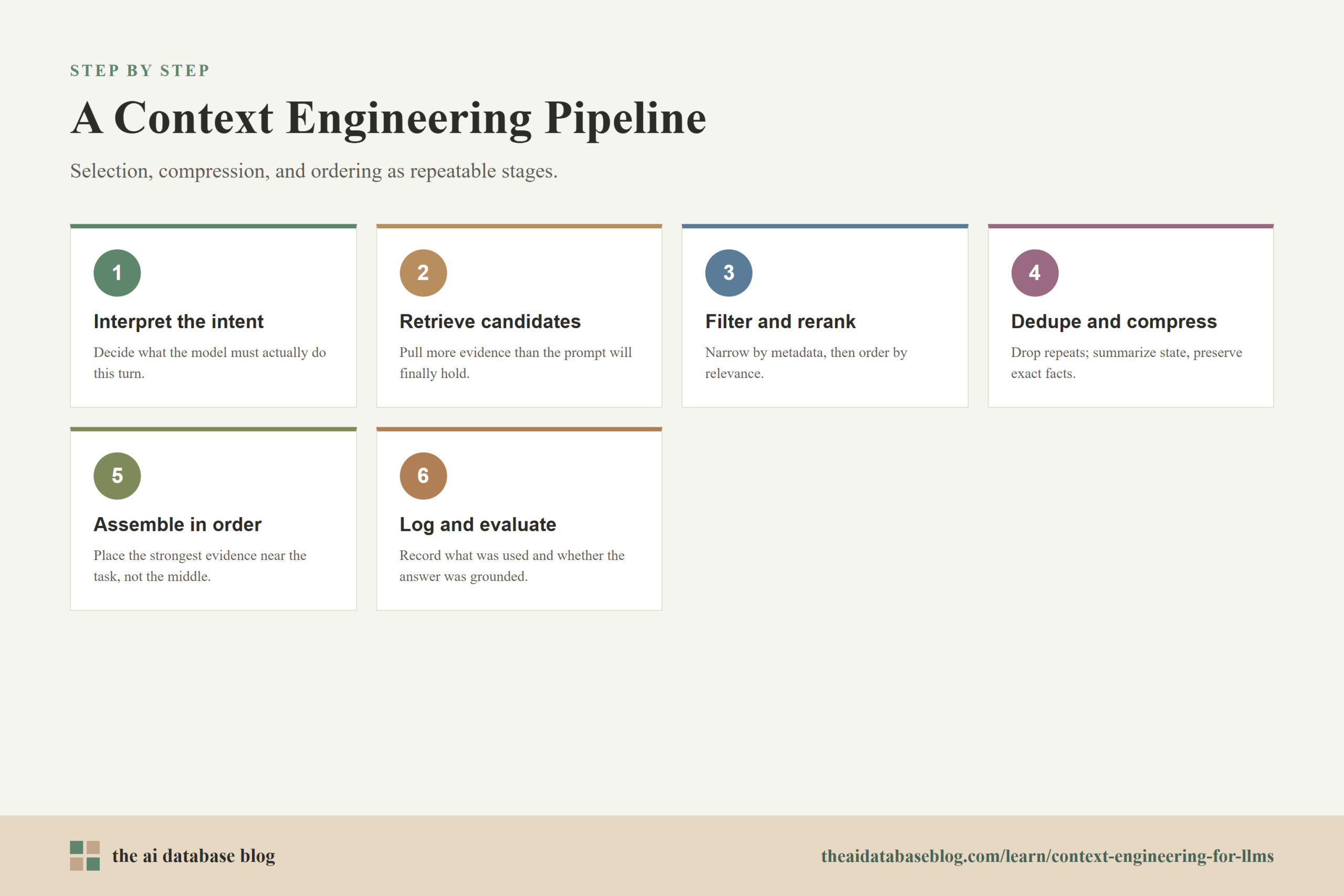
At request time, the pipeline should interpret the user’s intent, retrieve candidate evidence, apply filters, rerank the results, remove duplicates, compress or preserve content depending on the task, and assemble the final prompt in a stable order. After generation, the system should log which context was used and evaluate whether the answer was grounded in the provided evidence.
Use Context Layers
One practical pattern is to build context in layers. The first layer contains stable instructions. The second contains the current user request. The third contains retrieved evidence. The fourth contains active memory or session state. The fifth contains output requirements. These layers do not have to appear in that exact order for every application, but separating them conceptually makes the system easier to reason about.
Layering also supports different update schedules. Stable instructions may change rarely. Retrieved evidence changes every request. Memory may update after each interaction. Tool output may exist for only one step. By treating these as separate layers, developers can tune each part without rewriting the whole prompt assembly process.
Design For Inspection
Context engineering should be observable. Developers need to see what was retrieved, what was removed, what was summarized, what order was used, and how many tokens each section consumed. Without inspection, it is difficult to tell whether a weak answer came from a model limitation, a retrieval failure, a compression error, or a budget decision.
For AI database systems, this means storing enough metadata to trace answers back to source chunks and retrieval decisions. It also means testing context assembly separately from final generation. If the context package is poor, changing the model may only hide the underlying problem for a while.
The final step is turning these ideas into operating rules. The following practices are a compact way to apply context engineering without making every prompt a custom one-off design.
Best Practices For Context Engineering
Context engineering works best when it is systematic. The application should have explicit rules for what information enters the context window, how it is ranked, how it is compressed, and how overflow is handled. These rules can be simple at first, but they should be visible enough to test and improve.
- Start with the task. Decide what the model must do before deciding what evidence to include. A comparison task, extraction task, troubleshooting task, and summarisation task need different context.
- Keep the current user request intact. Do not summarize or rewrite the user’s latest question unless the system also preserves the original. The latest request is the anchor for the whole context.
- Retrieve more than you include. Candidate retrieval can be broad, but final context should be selective. Reranking and deduplication help keep the evidence budget focused.
- Preserve exact source text when exactness matters. Summaries are useful for orientation, but original passages are safer for quotes, numbers, code, policies, and definitions.
- Put the strongest evidence where it is easy to use. Do not bury decisive facts in the middle of a long prompt. Sort and group evidence intentionally.
- Reserve space for the answer. Token budgeting should include output length from the start, not only input size.
- Evaluate context separately from model output. Inspect whether the assembled context contains the right information before judging the generated answer.
These practices are especially useful when an AI application depends on a database of changing knowledge. The database can store and retrieve information, but the context pipeline decides what the model actually sees. That final assembly step is often where reliable systems separate themselves from fragile demos.
FAQs
1. What is context engineering for LLMs?
Context engineering is the process of selecting, compressing, ordering, and budgeting the information sent to an LLM. It includes prompt instructions, retrieved evidence, conversation history, tool results, memory, and output requirements. The goal is to give the model the information it needs for the current task without overloading the context window with irrelevant or poorly organized content.
2. How is context engineering different from prompt engineering?
Prompt engineering focuses mainly on wording instructions and examples. Context engineering focuses on the full input environment around the model. In retrieval-augmented systems, that means deciding which database records, chunks, metadata, summaries, and tool outputs should be included and how they should be arranged. Prompt wording still matters, but it is only one part of the broader context design problem.
3. Should I use the largest possible context window?
Not by default. A larger context window can help with long documents and complex workflows, but it can also increase cost, latency, and confusion. Long inputs may still suffer from positional bias, including lost-in-the-middle behavior. It is usually better to send a smaller, better-ranked, better-structured context than to fill the window simply because space is available.
4. When should context be summarized?
Context should be summarized when the model needs continuity, background, or state rather than exact wording. Conversation history, prior decisions, repeated tool logs, and broad document background are good candidates. Context should be preserved in original form when exact wording, numbers, code, definitions, citations, or policy details are needed for the answer.
5. What causes the lost-in-the-middle problem?
The lost-in-the-middle problem is related to positional bias in how LLMs use long inputs. Research has shown that models can be better at using information near the beginning or end of a context and worse at using information placed in the middle. The exact behavior varies by model and task, but the practical lesson is that developers should not assume all positions in a long prompt are equally reliable.
6. How do AI databases help with context engineering?
AI databases help by storing content in a form that can be retrieved, filtered, ranked, and assembled into useful context. Embeddings support semantic search, metadata supports precise filtering, and structured fields help preserve source information. A strong AI database design makes it easier to build compact, relevant context packages instead of sending large, unfocused document dumps to the model.
Takeaway
Context engineering is the discipline of turning the LLM context window into a carefully managed workspace. Readers should now understand how to choose relevant information, compress it without losing necessary detail, order it to reduce positional risk, account for the lost-in-the-middle problem, and budget tokens so the model has room to answer well. This guidance is most useful for teams building RAG systems, AI assistants, agent workflows, and document question-answering tools where an AI database retrieves knowledge and the context pipeline decides what the model can actually use.
Watch this video to learn more