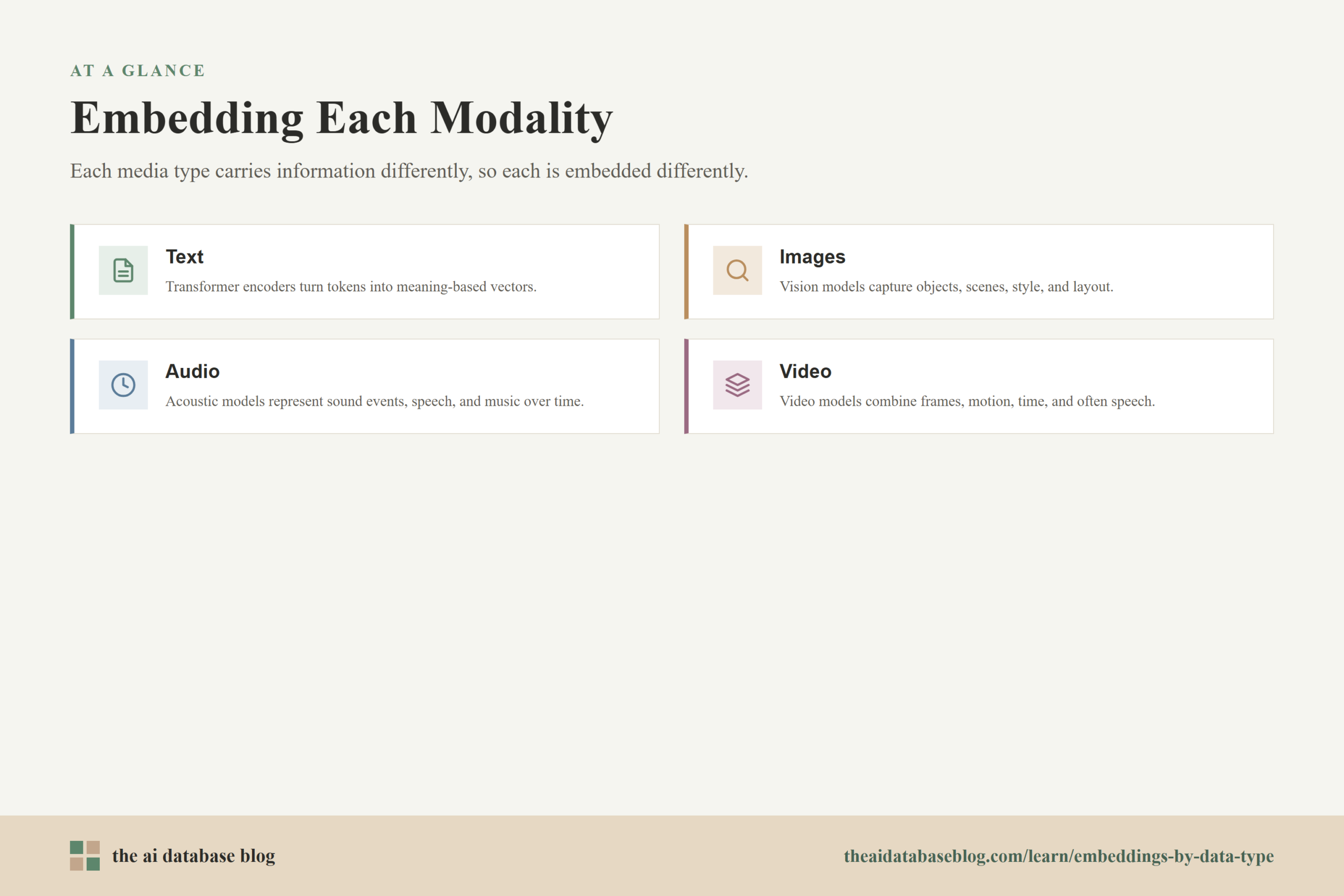
Embeddings turn text, images, audio, and video into vectors that an AI database can compare, search, filter, and rank. Each modality is embedded differently because each one carries information in a different form: text has tokens and meaning, images have visual regions and objects, audio has waveforms and time-based sound patterns, and video combines visual frames, motion, time, and often audio. Similarity also changes by modality: two text passages may be similar because they discuss the same concept, two images because they show similar objects or scenes, two audio clips because they contain similar sound events or speech patterns, and two videos because they share actions, events, visual context, or temporal structure. A shared embedding space extends this idea by placing different modalities into a comparable vector space so a text query can retrieve an image, an audio clip, or a video segment that matches its meaning.
This guide explains how embeddings work across text, images, audio, and video, which model families are commonly used for each modality, what similarity means in practical retrieval systems, and why shared embedding spaces are important for multimodal AI databases. By the end, you should understand how different media types become searchable vectors and how those vectors support search, recommendations, retrieval-augmented generation, and knowledge discovery.
What an Embedding Represents
An embedding is a numerical representation of data. Instead of storing only the original object, such as a paragraph, image, sound clip, or video, an embedding model converts that object into a vector: a list of numbers that captures features the model has learned to treat as meaningful. In an AI database, those vectors can be indexed so the system can find nearby items quickly.
The important idea is that embeddings are not hand-written labels. They are learned representations. A text embedding model learns patterns from language. An image embedding model learns visual patterns. An audio embedding model learns acoustic and semantic sound patterns. A video embedding model learns information across frames and time. When the model is trained well for retrieval, items with related meaning or behavior tend to land near each other in vector space.
This is why embeddings are useful for AI databases. They make search less dependent on exact keywords and more dependent on similarity. A user can search for “a customer asking about a delayed shipment” and retrieve messages that use different wording. The same idea extends to images, sounds, and videos when the system has embeddings that represent those media types well.
Once embeddings are understood as learned representations, the next question is how each type of input becomes a vector. Text, images, audio, and video each require different preprocessing and model architecture choices before they can be searched in a database.
How Text Is Embedded
Text is usually embedded by a language model that converts words or subword tokens into contextual representations. The model reads the input sequence, estimates how the tokens relate to one another, and produces a vector that represents the meaning of the whole passage or query. Modern text embedding models are commonly based on transformer encoders or encoder-like language model architectures because they are good at capturing context across a sentence, paragraph, or document chunk.
Common Text Embedding Model Types
Text embedding systems often use sentence embedding models, dense retrieval models, or instruction-tuned embedding models. Sentence embedding models are designed to place semantically similar sentences near each other. Dense retrieval models are trained for search tasks, usually by bringing relevant query-document pairs close together. Instruction-tuned embedding models can adapt to retrieval instructions such as “find passages that answer this question” or “find documents with similar intent.”
In an AI database workflow, long documents are usually split into chunks before embedding. The chunk size matters because each vector represents the information available in that chunk. If chunks are too short, they may lose context. If they are too long, the vector may become too broad and less useful for precise retrieval. Metadata such as source, author, date, permissions, or topic is often stored alongside the vector so search can combine semantic similarity with structured filtering.
What Similarity Means for Text
For text, similarity usually means semantic closeness. Two passages can be similar even when they share few exact words. A paragraph about “renewing a subscription” may be similar to a query about “extending a plan” because the underlying intent overlaps. Similarity can also include topical similarity, question-answer relevance, paraphrase similarity, entity overlap, or task-specific usefulness.
This is one reason text embeddings are central to retrieval-augmented generation. The embedding search step finds candidate passages that may answer a query, and the generation step uses those passages as context. Good text embeddings do not simply retrieve words that match; they retrieve information that is likely to be relevant to the user’s meaning.
Text is the most familiar embedding use case, but the same basic pattern applies to other modalities. The model changes, the input representation changes, and the definition of similarity becomes more specific to the data type.
How Images Are Embedded
Image embeddings convert visual content into vectors. An image model does not read words; it processes pixels, patches, regions, or visual features. Many modern image embedding models use vision transformers or convolutional networks, sometimes paired with a text encoder in a vision-language model. These systems can represent objects, scenes, layouts, colors, textures, styles, and higher-level visual meaning.
Common Image Embedding Model Types
Image-only embedding models are useful when the goal is to compare images to other images. For example, a product catalog might use image embeddings to find visually similar items. Vision-language models are useful when the search query may be text but the stored items are images. CLIP-style models are a common example of this approach: they learn to align images and captions so that a text phrase and a matching image can be compared in a shared space.
In an AI database, an image record often stores the image vector along with metadata and possibly additional extracted information. For example, a system may store category, upload date, location, detected objects, or moderation labels. The vector supports similarity search, while metadata supports filtering and governance.
What Similarity Means for Images
Image similarity depends on the model and the retrieval task. Two images may be similar because they show the same object, share the same visual style, contain the same scene type, have similar composition, or match a text description. A search for “red hiking backpack” may prioritize object identity and attributes. A search for “calm office workspace” may prioritize scene meaning. A search for “similar visual design” may prioritize layout, color, and style.
This makes image embeddings powerful but also task-sensitive. A model trained mainly on captions may understand broad visual concepts but may miss fine-grained product differences. A model trained for visual similarity may be better at matching appearance but less flexible for abstract text queries. Choosing the right model depends on whether the application needs object retrieval, style matching, visual deduplication, image classification, or cross-modal search.
Images introduce the first major shift from pure text: similarity becomes partly semantic and partly perceptual. Audio adds another shift because the signal unfolds over time, and the model must understand both what is heard and how it changes.
How Audio Is Embedded
Audio embeddings convert sound into vectors. The input may be raw waveform data, spectrograms, speech transcripts, or learned acoustic features. In many systems, audio is first transformed into a time-frequency representation such as a spectrogram, which makes patterns like pitch, rhythm, loudness, and frequency easier for a model to process. Other systems combine acoustic models with language models when speech meaning is important.
Common Audio Embedding Model Types
Audio embedding models can be grouped by what they are meant to represent. Speech embedding models focus on spoken language, speaker characteristics, pronunciation, or utterance meaning. Music embedding models may represent melody, rhythm, genre, instrumentation, or mood. General audio models represent sound events such as footsteps, alarms, rain, engine noise, applause, or a dog barking. Audio-language models, including CLAP-style systems, align sound clips with text descriptions so a natural language query can retrieve relevant audio.
Audio databases often need segmentation. A five-minute recording may contain many different events, so embedding the whole file as one vector can hide important details. A practical system may embed overlapping windows, speaker turns, transcript chunks, detected sound events, or scene-level segments. The database can then retrieve the specific part of the audio that matches a query rather than only returning the full file.
What Similarity Means for Audio
Audio similarity can mean several different things. Two clips may be similar because they contain the same sound event, the same spoken topic, the same speaker, the same emotion, the same acoustic environment, or the same musical feel. A model used for speaker similarity may not be ideal for finding semantically similar sound effects. A model used for music recommendation may not be ideal for retrieving spoken answers from meeting recordings.
This is why audio retrieval systems often combine multiple representations. A meeting search system may use transcript embeddings for meaning, speaker embeddings for identity, and audio embeddings for nonverbal events. A media search system may store embeddings for sound effects, music, and captions. The AI database then becomes the place where these representations can be indexed together and filtered with metadata.
Audio shows why modality-specific design matters. The same vector search infrastructure can support many media types, but the embeddings must reflect the similarity that the application actually cares about. Video extends this further because it combines visual content, motion, time, and often sound.
How Video Is Embedded
Video embeddings represent moving visual content, usually across frames or clips. Video is more complex than images because the meaning often depends on temporal change. A single frame may show a person standing near a door, while the full clip may show the person entering, leaving, unlocking the door, or delivering a package. A good video embedding needs to capture objects and scenes, but also action, motion, sequence, and context.
Common Video Embedding Model Types
Video embedding models often use video transformers, 3D convolutional networks, frame-level vision encoders with temporal pooling, or multimodal video-language models. Some systems embed sampled frames and aggregate them into a clip vector. Others train directly on video-text pairs so that text queries can retrieve relevant clips. More advanced systems may combine visual frames, motion features, audio, speech transcripts, and captions into one retrieval workflow.
Like audio, video usually benefits from segmentation. A long video can be divided into shots, scenes, fixed-length windows, or event-based clips. Each segment can receive its own vector, and the database can store timestamps so search results point to the relevant moment. This is essential for video retrieval because returning a full two-hour file is much less useful than returning the thirty-second segment where the event occurs.
What Similarity Means for Video
Video similarity can mean shared visual content, shared action, shared event structure, shared spoken topic, shared scene type, or shared intent. A query for “person assembling furniture” depends on action and object interaction. A query for “slide explaining quarterly revenue” may depend on visual text, speech transcript, and topic. A query for “similar soccer highlights” may depend on motion, event type, crowd sound, and camera angle.
Because video is so information-rich, many practical systems use layered retrieval. They may search transcript embeddings first, video embeddings second, and metadata filters throughout. They may also re-rank results with a model that examines candidate clips more carefully. The AI database handles the fast candidate search, while later stages refine the final ranking.
So far, each modality has its own embedding approach and its own idea of similarity. The next step is understanding how different modalities can be compared to each other, which is where shared embedding spaces become important.
What a Shared Embedding Space Means
A shared embedding space is a vector space where different modalities can be compared directly. Instead of having one space for text, one for images, one for audio, and one for video, a multimodal model learns representations that make related items land near each other even when their input types are different. A caption, an image, an audio clip, and a video segment about the same event can all be represented as vectors that are comparable.
Shared spaces are usually learned through paired or related data. For example, an image and its caption form a positive pair. A sound clip and its description form another positive pair. A video and a text summary can also be paired. Contrastive learning is a common training method: the model is trained to pull matching pairs closer together and push unrelated pairs farther apart. Over many examples, the model learns a space where semantic relationships can cross modality boundaries.
Why Shared Spaces Matter for Search
Shared embedding spaces make cross-modal retrieval possible. A user can type “glass breaking in a kitchen” and retrieve an audio clip, a video segment, or an image associated with that event. A user can provide an image and retrieve related text descriptions. A user can search a video archive with natural language without first relying only on manual tags.
This is useful because users often search in one modality while the answer lives in another. Text is the most convenient query format, but the best result may be a screenshot, a sound event, or a video clip. Shared embeddings reduce the gap between how users ask questions and how information is stored.
Why Shared Spaces Are Not Perfect
A shared embedding space does not mean every modality is represented with equal precision. Some details are easier to align than others. A caption may describe the main object in an image but omit small visual details. A video description may mention the action but ignore camera movement. An audio label may capture the sound source but miss spatial location or emotional nuance. When important details are not represented in the paired training data, the shared space may not preserve them well.
This is why production systems often combine shared embeddings with modality-specific embeddings, metadata filters, and re-ranking. The shared space is powerful for broad discovery and cross-modal search. Modality-specific representations are often better for specialized similarity, such as speaker matching, visual deduplication, fine-grained product comparison, or action recognition.
Understanding shared spaces helps explain why multimodal retrieval is not just “one vector for everything.” The strongest systems usually balance one common retrieval layer with specialized representations that preserve the details each media type needs.
How AI Databases Use Multimodal Embeddings
An AI database stores embeddings so applications can search, retrieve, and rank data by meaning or similarity. For multimodal systems, the database may store several vectors per item: one for text, one for image content, one for audio, one for video, or one shared multimodal representation. It may also store metadata, timestamps, permissions, source identifiers, and relationships between segments.
The database is responsible for making retrieval practical. Vector indexes make nearest-neighbor search efficient. Metadata filtering keeps results within the right scope. Hybrid search can combine keyword matching with vector similarity. Re-ranking can improve final result quality after the database returns an initial candidate set. These pieces are especially important for multimodal data because media files are large, varied, and often segmented into many searchable units.
A Practical Multimodal Retrieval Pattern
A common pattern is to store media as structured records with multiple searchable views. A video might have a video embedding for visual action, transcript embeddings for speech, audio embeddings for sound events, and metadata for date, location, project, or access control. A search query can then choose the most relevant representation or search across several of them.
Video record
- video_id
- segment_start_time
- segment_end_time
- video_embedding
- transcript_embedding
- audio_embedding
- title
- source
- permissions
- tags
This design lets the system answer different kinds of questions. A transcript query can find spoken content. A visual query can find scenes or actions. An audio query can find sound events. Metadata can narrow the search to the right collection. The best architecture depends on the application, but the general principle is consistent: store the representations that match the ways users will search.
Once the database design is clear, the final challenge is choosing the right similarity strategy. The distance metric, embedding model, segmentation method, and ranking approach all influence whether search results feel relevant.
How Similarity Is Measured Across Modalities
Similarity is usually computed by comparing vectors with a metric such as cosine similarity, dot product, or Euclidean distance. Cosine similarity measures the angle between vectors and is common when vector direction matters more than raw magnitude. Dot product is common in retrieval systems where models are trained to make relevant pairs produce high scores. Euclidean distance measures straight-line distance, though it is less common for many modern semantic embedding systems unless the model is designed for it.
The metric matters, but the model matters more. A distance score is only meaningful inside the representation learned by the model. If an embedding model was trained to align text with images, then text-image similarity scores can be useful. If an audio model was trained for speaker identity, then its similarity scores may reflect speaker likeness more than sound-event meaning. The database can calculate nearest neighbors, but the model defines what “near” means.
Similarity by Modality
- Text similarity often means semantic relevance, intent match, paraphrase similarity, topical overlap, or answer usefulness.
- Image similarity may mean shared objects, visual style, scene type, layout, color, texture, or alignment with a text description.
- Audio similarity may mean shared sound events, speaker traits, acoustic environment, emotion, rhythm, music style, or spoken meaning.
- Video similarity may mean shared actions, scene changes, events, visual context, spoken topic, or temporal patterns.
- Cross-modal similarity means that different media types are close because they express related meaning, such as a text query matching an image, audio clip, or video segment.
Good retrieval systems define similarity according to the user task. A legal archive, a product catalog, a music library, a video editing tool, and a support knowledge base all need different similarity behavior. The AI database can support the retrieval workflow, but model selection and evaluation determine whether the system retrieves what users actually expect.
That leads to the practical question: how should teams think about model choice and database design when they need embeddings for more than one modality?
Practical Design Choices for Multimodal Embedding Systems
Building a multimodal embedding system starts with the retrieval task, not the media type alone. The team should ask what users will search for, what kind of result should be returned, how precise the answer needs to be, and which details must be preserved. A system for searching surveillance footage, training videos, product images, podcasts, and support documents will not use the same embedding strategy even though all of them may involve vectors.
One important choice is whether to use one shared multimodal model or several modality-specific models. A shared model is useful when users need cross-modal search, such as text-to-image, text-to-audio, or text-to-video retrieval. Separate models are useful when each modality needs specialized similarity. Many systems use both: shared embeddings for broad cross-modal discovery and specialized embeddings for high-precision ranking within a modality.
Another choice is how to segment the data. Text needs chunks, audio needs time windows or events, and video needs clips or scenes. Segmentation determines the unit of retrieval. If the segment is too large, the result may be vague. If it is too small, it may lose context. Strong systems usually store enough metadata to connect small retrieved segments back to the larger document, recording, or video they came from.
Evaluation is also essential. Teams should test retrieval results with real queries and expected answers. For text, this may mean answer relevance. For images, it may mean visual or semantic match. For audio, it may mean sound-event accuracy or speaker match. For video, it may mean whether the returned timestamp actually contains the requested action. Without evaluation, similarity scores can look mathematically clean while producing results that feel wrong to users.
These design choices make multimodal embeddings practical rather than abstract. They connect model behavior, database indexing, and user expectations into one retrieval system.

FAQs
Multimodal embeddings raise practical questions because the same words, metrics, and database concepts can behave differently across media types. The answers below clarify the most common points that come up when teams begin designing search and retrieval systems for text, images, audio, and video.
1. Are embeddings the same as metadata?
No. Metadata is structured information such as title, date, category, author, timestamp, permissions, or file type. An embedding is a learned vector representation of the content itself. In an AI database, embeddings and metadata usually work together: embeddings support similarity search, while metadata supports filtering, access control, and organization.
2. Can one embedding model handle text, images, audio, and video?
Some multimodal models are designed to embed multiple modalities into a shared space, but one model is not always the best answer for every task. A shared model is useful for cross-modal retrieval, while specialized models may perform better for fine-grained similarity inside one modality. Many practical systems combine shared and modality-specific embeddings.
3. What is the difference between multimodal search and hybrid search?
Multimodal search retrieves across different data types, such as text, images, audio, and video. Hybrid search combines different search methods, usually vector search and keyword search. A system can be both multimodal and hybrid if it searches multiple media types while also combining semantic similarity with exact terms or structured filters.
4. Why not convert every image, audio clip, or video into text and only embed the text?
Text conversion can be useful, but it often loses details. Captions may miss visual layout, small objects, sounds, motion, timing, speaker tone, or background events. Direct modality embeddings can preserve information that a caption or transcript does not capture. A strong system may use both text-derived embeddings and direct media embeddings.
5. How does an AI database know which modality to search?
The application usually decides based on the query and the available indexes. A text query may search a shared multimodal vector index, a transcript index, or several modality-specific indexes. The database can store multiple vectors per record, and the retrieval layer can choose which vector field or combination of fields best matches the task.
6. Do similar vectors always mean the results are useful?
No. Similar vectors mean the model placed the items close together according to what it learned. That may or may not match the user’s expectation. Usefulness depends on model quality, training objective, segmentation, metadata, ranking, and evaluation. This is why retrieval systems should be tested with realistic queries and judged against the actual use case.
Takeaway
Embeddings make text, images, audio, and video searchable by turning them into vectors that represent meaning, perception, sound, motion, or cross-modal relationships. Text models focus on semantic language meaning, image models focus on visual content, audio models focus on time-based sound patterns, and video models combine frames, motion, time, and often speech or audio. Shared embedding spaces make it possible to compare different modalities directly, which is especially useful for AI databases that support cross-modal retrieval, multimodal RAG, media search, recommendations, or knowledge discovery. This guidance is most useful for teams designing retrieval systems where users may ask in one format but need answers from many kinds of data.
Watch this video to learn more