Dense vectors and sparse vectors are two different ways to represent text, documents, queries, and other data for search. Dense vectors store meaning as compact numerical embeddings where nearly every dimension has a value, while sparse vectors store weighted term signals across a very large vocabulary where most dimensions are empty. Dense vectors are usually produced by embedding models, sparse vectors are usually produced by keyword scoring or learned sparse encoders, and hybrid retrieval combines both so a search system can understand semantic similarity without losing exact-match precision.
This guide explains how dense and sparse vectors are structured, when each type is produced, how interpretable each representation is, what their memory implications look like, and how AI databases combine them in hybrid retrieval. By the end, you should understand why modern retrieval systems often use both approaches instead of treating dense and sparse search as competing choices.
What Dense Vectors Are
A dense vector is a fixed-length list of numbers that represents the meaning or features of an item in a continuous vector space. In text search, the item might be a sentence, paragraph, document chunk, product description, support ticket, image caption, or user query. The numbers are not usually human-readable on their own. Instead, the full pattern of values encodes relationships learned by a model, so items with similar meanings land near each other in the vector space.
Dense vectors are called dense because most or all dimensions contain non-zero values. A text embedding might have hundreds or thousands of dimensions, and each dimension might hold a floating-point value such as 0.021, -0.418, or 1.203. The dimensions do not typically correspond to obvious words or columns. A single dimension may help represent many concepts, and a single concept may be distributed across many dimensions.
Dense Vector Structure
A simplified dense vector might look like this:
[0.12, -0.44, 0.03, 0.91, -0.27, 0.18]
Real dense embeddings are much longer, but the principle is the same. The vector has a fixed number of positions, and each position contains a numerical value. Search systems compare dense vectors with similarity functions such as cosine similarity, dot product, or distance metrics. If a query vector is close to a document vector, the system treats the document as a likely match.
This structure makes dense vectors strong at semantic retrieval. A query for “how to reduce login delays” may retrieve a document about “authentication latency” even if the exact words do not overlap. The retrieval model has learned that the concepts are related, so the vectors can be close even when the surface language differs.
Dense vectors are powerful because they compress meaning, but that compression also creates the main tradeoff: the system can recognize broad semantic similarity, yet it may blur details that matter for exact matching. That leads naturally to sparse vectors, which preserve term-level signals more directly.
What Sparse Vectors Are
A sparse vector is a high-dimensional representation where most dimensions are zero or absent. In search, sparse vectors usually map terms, tokens, or vocabulary entries to weights. Instead of representing meaning as distributed coordinates, they represent which terms matter and how strongly those terms matter for a query or document.
The easiest example is a keyword-based representation. Imagine a vocabulary containing every searchable term in a collection. A document that contains “database,” “embedding,” and “retrieval” receives weights for those terms, while thousands or millions of unrelated vocabulary positions stay empty. The vector is large in theory, but compact in practice because the system stores only the non-zero entries.
Sparse Vector Structure
A simplified sparse vector might look like this:
{
  "database": 2.1,
  "embedding": 3.4,
  "retrieval": 2.8
}
This form is easier to interpret than a dense vector because the active dimensions are often recognizable terms. Traditional sparse retrieval methods such as TF-IDF and BM25 assign weights based on term frequency, document length, and how rare or informative a term is across the collection. Learned sparse retrievers, such as sparse lexical expansion models, can also assign weights to terms that may not appear exactly in the original text but are predicted to be useful for retrieval.
Sparse vectors are especially good at exact identifiers, names, codes, technical terms, legal references, file paths, product numbers, and uncommon phrases. If a user searches for a specific error code, the best result is often the document containing that exact code, not a semantically similar document about a neighboring issue.
Dense and sparse vectors therefore answer different retrieval questions. Dense vectors ask, “Which items mean something similar?” Sparse vectors ask, “Which items contain or strongly imply the important terms?” To understand where they fit in an AI database, it helps to look at when each one is produced.
When Dense and Sparse Vectors Are Produced
Dense and sparse vectors are usually produced during indexing and querying. Indexing is the process of preparing documents or data objects so they can be searched later. Querying is the process of turning a user request into a searchable form and comparing it against the indexed data. Both dense and sparse representations can exist for the same object, but they are created through different pipelines.
When Dense Vectors Are Produced
Dense vectors are produced when an embedding model encodes text or another input into a numerical vector. During indexing, each document or chunk is sent through the model, and the resulting embedding is stored in the AI database. During search, the user query is sent through the same or compatible model to produce a query embedding. The database then compares the query embedding with stored document embeddings.
This process is common in retrieval-augmented generation systems, semantic search, recommendation, clustering, deduplication, and similarity matching. Dense vectors can also be created for images, audio, video, tables, and multimodal content when the embedding model supports those inputs. The important point is that the representation is learned: the model decides how to compress the input into a vector based on training data and model architecture.
When Sparse Vectors Are Produced
Sparse vectors are produced when a search system analyzes text into term-level signals. In a classic keyword search pipeline, this may happen through tokenization, normalization, stemming or lemmatization, stopword handling, term frequency calculation, inverse document frequency statistics, and BM25-style scoring. The resulting index is often an inverted index, which maps terms to the documents that contain them.
Learned sparse vectors are produced by neural models that output weighted vocabulary dimensions while preserving sparse structure. These models can behave more semantically than pure keyword matching because they may expand or reweight terms based on context. Even so, the output remains sparse: only a small portion of the vocabulary receives meaningful weights for a given query or document.
Once both production paths are clear, the next practical question is not just which one retrieves better. It is also which one is easier to understand, debug, and trust when search results look surprising.
Interpretability Tradeoffs
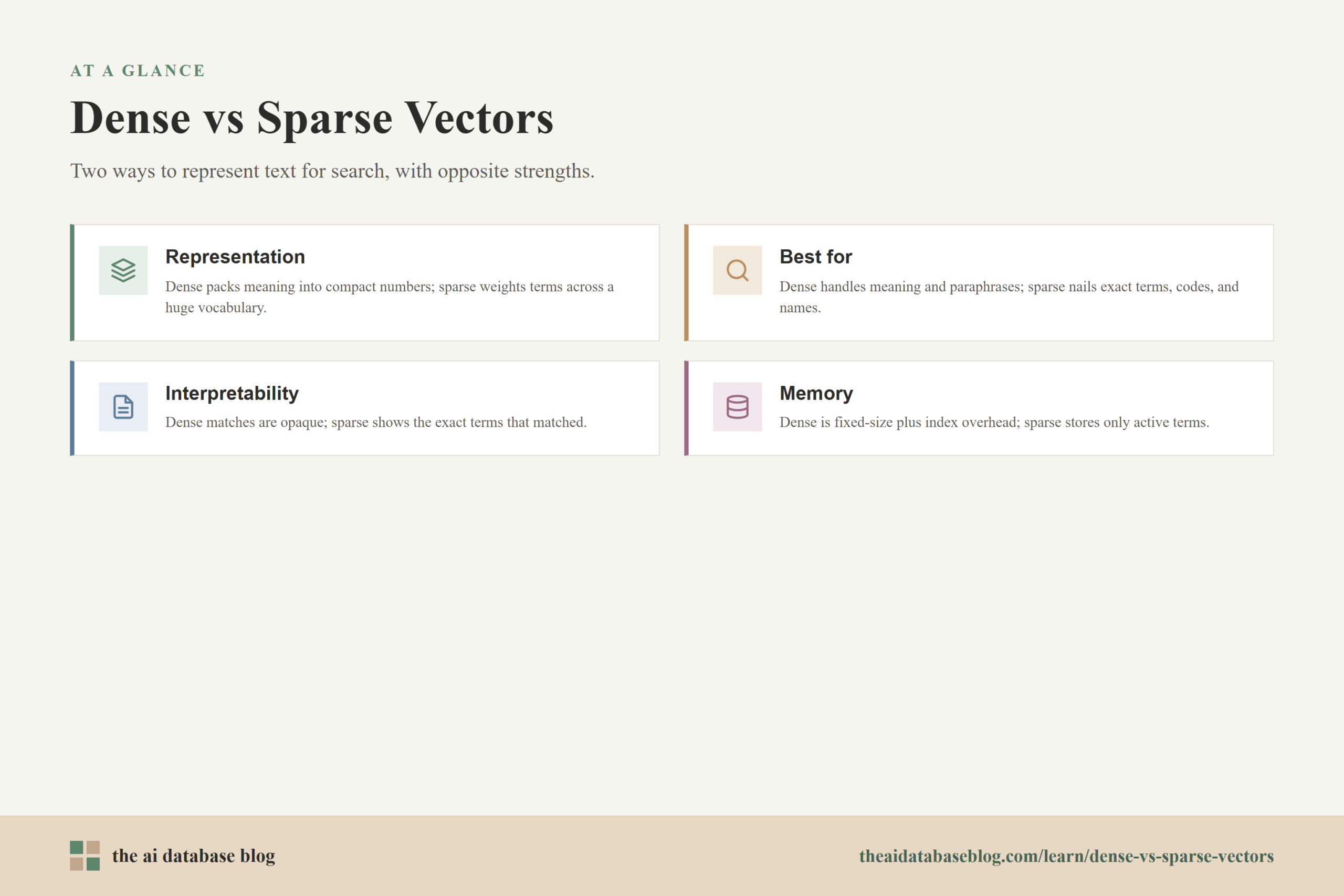
Interpretability is one of the clearest differences between dense and sparse vectors. Sparse vectors are generally easier to inspect because their active dimensions often correspond to words or tokens. Dense vectors are harder to inspect because their dimensions are abstract numerical features. This does not make dense vectors unreliable, but it does change how teams diagnose retrieval behavior.
Why Sparse Vectors Are Easier to Explain
With sparse retrieval, a developer or search analyst can often see why a document matched a query. If a query contains “invoice export error 409,” the system can show that the result matched “invoice,” “export,” “error,” and “409,” along with the weights assigned to those terms. This makes sparse retrieval useful for auditability, debugging, compliance-sensitive search, and domains where exact wording matters.
The tradeoff is that sparse vectors can miss relevant documents that use different words. A document about “payment receipt download failure” may be relevant to an “invoice export error” query, but a purely lexical retriever may not rank it highly unless the terms overlap or the system uses synonym expansion, query rewriting, or a learned sparse model.
Why Dense Vectors Are Harder to Explain
Dense vectors are less transparent because similarity comes from the overall geometry of the embedding space. A result may be retrieved because the model learned a semantic relationship between concepts, but there may be no single term or dimension that explains the match. This can make dense retrieval feel opaque when it returns a result that is conceptually related but not actually useful.
The advantage is that dense vectors can find relevant results with little or no exact term overlap. They are often better for natural language questions, paraphrases, broad conceptual search, and messy user queries. The downside is that they may underperform on rare strings, exact IDs, names, version numbers, or specialized terminology that the embedding model does not represent cleanly.
Interpretability affects more than debugging. It also shapes memory and infrastructure choices, because dense and sparse systems store, index, and compare data in different ways.
Memory and Storage Implications
Dense and sparse vectors have different memory patterns. Dense vectors are fixed-length and store a value for every dimension, so their raw storage cost is relatively predictable. Sparse vectors can have extremely high theoretical dimensionality, but they store only active terms, so their practical storage cost depends on vocabulary size, document length, tokenization, pruning, and how many term weights are retained.
Dense Vector Memory Implications
A dense embedding with 1,024 dimensions stored as 32-bit floating-point numbers uses about 4 KB before index overhead. At millions of documents, that becomes substantial. Systems may reduce memory by using smaller embedding models, lower-precision values, quantization, compression, or approximate nearest neighbor indexes. These techniques can reduce storage and improve speed, but they may also introduce recall or precision tradeoffs.
Dense vector indexes also have their own memory needs. Approximate nearest neighbor structures are designed to make similarity search fast, but they often store extra graph or partitioning data. The final footprint is therefore not just the raw vector size multiplied by the number of objects. It includes index overhead, metadata, deleted or updated objects waiting for compaction, and any replicas used for availability.
Sparse Vector Memory Implications
Sparse retrieval usually relies on inverted indexes or sparse vector indexes. Instead of storing every vocabulary dimension for every document, the system stores postings lists: for each term, which documents contain or activate that term and what weight is assigned. This can be efficient when documents have a modest number of active terms, especially for classic keyword retrieval.
However, sparse vectors are not automatically cheap. Learned sparse retrieval can expand text with additional weighted terms, increasing the number of active dimensions. Very large vocabularies, long documents, many fields, multilingual corpora, and aggressive expansion can all increase index size. Practical systems often prune low-weight terms, cap the number of active dimensions, or tune analyzers to keep the index useful without letting it grow unnecessarily.
Memory planning is one reason hybrid retrieval should be treated as a system design choice rather than a checkbox. Combining dense and sparse search can improve relevance, but it means operating two retrieval signals and deciding how they should work together.
How Dense and Sparse Vectors Are Combined in Hybrid Retrieval
Hybrid retrieval combines dense and sparse search so the system can benefit from semantic similarity and exact lexical matching at the same time. In an AI database, the same document may have a dense embedding, a sparse representation, and metadata fields. At query time, the system can search across both vector types, merge the candidates, and produce a final ranking.
Parallel Retrieval and Fusion
A common hybrid pattern runs dense retrieval and sparse retrieval in parallel. The dense retriever finds semantically similar candidates, while the sparse retriever finds candidates with strong lexical overlap or weighted term matches. The system then combines the result lists using a fusion method.
Two common fusion approaches are weighted score fusion and reciprocal rank fusion. Weighted score fusion normalizes dense and sparse scores, applies weights, and combines them into a final score. Reciprocal rank fusion combines rankings rather than raw scores, which can be useful because dense similarity scores and BM25-style scores do not naturally live on the same scale.
Final candidates = fuse(
  dense_results(query_embedding),
  sparse_results(query_terms_or_sparse_vector)
)
The right weighting depends on the data and query mix. A documentation search system with many error codes and API names may need stronger sparse weighting. A question-answering system over narrative text may benefit from stronger dense weighting. Many production systems evaluate different settings using real queries rather than assuming a universal default.
Hybrid Retrieval With Reranking
Hybrid retrieval is often used as a first-stage candidate generator. After dense and sparse results are fused, a reranker can rescore the top candidates using a more expensive model that examines the query and document together. This can improve final relevance because the first-stage retrievers are optimized for speed and recall, while the reranker is optimized for precision over a smaller candidate set.
This pattern is common in retrieval-augmented generation because the generator depends heavily on the quality of retrieved context. Dense retrieval may bring in semantically related passages, sparse retrieval may protect exact terms, and reranking may decide which passages are actually most useful for the specific question.
Metadata Filters and Hybrid Search
Hybrid retrieval is often combined with metadata filtering. A query might search dense and sparse signals only within documents that match a tenant, language, date range, permission group, product area, or content type. This matters because vector similarity alone does not know every business rule. Metadata filters keep retrieval grounded in the application’s constraints before or during ranking.
When designed well, hybrid retrieval is not just dense plus sparse. It is dense plus sparse plus filters, ranking logic, evaluation, and monitoring. The vector types provide complementary signals, but the search system still needs thoughtful data modeling and measurement.
When to Use Dense, Sparse, or Hybrid Retrieval
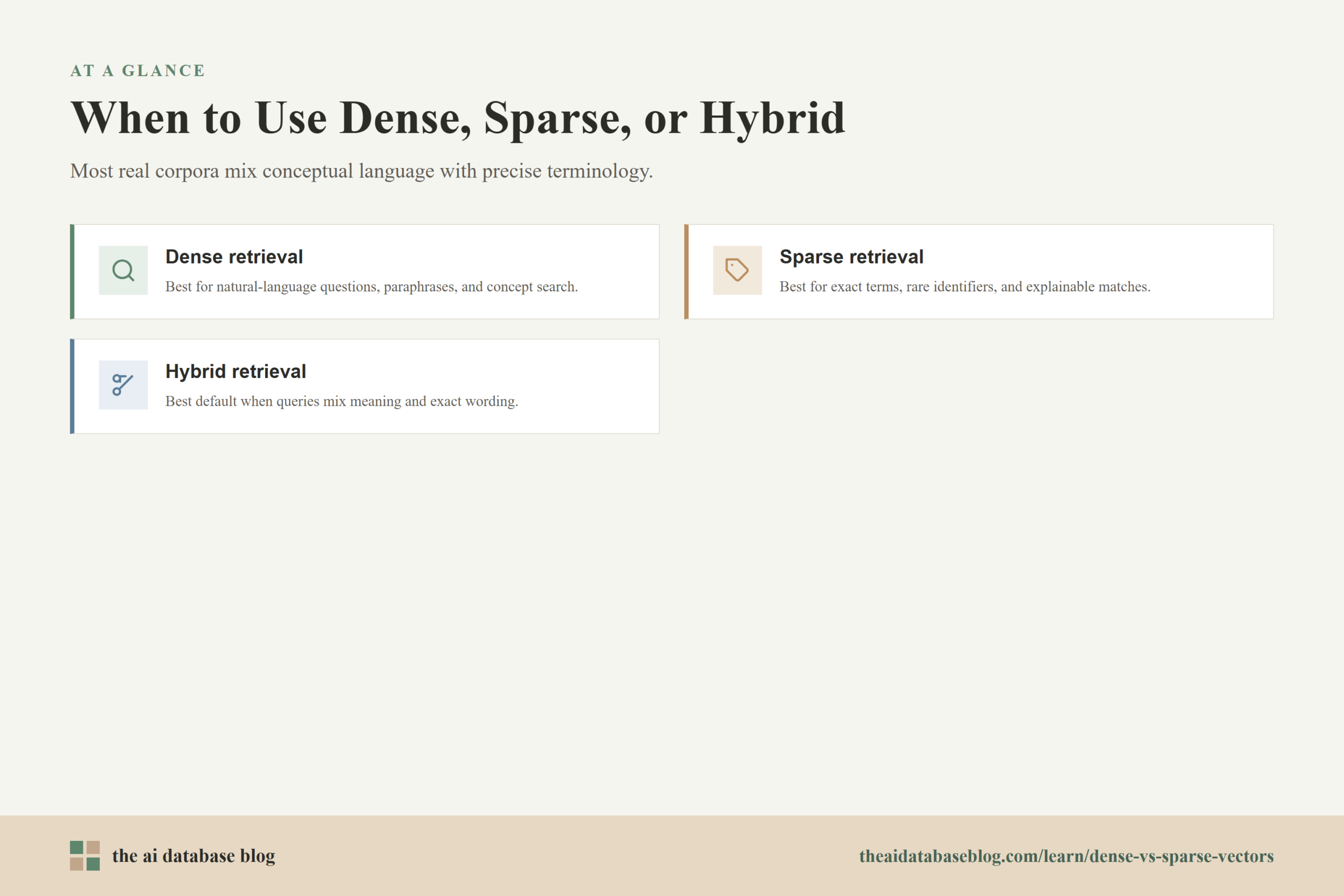
The best choice depends on the search problem. Dense retrieval is strong when users ask natural language questions, use paraphrases, or describe concepts without knowing the exact wording in the documents. Sparse retrieval is strong when exact terms, rare tokens, structured identifiers, and transparent matching are important. Hybrid retrieval is useful when the application needs both behaviors and the corpus contains a mixture of conceptual language and precise terminology.
Dense retrieval is often a good fit for semantic Q&A, recommendations, exploratory search, clustering, and finding conceptually similar content. Sparse retrieval is often a good fit for logs, legal references, technical documentation, product catalogs, code-related search, support ticket lookup, and any domain where exact terms carry high meaning. Hybrid retrieval is often the practical default for AI database applications because user queries are rarely all semantic or all lexical.
The choice should still be tested. Hybrid retrieval can add complexity and memory overhead, and it will not automatically improve results if the dense and sparse retrievers return nearly the same candidates or if the corpus is poorly chunked. Good retrieval design includes evaluation sets, query analysis, per-retriever recall checks, and tuning based on actual failure cases.
FAQs
1.
1. Are dense vectors always better than sparse vectors?
No. Dense vectors are better for semantic similarity, but sparse vectors are often better for exact words, rare identifiers, and explainable matching. In many AI database systems, the strongest retrieval setup uses both rather than choosing one permanently. 2.
2. Are sparse vectors the same as keyword search?
Classic sparse retrieval is closely related to keyword search, especially methods such as TF-IDF and BM25. However, learned sparse retrieval can go beyond literal keyword matching by assigning weights to expanded or contextually related terms while still keeping a sparse structure. 3.
3. Why are dense vectors less interpretable?
Dense vectors are less interpretable because their dimensions usually do not map directly to human-readable words or concepts. Meaning is distributed across many numerical dimensions, so it is difficult to point to one value and say exactly why a result matched. 4.
4. Do sparse vectors use less memory than dense vectors?
Sometimes, but not always. Sparse vectors store only active dimensions, which can be efficient, but large vocabularies, long documents, and learned expansion can increase index size. Dense vectors have predictable raw size, but their approximate nearest neighbor indexes add overhead too. 5.
5. What is the main benefit of hybrid retrieval?
The main benefit is robustness. Dense retrieval helps with meaning, paraphrases, and conceptual matches. Sparse retrieval helps with exact terms, names, IDs, and rare phrases. Hybrid retrieval combines these signals so the system is less likely to fail on one type of query. 6.
6. Should every RAG system use hybrid retrieval?
Not every system needs it, but many benefit from it. A small corpus with simple natural language questions may work well with dense retrieval alone. A system with technical terms, permissions, identifiers, or varied query styles should usually evaluate hybrid retrieval against dense-only and sparse-only baselines.
Takeaway
Dense vectors and sparse vectors represent different strengths in AI database retrieval: dense vectors capture semantic similarity in compact learned embeddings, while sparse vectors preserve weighted term-level signals that are easier to inspect and better for exact matching. Dense vectors are typically produced by embedding models, sparse vectors by lexical scoring or learned sparse encoders, and hybrid retrieval combines them through fusion and often reranking. This guidance is most useful for teams building semantic search, RAG, support search, documentation search, or knowledge retrieval systems where users may ask both broad conceptual questions and highly specific exact-match queries.
Watch this video to learn more