The right distance metric is usually the one your embedding model was trained or documented to use. If the model recommends cosine similarity, dot product, or Euclidean distance, start there because the metric determines how the vector database decides which items are closest to a query. After that, check whether vector magnitude carries useful meaning, whether vectors are already normalized, and whether your retrieval results change when you test alternative metrics on real queries.
This guide explains how cosine similarity, dot product, and Euclidean distance behave in AI databases, how normalization changes their relationship, and why the wrong metric can quietly reduce retrieval quality. By the end, you should be able to choose a metric for a vector index, understand when two metrics are effectively equivalent, and know what to test before putting a retrieval system into production.
Why Distance Metrics Matter in AI Databases
A distance metric tells an AI database how to compare one embedding with another. Embeddings are lists of numbers that represent text, images, audio, users, products, or other objects in a vector space. The database does not understand the original meaning directly. It compares the vectors and returns the stored objects that appear closest to the query vector according to the configured metric.
This means the metric is not a cosmetic setting. It shapes the order of search results. Two vectors can look close under one metric and less close under another, especially when their lengths differ. In retrieval-augmented generation, semantic search, recommendation, and question-answering systems, that difference can decide whether the system retrieves the passage that actually answers the query or a passage that is merely nearby in a less useful way.
The common metrics in vector search are cosine similarity, dot product, and Euclidean distance. Some systems also support Manhattan distance, Hamming distance, or more specialized metrics, but most text and multimodal retrieval systems revolve around those first three. The practical decision is less about which metric sounds mathematically elegant and more about which metric matches the geometry of the embedding space.
Once that foundation is clear, the next question is where to start. The most reliable starting point is not a generic rule from a tutorial. It is the recommendation attached to the embedding model itself.
Start With the Embedding Model Recommendation
The first decision rule is simple: use the distance metric recommended by the embedding model documentation whenever that guidance is available. Embedding models are trained with particular objectives, datasets, and scoring assumptions. If a model was tuned so that cosine similarity separates relevant and irrelevant pairs well, then configuring the database for a different metric may change the ranking in ways the model was not optimized for.
This is especially important because model names, examples, and configuration files often reveal the intended scoring function. Some embedding models are described as cosine-oriented. Others are tuned for dot product. Some produce unit-length vectors, which changes the practical relationship among cosine, dot product, and Euclidean distance. When the model provider tells you how to score the vectors, treat that as the default until evaluation shows a better option for your data.
A useful decision guide looks like this:
- If the model documentation recommends cosine similarity, configure the vector index for cosine distance or cosine similarity. This is common for semantic text retrieval where direction matters more than vector length.
- If the model documentation recommends dot product, use dot product or maximum inner product search. This is common when the model was trained so that the raw inner product is the scoring function.
- If the model outputs normalized vectors, cosine similarity and dot product usually produce the same ranking, because all vectors have the same length. In that case, dot product may be a faster implementation detail, while cosine may be the clearer conceptual label.
- If the model documentation recommends Euclidean distance, use Euclidean or squared Euclidean distance. This is more common when absolute position in vector space matters, not just angular alignment.
- If there is no recommendation, start with cosine for general semantic text search, then test dot product and Euclidean distance against labeled or human-reviewed retrieval examples.
The key is consistency. The metric used at query time should match the metric used to build and evaluate the embedding space. If you change the metric after indexing, you are changing the meaning of nearest neighbors, even if the stored vectors themselves are unchanged.
Model recommendations give you a strong default, but they do not answer every case. The next deciding factor is whether vector magnitude contains meaningful information or whether it is just noise that should be ignored.
Decide Whether Magnitude Carries Meaning
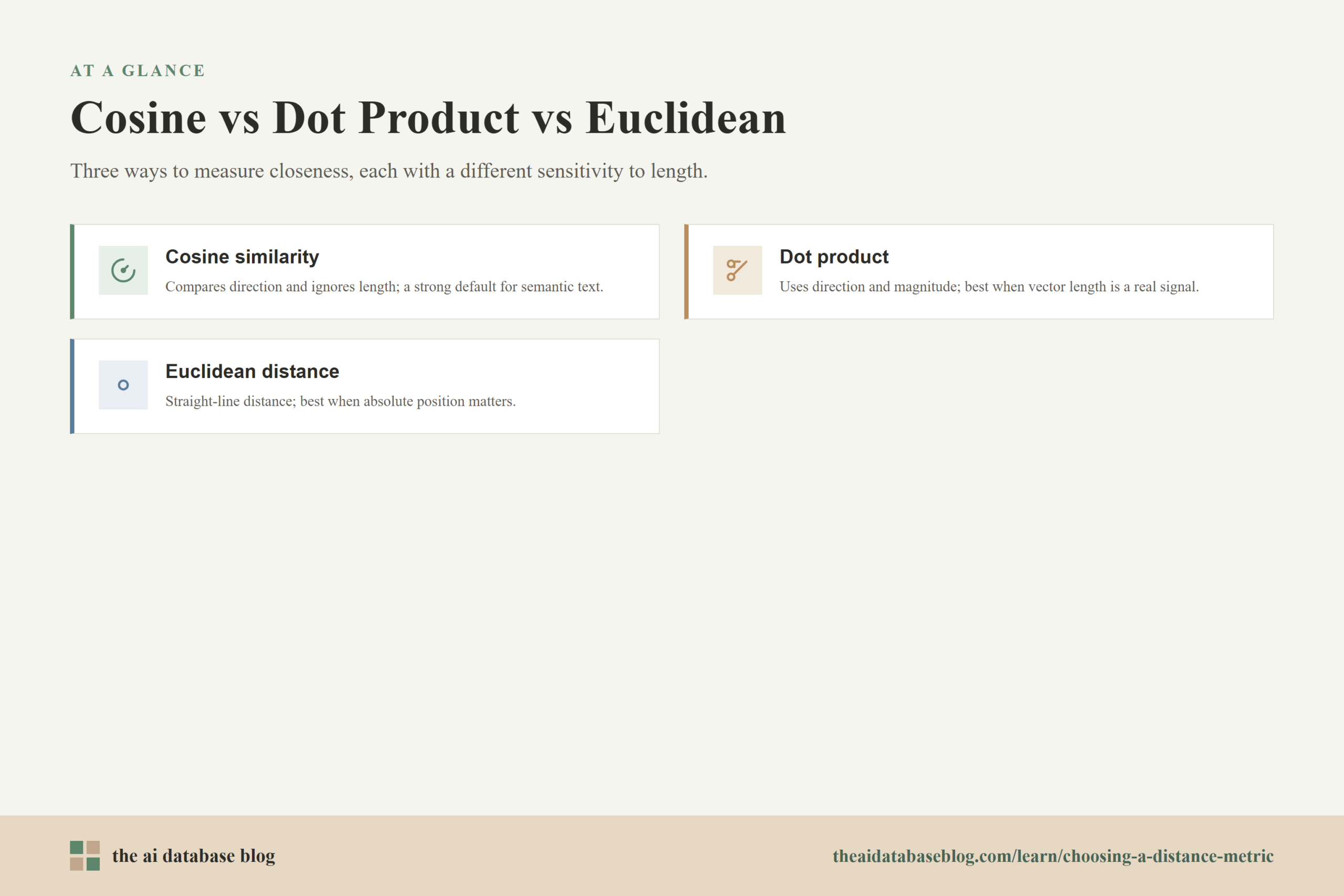
Vector magnitude is the length of an embedding. Cosine similarity mostly ignores magnitude and focuses on direction. Dot product uses both direction and magnitude. Euclidean distance is affected by both the direction and the absolute position of vectors in the space. Choosing among these metrics often comes down to whether the length of a vector should influence retrieval.
For many text embedding systems, magnitude is not meant to be the main signal. The question is usually whether two pieces of text point in a similar semantic direction. A short passage and a longer passage may still be about the same topic, and cosine similarity can compare their direction without letting vector length dominate the score. This is why cosine is a common default for semantic search.
Magnitude can matter in other systems. In recommendation, ranking, multimodal retrieval, or custom-trained embedding models, the length of the vector may encode confidence, popularity, frequency, intensity, or another useful signal. In those cases, normalizing everything to unit length can remove information the model intended to preserve. Dot product can be appropriate when larger vector norms should increase or decrease the final score.
A practical way to think about it is this:
- Use cosine when you want to compare direction and treat vector length as unimportant.
- Use dot product when both direction and vector length are part of the intended relevance signal.
- Use Euclidean distance when the absolute distance between vector positions matters and the embedding space was built for that interpretation.
Magnitude is easy to overlook because vector search APIs often make every metric look like a small configuration choice. In reality, the choice decides whether the database preserves or discards length information. That is why normalization deserves its own careful look.
Understand Normalization Before Choosing Cosine, Dot Product, or Euclidean Distance
Normalization usually means scaling a vector so its length becomes 1. This is often called L2 normalization or unit normalization. After normalization, all vectors have equal magnitude, so the comparison focuses on direction rather than length. This one step can make metrics that normally behave differently produce the same nearest-neighbor ranking.
For normalized vectors, cosine similarity and dot product are equivalent for ranking because the denominator in the cosine calculation becomes 1. In practical terms, the database can often compute a dot product over normalized vectors and get the same order it would get from cosine similarity. Some vector systems use this shortcut internally because dot product can be efficient while still preserving cosine behavior on unit-length vectors.
Euclidean distance also becomes closely related to cosine similarity when vectors are normalized. If all vectors lie on the unit sphere, smaller Euclidean distance corresponds to greater angular similarity. The scores may look different, but the ranking can be the same or nearly the same depending on implementation and precision. This is why normalized embeddings sometimes work with cosine, dot product, or Euclidean distance without a major ranking change.
However, normalization is not always harmless. If the model uses vector length as part of its scoring behavior, normalization can flatten that signal. A vector with high confidence and a vector with low confidence may become the same length, leaving only direction behind. That can improve retrieval when magnitude is noisy, but it can hurt retrieval when magnitude is meaningful.
Before normalizing vectors, answer these questions:
- Does the embedding model already output unit-length vectors?
- Does the model documentation recommend normalizing queries, documents, or both?
- Does the intended metric depend on magnitude, as dot product often does?
- Does the vector database normalize automatically for a chosen metric?
- Are query vectors and stored vectors being treated the same way?
The last point matters more than many teams expect. If stored vectors are normalized but query vectors are not, or if one pipeline normalizes and another does not, retrieval behavior can become inconsistent. The metric decision is only reliable when the indexing path and the query path use the same assumptions.
With normalization understood, the decision becomes more concrete. The next step is to map common retrieval situations to the metric that usually fits them best.
A Practical Decision Guide for Common Retrieval Scenarios
The best metric depends on the embedding model, the application, and the way relevance is defined. Still, many AI database projects fall into recognizable patterns. A question-answering system over documents usually has different needs from a product recommendation system or an image retrieval system. The table below gives a practical starting point, but it should be confirmed with evaluation on your own queries.
| Scenario | Likely metric | Why it fits |
|---|---|---|
| General semantic text search | Cosine similarity | Semantic direction is usually more important than vector length. |
| Normalized embeddings | Cosine or dot product | Dot product and cosine usually produce the same ranking on unit-length vectors. |
| Model explicitly tuned for dot product | Dot product | The model expects raw inner product scoring, so magnitude may be part of relevance. |
| Embedding space trained for geometric distance | Euclidean distance | Absolute position and straight-line distance are part of the intended comparison. |
| Recommendation or ranking where confidence matters | Dot product | Vector length may encode strength, confidence, or preference intensity. |
| No model guidance available | Start with cosine, then evaluate | Cosine is a reasonable default for many text embeddings, but testing is still needed. |
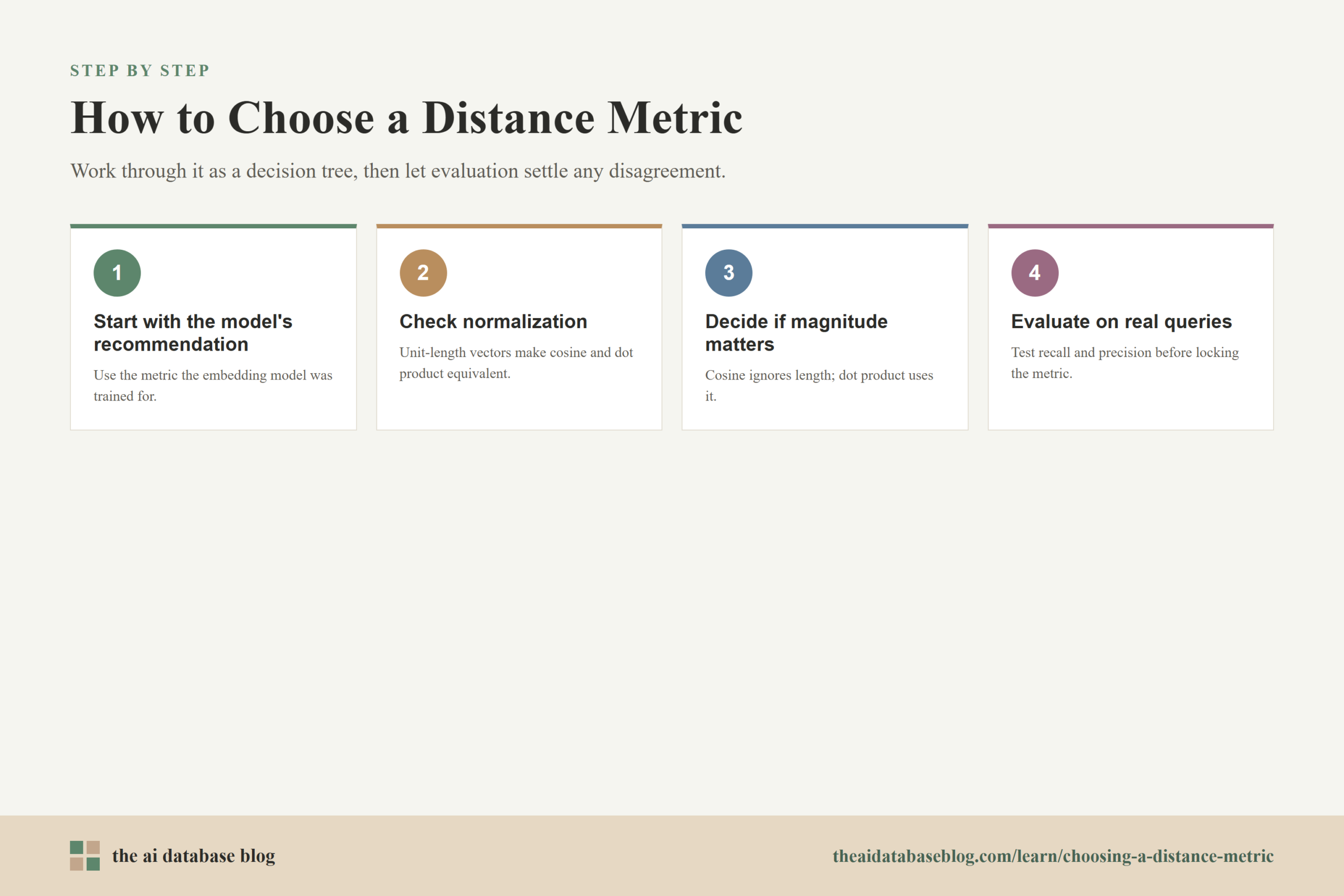
This guide should be treated as a decision tree, not a permanent rule. Start with the model’s intended metric. Then inspect normalization. Then decide whether magnitude matters. Finally, evaluate the result set. If those steps disagree, evaluation should decide the final configuration.
The reason evaluation matters is that the wrong metric rarely fails in an obvious way. It usually returns plausible results that are slightly less relevant, less stable, or less useful. That makes the effect on retrieval quality important to understand.
How the Wrong Metric Hurts Retrieval Quality
Using the wrong distance metric can reduce retrieval quality even when the system appears to work. The database may still return documents that look related to the query, but the best answer may be ranked lower, pushed out of the top results, or replaced by content that is similar in a shallow way. This is one of the reasons retrieval problems can be hard to debug: bad metric choices often create quiet ranking errors rather than obvious crashes.
One common failure mode is losing important magnitude information. If a model uses vector length to represent confidence or strength, cosine similarity can ignore that signal. Two vectors pointing in the same direction may be treated as equally relevant even if one was intended to be much stronger than the other. In a recommendation or ranking workflow, this can make results feel less personalized or less decisive.
The opposite problem can happen when dot product is used where magnitude is not meaningful. Longer or higher-norm vectors can dominate the ranking even when their semantic direction is only moderately aligned with the query. In text retrieval, this can surface passages that have strong vector norms but are not the best conceptual match. The result may look topically related while failing to answer the user’s actual question.
Euclidean distance can also cause issues when the embedding space was not designed for absolute straight-line distance. In high-dimensional embedding spaces, distance distributions can be unintuitive. If the useful signal is angular similarity, Euclidean distance on unnormalized vectors may overreact to differences in vector length. If the vectors are normalized, Euclidean distance may become a reasonable proxy for cosine; if they are not, it can produce a different ranking.
The practical symptoms of a metric mismatch include:
- Relevant results appear just below the top-k cutoff.
- Retrieved passages are about the right topic but do not answer the query.
- Results change unexpectedly after switching embedding models.
- Search quality differs between offline tests and production queries.
- Thresholds for similarity or distance feel unstable across query types.
These symptoms can also come from chunking, metadata filters, embedding quality, or reranking. The metric is not always the whole problem. But it is one of the first settings to verify because it affects every vector comparison the database performs.
After understanding the failure modes, the next question is how to choose confidently rather than guess. The answer is to test the metric against the retrieval behavior the application actually needs.
How to Evaluate Your Metric Choice
The safest way to choose a distance metric is to combine model guidance with retrieval evaluation. A small evaluation set can reveal whether the metric returns the right documents in the right order. This does not require a massive benchmark at the beginning. Even a carefully selected set of real queries, expected answers, and relevant documents can expose whether the chosen metric is preserving the model’s useful signal.
Start by collecting representative queries from the application. Include easy queries, ambiguous queries, long-tail queries, and queries that require specific facts. For each query, identify which stored chunks or records should be considered relevant. Then compare metrics using the same embedding model, same indexed data, same filtering rules, and same top-k setting.
Useful evaluation checks include:
- Recall at top-k: whether the relevant item appears in the first group of returned results.
- Precision at top-k: whether the returned results are mostly useful rather than loosely related.
- Mean reciprocal rank: how high the first truly relevant result appears.
- Answer success rate: whether a downstream system can answer correctly using the retrieved context.
- Human review: whether subject-matter reviewers judge the results as relevant and complete.
When comparing metrics, avoid changing too many things at once. If you change the embedding model, chunking strategy, index type, and distance metric in the same experiment, you will not know which change caused the improvement or decline. Hold everything else constant and compare the metric first. Then tune chunking, hybrid search, filtering, and reranking after the metric is no longer a source of uncertainty.
Evaluation also helps with threshold decisions. Cosine, dot product, and Euclidean scores live on different scales. A threshold that works for one metric may be meaningless for another. If your application uses a minimum similarity score or maximum distance cutoff, recalibrate it after choosing the metric.
Once the metric has been chosen and evaluated, the final step is operational discipline. The metric should be recorded, kept consistent, and revisited whenever the embedding model or retrieval objective changes.
Implementation Checklist for AI Database Teams
Distance metric decisions should be treated as part of the retrieval system design, not as a hidden default. The metric belongs in the same implementation checklist as embedding model selection, vector dimension, chunking, metadata schema, and index configuration. A clear checklist reduces the chance that a later model migration or database change silently alters retrieval behavior.
Before shipping a vector search system, confirm the following:
- The embedding model’s recommended metric has been identified and documented.
- The vector database index is configured with the intended metric.
- The team knows whether vectors are already normalized by the model.
- Query vectors and stored vectors use the same normalization policy.
- The team has decided whether magnitude should influence ranking.
- Retrieval quality has been tested with representative queries.
- Similarity or distance thresholds have been calibrated for the selected metric.
- The metric choice will be revisited when the embedding model changes.
This checklist is especially useful during migrations. If you move from one embedding model to another, do not assume the previous metric still applies. If you move from one vector database configuration to another, confirm whether the new system reports similarity or distance, whether smaller or larger scores are better, and whether it normalizes vectors automatically.
Metric choice is not the only part of retrieval quality, but it is foundational. With that foundation in place, teams can make more meaningful improvements through better chunking, hybrid search, metadata filtering, reranking, and evaluation.
FAQs
1.
1. What is the safest default distance metric for text embeddings?
Cosine similarity is often the safest starting point for general semantic text search when the embedding model does not provide guidance. It focuses on the direction of vectors, which often aligns with semantic similarity. However, the model recommendation should override this default when the documentation specifies dot product, Euclidean distance, or a required normalization step.
2.
2. Are cosine similarity and dot product the same?
They are the same for ranking when all vectors are normalized to length 1. Without normalization, they are not the same. Cosine similarity compares direction while ignoring magnitude, whereas dot product combines direction with vector length. That means dot product can produce different rankings when vector norms vary.
3.
3. Should embeddings always be normalized before vector search?
No. Normalization is useful when magnitude is not meaningful or when the model expects cosine-style comparison. It can be harmful if the model uses vector length as part of the relevance signal. The safest approach is to follow the model documentation and make sure stored vectors and query vectors use the same normalization policy.
4.
4. When should Euclidean distance be used for embeddings?
Euclidean distance should be used when the embedding model or application is designed around absolute distance in vector space. It can also produce rankings similar to cosine on normalized vectors. For many unnormalized text embeddings, though, Euclidean distance may be more sensitive to vector length than the retrieval task requires.
5.
5. Can the wrong metric make retrieval results look plausible but still be wrong?
Yes. A metric mismatch often returns results that are broadly related to the query but not the best results. This can lower recall, push relevant documents below the top-k cutoff, or make a retrieval-augmented generation system answer from weaker context. The system may look functional while quietly losing quality.
6.
6. Do distance thresholds transfer between metrics?
No. Cosine, dot product, and Euclidean distance use different score ranges and interpretations. A threshold that works for cosine similarity cannot be copied directly to dot product or Euclidean distance. After changing the metric, evaluate retrieval again and recalibrate any similarity or distance cutoff.
Takeaway
Choosing the right distance metric starts with the embedding model’s recommendation, then depends on whether vector magnitude carries meaning and whether vectors are normalized. Cosine similarity is a strong default for many semantic text search systems, dot product is appropriate when raw inner product or magnitude matters, and Euclidean distance fits spaces designed around absolute geometric distance. This guidance is most useful for teams building AI databases, semantic search, recommendation, and RAG systems where retrieval quality depends on ranking the right context near the top. A practical use case is a document question-answering system: matching the metric to the embedding model, keeping normalization consistent, and evaluating top-k results can prevent relevant passages from being quietly pushed below the retrieval cutoff.
Watch this video to learn more