Chunking is one of the most important design choices in retrieval-augmented generation because it decides what text gets embedded, indexed, retrieved, and passed to the language model. Fixed-size, sentence, recursive, and semantic chunking all solve the same basic problem in different ways: they divide source material into searchable units. The best chunking strategy is usually the one that keeps each chunk specific enough to match a user question while still preserving enough surrounding context for the answer to make sense. In many RAG systems, this decision affects retrieval quality more than changing the embedding model, because even a strong embedding model cannot recover information that was split, diluted, or separated from the context needed to interpret it.
This guide explains how the main chunking strategies work, where overlap helps, where it adds cost without much benefit, and why chunking quality often determines the ceiling of a RAG system. By the end, you will understand how to choose a practical chunking approach, how to evaluate whether it is working, and why document structure and query behavior matter as much as chunk size.
Why Chunking Matters in RAG
In a RAG pipeline, documents are usually too long to embed and retrieve as single units. A full policy, manual, research paper, support article, transcript, or product guide may contain many unrelated topics. If the entire document is embedded as one vector, the embedding becomes a broad average of many ideas. That makes retrieval less precise because the search system is trying to match a specific question against a representation that may include too much unrelated material.
Chunking solves this by breaking documents into smaller units before they are embedded and stored in an AI database. Each chunk becomes a retrievable object, often with metadata such as document title, section, page number, timestamp, author, or source type. When a user asks a question, the retrieval system searches over these chunks and returns the most relevant ones for generation.
The challenge is that chunks can be wrong in two opposite ways. If they are too small, they may contain the answer phrase but not the explanation, condition, definition, or exception that gives it meaning. If they are too large, they may include the answer but bury it inside unrelated text, making the vector less specific and making the language model work harder to find the relevant part. Good chunking is the practice of balancing precision and context.
Once that balance is clear, the next question is how to create those chunks. The simplest strategy is fixed-size chunking, which is often used as a baseline because it is easy to implement and easy to compare against other methods.
Fixed-Size Chunking
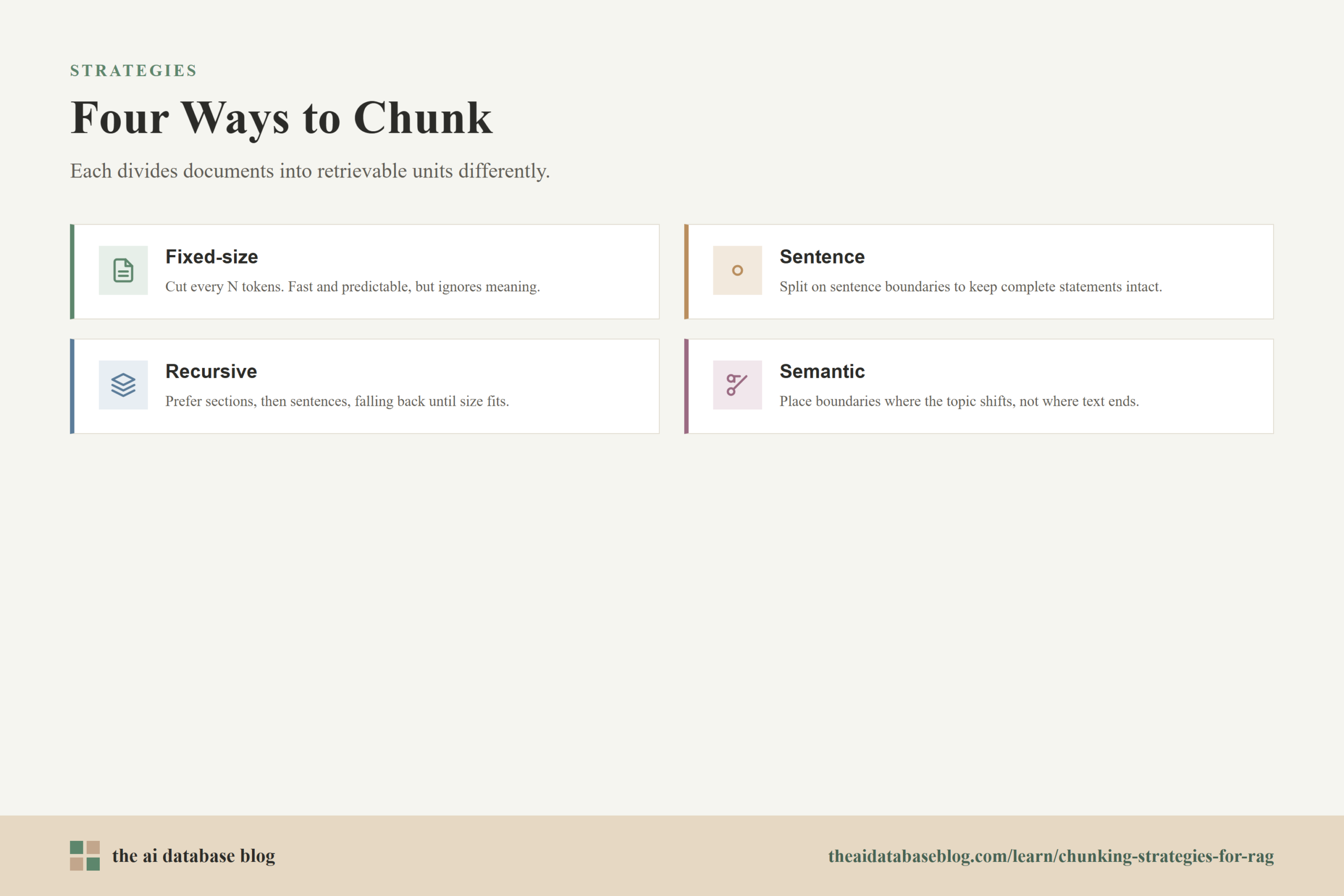
Fixed-size chunking splits text into chunks of a set length, usually measured in tokens, words, or characters. For example, a system might split every document into 500-token chunks with 50 tokens of overlap. This approach does not try to understand the document’s sentences, paragraphs, headings, or topic changes. It simply cuts text at regular intervals.
The main advantage of fixed-size chunking is predictability. It is fast, inexpensive, deterministic, and simple to test. If your documents are messy, inconsistent, or difficult to parse, fixed-size chunking can provide a workable starting point. It also makes storage and indexing costs easier to estimate because chunk lengths are relatively uniform.
The weakness is that fixed boundaries often cut across meaning. A definition can be split from the example that explains it. A condition can be separated from the rule it modifies. A table heading can land in one chunk while the rows land in another. In retrieval, these boundary errors show up as almost-right results: the system retrieves text that is near the answer but not complete enough to support a reliable response.
When Fixed-Size Chunking Works Well
Fixed-size chunking can work well for repetitive or loosely structured content where each passage is fairly self-contained. It is also useful as a baseline in evaluation because it gives you a simple reference point. If a more complex strategy does not outperform a fixed-size baseline on your own data, the added complexity may not be worth it.
It is less suitable for content where structure carries meaning, such as legal clauses, technical documentation, academic papers, troubleshooting guides, and multi-step procedures. In those cases, cutting by length alone can make retrieval brittle because the chunk boundaries do not match the way the information is actually organized.
Because fixed-size chunking is easy but often too blunt, many teams move next to sentence-based chunking. Sentence chunking is still simple, but it avoids one of the most common fixed-size failures: splitting a complete thought in the middle.
Sentence Chunking
Sentence chunking uses sentence boundaries as the basic splitting unit. Instead of cutting after a fixed number of characters or tokens, the system identifies sentences and groups them into chunks. A chunk might be one sentence, a small window of adjacent sentences, or a group of sentences that stays under a maximum token limit.
This approach usually preserves readability better than fixed-size chunking. A complete sentence is more likely to contain a complete claim, definition, or instruction. For question answering, that can make retrieval more reliable because the retrieved text is less likely to contain broken grammar or a partial statement.
Sentence chunking also works well with surrounding sentence windows. For example, a system can index one sentence as the searchable unit but store nearby sentences as expansion context. When the sentence is retrieved, the generator receives the sentence plus its local context. This can improve precision during search while still giving the language model enough context to answer naturally.
Where Sentence Chunking Falls Short
Sentence chunking can be too narrow when the meaning of a passage depends on several sentences together. A single sentence might say, “The feature is disabled by default,” but the previous sentence may identify which feature is being discussed. A later sentence may explain the exception. If each sentence is treated too independently, retrieval can return fragments that are technically relevant but incomplete.
The practical solution is to group sentences into chunks that preserve local meaning. This is often better than retrieving isolated sentences. It is also why sentence chunking should be thought of as a boundary strategy, not always as a one-sentence-per-chunk strategy. The goal is to respect sentence boundaries while still creating chunks that are useful to answer real questions.
Sentence chunking gives the system a better sense of linguistic boundaries, but many documents are organized in larger structures than sentences. Sections, paragraphs, headings, lists, and code blocks often matter too. Recursive chunking is designed for that problem.
Recursive Chunking
Recursive chunking tries to split text using a hierarchy of preferred boundaries. A common pattern is to split first by large structure, such as sections or paragraphs. If a section is still too long, the splitter tries smaller boundaries such as sentences. If a sentence group is still too long, it may fall back to words, tokens, or characters. The process continues until each chunk fits within the desired size limit.
This strategy is popular because it combines the practicality of fixed-size limits with more respect for document structure. It does not assume that every paragraph or section will be the right size. Instead, it tries to keep natural units intact when possible and only uses smaller cuts when necessary.
Recursive chunking is often a strong default for general text corpora. It can handle inconsistent documents better than strict paragraph chunking, and it usually creates more coherent chunks than raw fixed-size splitting. For many AI database applications, it is a sensible first production strategy because it is predictable, tunable, and structure-aware without requiring expensive semantic analysis.
How Recursive Chunking Affects Retrieval
Recursive chunking improves retrieval by reducing accidental boundary damage. If a paragraph is short enough, it stays together. If a section is too long, it is split in a way that tries to preserve sentences. The resulting chunks are more likely to contain complete ideas, which makes their embeddings more representative of what the text actually says.
However, recursive chunking still depends on the quality of the source text. If a document has poor formatting, missing paragraph breaks, repeated headers, or extracted PDF artifacts, the splitter may still produce awkward chunks. Preprocessing matters. Removing boilerplate, repairing line breaks, preserving headings, and keeping tables understandable can matter as much as the chunking algorithm itself.
Recursive chunking uses structure as a proxy for meaning. Semantic chunking goes one step further by trying to detect meaning shifts directly. That can be useful, but it also introduces new tradeoffs around cost, stability, and evaluation.
Semantic Chunking
Semantic chunking splits text based on topic changes rather than only length or visible structure. A typical semantic chunking process breaks text into sentences, creates embeddings for sentence groups, compares nearby groups, and places a boundary where the meaning changes sharply. The result is a set of chunks that aim to keep semantically related sentences together.
The appeal is clear: user questions usually refer to concepts, not token counts. If semantic chunking can group related ideas and separate unrelated ones, each chunk should become a cleaner retrieval target. This can help when documents shift topics frequently, contain uneven sections, or mix explanations, examples, and exceptions in ways that fixed boundaries do not capture.
Semantic chunking is not automatically better in every system. It can be more expensive because it may require additional embedding passes or model calls during ingestion. It can also be harder to debug because boundaries depend on thresholds and similarity calculations. If the threshold is too sensitive, the system may create many small chunks. If it is too loose, it may merge topics that should be separate.
When Semantic Chunking Is Worth Considering
Semantic chunking is most useful when topic boundaries are more important than formatting boundaries. Examples include long explanatory articles, transcripts, meeting notes, research summaries, and documents where paragraphs are inconsistent or overly long. It can also help when user queries tend to ask conceptual questions that require a coherent block of related explanation.
It is less compelling when the source already has clean structure, such as short support articles, well-formed documentation pages, or records where each item is already a natural retrieval unit. In those cases, recursive or sentence-based chunking may perform similarly with less ingestion complexity.
Choosing among these strategies is only half the problem. The other major decision is whether to overlap chunks. Overlap is common because it seems like a simple way to avoid boundary mistakes, but it should be used carefully.
How Overlap Helps and Hurts
Overlap means repeating some text from the end of one chunk at the beginning of the next chunk. For example, if a system creates 500-token chunks with 50 tokens of overlap, each chunk shares a small amount of text with its neighbor. The goal is to prevent important information from being lost when an answer spans a boundary.
Overlap can help when boundaries are risky. It is especially useful in fixed-size chunking, where a sentence, list item, or explanation may be cut between chunks. It can also help in dense technical content where the meaning of a passage depends on a few surrounding lines. In these cases, overlap gives retrieval more chances to capture the complete answer.
But overlap is not free. It increases the number of tokens stored, embedded, indexed, and retrieved. It can create duplicate results that crowd out more diverse chunks. It can also make evaluation look better at first while hiding the real issue: the chunking strategy is not respecting the document’s natural structure. Recent evaluations have also shown that overlap does not always produce measurable gains, especially when chunking already uses sentence or semantic boundaries effectively.
Practical Overlap Guidance
A practical approach is to start with modest overlap only where it addresses a real boundary risk. Fixed-size chunks often benefit from a small overlap. Recursive and sentence-based chunks may need less, especially if the chunk boundaries already preserve complete thoughts. Semantic chunks may need little or no overlap if the boundaries are chosen well, though retrieval expansion can still add neighboring context at query time.
It is also useful to distinguish ingestion overlap from retrieval expansion. Ingestion overlap duplicates text in the index. Retrieval expansion keeps the index cleaner but fetches neighboring chunks after a relevant chunk is found. For many systems, retrieval expansion is a more flexible way to provide context without permanently duplicating large amounts of text in the AI database.
Overlap can rescue some boundary problems, but it cannot fix chunks that are fundamentally too vague or too fragmented. This is why chunking often has a larger practical effect on retrieval quality than the embedding model.
Why Chunking Can Matter More Than the Embedding Model
Embedding models convert text into vectors, but they can only represent the text they are given. If a chunk mixes five unrelated topics, the embedding becomes a blended representation of all five. If a chunk cuts a definition away from its condition, the embedding may match the query but still fail to retrieve enough evidence for a correct answer. If a chunk contains repeated navigation text, boilerplate, or extracted PDF noise, the vector may represent that noise alongside the useful content.
This is why changing the embedding model is not always the first fix for poor RAG quality. A stronger embedding model may improve ranking, but it cannot reliably reconstruct context that was removed during chunking. It also cannot make an oversized chunk more focused. The retrieval system still needs chunks that match the way users ask questions and the way answers appear in the source material.
Chunking controls the retrieval unit. The embedding model controls how that unit is represented. Both matter, but the retrieval unit comes first. If the unit is poorly chosen, the model is optimizing over bad inputs. If the unit is well chosen, even a standard embedding model has a much better chance of returning useful context.
Common Signs That Chunking Is the Problem
Chunking is likely the problem when retrieved chunks are topically close but answer-incomplete. You may see the right section retrieved but not the exact sentence, or the right sentence retrieved without the condition that changes its meaning. Another sign is inconsistent performance across document types: the system works on short help articles but fails on PDFs, tables, transcripts, or long procedures.
Chunking may also be the issue when increasing top-k results gives the generator more text but not better answers. That often means the system is retrieving more fragments rather than better evidence. Before changing the embedding model, inspect the retrieved chunks for failed queries. If the answer was split, buried, duplicated, or surrounded by irrelevant text, chunking should be tuned first.
Once you know chunking is a retrieval-quality lever, the right next step is to choose a strategy based on content type, query type, and evaluation data rather than relying on a universal default.
How to Choose a Chunking Strategy
The best chunking strategy depends on the relationship between your documents and your user questions. A system that answers short factual questions from support articles needs different chunks than a system that explains legal clauses, summarizes research, or retrieves steps from a maintenance manual. The aim is not to find the most advanced splitter. The aim is to create chunks that contain the smallest complete unit of useful meaning.
Start by looking at answer spans. If most answers are one or two sentences, sentence-based or sentence-window retrieval may work well. If answers are usually paragraph-level explanations, recursive chunking with paragraph preference is a stronger fit. If topics shift unpredictably or document formatting is unreliable, semantic chunking may be worth testing. If the corpus is messy and you need a baseline quickly, fixed-size chunking can get you started while you collect evaluation data.
It also helps to preserve metadata during chunking. Store the document title, section heading, page number, source URL or file path, chunk position, and any access-control fields. Metadata filtering can narrow the search space before vector retrieval, and source metadata helps the generator cite or contextualize the retrieved information. In many AI database systems, metadata design and chunking strategy work together.
A Simple Comparison
| Strategy | Best for | Main risk |
|---|---|---|
| Fixed-size chunking | Fast baselines, messy text, predictable indexing costs | Can split important ideas at arbitrary boundaries |
| Sentence chunking | Short factual answers, sentence-window retrieval, readable snippets | Can be too narrow without surrounding context |
| Recursive chunking | General-purpose text, documentation, structured prose | Depends on clean formatting and good separator choices |
| Semantic chunking | Conceptual content, long passages, uneven topic shifts | Can add ingestion cost and threshold complexity |
A comparison table can point you in the right direction, but production RAG quality still needs measurement. The final decision should come from testing how each strategy performs on the questions your system actually needs to answer.
How to Evaluate Chunking Quality
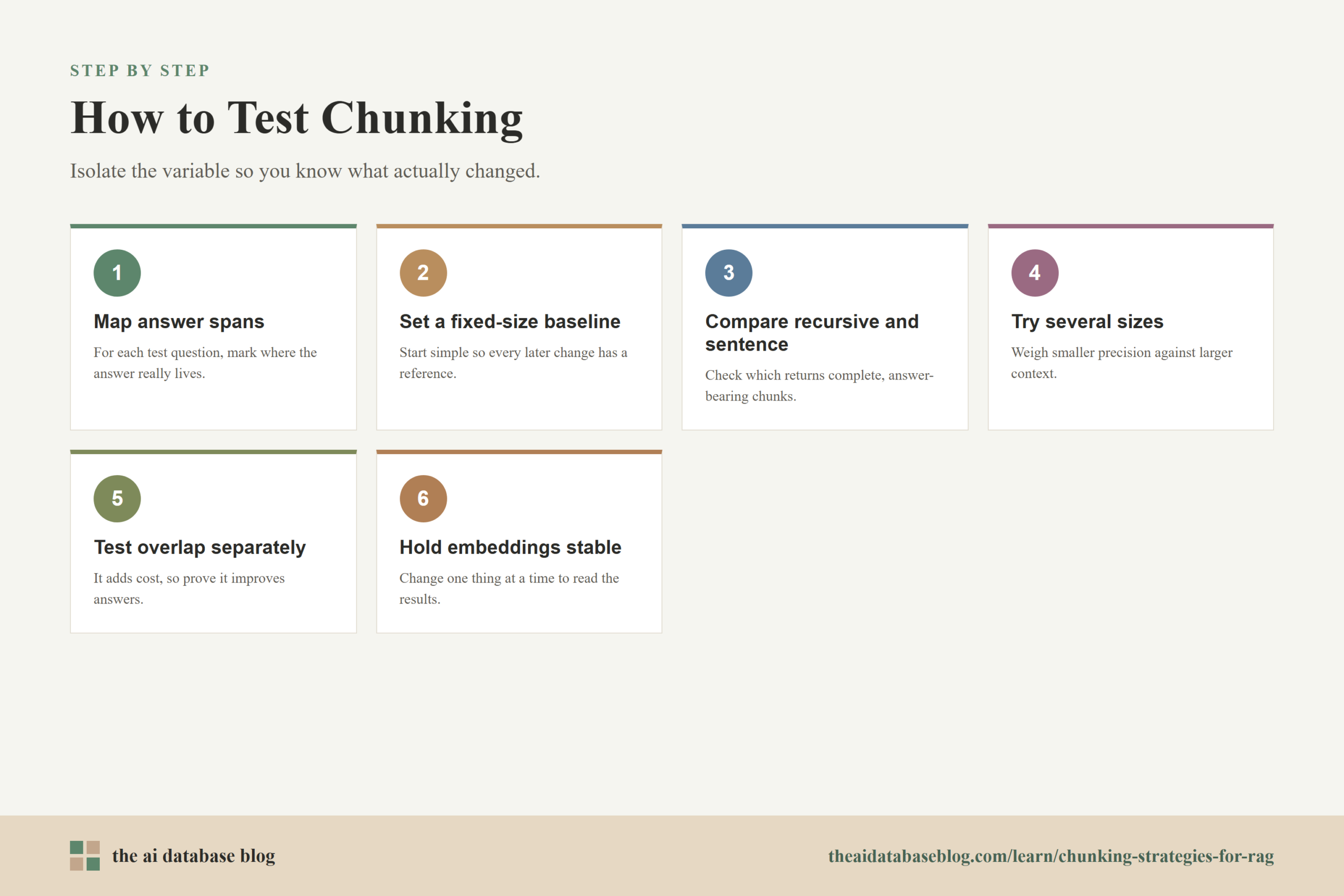
Chunking evaluation should begin with a small set of realistic questions and known answer locations. For each question, identify the source span that contains the answer. Then compare chunking strategies by asking whether retrieval returns the right evidence, whether the answer is complete, and whether the generator can use the retrieved context without guessing.
Common retrieval metrics such as recall at k, precision at k, mean reciprocal rank, and nDCG can help, but qualitative inspection is just as important early on. Look at failed examples. Did the retriever miss the right chunk entirely? Did it retrieve the right chunk but the chunk lacked surrounding context? Did duplicate overlapped chunks crowd out other relevant evidence? Did a large chunk match broadly but bury the answer?
End-to-end answer quality also matters. A chunking strategy that improves retrieval recall but sends noisy, repetitive, or overly long context to the generator may still produce weak answers. Evaluate both retrieval and generation. The best strategy is the one that consistently returns compact, answer-bearing, source-grounded context for the questions users actually ask.
Useful Evaluation Experiments
Start with a fixed-size baseline, then compare it with recursive and sentence-based chunking. Add semantic chunking if the corpus has unclear topic boundaries or long conceptual passages. Test several chunk sizes rather than only one. For example, compare smaller chunks that improve precision against larger chunks that preserve more context. Then test overlap separately, because overlap can increase storage and retrieval cost without always improving answer quality.
Keep the embedding model and retrieval settings stable while testing chunking. If you change the chunking strategy, embedding model, top-k, reranker, and prompt at the same time, you will not know which change improved the system. Isolate chunking first. Once the retrieval units are healthy, then compare embedding models or reranking methods.
Evaluation makes chunking less mysterious. Instead of asking which strategy is universally best, you can ask which strategy retrieves the right evidence for your corpus, your questions, and your latency and cost limits.
Recommended Starting Points
For most text-heavy RAG systems, recursive chunking with sentence or paragraph awareness is a strong starting point. It respects natural boundaries when possible while still enforcing maximum chunk size. Pair it with clean metadata, modest overlap only when needed, and retrieval expansion when the generator needs neighboring context.
For short support content or question-answer style documents, sentence grouping or paragraph-level chunks may be enough. For long technical documents, procedures, and policy content, recursive chunking with section headers preserved is often safer. For transcripts, research notes, and loosely structured explanatory text, semantic chunking is worth testing because topic shifts may not align with formatting.
As a practical rule, begin with chunks that are large enough to contain a complete answer but small enough that one chunk is still mostly about one idea. Avoid treating chunk size as a fixed universal constant. The right size depends on answer length, document density, and how much context the generator needs to respond accurately.
These starting points are useful because they keep the system grounded in retrieval behavior. They also lead naturally to the most common questions teams ask when tuning chunking for production RAG.
FAQs
1. What is chunking in RAG?
Chunking is the process of splitting source documents into smaller pieces before embedding and indexing them in an AI database. Each chunk becomes a retrievable unit that can be matched to a user query and passed to a language model as context. Good chunking makes retrieval more precise and gives the model enough evidence to answer accurately.
2. What is the best chunking strategy for RAG?
There is no single best strategy for every RAG system. Recursive chunking is often a strong default for general text because it respects paragraphs and sentences while keeping chunks within a size limit. Sentence chunking can work well for short factual answers, fixed-size chunking is useful as a baseline, and semantic chunking can help when topic boundaries matter more than formatting.
3. How much overlap should RAG chunks have?
Overlap should be treated as a tunable parameter, not a rule. A small overlap can help when fixed-size chunks might cut important context at the boundary. However, overlap increases index size and can produce duplicate retrieval results. If your chunks already respect sentence, paragraph, or semantic boundaries, you may need little overlap or none at all.
4. Is semantic chunking always better than fixed-size chunking?
No. Semantic chunking can create more meaningful chunks when documents have uneven topic shifts, but it can also add cost and complexity. Fixed-size chunking can still perform well for some repetitive or simple content, especially when used with modest overlap. The better strategy is the one that performs best on your actual documents and queries.
5. Why does chunking affect retrieval more than embeddings?
Chunking defines what the embedding model receives. If a chunk is too broad, too fragmented, or missing key context, even a strong embedding model has a poor unit of text to represent. Better embeddings can improve ranking, but they cannot fully repair chunks that split answers apart or mix unrelated topics together.
6. How should I test chunking quality?
Create a small evaluation set of realistic questions with known answer locations. Test whether each chunking strategy retrieves the answer-bearing chunk, whether the retrieved context is complete, and whether the generated answer is grounded in the source. Compare chunking strategies while keeping the embedding model and retrieval settings stable so you can see what chunking actually changes.
Takeaway
Chunking is not a minor preprocessing step in RAG; it is the decision that shapes what your AI database can retrieve. Fixed-size chunking gives you a simple baseline, sentence chunking protects complete statements, recursive chunking balances structure with size limits, and semantic chunking tries to follow topic changes directly. Overlap can help at risky boundaries, but it should be measured because it adds cost and can duplicate results. This guidance is most useful for teams building RAG systems over documents, knowledge bases, support content, policies, manuals, or research collections where retrieval quality determines whether the generated answer is trustworthy. A practical use case is a technical documentation assistant: better chunking can help it retrieve the exact procedure, warning, or configuration detail before the language model writes an answer.
Watch this video to learn more