Binary quantization is a way to compress embeddings by turning each numeric dimension into a bit, usually reducing storage from 32 bits per dimension to 1 bit per dimension. Hamming distance then compares those compressed bit vectors by counting how many bit positions differ. This makes search extremely fast and memory-efficient, especially when binary vectors are used as a first-pass filter before reranking the best candidates with full-precision embeddings or a stronger relevance model. The trade-off is accuracy: binary vectors keep the broad shape of similarity, but they discard detail that can matter for final ranking.
This guide explains how binary quantization works, why Hamming distance is so fast, where this technique fits in an AI database retrieval pipeline, and how to think about the accuracy trade-off. By the end, you should understand when binary search is useful, when it is risky, and how to evaluate whether it improves a real retrieval system.
What Binary Quantization Does to Embeddings
Embeddings are usually stored as floating-point vectors. A text chunk, product, image, or user query might be represented by hundreds or thousands of dimensions, and each dimension usually stores a decimal value. Those values capture semantic patterns learned by an embedding model, but they are expensive to store and compare at large scale. When a database contains millions or billions of embeddings, the cost of memory movement can become just as important as the cost of the distance calculation itself.
Binary quantization compresses those embeddings into a much smaller representation. In the simplest version, each dimension becomes a single bit based on whether the value is above or below a threshold. A positive value may become 1, and a negative value may become 0. Other implementations use learned thresholds, centering, rotation, or model-specific techniques, but the core idea is the same: replace a high-precision numeric vector with a compact binary code.
The storage savings are the easiest part to understand. A 768-dimensional embedding stored as 32-bit floating-point numbers uses 24,576 bits, or 3,072 bytes, before database overhead. If each dimension is represented by one bit, the vector uses 768 bits, or 96 bytes. That is a 32x reduction in raw vector storage. The exact end-to-end storage savings depend on the database layout, metadata, indexes, and whether the original vectors are also retained for reranking.
This compression is useful because retrieval systems often need to scan, rank, or navigate through many candidate vectors. Smaller vectors reduce memory pressure, improve cache behavior, and allow more of the searchable representation to stay close to the processor. In practical AI database systems, that can be the difference between a search path that is bottlenecked by moving large arrays and one that can evaluate many more candidates quickly.
Once embeddings have been compressed into bits, the next question is how to compare them. That is where Hamming distance becomes important, because it gives binary vectors a simple and efficient similarity measure.
How Hamming Distance Compares Binary Vectors
Hamming distance measures the number of positions where two equal-length binary strings differ. If two binary vectors are identical, their Hamming distance is 0. If they differ in 25 positions, their Hamming distance is 25. In vector search, a lower Hamming distance means the binary codes are more similar under that compressed representation.
For example, compare these two short binary vectors:
Query:    1 0 1 1 0 0 1 0
Document: 1 1 1 0 0 0 1 1
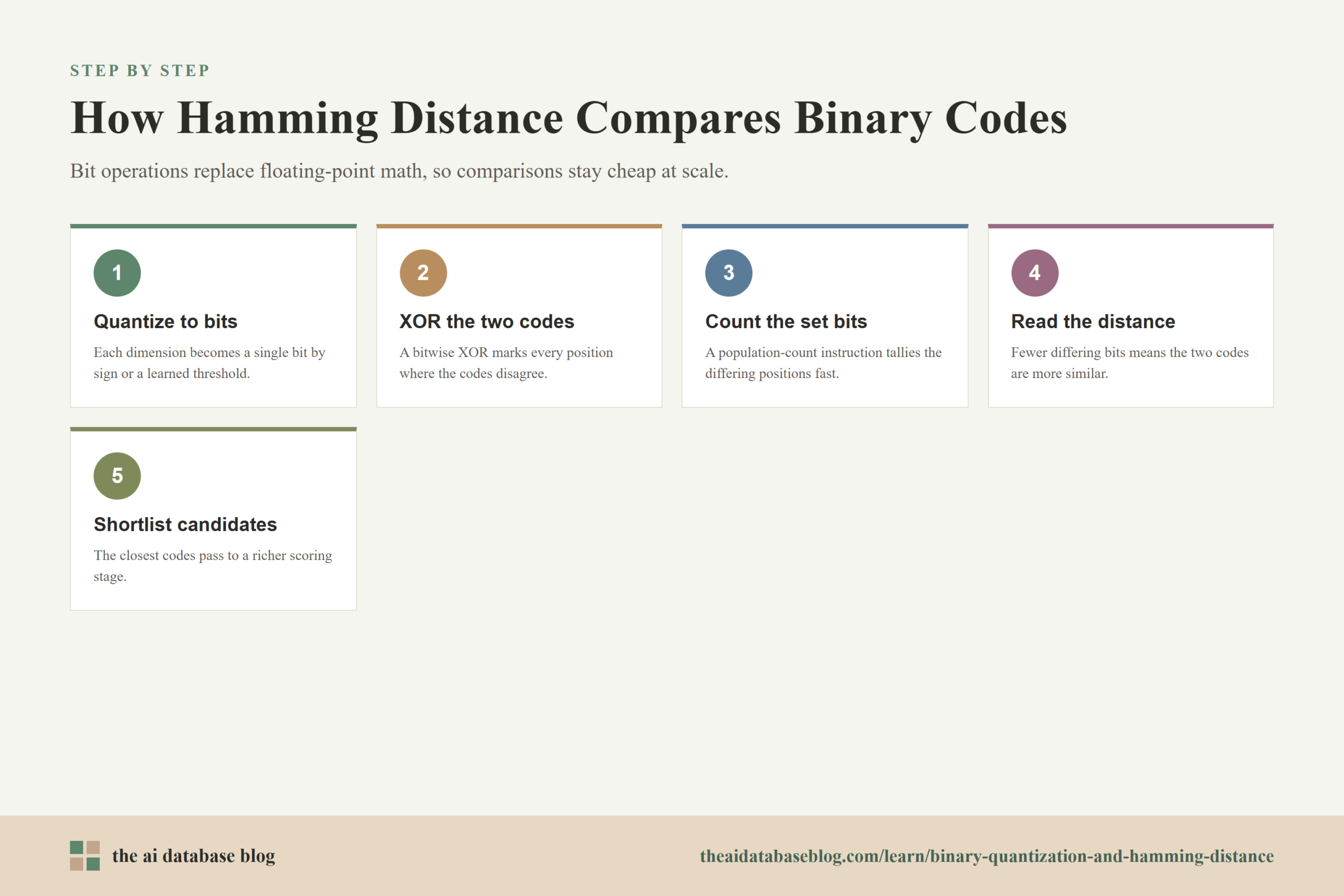
They differ at the second, fourth, and eighth positions, so their Hamming distance is 3. A database can perform the same idea on vectors with hundreds or thousands of bits, but it does not usually compare one bit at a time in a slow loop. Packed binary vectors can be compared with bitwise operations. The system can apply an XOR operation to find which bit positions differ, then count the number of 1 bits in the result.
This is why Hamming comparisons are fast. Modern processors include efficient instructions for counting set bits, often called population count operations. Instead of multiplying and adding hundreds of floating-point numbers for a dot product or cosine similarity calculation, the database can compare chunks of bits using CPU-friendly operations. The result is a compact distance score that is cheap to compute many times.
Hamming distance is not the same as cosine similarity, dot product, or Euclidean distance. It is a distance over binary codes, not over the original floating-point vectors. That distinction matters because the binary code is an approximation of the original embedding. Hamming distance can be very useful for finding likely candidates, but it should not automatically be treated as a perfect replacement for full-precision similarity.
Because Hamming distance is fast but approximate, its strongest role is often not as the only ranking signal. It is commonly most useful as an early retrieval stage that narrows the search space before a more detailed ranking step.
Why Binary Search Works Well as a First-Pass Filter
Many AI database workloads do not need the first stage of retrieval to produce the final answer. They need it to produce a strong candidate set. In a retrieval-augmented generation system, semantic search application, or recommendation pipeline, the database may first retrieve 100, 500, or 1,000 candidates, then rerank a smaller subset using richer signals. Binary quantization fits naturally into that pattern because it is designed to make broad candidate retrieval cheaper.
As a first-pass filter, binary search answers a practical question: which stored items are close enough to the query that they deserve more expensive attention? The database can compare the query’s binary code against many stored binary codes using Hamming distance. The top candidates then move to a second stage, where the system can use full-precision vector similarity, hybrid search signals, metadata rules, business logic, or a reranker.
This two-stage design is valuable because the most expensive scoring step is applied to fewer items. Instead of running a full-precision comparison against a very large candidate pool, the system uses the binary index to quickly produce a shortlist. If that shortlist is large enough and the binary representation preserves enough of the embedding structure, the final results can remain strong while latency and memory usage improve.
Oversampling is a common way to make this work. If the application needs the top 20 final results, the binary stage might retrieve the top 200 or 500 candidates. The second stage then reranks those candidates with a more accurate method and returns the best 20. Oversampling accepts that the binary ranking may not be perfect, but it gives the reranker enough candidates to recover items that might otherwise be slightly misplaced by compression.
This pattern is especially useful when the original vectors are retained alongside the binary index. The binary representation handles broad search efficiently, while the full vector remains available for final scoring. If only the binary vectors are stored, the system may save more memory, but it loses the ability to recover accuracy through full-precision reranking.
The first-pass filter idea is powerful, but it also explains the main risk. If the binary stage fails to include a relevant item in the candidate set, no later reranker can rescue it. That makes recall evaluation central to any decision about binary quantization.
The Accuracy Trade-Off
Binary quantization is lossy compression. It removes information from the original embedding. A floating-point dimension can express magnitude and subtle differences between values. A single bit can only express one of two states. This means two vectors that were meaningfully different in the original space can become more similar in binary space, and two vectors that were close in the original space can be pushed farther apart after quantization.
The most important trade-off is usually recall versus efficiency. Recall measures whether the retrieval system finds the relevant items that should be in the candidate set. Binary quantization can reduce memory use and speed up comparison, but it may also cause some relevant items to fall below the cutoff. The practical question is not whether binary quantization changes the ranking. It does. The practical question is whether the lost detail matters for the application’s quality target.
Some embedding models and datasets tolerate binary quantization better than others. If an embedding space has strong sign patterns and the retrieval task mainly needs broad semantic grouping, binary codes may preserve enough structure for a strong first pass. If the task depends on fine-grained distinctions, near-duplicate ranking, legal or medical nuance, or subtle product attributes, the lost magnitude information may hurt more.
The size of the candidate set also affects accuracy. A small binary top-k can be brittle because the compressed ranking has little room for mistakes. A larger candidate set gives the system more room to recover through reranking. This is why binary quantization is often paired with oversampling and careful evaluation rather than treated as a drop-in replacement for full vectors.
There is also a score interpretation trade-off. Hamming distance scores are not directly comparable to cosine similarity scores. A Hamming distance of 120 does not mean the same thing as a cosine similarity of 0.78. Thresholds, cutoffs, and quality expectations need to be calibrated for the binary representation rather than copied from the original vector search setup.
Once the trade-off is clear, the next step is to decide when the benefits are likely to outweigh the risk. That depends less on whether binary quantization is theoretically elegant and more on the shape of the workload.
When Binary Quantization Is a Good Fit
Binary quantization is most attractive when a retrieval system is constrained by memory, storage, or candidate-generation speed. Large collections, high query volume, and latency-sensitive applications can all benefit from smaller representations. If the database can search a compact binary index quickly and rerank a limited candidate set afterward, the system may reduce cost without giving up much visible quality.
It is often a good fit for broad semantic retrieval, recommendation candidate generation, duplicate or near-duplicate discovery, and RAG systems where the first stage retrieves more candidates than the final answer needs. These applications usually care about finding a useful pool of candidates quickly. They can tolerate some imperfection in the first-stage order as long as the relevant items remain inside the candidate set.
Binary quantization can also help in edge or local-first systems where memory is limited. A compact binary index may make it possible to keep a useful search layer on a smaller machine, inside a local application, or closer to the user. In those cases, the alternative may not be full-precision search at the same scale. The real comparison may be between a compressed search layer that fits and a larger search layer that is too expensive or too slow.
However, binary quantization is not automatically the right choice for every AI database. If a system already meets latency and cost goals with full vectors, compression may add complexity without enough benefit. If ranking precision is the main product feature, the team may prefer scalar quantization, product quantization, dimensionality reduction, or full-precision reranking rather than relying heavily on binary codes.
Choosing the right fit requires measurement. The useful question is not simply whether binary search is faster. It is whether the faster first pass still feeds enough high-quality candidates into the rest of the retrieval pipeline.
How to Evaluate Binary Quantization in Practice
A practical evaluation should compare binary retrieval against a full-precision baseline using the same queries, corpus, filters, and relevance judgments. The baseline does not have to be perfect, but it should represent the quality the system currently expects. Without a baseline, it is easy to mistake faster search for better search, even when the final results have quietly degraded.
Start with recall-oriented metrics for the candidate stage. If the final application needs 10 results, measure whether the binary stage retrieves the documents that would have appeared in the full-precision top 10 when using a larger candidate pool, such as 100 or 500. Recall at candidate depth is usually more important than the exact binary ordering because a later stage can rerank candidates but cannot rerank missing documents.
Then measure final ranking quality after reranking. This is where application-level metrics matter. For RAG, inspect answer quality, source usefulness, and whether the retrieved context contains the needed information. For semantic search, evaluate click-through behavior, human relevance labels, or judged result quality. For recommendations, measure downstream engagement or conversion signals if those are available and appropriate.
Latency and cost should be measured alongside quality. Track index size, memory use, query latency, throughput, and reranking cost. A binary first pass that saves memory but requires a very large reranking pool may still be worthwhile, but the trade-off should be visible. Similarly, a small reranking pool may be fast but may lose too much recall.
It is also important to test with realistic filters. Many AI database searches combine vector similarity with metadata filters, such as language, tenant, category, date range, access permissions, or document type. Compression behavior can look different when the searchable candidate pool becomes smaller or more fragmented. Testing only on an unfiltered benchmark can miss problems that appear in production query patterns.
Evaluation turns binary quantization from a general optimization idea into a specific engineering decision. Once the team knows the recall, latency, and cost effects, it can decide how to place binary search inside the retrieval architecture.
Common Design Patterns
Binary quantization can be used in several retrieval designs, but the most robust patterns treat it as one part of a larger system. The goal is not to force every search decision through a one-bit representation. The goal is to spend compute where it matters most. Binary codes are useful when they reduce the amount of work needed before the system applies more accurate scoring.
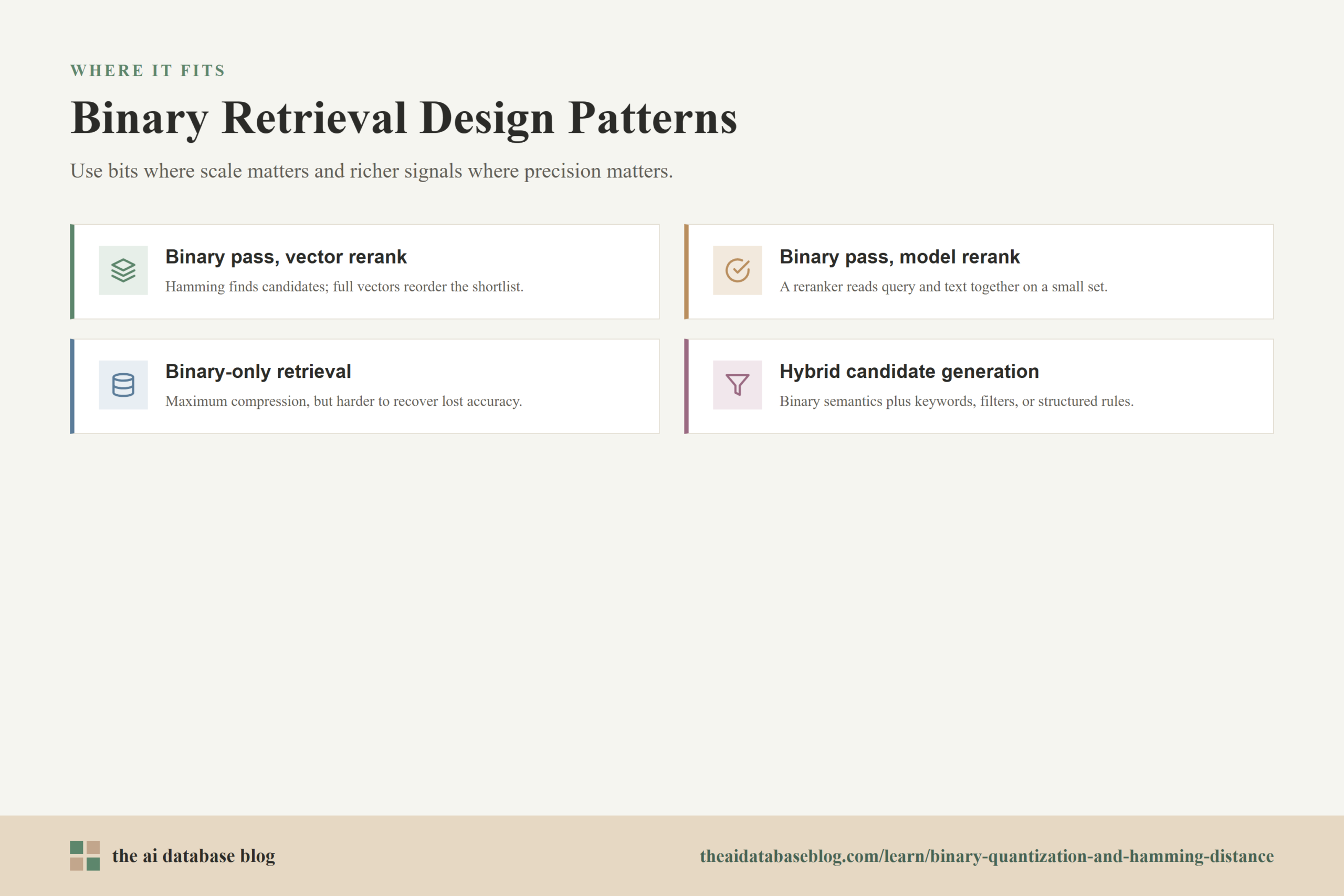
Binary First Pass, Full-Vector Rerank
In this pattern, the database stores both the compressed binary representation and the original or higher-precision vector. The binary index retrieves a candidate set quickly using Hamming distance. The system then reranks those candidates using cosine similarity, dot product, or another full-vector metric. This is often the easiest pattern to reason about because it separates candidate generation from final scoring.
Binary First Pass, Reranker Model Second Stage
For text retrieval, the second stage may use a reranker that reads the query and candidate text together. This can produce a more relevance-aware ranking than vector similarity alone, but it is more expensive. Binary retrieval helps by limiting how many candidates the reranker needs to inspect. This pattern is common in systems where the final result quality matters more than returning the absolute fastest possible vector-only ranking.
Binary-Only Retrieval
Some systems may use binary vectors as the main searchable representation without retaining full vectors. This maximizes compression benefits, but it makes the accuracy trade-off harder to recover from. Binary-only retrieval can be reasonable when memory constraints are strict, result quality requirements are moderate, or the task is naturally tolerant of approximate similarity. It should be tested carefully before being used for high-precision ranking.
Hybrid Retrieval with Binary Candidate Generation
Binary quantization can also work inside a hybrid retrieval system that combines vector search with keyword matching, metadata filters, or structured ranking rules. In this design, Hamming search provides semantic candidates quickly, while other signals help control precision. This can be useful when users expect both semantic flexibility and exact constraints, such as searching within a product category, a permission boundary, or a time window.
These patterns all share the same principle: use the binary representation where speed and scale matter most, and use richer signals where ranking precision matters most. That principle helps avoid the common mistake of expecting one compressed distance measure to solve every retrieval problem.
Practical Guidelines for AI Database Teams
The safest way to adopt binary quantization is to treat it as a candidate-generation optimization. Start by preserving the original vectors, if storage allows, so the system can rerank candidates and compare results against a trustworthy baseline. This gives the team a way to capture most of the speed and memory benefit while limiting the quality risk.
Use a larger candidate pool than the final result count. If the application returns 10 results, do not assume that retrieving exactly 10 binary neighbors is enough. Test several oversampling settings and look for the point where final result quality stops improving meaningfully. That point is often more useful than a theoretical rule because it reflects the actual embedding model, corpus, and query distribution.
Evaluate with the same filters and data distribution the production system uses. If the system has many tenants, narrow categories, rare languages, or uneven document groups, test those cases directly. Binary quantization may behave well on common queries and poorly on sparse or highly specific ones. A good evaluation should include both typical and difficult searches.
Be careful with thresholds. A distance threshold chosen for full-precision vectors will not transfer directly to Hamming distance. If the system uses cutoffs, calibrate them separately for the binary representation and monitor how they affect empty results, low-quality results, and result diversity.
Finally, keep the user experience in mind. A small drop in benchmark recall may be acceptable if users still get useful answers faster and at lower cost. A small drop may be unacceptable if it removes the exact document needed for support, compliance, or expert workflows. The right decision depends on the retrieval job, not on compression alone.
FAQs
1. What is binary quantization in vector search?
Binary quantization is a compression technique that converts floating-point embeddings into binary codes. Instead of storing each dimension as a full numeric value, the system stores each dimension as a bit. This can greatly reduce memory use and make comparisons faster, but it also removes information from the original embedding.
2. Why is Hamming distance fast?
Hamming distance is fast because it compares binary vectors by counting bit differences. Databases can use bitwise operations to find differences and efficient processor instructions to count them. This is much cheaper than many full-precision vector comparisons, especially when the system needs to evaluate a large number of candidates.
3. Does binary quantization always reduce accuracy?
Binary quantization is lossy, so it usually changes the ranking compared with full-precision vectors. Whether that causes a meaningful accuracy problem depends on the model, dataset, query types, and retrieval design. Many systems reduce the impact by retrieving more binary candidates than needed and reranking them with fuller signals.
4. Should binary vectors replace full embeddings?
Binary vectors should not automatically replace full embeddings. For many production systems, the stronger design is to use binary vectors for fast candidate generation while keeping full embeddings for reranking or evaluation. Binary-only retrieval can be useful when memory is very constrained, but it should be validated carefully.
5. How large should the first-pass candidate set be?
The candidate set should usually be larger than the final number of results. If the application needs 10 final results, the binary stage might retrieve 100, 200, or more candidates before reranking. The right number depends on measured recall, latency, and reranking cost for the specific application.
6. Is Hamming distance the same as cosine similarity?
No. Hamming distance counts differences between binary codes, while cosine similarity measures the angle between numeric vectors. Binary quantization may preserve enough similarity structure for candidate retrieval, but Hamming scores should not be interpreted as cosine scores or calibrated with the same thresholds.
Takeaway
Binary quantization and Hamming distance give AI database teams a practical way to make embedding retrieval smaller and faster by compressing vectors into bits and comparing them with efficient bit operations. The approach is most useful for systems that need fast first-pass candidate generation, such as RAG, semantic search, recommendations, and local or memory-constrained retrieval. The key lesson is that binary search should be evaluated as part of the whole pipeline: it can reduce cost and latency substantially, but the best results usually come from oversampling, reranking, and measuring recall against the quality needs of the actual use case.
Watch this video to learn more