A recall cliff happens when a retrieval system that works well on broad searches suddenly misses important results once restrictive filters are added. In AI databases, this usually appears when approximate nearest neighbor search is asked to satisfy metadata constraints such as tenant, date range, region, permissions, category, or product type. The practical way to avoid it is to measure recall under real filter selectivity, use indexing and query planning that can account for filters during search, and load-test the exact mix of filtered queries the production system will see.
This guide explains why filtered vector search can fail abruptly, how to detect a recall cliff before users do, and how to design indexing, query parameters, and tests that keep retrieval stable in production. By the end, you should understand how restrictive filters change the search problem, what warning signs to monitor, and how to build a production validation process that measures both relevance and latency under realistic constraints.
What the Recall Cliff Means in Filtered Vector Search
The recall cliff is not a small, gradual quality decline. It is a sudden drop in the system’s ability to retrieve the right neighbors when the candidate pool becomes highly constrained. A query may return excellent results when it searches across the whole collection, acceptable results when it filters to a broad category, and then unexpectedly poor results when it filters to a narrow tenant, permission group, region, time window, or document type. The system still returns results, so the failure can be quiet, but the results are no longer the best matches inside the filtered subset.
In vector search, recall means how many of the true nearest or most relevant items the system retrieves in its top results. In production AI applications, recall matters because downstream steps often depend on the retrieved set. A retrieval-augmented generation system may produce a weak answer if the right source document is missing. A recommendation system may show generic items instead of the best eligible items. An internal search tool may appear responsive while silently failing to surface documents the user is allowed to see.
The cliff appears because approximate search is built to avoid scanning every vector. It follows shortcuts through an index and stops after it has explored enough candidates. Filters change what “enough” means. If the search algorithm explores many vectors that fail the filter, the number of valid candidates may be too small to preserve recall. The stricter the filter, the more likely it is that ordinary approximate search settings will no longer be enough.
Once you understand the recall cliff as a mismatch between approximate traversal and filtered eligibility, the next question is where that mismatch enters the system. The answer depends on how the database applies filters: before search, after search, or during index traversal.
Why Restrictive Filters Can Break Otherwise Good Retrieval
Filtering changes vector search from “find the nearest items” into “find the nearest items that also satisfy these constraints.” That second version is harder because the closest vectors in the whole collection may not be valid results. If the database retrieves the top 100 approximate neighbors first and then applies a filter afterward, a narrow filter might remove almost all of them. The result set may contain fewer than the requested number of items, or it may contain lower-quality items because the search never explored deeply enough inside the eligible subset.
Post-filtering can hide the problem until filters become selective
Post-filtering means the system runs vector search first and then removes results that do not match the filter. This can work for loose filters because many of the initial nearest neighbors are still eligible. It becomes risky when the filter matches only a small percentage of the collection. If only one percent of documents are eligible, a search that retrieves 100 candidates before filtering may leave only one valid candidate on average. That is rarely enough if the application asks for the top 10 results.
The dangerous part is that post-filtering may look healthy in basic tests. Latency can remain low, error rates can stay flat, and the system can still return something. The failure is relevance quality. The retrieved set is not necessarily the best set within the filtered population, and the application may not notice unless it measures recall against a known answer set.
Pre-filtering can preserve correctness but create latency pressure
Pre-filtering means the system identifies the eligible subset first and then searches within that subset. This can protect recall because the vector comparison is focused on valid records. However, it can also become slow or operationally complex when filters are dynamic, multi-field, or high-cardinality. A production system may need to support combinations such as tenant plus permission plus language plus freshness plus product area. Building and maintaining a perfect separate vector index for every possible filter combination is usually not practical.
Pre-filtering works best when the eligible set is small enough for exact search, when the filters are predictable, or when the system has efficient structures for narrowing candidates before vector comparison. It becomes harder when the filtered subset is large enough to need approximate search but selective enough that ordinary graph traversal may not reach enough valid items.
Filtering during traversal is often the production goal
A filter-aware search approach applies metadata constraints during the search process instead of treating filters as an afterthought. In graph-based approximate indexes such as HNSW-like structures, this means the traversal can account for which nodes are eligible and can continue exploring when too many candidates fail the filter. Some approaches add filter-aware links, use payload or metadata indexes, switch between approximate and exact search depending on filter selectivity, or use query planning to choose the safest execution path.
The goal is not to make every filtered query use the same method. The goal is to choose the execution strategy that preserves recall while staying within latency and cost limits. A broad filter may perform well with ordinary approximate search. A highly selective filter may need deeper exploration, exact search over a small subset, or an index designed specifically for filtered ANN workloads.
Because filter behavior depends on actual data distribution, it is not enough to know that a database “supports filters.” The production question is whether the filter execution path maintains recall at the selectivity levels your application actually uses.
How to Detect the Recall Cliff Before It Reaches Users
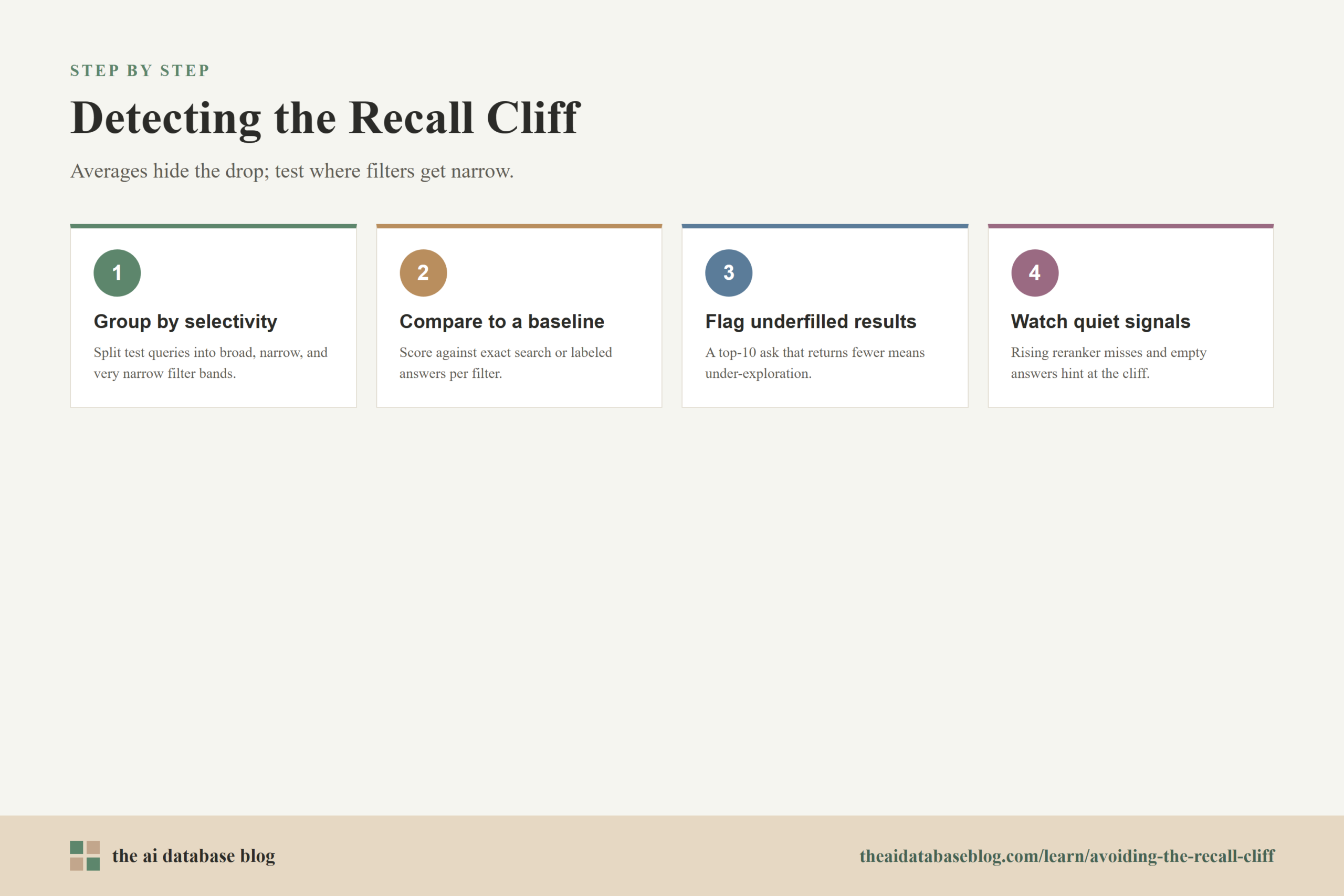
Detecting a recall cliff requires testing retrieval quality across different filter selectivity bands. A broad benchmark that measures unfiltered vector search can miss the problem entirely. The system may have strong recall at the collection level while failing for queries that match only a small portion of the data. Production validation should therefore compare filtered approximate results against a more exact or trusted baseline for the same query and filter.
Measure recall by filter selectivity
Filter selectivity describes how much of the collection passes a filter. A filter that matches 50 percent of the collection is broad. A filter that matches one percent is restrictive. A filter that matches a few dozen records in a large collection is extremely selective. Instead of reporting one average recall number, group test queries into selectivity bands so the drop is visible.
Useful bands might include broad filters, moderate filters, narrow filters, and near-empty filters. The exact cutoffs should match the application, but the principle is simple: do not average away the edge cases. A system can look acceptable overall while failing exactly where the business logic is most important, such as permission-scoped enterprise search or tenant-specific support retrieval.
Compare approximate results with an exact baseline
To detect the cliff, create a baseline that represents the best available answer for each filtered query. For smaller subsets, this can be exact vector search over all eligible records. For larger subsets, it may be a slower offline evaluation process, a higher-depth search configuration, or a labeled relevance set. The baseline does not need to be cheap enough for production. It needs to be trustworthy enough to reveal what production search is missing.
For each query, compare the production retrieval path against the baseline using metrics such as recall at 5, recall at 10, hit rate for known relevant documents, and the number of valid results returned. These metrics should be tracked separately for each filter pattern. Tenant filters, time filters, permission filters, and category filters may fail differently because they produce different candidate distributions inside the index.
Watch for quiet operational warning signs
Recall cliffs often have operational signals even when the application does not throw errors. A filtered query that regularly returns fewer than the requested number of results may be under-exploring. A query that returns generic or stale documents after a narrow filter may be substituting whatever candidates survived instead of the best eligible candidates. A sudden increase in reranker misses, user reformulations, empty final answers, or “no useful context found” events can also indicate that the retrieval layer is failing under constraints.
Production dashboards should include more than latency and request volume. Track filtered query count, filter selectivity, candidate count before and after filtering when available, final result count, top result score distribution, and recall or hit rate for a monitored query set. If the system can expose index traversal details, also watch exploration depth, scanned candidates, or fallback path usage. These signals help distinguish a true retrieval problem from an embedding, chunking, or ranking problem.
Detection is the first layer of protection, but it only tells you that the system is vulnerable. Preventing the cliff requires designing the search path so restrictive filters are handled intentionally rather than accidentally.
How to Prevent Sudden Recall Drops Under Restrictive Filters
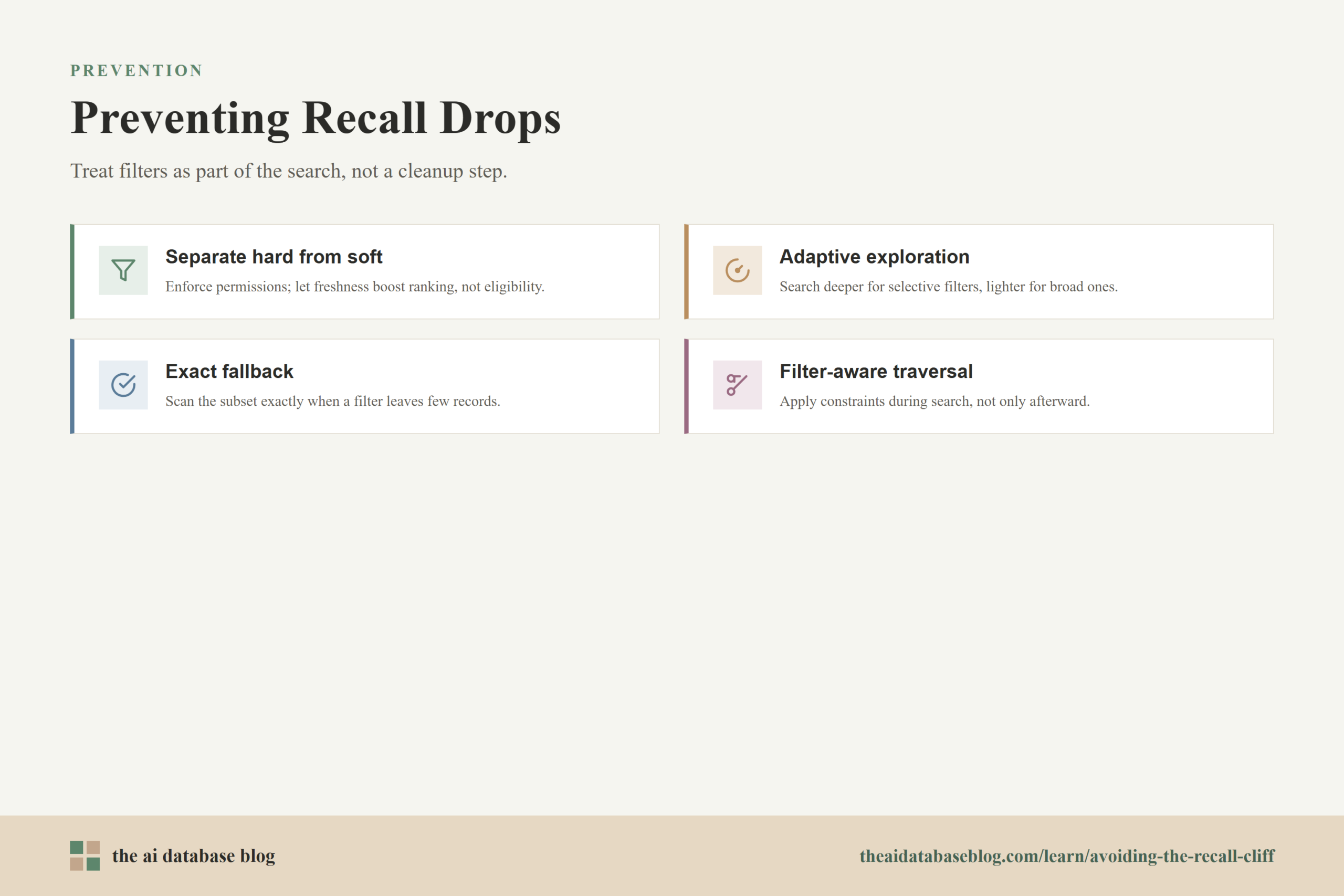
Preventing a recall cliff starts with treating filters as part of the retrieval problem, not as a final cleanup step. The right prevention strategy depends on the application’s data shape, filter patterns, latency target, and tolerance for approximate results. In many production systems, the safest design combines several techniques: better query planning, filter-aware indexing, adaptive search parameters, exact fallback for small subsets, and evaluation that keeps filter behavior visible.
Design filters around real access and relevance needs
Some filters are hard requirements. Permission, tenant, compliance, and availability filters usually cannot be softened because returning an ineligible item would be wrong. Other filters are relevance preferences, such as freshness, category, or content type. Treating every preference as a hard filter can shrink the candidate pool too aggressively and trigger avoidable recall loss. When a condition is a ranking preference rather than a strict constraint, it may be better represented as a boost, reranking feature, or hybrid scoring signal.
This distinction matters because hard filters reduce the search space before the final ranking can recover. If a user asks for “recent troubleshooting guidance,” it may be safer to retrieve relevant results across a wider date range and then rank newer content higher. If the user is only authorized to see one tenant’s documents, that tenant filter must remain hard. Good retrieval design separates eligibility rules from ranking preferences.
Increase exploration only where it helps
Many approximate search systems expose parameters that control how deeply the index is explored at query time. Increasing exploration can improve filtered recall because the search sees more candidates before returning top results. However, raising these settings globally can increase latency and compute cost for every query, including broad queries that do not need the extra work.
A better pattern is adaptive tuning. Use higher exploration for selective filters, larger requested result counts before reranking, or query classes where recall is more important than speed. Use lower exploration for broad filters and low-risk experiences where latency matters more. The key is to tune by workload class rather than relying on one universal setting.
Use exact search or fallback paths for very small subsets
When a restrictive filter leaves only a small number of eligible records, approximate search may not be necessary. Exact search over the filtered subset can be both accurate and fast enough because the candidate pool is small. This is especially useful for tenant-scoped collections, permission groups, or narrow time windows where the filtered set may contain hundreds or thousands of vectors rather than millions.
A production system can use simple rules to choose a fallback path. If the estimated filtered subset is below a threshold, run exact search over eligible records. If the subset is moderate, use filter-aware approximate search with deeper exploration. If the subset is broad, use the standard approximate path. These thresholds should be based on measured latency and recall, not assumptions.
These prevention techniques work best when the index itself is designed for the filters the system actually uses. That is where filter-aware indexing becomes a central architectural choice.
Choosing Filter-Aware Indexing for Production AI Databases
Filter-aware indexing means the database has structures that help vector search respect metadata constraints efficiently. It is not just metadata storage. A system can store metadata and still perform poorly if it applies filters only after retrieving approximate neighbors. For production workloads, the important question is whether the index, query planner, and execution path can maintain recall when filters are selective, combined, and unevenly distributed.
Index the fields that shape retrieval
Not every metadata field deserves the same indexing treatment. Fields used only for display can be stored without affecting search. Fields used in hard filters should be indexed or otherwise made efficient for query planning. Common examples include tenant ID, user or group permissions, language, document type, category, region, source system, and time range. These fields directly shape which vectors are eligible, so they influence both correctness and performance.
High-cardinality fields need careful handling. A field such as tenant ID may have many values, but it is often essential. A field such as request ID may also have many values but may not belong in retrieval filters at all. Indexing decisions should follow actual query behavior rather than a blanket rule. The best metadata model is one that makes common filtered searches predictable without adding unnecessary memory or maintenance overhead.
Prefer search paths that combine vector traversal and filtering
For filtered ANN workloads, look for an execution path that can combine vector similarity and metadata constraints during search. This may involve filter-aware graph traversal, metadata-aware candidate selection, adaptive exact search, or a query planner that estimates filter selectivity before choosing a method. The details vary by system, but the evaluation question is the same: does recall remain stable when the filter matches a small fraction of the collection?
When evaluating an AI database, ask how it handles post-filtering, pre-filtering, and filter-aware traversal. Ask whether it can estimate filtered subset size, whether it changes strategy for highly selective filters, and whether it exposes metrics that show candidates scanned and results filtered out. These capabilities matter more than generic claims about fast vector search because the recall cliff appears in the interaction between vector search and metadata constraints.
Partition only when the access pattern is stable
Partitioning can help when a filter is predictable and central to the workload. For example, a system with strict tenant isolation may choose separate collections, shards, or partitions for large tenants. This can reduce the search space and simplify access control. However, partitioning becomes less helpful when users combine many dynamic filters or when partitions become too small and uneven.
Over-partitioning can create its own recall and operations problems. Small partitions may not have enough useful neighbors for approximate graph structure. Uneven partitions may create latency outliers. Many partitions can complicate ingestion, rebalancing, and query routing. Use partitioning when it reflects a stable retrieval boundary, not as a substitute for filter-aware query execution.
Once the index and query path are chosen, the remaining risk is assuming that synthetic tests represent real production behavior. They often do not, which is why load testing must include realistic filtered queries.
Load-Testing Realistic Filtered Queries
Load testing for AI database retrieval should measure quality and performance together. A system that keeps latency low by returning weak filtered results is not production-ready. A system that preserves recall only by making every narrow query too slow may also fail the user experience. The test should therefore reproduce the real mix of query text, filter combinations, selectivity, concurrency, result sizes, and downstream reranking behavior.
Build a query set from production-like behavior
A useful load test starts with a representative query set. Include broad searches, narrow searches, permission-scoped searches, tenant-specific searches, date-range searches, category filters, and combined filters. If the application uses hybrid search, reranking, or query expansion, include those paths too. The goal is to test the retrieval system that users will actually touch, not a simplified vector-only endpoint.
When production logs are available, sample from them carefully and remove sensitive data. When logs are not available, build scenarios from expected workflows. For an internal knowledge assistant, include queries from different departments, permission groups, document types, and freshness requirements. For product search, include queries that combine semantic intent with inventory, region, category, or price constraints. For support retrieval, include product version, language, and customer segment filters.
Test concurrency and tail latency, not only average latency
Filtered queries can create uneven load because some filters are easy and others require deeper search or fallback. Average latency may hide this. Track p95 and p99 latency by filter type and selectivity band. Also track throughput, timeout rate, result count, and recall for the monitored evaluation set. If the system has adaptive paths, measure how often each path is used under load.
Concurrency matters because filtered search can stress different parts of the system than unfiltered search. Metadata indexes, query planners, cache behavior, disk reads, and reranking queues may become bottlenecks. A test that sends one query at a time may show stable quality and latency, while a concurrent test reveals tail-latency spikes or recall degradation caused by timeouts and early stopping.
Include failure thresholds before launch
Define launch thresholds before interpreting the test. For example, the system might need recall at 10 above a chosen target for each important filter band, fewer than a small percentage of underfilled result sets, p95 latency below the product target, and no serious degradation during sustained concurrency. The exact numbers depend on the application, but the important point is that filtered recall should have its own acceptance criteria.
Also test changes over time. Ingestion, deletion, tenant growth, new metadata fields, and changing query behavior can shift filter selectivity. A filter that was broad at launch may become narrow later, or a once-small tenant may become large enough to need a different search path. Repeat load tests after major index changes, data distribution changes, and embedding model migrations.
Load testing gives you confidence before launch, but production systems still need ongoing monitoring because data and user behavior keep changing. The final layer is a practical operating checklist that keeps recall visible after deployment.
Production Checklist for Avoiding the Recall Cliff
A production retrieval system should make filtered recall observable, testable, and tunable. The most reliable teams treat retrieval quality like an operational metric, not a one-time benchmark. They know which filters are hard constraints, which filters are ranking preferences, which query paths are used for different selectivity bands, and what recall looks like under realistic load.
- Measure recall by filter selectivity. Do not rely on one overall recall number. Break results into broad, moderate, narrow, and very narrow filter bands so the cliff cannot hide inside an average.
- Compare against a trusted baseline. Use exact search, deeper offline search, or labeled examples to identify what the production path misses under each filter pattern.
- Track underfilled results. If a query asks for 10 results and regularly returns fewer after filtering, the search path may not be exploring enough eligible candidates.
- Separate hard filters from preferences. Keep eligibility rules strict, but consider ranking boosts or reranking features for softer relevance preferences.
- Use filter-aware indexing for common constraints. Index the metadata fields that shape retrieval, and evaluate whether the search path handles selective filters during traversal rather than only after retrieval.
- Load-test the real workload. Include realistic filter combinations, concurrency, hybrid retrieval paths, reranking, and production-like result sizes.
- Monitor drift after launch. Data growth and changing user behavior can alter filter selectivity, so repeat evaluation when the collection, metadata model, or embedding pipeline changes.
This checklist is not just a quality-control exercise. It is a way to connect retrieval design with operational reality. Once the system can show how it behaves under constrained search, teams can tune recall, latency, and cost with evidence instead of waiting for user complaints.
FAQs
1. What is a recall cliff in an AI database?
A recall cliff is a sudden drop in retrieval quality when a vector search query is combined with restrictive filters. The system may still return results, but it misses the best eligible matches because the search process did not explore enough valid candidates inside the filtered subset.
2. Why do restrictive filters cause recall to drop?
Restrictive filters reduce the number of eligible records. If approximate search retrieves candidates first and filters afterward, many retrieved candidates may be discarded. When too few valid candidates remain, the final result set may be incomplete or less relevant than the true nearest results within the filtered population.
3. Is post-filtering always bad for vector search?
No. Post-filtering can work when filters are broad and many retrieved candidates are eligible. It becomes risky when filters are highly selective, because the system may need to retrieve a much larger candidate pool to preserve recall. The right approach depends on filter selectivity, latency requirements, and how much recall the application needs.
4. What does filter-aware indexing mean?
Filter-aware indexing means the database can use metadata constraints as part of the search process, not merely as a cleanup step after vector retrieval. This can include metadata indexes, filter-aware graph traversal, adaptive query planning, exact fallback for small subsets, or other methods that help the system find the best eligible vectors efficiently.
5. How should teams test for filtered recall problems?
Teams should build an evaluation set that includes realistic filters and compare production search results with an exact or trusted baseline. The results should be grouped by filter selectivity and filter type. This makes it easier to see whether narrow filters, permission filters, tenant filters, or date filters are causing recall to drop.
6. What metrics should be monitored in production?
Useful metrics include recall for a monitored query set, filtered query volume, filter selectivity, candidate count, final result count, underfilled result rate, p95 and p99 latency, timeout rate, reranker miss patterns, and fallback path usage. These signals help teams detect whether retrieval is failing quietly under restrictive filters.
Takeaway
Avoiding the recall cliff in production means designing filtered vector search as a first-class retrieval problem. Readers should now understand why restrictive filters can break approximate search, how to detect the problem with selectivity-based evaluation, how filter-aware indexing and adaptive query planning can prevent sudden drops, and why realistic load testing is essential before launch. This guidance is most useful for teams building AI databases, RAG systems, enterprise search tools, recommendation systems, or any application where semantic retrieval must obey tenant, permission, category, freshness, or other metadata constraints without sacrificing relevance.